

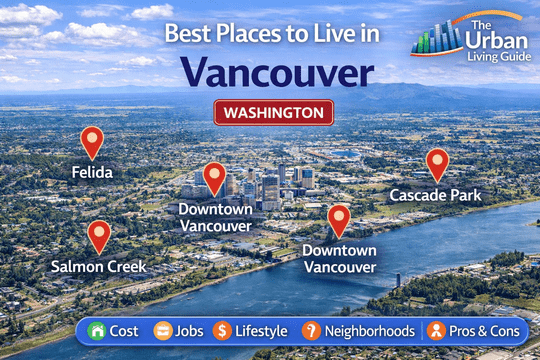
Best Neighborhoods in Vancouver, Washington: Columbia Riverfront Living, Top Subdivisions & Pacific Northwest Pockets in 2026
Covering approximately 51.8 square miles of land area along the northern bluffs of the Columbia River directly opposite Portland, Oregon, the City of Vancouver functions under the council-manager municipal governance of the City of Vancouver while serving as the primary county seat and economic engine of Clark County. Housing an incorporated municipal core population exceeding 194,000 residents and anchoring a broader Southwest Washington regional footprint of over 510,000 people, Washington’s fourth-largest city offers a compelling blend of Pacific Northwest natural beauty, high-tech manufacturing corridors, and significant financial advantages—most notably Washington State’s lack of a personal state income tax.
Relocating across the Vancouver metropolitan area requires evaluating river crossing logistics, maritime climate patterns, school district assignment boundaries, and regional transit systems operated by C-TRAN. Inbound movers consistently balance direct access to primary regional employers—such as the Columbia Tech Center, corporate campuses for Banfield Pet Hospital and Fisher Investments, healthcare networks anchored by PeaceHealth Southwest Medical Center and Legacy Salmon Creek Medical Center, and downtown Portland employment towers—against daily interstate travel routes across Interstate 5, Interstate 205 (Glenn L. Jackson Memorial Bridge), State Route 14 (Lewis and Clark Highway), and State Route 500.
Take a virtual walking tour through the tree-lined streets, riverfront promenades, and distinctive residential neighborhoods of Vancouver, Washington:
Key Residential Districts Across Vancouver, Washington in 2026
| Neighborhood Name | Location | Distance from Core (Downtown Vancouver) | Development Status | Transit Connectivity | Cost Level | Best Fit For |
|---|---|---|---|---|---|---|
| Felida | Northwest Lake Basin | Approximately 7 miles northwest | Established Master-Planned Suburban | Moderate (Automobile-centric, NW Lakeshore Ave, I-5) | High-to-Premium | Suburban Families, Executives & Nature Lovers |
| Downtown Vancouver | Southwest Columbia Riverfront | 0 miles (Urban Center) | High-Density Riverfront Mixed-Use | Exceptional (C-TRAN The Vine BRT, Amtrak, I-5) | High-to-Premium | Young Professionals, Portland Commuters & Foodies |
| Salmon Creek | North Highway Junction | Approximately 6.5 miles north | Established Medical & University Suburban | High (I-5, I-205 Junction, Hwy 99) | Mid-Range | Healthcare Staff, University Faculty & Families |
| Cascade Park | East Vancouver Sector | Approximately 8 miles east | Established Master-Planned Residential | High (I-205, SR-14, Mill Plain Blvd) | Mid-to-High Range | Corporate Commuters, Families & Tech Workers |
| Fourth Plain Village | Central Urban Basin | Approximately 2.5 miles northeast | Historic Mid-Century Infill | High (The Vine Red Line BRT, Fourth Plain Blvd) | Accessible / Budget-Friendly | First-Time Buyers, Value Renters & Commuters |
Comprehensive Breakdown of the Best Neighborhoods in Vancouver, Washington
Felida — Scenic Lake River Overlooks, Custom Estates & Premier Public Schools
Nestled along the scenic western ridges overlooking Vancouver Lake and Lake River in northwestern Clark County, Felida is widely celebrated as one of the region’s most affluent, tranquil, and family-oriented residential communities. Developed predominantly from the 1990s onward with upscale master subdivisions and custom estate enclaves, Felida operates under Clark County and City of Vancouver municipal coordination and is guided by the Felida Neighborhood Association.
The neighborhood is defined by towering Douglas firs, wide landscaped sidewalks, private community parks, and top-tier public school assignments, providing a peaceful retreat within a 15-minute drive of downtown employment centers.
- Housing: Real estate is composed of spacious two-story craftsman single-family homes, custom luxury estates with territorial views of Vancouver Lake, and modern gated subdivisions. Single-family purchase prices typically range from $550,000 to $1,450,000+, while luxury residential rentals and executive homes average $2,200 to $3,800 per month.
- Safety & Crime Rate: Patrolled by the Clark County Sheriff’s Office West Precinct and Vancouver Police Department (VPD) West Precinct. Felida consistently records some of the lowest property and violent crime rates in Southwest Washington, supported by active neighborhood watch networks.
- School District & Education Quality: Governed by the highly regarded Vancouver Public Schools (VPS), containing top-performing public institutions such as Skyview High School (nationally recognized for its Science, Math, and Technology STEM magnet programs), Thomas Jefferson Middle School, and on-site Felida Elementary School.
- Walkability & Daily Conveniences: The central village intersection along NW 119th Street and NW 36th Avenue is pedestrian-friendly, featuring local artisan coffee shops, neighborhood bistros, and bakeries, while major grocery shopping is a short drive away at Chuck’s Produce & Street Market and Fred Meyer on Highway 99.
- Parks & Green Spaces / Pet-Friendliness: Exceptional community parklands anchored by the 14-acre Felida Community Park (featuring lighted soccer fields, paved walking loops, and playgrounds), Salmon Creek Regional Park / Klineline Pond, and direct boat ramp access to Vancouver Lake Regional Park. Exceptionally pet-friendly with tree-shaded sidewalks.
- Parking & Traffic Congestion: Plentiful attached two-to-three car garages and wide private driveways keep neighborhood lanes clear. Commuter traffic slows along NW Lakeshore Avenue and NW 119th Street heading toward the I-5 corridor during peak morning hours.
- Noise Levels & Vibe: Serene, refined, and family-centered, characterized by singing birds, mountain views, and quiet residential evenings.
- Medical Facilities & Hospitals: Direct 8-minute drive to Legacy Salmon Creek Medical Center on NE 139th Street and local outpatient primary care centers.
- Transit Connectivity: Road travel connects quickly via NW 119th Street, NW Lakeshore Avenue, and Interstate 5 (Exits 5 and 7), providing a 12-minute drive into Downtown Vancouver and 20 minutes to Downtown Portland.
- Affordability: High-tier suburban price profile; higher real estate acquisition costs are balanced by top-tier Skyview STEM school zoning, safety, and strong long-term property values.
- Who It’s Best For: Families prioritizing public education, corporate executives, medical leaders, and buyers seeking quiet residential streets with natural lake surroundings.
- Drawbacks: Higher initial home purchase pricing, automobile reliance for major grocery and department store shopping, and peak-hour traffic bottlenecks connecting to I-5.
Downtown Vancouver — Waterfront Renaissance, Urban Arts & Walkable Columbia River Living
Situated directly on the north bank of the Columbia River, Downtown Vancouver serves as the historic, governmental, financial, and cultural hub of Southwest Washington. Transformed by the multi-billion-dollar Vancouver Waterfront Park development, downtown combines preserved 19th-century brick architecture around Esther Short Park with sleek modern glass mid-rises, urban wineries, and world-class riverfront promenades. City master planning is guided by municipal leadership and the Vancouver Downtown Association.
The urban core offers a vibrant, walkable lifestyle within steps of artisan cafes, craft breweries, summer festivals, and direct commuter transit into Portland.
- Housing: Real estate stock is dominated by contemporary luxury waterfront condominiums (such as The Murdock, RiverWest, and Kirkland Tower), converted historic upper-floor lofts along Main Street, and modern podium mid-rise apartment communities. Condominium purchase valuations typically range from $320,000 to $1,850,000+, while modern rental apartments average $1,550 to $2,950 per month.
- Safety & Crime Rate: Patrolled by the VPD West Precinct and supported by downtown safety ambassadors. Well-lit dining corridors along the Columbia River Waterfront and Esther Short Park maintain safe pedestrian foot traffic, though standard city awareness is advised on peripheral commercial streets late at night.
- School District & Education Quality: Governed by VPS, featuring specialized magnet options such as Vancouver School of Arts and Academics (VSAA) and Fort Vancouver High School Center for International Studies, alongside higher-education footprints at nearby campuses.
- Walkability & Daily Conveniences: Outstanding pedestrian walkability (Walk Score of 88-92/100). Residents walk to over 40 local restaurants, craft tasting rooms, independent bookstores, the historic Kiggins Theatre, and the massive weekly Vancouver Farmers Market at Esther Short Park.
- Parks & Green Spaces / Pet-Friendliness: Exceptional riverfront public spaces anchored by the 7.3-acre Vancouver Waterfront Park (featuring the iconic Grant Street Pier jutting over the Columbia River), the historic 5-acre Esther Short Park, and the 5-mile paved Columbia River Renaissance Trail connecting to Fort Vancouver. Highly dog-friendly.
- Parking & Traffic Congestion: Managed through municipal on-street meters and multi-level parking garages; most modern residential mid-rises provide dedicated underground tenant parking. Commuter traffic builds along Washington Street and on-ramps to the Interstate 5 Bridge during morning and evening rush hours.
- Noise Levels & Vibe: Vibrant, historic, and energetic, filled with riverboat horns, live outdoor summer concert crowds, and lively sidewalk dining conversations.
- Medical Facilities & Hospitals: Direct 6-minute drive to comprehensive emergency and acute hospital care at PeaceHealth Southwest Medical Center on NE Mother Joseph Way.
- Transit Connectivity: Major regional transit hub centered at the Vancouver Transit Center, offering the C-TRAN The Vine Bus Rapid Transit (Red and Green Lines), express commuter buses into Downtown Portland, Amtrak passenger rail service at Vancouver Station, and immediate vehicular on-ramps to Interstate 5 and State Route 14. Regional air travel connects via Portland International Airport (PDX) located 10 miles southeast across the river.
- Affordability: Mid-to-high urban pricing tier; delivers modern waterfront luxury and dining convenience at rates competitive with inner Portland neighborhoods while offering Washington tax advantages.
- Who It’s Best For: Young professionals, Portland corporate commuters, healthcare specialists, remote creatives, and urbanites seeking walkable riverfront living.
- Drawbacks: Interstate 5 bridge commute bottlenecks during peak hours, monthly parking garage overhead, and ongoing construction in expanding waterfront districts.
Salmon Creek — Medical Nexus, Washington State University & Commuter Junction
Positioned at the strategic junction of Interstate 5 and Interstate 205 in northern Vancouver, Salmon Creek is one of the region’s most established, practical, and well-equipped suburban communities. Governed under Clark County and City of Vancouver municipal coordination, the district is centered along NE Highway 99 and NE 134th Street.
Salmon Creek combines major regional healthcare institutions and university research faculties with established residential subdivisions, extensive greenway trail systems, and straightforward highway connectivity across the Portland metro area.
- Housing: Real estate features 1980s to 2000s two-story traditional single-family homes, established swim/tennis subdivisions (such as Salmon Creek Estates), modern townhomes, and contemporary garden-style apartment complexes. Single-family purchase prices typically range from $420,000 to $780,000, while modern apartment rentals average $1,450 to $2,350 per month.
- Safety & Crime Rate: Patrolled by the Clark County Sheriff’s Office West Precinct. Salmon Creek consistently maintains low property and violent crime rates, supported by established community watch networks and responsive emergency services.
- School District & Education Quality: Governed by Vancouver Public Schools, containing strong public campuses such as Columbia River High School (offering the prestigious International Baccalaureate Diploma Programme) and Alki Middle School, alongside higher-education research anchors at Washington State University Vancouver (WSUV).
- Walkability & Daily Conveniences: The commercial power centers along NE Highway 99 and NE 139th Street host Fred Meyer, Chuck’s Produce, ALDI, specialty pharmacies, and diverse casual family dining within a 3-minute drive.
- Parks & Green Spaces / Pet-Friendliness: Outstanding recreational amenities anchored by the 35-acre Salmon Creek Regional Park / Klineline Pond (featuring freshwater swimming, splash pads, trout fishing, and picnic groves), Whipple Creek Regional Park (offering 300 acres of forested equestrian and hiking trails), and the paved 3-mile Salmon Creek Greenway Trail. Extremely pet-friendly.
- Parking & Traffic Congestion: Plentiful private two-car garages and wide residential driveways keep neighborhood lanes clear. Highway congestion occurs near the I-5 / I-205 split during peak morning commute windows heading southbound toward Oregon.
- Noise Levels & Vibe: Grounded, active, and family-centered, characterized by quiet subdivision loops, hospital staff shift movements, and calm evenings.
- Medical Facilities & Hospitals: Direct medical infrastructure anchored within the district by Legacy Salmon Creek Medical Center (featuring a Level III Trauma Center and pediatric emergency department) on NE 139th Street.
- Transit Connectivity: Unrivaled highway positioning at the convergence of I-5 (Exit 7), I-205 (Exit 36), and Highway 99, offering a 10-minute drive to Downtown Vancouver and rapid access to C-TRAN commuter park-and-ride transit hubs.
- Affordability: Balanced mid-range price tier; delivers modern suburban housing, large lot sizes, and premier healthcare access at attainable price points.
- Who It’s Best For: Physicians, nurses, and medical staff at Legacy Salmon Creek, WSU Vancouver professors and researchers, interstate commuters needing dual-freeway access, and growing families.
- Drawbacks: Highway traffic bottlenecks during rush-hour commutes across the Columbia River, automobile reliance for daily shopping, and less historic architectural character compared to inner enclaves.
Cascade Park — East Vancouver Tech Corridor, Tree-Lined Subdivisions & I-205 Access
Covering an expansive master-planned suburban sector in eastern Vancouver between Mill Plain Boulevard and the Columbia River bluffs, Cascade Park is one of the city’s most established, organized, and popular residential communities. Developed extensively starting in the 1970s and 1980s, the community encompasses distinct sub-neighborhoods like Fisher’s Landing, Mountain View, and Riverview centered around SE 164th Avenue and SE McGillivray Boulevard.
Cascade Park combines manicured tree-lined parkways, extensive neighborhood shopping centers, and direct bridge access into Portland with proximity to major corporate technology campuses.
- Housing: Real estate stock features classic 1980s–2000s two-story brick and cedar executive single-family homes, established subdivisions on quarter-acre wooded lots, modern townhomes, and luxury garden-style apartment communities. Single-family purchase prices typically range from $440,000 to $850,000+, while rental apartments average $1,500 to $2,500 per month.
- Safety & Crime Rate: Patrolled by the VPD East Precinct. Cascade Park maintains low property and violent crime rates, supported by active homeowners associations and stable residential tracts.
- School District & Education Quality: Governed by the highly rated Evergreen Public Schools, containing public institutions such as Mountain View High School, Union High School (celebrated for top AP participation and college placement), and Cascadia Tech Academy.
- Walkability & Daily Conveniences: The commercial power centers along SE 164th Avenue and Mill Plain Boulevard are dense with retail, hosting Trader Joe’s, New Seasons Market, Fred Meyer, Target, and extensive casual dining options.
- Parks & Green Spaces / Pet-Friendliness: Municipal recreation is anchored by Pacific Community Park (featuring lighted turf sports complexes, extreme skate parks, and the popular Dakota Dog Park), Biddlewood Park, and scenic walking trails through Firstenburg Community Center Grounds. Exceptionally pet-friendly.
- Parking & Traffic Congestion: Generous two-to-three car garages and spacious driveways. Commuter traffic builds along SE 164th Avenue and the on-ramps to Interstate 205 (Glenn Jackson Bridge) during morning drive times heading into Portland.
- Noise Levels & Vibe: Peaceful, organized, and family-oriented, characterized by mature evergreen canopies, children riding bicycles, and quiet evenings.
- Medical Facilities & Hospitals: Direct 5-to-7 minute drive via Mill Plain Boulevard to PeaceHealth Southwest Medical Center and local urgent care clinics.
- Transit Connectivity: Major highway positioning along Interstate 205 (Exit 27/28), State Route 14, and Mill Plain Boulevard, offering a 10-minute drive to Portland International Airport (PDX) and 12 minutes to Downtown Vancouver, supported by C-TRAN The Vine Mill Plain Line.
- Affordability: Mid-to-high suburban price profile; provides strong construction quality, mature tree canopy lots, and premier East Vancouver shopping convenience.
- Who It’s Best For: Corporate tech workers at Columbia Tech Center or HP, PDX airport personnel, interstate commuters using the I-205 bridge, and families prioritizing Evergreen public schools.
- Drawbacks: Commuter traffic slowdowns on the I-205 bridge during peak hours, automobile reliance for daily errands outside commercial nodes, and older interior home finishes requiring modern cosmetic updates.
Fourth Plain Village — Historic Post-War Roots, Bus Rapid Transit & Attainable Starter Homes
Covering the central urban basin northeast of the downtown core along Fourth Plain Boulevard (SR-500), Fourth Plain Village is one of Vancouver’s most historically grounded, culturally diverse, and budget-accessible residential neighborhoods. Developed primarily in the 1940s to provide housing for wartime shipyard workers along the Columbia River, the neighborhood operates under City of Vancouver municipal administration and is championed by the Fourth Plain Village Neighborhood Association.
The district provides an accessible entry point for first-time homebuyers, tradespeople, and budget-conscious renters seeking starter homes with direct Bus Rapid Transit connectivity.
- Housing: Real estate consists of classic 1940s single-story wood-frame cottages, mid-century bungalows on generous quarter-acre lots, attached duplexes, and value-oriented apartment complexes. Single-family purchase prices typically range from $280,000 to $420,000, while rental apartments and homes average $1,150 to $1,750 per month.
- Safety & Crime Rate: Patrolled by the VPD Central Command. Safety and property maintenance metrics can vary from street to street, making targeted block-level research important, though sustained city infrastructure investments and community block programs continue to stabilize residential corridors.
- School District & Education Quality: Governed by VPS, containing neighborhood public campuses such as Fort Vancouver High School, McLoughlin Middle School, and Harney Elementary School.
- Walkability & Daily Conveniences: High pedestrian accessibility along the designated Fourth Plain International District, hosting international grocers, authentic Mexican taquerias, Asian bakeries, community pharmacies, and local service shops, with major department retail at Vancouver Mall located 3 miles east.
- Parks & Green Spaces / Pet-Friendliness: Municipal recreation is anchored by Waterworks Park, Meadow View Park, and the natural greenways along the Burnt Bridge Creek Trail (an 8-mile paved multi-use trail winding through scenic wetlands and grasslands). Dog-friendly with quiet residential side streets.
- Parking & Traffic Congestion: Plentiful private residential driveways, detached garages, and open on-street parking. Highway on-ramps provide fast access to State Route 500 and Interstate 5 without major local delays.
- Noise Levels & Vibe: Community-centered, multicultural, and active, shifting from busy commercial daytime avenues to quiet residential evenings in established pockets.
- Medical Facilities & Hospitals: Direct 4-minute access to PeaceHealth Southwest Medical Center on Mill Plain Boulevard.
- Transit Connectivity: High-frequency public transit provided by C-TRAN The Vine Red Line (Bus Rapid Transit) running continuously along Fourth Plain Boulevard directly between Downtown Vancouver and Vancouver Mall, with rapid vehicle access to SR-500 and I-5.
- Affordability: Vancouver’s most accessible entry-level homeownership and rental price tier, offering lower purchase barriers and manageable property assessments.
- Who It’s Best For: First-time homebuyers, budget-conscious renters, tradespeople, real estate investors, and commuters seeking fast transit connectivity to downtown employers.
- Drawbacks: Pockets of deferred property maintenance, variable public school test performance ratings, older housing infrastructure requiring mechanical updates, and commercial traffic along Fourth Plain Boulevard.
Neighborhood Trade-offs: Living Advantages & Drawbacks Across Vancouver, Washington
| Neighborhood | Core Advantages (Pros) | Core Limitations (Cons) |
|---|---|---|
| Felida | Top-performing Skyview High STEM school zoning; custom estate subdivisions; 14-acre Felida Community Park; lowest crime rates. | Higher purchase entry barrier; complete automobile dependence for major errands; morning rush-hour traffic connecting to I-5. |
| Downtown Vancouver | Direct pedestrian access to the Vancouver Waterfront Park and Grant Street Pier; walkable dining and farmers market; C-TRAN The Vine BRT. | Commuter bottlenecks crossing the Interstate 5 Bridge; monthly residential parking garage fees; ongoing development construction. |
| Salmon Creek | Dual freeway junction (I-5 and I-205); major healthcare hub at Legacy Salmon Creek; WSU Vancouver campus; Klineline Pond park. | Highway traffic slowdowns during peak interstate commutes; car reliance for errands; less historic architectural character. |
| Cascade Park | Established master-planned tree-canopied tracts; 10 minutes to Portland International Airport (PDX); Trader Joe’s; top Evergreen schools. | Commuter traffic congestion across the I-205 Glenn Jackson Bridge; automobile dependence; older 1980s interior home finishes. |
| Fourth Plain Village | Vancouver’s most affordable home and rental pricing; high-frequency The Vine BRT rapid transit; direct access to Burnt Bridge Creek Trail. | Safety and property upkeep vary significantly by block; variable public school performance ratings; older housing infrastructure. |
Finding Your Ideal Fit Among Vancouver, Washington Neighborhoods
Selecting your ideal neighborhood in Vancouver requires balancing your gross household budget with daily workplace destinations, family schooling priorities, and interstate bridge commuting realities. Because Vancouver sits directly on the Washington-Oregon state line along the Columbia River, your chosen location dictates whether your daily commute relies on the Interstate 5 Bridge (Downtown Vancouver, Felida, Salmon Creek), the Interstate 205 Glenn Jackson Bridge (Cascade Park, East Vancouver), or high-frequency transit via C-TRAN The Vine Bus Rapid Transit.
Healthcare professionals at PeaceHealth Southwest or Legacy Salmon Creek, faculty and researchers at WSU Vancouver, tech employees at Columbia Tech Center, and corporate professionals commuting into Downtown Portland should evaluate transit corridors to optimize daily convenience.
Beyond commuter corridors, evaluate essential municipal utility and building infrastructure realities. Southwest Washington experiences extended overcast skies and mild winter rainfall with warm, dry summers, making heating efficiency, moisture ventilation, and utility reliability through Clark Public Utilities—an award-winning customer-owned electric and water utility providing some of the lowest electric rates in the Pacific Northwest—and NW Natural an important factor.
In addition, prospective homebuyers evaluating historic post-war homes in Fourth Plain Village should inspect plumbing and electrical panels, while buyers in Felida or Cascade Park should verify homeowners association (HOA) covenants. Before executing a residential lease or property purchase agreement, verify high-speed fiber broadband availability (such as CenturyLink / Quantum Fiber or Xfinity Gigabit) and confirm county school assignment boundaries.
Essential FAQs About Living in Vancouver, Washington Neighborhoods
Which neighborhood in Vancouver is considered best for families with school-age children?
Felida, Salmon Creek, and Cascade Park are widely regarded as premier family communities in Greater Vancouver. Felida provides access to top-performing public institutions like Skyview High School (known for its STEM magnet program) alongside safe, tree-lined residential neighborhoods and community parks. Cascade Park offers established master-planned subdivisions zoned for the highly rated Evergreen School District (Mountain View and Union High Schools).
What is the most walkable neighborhood in Vancouver where you can live without relying heavily on a car?
Downtown Vancouver (specifically the Waterfront Park and Esther Short Park districts) offers the highest walkability in the city, boasting Walk Scores above 88. Residents can complete all daily errands on foot, walk to local restaurants, tasting rooms, the Vancouver Farmers Market, and connect directly to C-TRAN The Vine Bus Rapid Transit and regional Amtrak train service.
What are the safest residential neighborhoods to live in within Vancouver?
Felida, Salmon Creek, and master-planned subdivisions in Cascade Park consistently report some of the lowest violent and property crime rates in Clark County. Felida benefits from isolated residential layouts with minimal pass-through traffic, while Salmon Creek and Cascade Park maintain active community block watch networks and dedicated police patrols.
What are the most affordable neighborhoods for homebuyers and renters in Vancouver?
Fourth Plain Village, Rose Village, and parts of Central Vancouver provide the most budget-friendly housing opportunities in the area. In Fourth Plain Village, buyers and renters can secure single-family starter homes and apartments with direct Bus Rapid Transit access at price points substantially lower than west side lake enclaves or waterfront towers.
How bad is traffic congestion when commuting from Vancouver across the Columbia River into Portland?
Commuting from Vancouver into Portland across the Interstate 5 Bridge or Interstate 205 Glenn Jackson Bridge during peak morning rush hours (6:30 AM to 9:00 AM) and returning during evening rush hours typically takes between 30 and 60 minutes. Utilizing C-TRAN express commuter buses or living close to your bridge of choice significantly reduces travel stress.
What is the tax advantage of living in Vancouver, Washington while shopping in Oregon?
Washington State has no personal state income tax, allowing residents to keep a higher percentage of their gross earnings compared to living in Oregon. In addition, Vancouver residents can cross the Columbia River into Portland to make major retail purchases with 0% state sales tax, maximizing regional tax efficiency.
Which Vancouver neighborhood is best for healthcare professionals working at local hospitals?
Salmon Creek and Central Vancouver provide the fastest commutes to major medical campuses. Salmon Creek is centered directly around Legacy Salmon Creek Medical Center, while Cascade Park and Downtown Vancouver are within a 5-to-8 minute drive to PeaceHealth Southwest Medical Center on Mill Plain Boulevard.
Vancouver, Washington Relocation Resources & Living Guides
The Urban Living Guide creates deeply researched, practical, and informative city relocation resources designed to help individuals, working professionals, and families navigate complex urban landscapes. By analyzing municipal infrastructure, hyper-local zoning patterns, commuter realities, and housing markets, our guides provide actionable insights so you can make confident, data-backed decisions when moving to major metropolitan areas.
Explore our regional guides across Vancouver and Southwest Washington:
- Living in Vancouver, Washington
- Cost of Living in Vancouver, Washington
- Pros and Cons of Living in Vancouver, Washington
Made your decision to move to the Pacific Northwest’s tax-friendly riverfront hub? Read our comprehensive relocation roadmap: Moving to Vancouver, Washington.
Follow The Urban Living Guide for ongoing regional insights, neighborhood developments, and expert local coverage across Greater Vancouver and the state of Washington.