

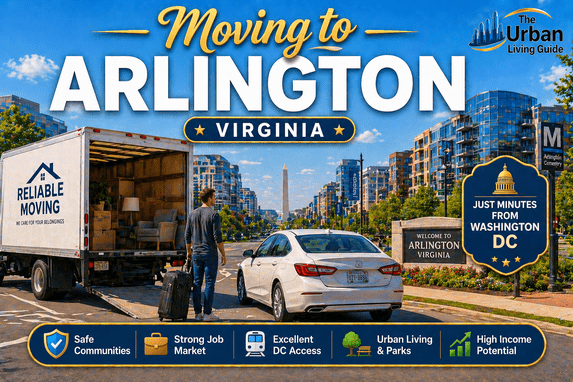
Arlington Doesn’t Let You Settle – It Makes You Level Up
There’s a reason Arlington, Virginia consistently ranks among the most sought-after relocation destinations on the entire East Coast. This isn’t a city where people end up by accident. People choose Arlington deliberately — because they’ve done the math, weighed the options, and decided that proximity to Washington D.C., world-class transit, and a genuinely walkable urban environment is worth the premium.
And yes — there is a premium. Arlington is expensive. That needs to be said upfront. But what you get in return is a city that functions at an exceptionally high level. Top-tier schools, career opportunities that don’t exist at this density anywhere else in Virginia, a food scene that punches well above its weight, and a Metro system that actually works.
The typical Arlington transplant is someone in federal government, defense contracting, tech, or consulting. Amazon HQ2 landing in National Landing has added a new wave — tech professionals relocating from Seattle, San Francisco, and New York who want D.C. access without D.C. city limits.
This guide skips the tourism pitch. Here’s what moving to Arlington actually looks like from a logistics and lifestyle standpoint.
A well-known vlogger who relocated from the West Coast breaks down what the first 90 days in Arlington actually feel like — worth watching before you finalize your decision.
Where Are You Moving From?
✔ Within Virginia (Richmond, Virginia Beach, Norfolk) Straightforward move. I-95 and I-64 connect most of Virginia to Arlington cleanly. Most in-state moves wrap in a single day. Budget $400–$900 depending on load and distance.
✔ Interstate (Maryland, New York, New Jersey, Pennsylvania) One of the most active moving corridors in the country. I-95 feeds Arlington constantly — moving companies know this route extremely well. Budget $1,800–$4,000. Book 6–8 weeks out for spring and summer moves — this market moves fast.
✔ Long Distance / Cross Country (West Coast, Midwest, Texas) The Amazon HQ2 effect has made this a genuinely common move. Full household moves from 1,500+ miles run $4,500–$9,000. PODS and portable containers give you scheduling flexibility — critical when lease start dates and move-out dates don’t align perfectly.
If you’re relocating from a West Coast city like Seattle or San Francisco, Arlington’s East Coast pace and four-season weather will take some recalibration — but most people find the career density and transit access more than compensates.
Who Thrives in Arlington — And Who Finds It Overwhelming
Strong fit for:
- Federal government employees and contractors
- Amazon, Deloitte, Booz Allen Hamilton, and tech sector professionals
- Young professionals who want urban energy with suburban safety
- Families willing to pay for exceptional school quality (Arlington Public Schools consistently rank among Virginia’s best)
- Anyone who values walkability and genuine Metro access as daily non-negotiables
May struggle:
- People on tight budgets — Arlington is genuinely expensive across the board
- Those wanting large homes with yards at reasonable prices
- Anyone who prefers a slower, quieter suburban pace
Moving Logistics – What You Need to Actually Plan For
Arlington is not an easy city to move into physically. High-rise buildings, elevator reservations, loading dock restrictions, and dense street parking make this more logistically complex than most destinations. Plan for this specifically.
Local and In-State Moves: A 2-bedroom apartment move within Northern Virginia runs $700–$1,300 with local movers. DIY is possible but parking a large truck in Arlington requires advance coordination with your building management. Don’t assume — confirm.
Interstate Moves: Get at least 3–4 quotes starting 6–8 weeks out. The I-95 Northeast corridor is competitive but demand is high. Two Men and a Truck, Mayflower, and several strong local operators all serve this market well.
DIY vs. Movers:
- Studio or 1-bedroom, under 400 miles → DIY possible but building logistics complicate it
- 2–3 bedroom, interstate → full-service movers strongly recommended
- Full household, cross country → professional movers are the only practical choice
Many people moving to Arlington underestimate how much the high-rise building logistics complicate what seems like a straightforward move — elevator reservations, loading dock time slots, and parking permits all need to be coordinated well in advance.
Housing Strategy – This Is Where People Make Expensive Mistakes
Arlington’s rental market is competitive, fast-moving, and unforgiving of indecision. Well-priced units in desirable buildings near Metro stations get applications within 24–48 hours of listing.
Smart approach:
- Secure 2–4 weeks of temporary housing first — Airbnb, Furnished Finder, and extended stay hotels near Rosslyn or Ballston work well
- Neighborhoods worth visiting in person: Rosslyn, Clarendon, Ballston, Pentagon City, Columbia Pike, Crystal City / National Landing
- Proximity to your specific Metro line matters enormously — map your commute before shortlisting neighborhoods
- Amazon HQ2 in National Landing has fundamentally changed the Crystal City and Pentagon City rental market — prices have moved significantly upward in that corridor
Lease timing tip: November through January offers slightly more inventory and negotiating room — but even off-season, Arlington rarely gives you much leverage.
Storage and Utilities – Getting Set Up Fast
Storage: Extra Space Storage, CubeSmart, and Public Storage all have Arlington locations. Urban storage pricing here is notably higher than suburban Virginia — budget accordingly if you need medium to long-term storage.
Utility Setup:
- Electricity (Dominion Energy Virginia): Set up 5–7 days before move-in
- Internet (Xfinity, Verizon Fios — both strong in Arlington): Fios availability in Arlington is excellent — check your building first, then book 7–10 days out
- Gas (Washington Gas): Activate 3–5 days before arrival — note this is different from the provider used in most of Virginia
- Water (Arlington County DES): Set up online before move-in
Most Arlington utilities activate within the first week if scheduled before arrival — Verizon Fios is worth prioritizing where available, as it consistently outperforms cable alternatives in the area.
First Weeks in Arlington – The Honest Reality
The cost hits differently when it’s real. Researching Arlington prices and actually paying them are two different experiences. $2,200–$2,800/month for a 1-bedroom near Metro is standard. Budget for this honestly before you commit.
The Metro changes your life. If you’re coming from a car-dependent city, having genuine rail access to D.C., Reagan National Airport, and the broader Northern Virginia employment corridor is a quality-of-life shift that’s hard to overstate. Most people stop driving to work entirely within the first month.
Clarendon will immediately become your neighborhood regardless of where you live. The restaurant density, bar scene, weekend farmers market, and general energy of Clarendon acts as a gravitational center for most Arlington residents — you’ll end up there constantly.
Many newcomers don’t realize that Arlington is technically a county, not a city — it has no incorporated municipalities within it, which gives it an unusually unified and well-managed infrastructure compared to most urban areas its size.
Key Things to Know Before You Arrive
- Reagan National Airport (DCA) is literally Metro-accessible — one of Arlington’s most underappreciated daily advantages
- Four full seasons — winters include real snow and occasional ice storms that shut things down
- Arlington National Cemetery shapes the character of certain neighborhoods in ways worth understanding before you choose where to live
- Parking a personal vehicle long-term in Arlington is expensive — monthly garage parking runs $150–$250
Quick Moving Checklist
30 Days Out:
- Contact building management about elevator reservation and loading dock access
- Book movers — 6–8 weeks out for spring/summer moves
- Arrange temporary housing near target neighborhood
- Get 3–4 moving quotes
- Open Dominion Energy account
1 Week Out:
- Schedule Fios or Xfinity installation
- Activate Washington Gas and county water
- Confirm building move-in logistics — elevator time slot, parking permit
- Pack and label by room
- File USPS mail forwarding
Moving Day:
- Photograph old place before leaving
- Keep documents and valuables in personal vehicle
- Confirm elevator and loading dock reservation morning of
- Full walkthrough before movers leave
- Verify all utilities are live
Final Verdict – Is Relocating to Arlington Worth the Cost?
For the right person — unambiguously yes. Arlington delivers at a level that few cities its size can match. The career access, the transit, the walkability, the schools — these aren’t marketing claims, they’re daily lived realities for the people who live here. The cost is real and it requires honest budgeting. But for professionals who need to be in the D.C. metro orbit, relocating to Arlington consistently proves to be one of the highest-value decisions they make — financially and in terms of quality of life.
FAQs
How much does it cost to move to Arlington?
Local Northern Virginia moves run $600–$1,300. Interstate moves from the Northeast cost $1,800–$4,000. Cross-country full household moves range $4,500–$9,000. Building logistics in Arlington can add time and therefore cost — factor this in.
Is the rental market in Arlington competitive?
Extremely. Well-located units near Metro stations move within 24–48 hours. Start searching 60 days out, have all documents ready, and be prepared to apply same-day on anything well-priced.
Do I need a car in Arlington?
Less than almost anywhere else in Virginia. Metro access is genuinely excellent and most daily needs are walkable in the right neighborhoods. Many Arlington residents go car-free or car-light successfully.
What surprises people most about living in Arlington?
How functional everything is. Transit works, infrastructure is maintained, services are responsive. Coming from cities where basic urban systems underperform, Arlington’s operational quality is genuinely striking.
Is Arlington safe?
Yes — it consistently ranks among the safest urban areas in the entire Mid-Atlantic region. Violent crime rates are significantly below national averages across virtually all neighborhoods.
Explore More with The Urban Living Guide
Arlington rewards research — the more you know before you arrive, the better your transition will be. Here’s everything we’ve put together:
- Living in Arlington, Virginia
- Cost of Living in Arlington
- Pros and Cons of Living in Arlington
- Best Neighborhoods in Arlington
Ground-level insights, honest cost breakdowns, and neighborhood detail — built for people making real relocation decisions.