

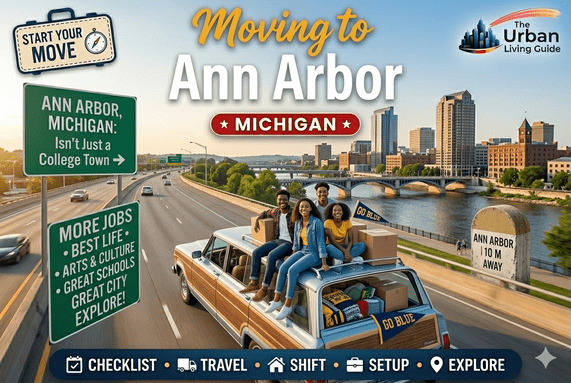
Moving to Ann Arbor – Where Big Ten Energy Meets Real-World Livability
Ann Arbor has a reputation problem — but it’s the good kind. Most people hear “college town” and mentally file it under temporary, transient, student-dominated. Then they actually spend time here and realize they’ve completely misjudged it.
This is a city of 120,000+ residents anchored by one of the most powerful universities in the country — University of Michigan — but built into something far more layered than a campus support system. The research economy here is serious. The healthcare infrastructure through Michigan Medicine is world-class. The restaurant and arts scene has genuine depth. And the neighborhoods that surround the university have a quality and character that most college towns simply never develop.
The people relocating to Ann Arbor are a specific mix — researchers and faculty at U of M, healthcare professionals at Michigan Medicine, tech workers drawn by the growing startup ecosystem, and remote workers from Detroit, Chicago, and beyond who want Midwest affordability with a genuinely stimulating environment.
If moving to Ann Arbor, Michigan is on your list, this guide is built for the actual move — not the campus tour version.
Where Are You Moving From?
✔ Within Michigan (Detroit, Grand Rapids, Lansing, Flint)
- Clean same-day move in virtually all cases
- I-94 connects Detroit to Ann Arbor in under 45 minutes — one of the shortest major city connections in Michigan
- Budget $300–$750 depending on load
✔ Interstate Move (Ohio, Illinois, Indiana, Pennsylvania)
- Well-serviced Midwest corridor with strong moving company competition
- Book 4–6 weeks out — spring moves near U of M’s academic calendar get booked fast
- Budget $1,400–$3,200
✔ Long Distance / Cross Country (East Coast, South, West Coast)
- Full household moves from 1,500+ miles run $4,000–$8,500
- PODS containers work well — Ann Arbor’s rental market moves fast around academic calendar windows
- Start planning 8–10 weeks out
If you’re relocating from a larger metro, Ann Arbor’s compact scale takes brief adjustment — everything is genuinely closer than you’re used to, which most people find immediately appealing rather than limiting.
Watch this video by a popular vlogger who covers Ann Arbor life beyond the university — genuinely useful perspective before your move.
Who Ann Arbor Actually Works For — And Who It Doesn’t
Strong fit for:
- University of Michigan faculty, researchers, and staff
- Healthcare professionals — Michigan Medicine is one of the top academic medical centers in the country
- Tech and biotech professionals — Ann Arbor’s startup and research ecosystem is growing steadily
- Remote workers wanting intellectual environment with Midwest cost structure
- Graduate students and postdocs settling into longer-term careers in the region
May not suit:
- People on tight budgets — Ann Arbor is notably more expensive than most Michigan cities
- Those wanting large suburban homes at moderate prices — land costs here reflect university proximity
- Anyone needing major airport access daily — Detroit Metropolitan Airport is 30 minutes away but not walkable
Moving Logistics – Compact City, Specific Challenges
Ann Arbor is a compact city but with specific moving challenges. Older residential neighborhoods near campus have narrow streets, limited parking, and significant foot traffic. Downtown apartments have their own building logistics. Plan specifically for your target neighborhood.
Local and In-State Moves:
A 2-bedroom move within Ann Arbor or from nearby Michigan cities runs $500–$1,000 with local movers.
DIY is workable but confirm street parking and building access well in advance — particularly near Central Campus and Kerrytown where street space is genuinely limited.
Interstate Moves:
Get 3–4 quotes starting 4–6 weeks out. Avoid scheduling moves during U of M move-in weekend in late August — local moving company availability tightens significantly.
HireAHelper works well for local loading labor at both ends.
DIY vs. Movers:
- Studio or 1-bedroom, under 500 miles → DIY workable with advance street planning
- 2–3 bedroom, interstate → full-service movers recommended
- Full household, cross country → professional movers only
One Ann Arbor-specific tip — if you’re moving in late August or early September, book everything significantly earlier than you normally would. University move-in season creates real competition for moving company slots and parking access throughout the city.
Housing in Ann Arbor – Honest About the Cost
Ann Arbor is the most expensive city in Michigan by a meaningful margin. A well-located 1-bedroom runs $1,400–$2,200/month. 2-bedrooms in desirable areas range $1,800–$2,800. Homeownership requires serious financial preparation — median home prices consistently exceed $400,000.
Smart approach:
Book 2–3 weeks of temporary housing first — Airbnb has strong Ann Arbor inventory year-round outside of football season and graduation weekends.
Neighborhoods worth visiting in person: Kerrytown, Old West Side, Burns Park, Water Hill, Germantown, Downtown.
Kerrytown is arguably the most desirable neighborhood — farmers market, independent shops, walkable streets, and beautiful older homes. Pricing reflects it.
Old West Side offers similar historic character at slightly more accessible price points — a favorite among faculty and long-term residents.
Burns Park is the go-to for families — excellent school proximity, safe streets, and strong community feel.
Lease timing tip: November through February gives the best availability — avoid competing with the academic calendar rush in August and September.
Storage and Utilities – First Week Setup
Storage:
Extra Space Storage and Public Storage both operate in Ann Arbor.
Pricing is higher than most Michigan cities — urban university market rates apply. Book early if you need storage around August move-in season.
Utility Setup:
- Electricity and Gas (Consumers Energy or DTE Energy): Confirm provider for your specific address — both operate in Ann Arbor. Set up 5–7 days before move-in
- Internet (Xfinity or WOW!): Both have Ann Arbor coverage — Xfinity is more widely available. Book 7–10 days out
- Water (City of Ann Arbor Water Utilities): Set up through city portal before move-in
Most Ann Arbor utilities activate within the first week if scheduled before arriving — confirming your gas and electric provider for your specific address before calling saves the most common setup confusion.
First Weeks in Ann Arbor – What Actually Happens
The intellectual energy is not a marketing claim.
Within the first few weeks, most newcomers notice something different about daily life here — conversations at coffee shops, events at Rackham Graduate School, public lectures, Hill Auditorium performances. The university presence creates a baseline cultural stimulation that permeates the entire city, not just the campus.
Football Saturdays are a lifestyle, not just a game.
Michigan Stadium holds 107,000+ people — the largest stadium in the country. On home game days, the city transforms completely. If you’re not a football person, understanding the rhythm of the fall schedule helps you plan around it intelligently.
The cost catches people off guard relative to the rest of Michigan.
Moving to Ann Arbor, Michigan from Detroit or Grand Rapids expecting similar pricing is the most common financial miscalculation new residents make. Budget specifically for Ann Arbor rates — not general Michigan averages.
Many newcomers don’t realize that Ann Arbor has one of the most developed independent bookstore, music venue, and arts event scenes of any city its size in the country — the Ark, Literati Bookstore, and Michigan Theater become part of regular life faster than most people expect.
Key Things to Know Before You Arrive
- Parking in Ann Arbor is expensive and competitive — factor monthly parking costs into your true budget before committing to a car-dependent lifestyle
- Four full seasons — winters include real snowfall, Lake Michigan weather influence is moderate here
- Ann Arbor has a strong progressive political culture — relevant context for people moving from different political environments
- Detroit Metro Airport (DTW) is 30 minutes away — solid domestic and international connections
Quick Moving Checklist
30 Days Out:
- Avoid booking moves during late August U of M move-in weekend
- Visit target neighborhoods in person
- Book movers or reserve rental truck — earlier than usual if moving in summer
- Arrange temporary housing away from football season weekend pricing
- Get 3 moving quotes if coming from out of state
- Confirm Consumers Energy vs DTE for your address
1 Week Out:
- Schedule Xfinity or WOW! internet installation
- Activate city water account
- Set up gas and electric with correct provider
- Pack and label by room
- File USPS mail forwarding
Moving Day:
- Photograph old place before leaving
- Keep documents and valuables in personal vehicle
- Confirm street parking logistics — especially near campus neighborhoods
- Full walkthrough before movers leave
- Verify all utilities are live
Final Verdict – Is Relocating to Ann Arbor Worth the Premium?
For the right person — unambiguously yes. Ann Arbor is expensive by Michigan standards but delivers something genuinely rare — intellectual vitality, world-class healthcare and research infrastructure, a food and arts scene that punches well above city size, and neighborhoods with real character. The cost requires honest budgeting and the university calendar shapes daily life in ways worth understanding before you arrive. But for people who fit the profile, this city rewards the decision consistently and durably.
FAQs
How much does it cost to move to Ann Arbor?
Local Michigan moves run $450–$1,000. Interstate moves from the Midwest cost $1,400–$3,200. Cross-country full household moves range $4,000–$8,500. Book earlier than usual if moving in summer — U of M move-in season creates real competition for slots.
Is the Ann Arbor rental market competitive?
Yes — particularly around the academic calendar. August and September are extremely competitive. November through February gives the best availability. Have all documents ready and be prepared to apply same-day on well-priced units.
Do I need a car in Ann Arbor?
Less than most Michigan cities. TheRide bus system covers decent ground and campus areas are walkable. Many residents near Downtown or Central Campus manage car-light successfully. Outside the urban core, a vehicle helps significantly.
How does Ann Arbor compare to other Michigan cities for cost?
It’s the most expensive by a clear margin. Expect to pay 30–50% more for comparable housing than Grand Rapids or Lansing. The premium reflects university proximity and the quality of amenities and infrastructure that come with it.
What surprises people most about living in Ann Arbor?
How complete it feels for its size. Most people expect to sacrifice urban amenities for Midwest affordability and find instead a city that delivers restaurant quality, cultural programming, and neighborhood character that rivals cities three times its population.
Explore More with The Urban Living Guide
Everything we’ve built for Ann Arbor to help you relocate with full confidence:
- Living in Ann Arbor, Michigan
- Cost of Living in Ann Arbor
- Pros and Cons of Living in Ann Arbor
- Best Neighborhoods in Ann Arbor
Honest tradeoffs, real cost data, neighborhood detail — built for people making actual decisions.