

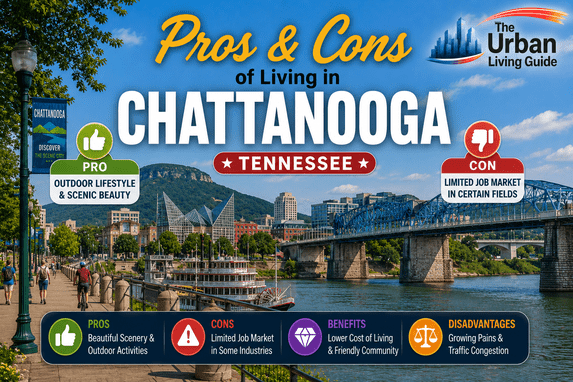
The Pros and Cons of Living in Chattanooga Reveal a City That Consistently Defies Expectations
Chattanooga sits in a dramatic natural setting where the Tennessee River cuts through the Appalachian Mountains — and for a city of just 180,000 people, it has quietly built a reputation that punches far above its weight. First in the nation to launch gigabit internet citywide, consistently ranked among America’s most livable mid-sized cities, and home to an outdoor lifestyle that rivals cities twice its size. But before you start searching apartments, the real story here deserves honest attention.
Here’s what Chattanooga life actually looks like beyond the scenic overlooks.
Pros of Living in Chattanooga That Make It Stand Out in the South
1. Natural Setting That’s Genuinely Spectacular
Lookout Mountain, Signal Mountain, Raccoon Mountain, and the Tennessee River Gorge create an outdoor playground that most cities could never manufacture. Many residents appreciate that world-class rock climbing at Tennessee Wall, hang gliding off Lookout Mountain, and kayaking the Ocoee River — site of the 1996 Olympic whitewater events — are all within 45 minutes of downtown. This isn’t weekend recreation — it’s Tuesday evening culture here.
2. Gigabit Internet That Actually Changed the City
When Chattanooga launched its city-owned gigabit fiber network through EPB in 2010, it became the first city in America to offer it publicly. That infrastructure decision quietly transformed the local economy — attracting remote workers, tech startups, and small businesses that chose Chattanooga specifically for connectivity that most major metros still struggle to match consistently.
3. A Downtown Transformation That’s the Real Deal
The Tennessee Aquarium, Coolidge Park, Walnut Street Bridge — one of the longest pedestrian bridges in the world — and the North Shore dining district have created a walkable urban core that genuinely surprises first-time visitors. One thing people often mention is how Chattanooga’s downtown feels authentically revitalized rather than artificially polished for tourism purposes.
4. Cost of Living That Remains Genuinely Accessible
Chattanooga maintains meaningful affordability relative to Nashville, Atlanta, and most comparable Southeastern cities. Median home prices remain attainable for middle-income earners, and renters get solid value compared to growth markets that have seen dramatic price surges. The combination of Tennessee’s zero state income tax and Chattanooga’s relative affordability creates real financial breathing room.
5. Volkswagen, Amazon, and a Diversifying Economy
Volkswagen‘s North American manufacturing plant employs thousands and anchors Chattanooga’s manufacturing base. Amazon, BlueCross BlueShield of Tennessee, and a growing cluster of logistics and tech companies have added economic diversity that has meaningfully reduced the city’s historical dependence on any single industry.
6. Small City Feel With Genuine Urban Amenities
Chattanooga operates at a human scale that larger cities genuinely cannot replicate. Traffic is manageable, commutes are short, and the community feels navigable without sacrificing the restaurants, arts venues, and professional opportunities that make urban living worthwhile.
📺 Chattanooga newcomers and longtime locals share what genuinely surprised them about living here.
Cons of Living in Chattanooga Worth Knowing Before You Commit
1. Job Market Ceiling Is Real for Certain Careers
The pros and cons of living in Chattanooga, Tennessee conversation always returns here eventually. Outside manufacturing, logistics, healthcare, and tourism, the private sector job market is relatively constrained. Professionals in finance, media, or specialized tech will find career depth noticeably shallower than Nashville or Atlanta — a ceiling that eventually pushes ambitious movers toward larger metros.
2. Summer Heat and Humidity Are Legitimately Intense
Chattanooga sits in a river valley that traps summer heat effectively. July and August temperatures regularly exceed 90°F with significant humidity — a combination that makes outdoor activity genuinely uncomfortable during peak summer months for those not acclimated to Deep South climate conditions.
3. Public Transit Remains Limited
Chattanooga’s electric shuttle downtown is charming and free — but the broader CARTA bus network doesn’t come close to supporting a car-free lifestyle beyond the immediate urban core. For most daily routines outside downtown, a car remains completely necessary.
4. Rapid Growth Is Creating Growing Pains
Some newcomers find it challenging that Chattanooga’s popularity — fueled by national media attention and remote worker relocation — is beginning to strain the infrastructure and character that made it attractive in the first place. Housing costs are rising, certain neighborhoods are gentrifying rapidly, and long-term residents quietly note the city is changing faster than many would prefer.
5. Limited Diversity in Certain Sectors and Social Circles
Despite genuine cultural improvement, Chattanooga remains a relatively homogeneous mid-sized Southern city in certain social and professional contexts. Immigrants and multicultural communities seeking deep established networks will find options more limited than in Nashville, Memphis, or larger Southeastern metros.
Who Thrives in Chattanooga?
Chattanooga is an outstanding fit for outdoor enthusiasts who want urban amenities alongside genuine wilderness access, remote workers who prioritize gigabit connectivity and quality of life over metro scale, manufacturing and logistics professionals connected to Volkswagen and the broader industrial base, and families seeking affordability with a genuine community feel.
Who should reconsider? Career-driven professionals in specialized fields needing deep private sector markets, those requiring robust public transit, and anyone expecting Nashville-level urban energy and nightlife should calibrate expectations honestly before committing.
Final Verdict – Is Chattanooga the Right Move for You?
Few mid-sized cities in America get as much right simultaneously as Chattanooga does. The pros and cons of living in Chattanooga, Tennessee tilt genuinely positive for the right profile — particularly remote workers, outdoor enthusiasts, and families who value livability over urban scale. The job market ceiling and summer heat are real trade-offs, but for those they don’t disqualify, Chattanooga consistently delivers on its growing reputation.
FAQs
Is Chattanooga, TN safe to live in?
Safety varies by neighborhood. North Shore, Signal Mountain, and East Brainerd are among the safer residential areas. Parts of downtown-adjacent corridors and certain East Chattanooga neighborhoods have higher crime activity. Overall, Chattanooga sits in a moderate range for cities its size — neighborhood research matters.
What salary do you need to live comfortably in Chattanooga?
A single professional can live comfortably on $48,000-$62,000 annually. Families generally need $78,000-$95,000 depending on housing neighborhood and lifestyle expectations. Tennessee’s zero income tax improves effective purchasing power meaningfully across all income levels.
Is Chattanooga cheaper than Nashville?
Yes — notably so. Housing costs run 30-40% lower than comparable Nashville neighborhoods, and overall cost of living remains more accessible despite recent growth-driven price increases. Chattanooga represents genuine value relative to most comparable Southeastern growth cities.
How far is Chattanooga from Atlanta and Nashville?
Atlanta sits approximately 120 miles south — about 2 hours by car via I-75. Nashville is approximately 135 miles northwest — roughly 2 hours via I-24. This central positioning gives Chattanooga residents practical access to two major metros for work, travel, and specialized services.
Is Chattanooga good for families?
Strongly yes for the right profile. Hamilton County Schools performs reasonably well, outdoor access for children is exceptional, and community character in suburban neighborhoods like Hixson and Ooltewah is genuinely family-friendly. Affordability makes homeownership realistic at income levels that wouldn’t work in larger metros.
What is Chattanooga known for?
Chattanooga is known for the Tennessee Aquarium, Lookout Mountain, Rock City, the Walnut Street Bridge, the Choo Choo historic terminal, gigabit internet infrastructure, Volkswagen manufacturing, and its reputation as one of America’s most successfully revitalized mid-sized cities.
Explore More
- 📍 Living in Chattanooga, Tennessee — Complete relocation guide covering Lookout Mountain lifestyle, neighborhood breakdown, and what everyday life in Chattanooga genuinely demands
- 💰 Cost of Living in Chattanooga, Tennessee — Honest breakdown of housing costs, gigabit internet savings, and how Chattanooga compares to Nashville and Atlanta on real monthly expenses
- 🏘️ Best Neighborhoods in Chattanooga, Tennessee — From North Shore to Signal Mountain — find your right fit based on lifestyle, budget, and outdoor access priorities