
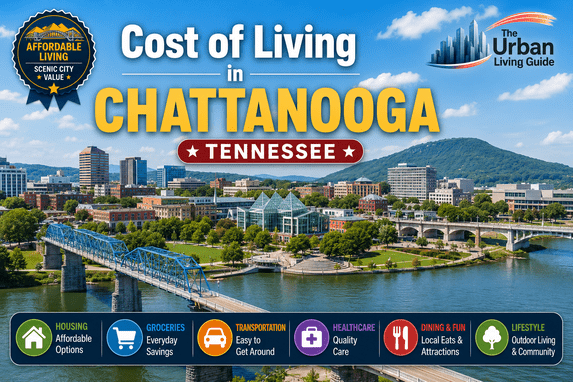
Where Outdoor Lifestyle Meets Tech-Forward Affordability
Chattanooga has quietly become one of the South’s most compelling relocation targets — blending genuine outdoor recreation access, a revitalized downtown anchored by tech investment, America’s fastest municipal internet (EPB Fiber Optics), and housing costs that remain reasonable despite the city’s rising profile. The cost of living in Chattanooga, Tennessee sits below Nashville and broadly comparable to Knoxville and Memphis, yet the city offers distinct advantages through its natural setting along the Tennessee River and proximity to climbing, hiking, and water sports that define daily life for active residents.
City-specific insight worth understanding: Chattanooga’s transformation from declining industrial city to outdoor-tech hub is real and ongoing — the Innovation District downtown, Volkswagen manufacturing plant, and tech startup ecosystem have attracted steady migration without triggering the explosive rent inflation Nashville experienced. The city rewards early movers who recognize value before national attention resets baseline pricing.
📹 Watch this video for a realistic breakdown of what Chattanooga actually costs before relocating to Tennessee’s outdoor hub.
Average Monthly Cost of Living in Chattanooga
Chattanooga keeps comfortable living genuinely feasible:
- Single person: Around $2,300–$3,000/month
- Couple: Typically $3,500–$4,600/month
- Family (2 adults, 2 kids): Around $4,900–$6,400/month including childcare
Many people moving from Nashville to Chattanooga discover the $400–$700/month savings on rent combined with superior outdoor access creates meaningful lifestyle upgrade alongside financial relief. If you’re coming from Atlanta (120 miles south), Chattanooga offers noticeably lower costs with comparable city amenities. Coming from smaller Tennessee cities? Chattanooga delivers more urban infrastructure and outdoor recreation density without dramatic cost premiums.
Housing in Chattanooga — Where Rivers and Mountains Set the Scene
Housing costs vary significantly by proximity to downtown and natural features. Downtown Chattanooga, Northshore, Southside, and St. Elmo near Lookout Mountain command premium rents, while neighborhoods like Red Bank, East Ridge, and Hixson offer solid value with quick access to city amenities.
- Studio: $850–$1,250/month
- 1-bedroom: $1,050–$1,550/month
- 2-bedroom: $1,350–$2,000/month
- 3-bedroom/family home: $1,700–$2,600/month
Locals often note that Chattanooga’s rental market rewards patience and neighborhood research — units with Tennessee River views or Lookout Mountain proximity hold firm on pricing, while neighborhoods slightly removed offer genuine negotiating room. If you’re coming from Nashville at $1,900–$2,400/month for a 2-bedroom, a comparable Chattanooga unit at $1,450–$1,750/month represents real budget relief. Coming from Knoxville? Broadly similar pricing with different outdoor character — Chattanooga’s river and mountain setting versus Knoxville’s Smoky Mountains proximity.
Utilities Stay Competitive With Municipal Provider
Chattanooga sits at roughly elevation 680 feet in the Tennessee Valley with hot, humid summers and mild winters.
- Electricity + Gas + Water: Typically $100–$170/month
- Summer peak (Jul–Aug): Can reach $160–$215/month
- Internet via EPB Fiber Optics: Around $58–$70/month for 1 Gig fiber — genuinely fastest municipal internet in America
- Combined monthly average: Budget $160–$250/month
EPB (Electric Power Board of Chattanooga) provides municipally-owned fiber internet that’s genuinely world-class — 10 Gig speeds available at prices private ISPs can’t match. For remote workers and tech professionals, this is a meaningful quality-of-life and cost advantage.
Grocery and Food Costs Track Regional Averages
Grocery costs in Chattanooga run close to Tennessee norms — noticeably below Nashville, broadly in line with Knoxville and Memphis.
- Single person: Around $270–$390/month
- Family of 4: Typically $630–$880/month
Publix, Walmart, Whole Foods (downtown), and regional chains keep grocery options diverse and competitive. The dining scene has improved meaningfully — Southside and Northshore neighborhoods offer genuine quality at $14–$21 per person for solid mid-range meals. Chattanooga’s craft brewery culture rivals Asheville’s at noticeably lower cost.
Transportation Requires Car Despite Walkable Downtown
Chattanooga’s downtown is genuinely walkable and bikeable, but the broader metro requires car ownership for most residents. CARTA (Chattanooga Area Regional Transportation Authority) provides bus service and a free downtown electric shuttle, but coverage outside the city core is limited.
- Car ownership (insurance + fuel + maintenance): $370–$560/month
- Auto insurance: $115–$170/month — competitive for Tennessee
- CARTA bus pass: Around $35–$55/month for regular riders
- Free Electric Shuttle: Downtown circulator at no cost
- Traffic: Generally light — I-24 and I-75 congestion manageable compared to Nashville
Chattanooga’s compact layout and proximity to outdoor recreation (Lookout Mountain, Signal Mountain, Tennessee River Gorge) means weekend activities are genuinely accessible without long-distance travel costs.
Healthcare Access Via Regional Systems
Erlanger Health System and CHI Memorial anchor Chattanooga’s healthcare landscape with solid regional capacity, though complex specialist care sometimes requires Nashville (135 miles) or Atlanta (120 miles) travel.
- Employer-sponsored plan: Typically $145–$280/month employee contribution
- Marketplace individual plan: Around $240–$460/month
- Urgent care visit: $95–$165 without insurance
BlueCross BlueShield of Tennessee (headquartered in Chattanooga) and other regional employers provide competitive benefits that help manage healthcare costs for that employment segment.
Other Living Expenses Complete the Budget
- Gym membership: $25–$65/month — climbing gyms popular given outdoor culture
- Childcare (per child): $1,000–$1,500/month — noticeably lower than Nashville
- Entertainment & dining out: $130–$240/month
- Outdoor recreation: Largely free — Lookout Mountain, Prentice Cooper State Forest, Tennessee Riverwalk all free access
- Rock climbing gear/passes: Budget $50–$100/month if engaged with climbing culture
Chattanooga’s identity revolves heavily around outdoor lifestyle — rock climbing, mountain biking, paddling, and trail running define the city’s character more than any other Tennessee metro.
Chattanooga vs Tennessee and Regional Cities
- vs Nashville: Chattanooga is 25–30% cheaper on housing, meaningfully lower across services
- vs Knoxville: Broadly comparable overall; Chattanooga offers river/mountain setting, Knoxville has UT energy
- vs Memphis: Similar pricing tier; Chattanooga skews outdoor-focused, Memphis more urban
- vs Asheville, NC: Chattanooga is 20–30% cheaper — similar outdoor culture without tourism premium
Micro insight: A growing number of Atlanta remote workers have relocated to Chattanooga to escape Atlanta’s cost and traffic while maintaining occasional office access via I-75 (120 miles, 2 hours). The EPB fiber internet makes remote work seamless at speeds private ISPs in larger cities can’t match.
The Chattanooga Value Proposition — Outdoor Lifestyle Without Resort Pricing
The cost of living in Chattanooga, Tennessee reflects a city that has modernized its economy (Volkswagen, Amazon fulfillment, tech startups), invested in infrastructure (EPB fiber), and leveraged natural assets (Tennessee River, Lookout Mountain) without pricing out moderate-income residents. For outdoor enthusiasts, remote workers, and families seeking quality of life over urban density, Chattanooga delivers exceptional value.
Who Thrives in Chattanooga and Who May Struggle
Strong fit: Outdoor enthusiasts (climbers, paddlers, mountain bikers), remote workers prioritizing gigabit fiber and lifestyle, Volkswagen and manufacturing employees, tech startup workers, families wanting nature access and good schools, anyone seeking Asheville-style culture at lower cost.
May face pressure: Job seekers without connections to Volkswagen, Amazon, BlueCross BlueShield, or tech sector — local job market is smaller than Nashville’s. Anyone requiring constant Nashville or Atlanta access will find commuting doable but tiring. People specifically seeking big-city cultural density and nightlife may find Chattanooga’s scale feels limited.
FAQs
What is the cost of living in Chattanooga, Tennessee in 2026?
A single person typically needs $2,300–$3,000/month for comfortable living in Chattanooga. Families of four should budget $4,900–$6,400/month covering rent, childcare, groceries, and transportation.
Is Chattanooga cheaper than Nashville and Atlanta?
Yes — Chattanooga is 25–30% cheaper than Nashville on housing and noticeably more affordable than Atlanta across most categories while offering comparable outdoor access and city amenities.
Do I need a car to live in Chattanooga?
Yes for most residents — downtown Chattanooga is walkable and bikeable with a free electric shuttle, but broader metro access and outdoor recreation require a car for practical daily living.
What salary do you need to live comfortably in Chattanooga?
Singles need roughly $52,000–$65,000/year. Couples can live well on $78,000–$100,000 combined. Families should target $100,000–$128,000+ to cover childcare, housing, and maintain savings comfortably.
What’s EPB Fiber Optics and why does it matter?
EPB is Chattanooga’s municipally-owned fiber internet provider offering 1 Gig speeds for $58/month and 10 Gig speeds available — genuinely the fastest municipal internet in America. For remote workers, this is a significant quality-of-life and cost advantage over private ISPs.
What are the main employers in Chattanooga?
Volkswagen (manufacturing plant), Amazon (fulfillment center), BlueCross BlueShield of Tennessee (headquarters), Erlanger Health System, EPB, Unum (insurance), and growing tech startup ecosystem anchor the job market.
🔗 Explore the complete Living in Chattanooga, Tennessee guide with The Urban Living Guide