

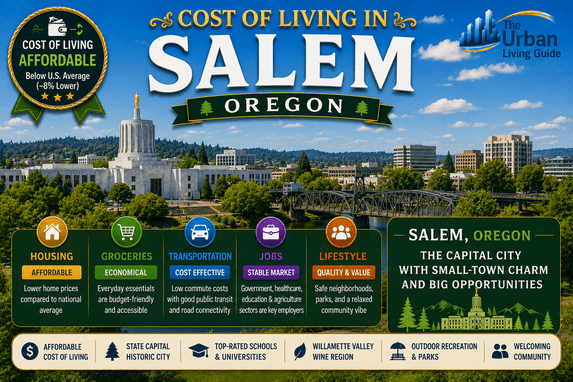
Cost of Living in Salem, OR: Capitol Living, Willamette Valley Access & Lower Housing Costs
Salem offers small-city affordability with state capital stability. This isn’t a trendy destination like Portland or Bend—it’s a practical, family-oriented city with steady government employment and Willamette Valley charm. If you’re relocating for state government jobs, hospital work, or seeking affordable Oregon living with decent schools, Salem delivers some of the state’s best value.
This guide breaks down real monthly costs so you can budget accurately. Many people moving to Salem notice that rent near downtown or West Salem runs slightly higher than East Salem or Keizer areas. The state employee population creates stable year-round demand without the wild price swings seen in college or tech towns.
Average Monthly Cost in Salem
Here’s what monthly living typically looks like:
-
- Single person: Around $2,300–$3,000
- Couple: Typically $3,700–$4,700
- Family of four: Approximately $5,500–$7,200
These estimates include rent, utilities, groceries, transportation, and essential expenses. Your actual spending depends on neighborhood choice and whether you’re in central Salem or nearby Keizer.
Watch this video to explore Salem neighborhoods, commute routes, and what daily life looks like before making your decision.
Housing Costs in Salem
Rent here remains Oregon’s most affordable among mid-sized cities:
-
- Studio: Typically $850–$1,300 depending on neighborhood
- 1-bedroom apartment: Averages $1,100–$1,600, higher near downtown or Riverfront Park
- 2-bedroom units: Range from $1,400–$2,100, newer complexes cost more
- Family homes (3+ bedrooms): Cost $1,700–$2,800 monthly
West Salem, South Salem near Bush’s Pasture Park, and areas close to Willamette University command slightly higher rents due to neighborhood reputation and school quality. Locals often mention that East Salem, North Salem, and Keizer offer better value for families needing space. If you’re coming from Portland or Eugene, housing here feels noticeably cheaper—rural Oregon transplants find it comparable or slightly higher.
The rental market stays steady year-round thanks to state government employees, Salem Hospital workers, and families choosing Salem-Keizer schools. Unlike college towns, demand doesn’t fluctuate seasonally.
Utilities & Internet
Monthly costs breakdown:
-
- Utilities (electricity, water, trash, sewer): $110–$180 for standard apartments
- Internet: $50–$75 for reliable speeds
- Winter heating: Mild climate keeps heating costs manageable
Salem’s Willamette Valley location means moderate weather and lower utility bills compared to mountain or coastal areas.
Grocery & Food Costs
Expect to spend $320–$480 monthly per person on groceries:
-
- Salem has WinCo, Safeway, Fred Meyer, Trader Joe’s, and Saturday Market
- Dining out: Runs $11–$25 per meal at local restaurants and chains
- The food scene is family-oriented and practical rather than trendy
No Oregon sales tax helps keep grocery and dining affordable. Shopping at WinCo or Fred Meyer saves significantly.
Transportation Costs
Transportation depends on commute and lifestyle:
-
- Car owners: Gas, insurance, and parking average $170–$300 monthly
- Cherriots (Salem-Keizer Transit) monthly pass: $50 for unlimited bus access
- Biking: Growing infrastructure but car dependency remains high
- Parking: Free in most neighborhoods; downtown has affordable paid lots
Most Salem residents drive. Cherriots covers local areas but routes are limited compared to Portland’s system. Families and commuters to Portland or Corvallis rely heavily on cars.
Healthcare & Insurance
Health insurance and medical expenses:
-
- Employer health insurance: Typically $180–$420 per month for individuals
- Salem Health serves the region with comprehensive care
- Specialist visits and prescriptions: Budget $45–$130 monthly for regular needs
Other Living Expenses
Entertainment, gym memberships, phone plans, and personal care add $170–$350 monthly:
-
- Salem offers Bush’s Pasture Park, Riverfront Park, Enchanted Forest, and Willamette Mission State Park
- Many outdoor activities are free or low-cost
- Families should budget for kids’ activities, though costs run lower than Portland or Eugene
Cost Comparison with Nearby Cities
| Expense Category | Salem | Portland | Eugene | Keizer | Albany |
|---|---|---|---|---|---|
| 1-BR Rent | $1,100–$1,600 | $1,600–$2,400 | $1,200–$1,800 | $1,000–$1,500 | $950–$1,400 |
| Groceries (monthly) | $320–$480 | $380–$550 | $330–$490 | $310–$470 | $300–$460 |
| Transportation | $170–$300 (or $50 Cherriots) | $220–$380 (or $100 TriMet) | $180–$320 (or $60 LTD) | $170–$300 | $160–$290 |
| Overall Affordability | Moderate-low | High cost | Moderate | Low-moderate | Low-moderate |
Salem costs significantly less than Portland and slightly less than Eugene. It offers better job stability through government employment while maintaining lower housing costs than larger cities.
Is Salem Expensive or Affordable?
Salem lands in the affordable zone for Oregon. It’s not rural-cheap, but it’s one of the state’s best values for city living. Housing drives affordability—steady state government employment, Salem-Keizer schools, and lack of tech industry hype keep prices reasonable. Why? Limited transplant pressure compared to Portland or Bend, plus older housing stock and practical rather than trendy appeal mean less bidding competition.
Overall, this city works well for state employees, healthcare workers, young families, and anyone prioritizing affordability over urban amenities. Single earners and retirees also find Salem manageable on moderate incomes.
👤 Who Can Afford to Live Comfortably
A household income around $55,000–$70,000+ makes Salem comfortable. State government workers, Salem Hospital employees, teachers, and dual-income families handle costs easily. Those on fixed incomes or single-parent households find Salem more accessible than larger Oregon cities.
⚠️ Who May Find Salem Expensive?
Single earners making under $35,000 will feel some rent pressure, though Salem remains more forgiving than Portland or Eugene. Part-time workers, students, or those in minimum-wage jobs may need roommates. The cost mismatch is less severe here—even on modest income, you can find decent housing if willing to live in North Salem, East Salem, or Keizer.
Money-Saving Tips
- Rent in East Salem, North Salem, Keizer, or West Stayton
- Shop at WinCo, Grocery Outlet, or Fred Meyer instead of specialty stores
- Use Cherriots for local trips when possible
- Take advantage of free parks—Bush’s Pasture, Minto-Brown Island Park, Riverfront Park
- Cook at home and visit Saturday Market for local produce
FAQs
Is Salem cheaper than Portland?
Yes, Salem costs 30–40% less than Portland overall. Housing, dining, and transportation all run significantly lower, though job opportunities are more limited outside government and healthcare.
What salary do I need to live comfortably in Salem?
A household income of $55,000–$70,000+ covers rent, utilities, food, and lifestyle comfortably. Single individuals can manage on $35,000–$45,000, depending on housing choice.
Are groceries expensive in Salem?
Groceries run below Oregon averages—$320–$480 per person monthly. Shopping at WinCo keeps costs very reasonable, and no sales tax helps stretch budgets.
Do I need a car in Salem?
Most residents drive. Cherriots covers basic routes, but car ownership is practical for work, family activities, and accessing nearby cities like Portland or Eugene.
How does Salem compare to Eugene in cost?
Salem costs 10–20% less than Eugene overall. Housing is cheaper, though Eugene offers more cultural amenities, university employment, and outdoor recreation variety.
Explore more with The Urban Living Guide
Before moving to Salem, make sure you check: