

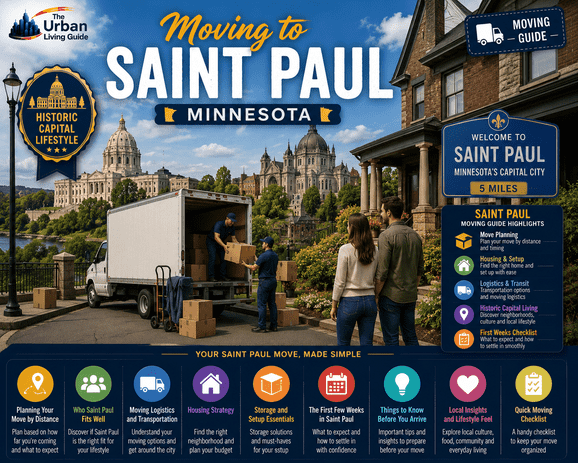
Moving to Saint Paul, Minnesota – Minnesota’s Capital Has a Quieter Edge and Lower Price Tag
Saint Paul lives in Minneapolis’s shadow — and most of the time, that’s a genuine advantage for the people who actually move here. Minnesota’s capital city offers a meaningfully more affordable alternative: median home prices around $217,000–$250,000 compared to Minneapolis’s $325,000–$375,000. Average rent across Saint Paul sits at $1,534/month in 2026, and over 53% of Saint Paul residents own their homes — a meaningfully different profile than its larger twin. The cost of living index runs at 99.7 — essentially at the national average — giving this city one of the most honest price-to-quality ratios in the entire Midwest.
Watch this local vlogger’s moving guide for Saint Paul –
Moving to Saint Paul, Minnesota – Planning Your Move by Distance
Saint Paul sits directly across the Mississippi River from Minneapolis, connected by the Green Line light rail and a dense network of highways — making it one of the most geographically flexible relocations in this guide.
-
- Same-State or Regional Move (from Wisconsin, Iowa, or elsewhere in Minnesota): The most common path. A local crew handles most volumes in a single day. Budget $400–$1,000. I-94 and I-35E provide direct regional access.
- Interstate Move (from Illinois, Michigan, or other Midwest states): Mid-range complexity. Budget $1,200–$2,800. Saint Paul’s historic districts are generally truck-accessible without significant complications.
- Long-Distance or Cross-Country Move: Full-service movers run $3,800–$9,000. Strongly consider a May-through-September move window if your timeline allows — Minnesota winter logistics are a real planning factor.
- Minneapolis-to-Saint Paul Move: Extremely common as people seek more affordable housing without leaving the metro. Typically completed by a small crew in a few hours.
Who Saint Paul Fits Well
Saint Paul attracts people with somewhat different priorities than Minneapolis — and the city serves that population particularly well.
-
- First-time homebuyers: Median home price of $217,000–$250,000 is a genuinely more accessible path to ownership than Minneapolis, while still delivering Twin Cities job access and amenities.
- Families: Strong, stable residential neighborhoods, excellent parks — particularly Como Park and its conservatory — and a quieter, more settled character than Minneapolis’s urban pace.
- Government, education, and healthcare professionals: Saint Paul’s economy, built around state government, university presence, and healthcare institutions, makes it a natural professional fit as Minnesota’s capital.
- Historic architecture lovers: Summit Avenue, Crocus Hill, and Highland Park offer some of the best-preserved Victorian and late 19th-century residential streets in the country.
- Budget-conscious Twin Cities seekers: People priced out of Minneapolis’s hottest neighborhoods but unwilling to leave the metro consistently land in Saint Paul as the financially sensible alternative that doesn’t sacrifice urban amenities.
Who May Find Saint Paul Limiting
Saint Paul’s character, while genuinely appealing to many, isn’t the right fit for everyone.
-
- Urban nightlife seekers: Saint Paul has a noticeably quieter nightlife and restaurant scene than Minneapolis. People who want maximum urban energy will generally find Minneapolis or Grand Avenue more satisfying.
- Corporate career professionals: Saint Paul’s job market is solid in government, healthcare, and education — but lacks the concentration of major corporate HQs that defines Minneapolis’s economy across the river.
- Winter avoiders: Winter conditions are identical to Minneapolis — the same genuine cold and 40+ inches of annual snowfall apply regardless of which side of the river you choose.
- Neighborhood-sensitive buyers: Some Saint Paul neighborhoods carry higher crime statistics than others. The Summit Avenue, Highland Park, and Como Park areas are consistently the strongest options — research at the neighborhood level matters.
Moving Logistics and Transportation Planning
Saint Paul is logistically comparable to Minneapolis — wide residential streets in most neighborhoods, with the historic districts requiring slightly more careful navigation due to older street layouts and mature tree-lined boulevards.
-
- Local Saint Paul moves: $400–$900 for a one to two bedroom with a professional crew
- Interstate moves from the Midwest: $1,200–$2,800
- Cross-country moves: $3,800–$9,000 with full-service movers
- Truck rental: Reserve 4–6 weeks ahead if moving June through August (peak season)
- Metro Transit Green Line: Connects downtown Saint Paul to downtown Minneapolis via University Avenue — practical for commuters working across the river
- Minneapolis–Saint Paul International Airport (MSP): Located closer to Saint Paul than most people expect — a real convenience for frequent travelers
- Winter driving prep: Identical considerations to Minneapolis — snow tires, block heaters, and timeline buffers for winter moves
Housing Strategy in Saint Paul’s 2026 Market
Saint Paul’s housing market remains the more affordable Twin City by a meaningful margin — and the range of options across neighborhoods gives buyers real choices.
-
- Summit Avenue / Crocus Hill: The city’s most prestigious historic district — well-preserved Victorian mansions and tree-lined boulevards, walking distance to Grand Avenue’s shops and restaurants. Premium pricing reflecting architectural significance.
- Highland Park: Family-friendly, walkable commercial strip, mix of housing types. Consistently recommended for households wanting established residential character with good amenity access.
- Como Park area: Anchored by Como Park and its acclaimed conservatory and zoo, offering year-round recreation. Popular with families who prioritize park access.
- West Side: Established residential area along the river with parks and active commercial corridors. Major Highland Bridge redevelopment underway — good greenspace access and convenient routes to both downtowns and MSP airport.
- Affordable neighborhoods: Payne-Phalen (average rent $1,190/month) and Battle Creek–Highwood (13% below city average) offer the most budget-friendly entry points.
- Downtown / Lowertown: Condo and loft living with walkable urban character — a smaller-scale, quieter alternative to Minneapolis’s North Loop.
Storage and Setup Essentials
Saint Paul’s housing stock includes a genuine mix of historic single-family homes, duplexes, and newer construction in redeveloping areas like Highland Bridge. If you need storage during your transition, Public Storage and Extra Space Storage both have Saint Paul-area locations. For utilities, Xcel Energy serves electricity and gas across most of the city — the same provider as Minneapolis, with the same winter heating cost considerations. Internet is served by Comcast Xfinity and CenturyLink/Quantum Fiber in most neighborhoods.
The First Few Weeks in Saint Paul — What to Expect
Saint Paul’s pace rewards people who engage with neighborhood life rather than seeking constant urban stimulation. Give it time and the city reveals genuine depth.
-
- Cross-river access: Most Saint Paul residents working in Minneapolis describe the commute via the Green Line or highway as entirely manageable — 20–30 minutes in most cases.
- Summit Avenue: Walking or driving this street, even if you don’t live there, is a genuine local rite of passage. Most newcomers complete it within their first month.
- Como Park: The park’s conservatory, zoo, and lake make it a genuine year-round destination — not just a summer amenity. Free admission to the conservatory is a detail locals treasure.
- ‘Minnesota Nice’ culture: Identical to Minneapolis — friendly surface culture with a longer runway to deeper friendships. Saint Paul’s slightly smaller scale can actually accelerate this process for engaged newcomers.
Things to Know Before You Arrive
-
- State income tax: Minnesota’s state income tax and general tax structure apply identically whether you choose Saint Paul or Minneapolis.
- Combined sales tax: Runs similarly to Minneapolis’s rate — around 7.875% Clothing remains exempt statewide.
- Driver’s license: Out-of-state conversion required within 60 days of Minnesota residency.
- Parking regulations: Vary meaningfully by Saint Paul neighborhood. Some areas require residential permits — confirm specifics for your target address before move-in.
- Moving season: Summer is genuinely the busiest moving season — plan and book accordingly if your timeline has flexibility.
Local Insights and Lifestyle Feel
-
- Grand Avenue: Walkable mix of local boutiques, restaurants, and neighborhood retail that larger commercial districts often lose. One of the best walkable corridors in the Twin Cities metro.
- Minnesota Music Cafe: Blues, R&B, and rock shows — a Saint Paul institution for live music that the city’s smaller scale actually supports better than you’d expect.
- Chroma Zone Mural & Art Festival: Produces murals by diverse voices for building beautification across the Creative Enterprise Zone — an active and growing arts community investing in public space.
- Mississippi River corridor: Parks and trails connecting to the broader regional river corridor provide recreational and scenic value that’s accessible throughout the year.
- Cathedral of Saint Paul: Visible from much of the city skyline — anchors the city’s historic character and civic identity in a way few urban landmarks manage.
Quick Moving Checklist
Saint Paul moves follow similar logistics to Minneapolis, with neighborhood character research being the most valuable upfront investment.
30 Days Before:
-
- Research neighborhoods: Summit Avenue/Crocus Hill for historic charm, Highland Park for family walkability, Como Park area for green space, West Side for river access
- Book moving company or truck rental — especially if moving June through August
- Begin housing search with in-person tours scheduled
- Contact Xcel Energy for electricity and gas setup
- If moving in winter, build in weather timeline buffers
- Arrange short-term housing if arriving without a signed lease
1 Week Before:
-
- Confirm all moving bookings in writing
- Pack with Minnesota seasonal considerations in mind
- Schedule internet installation (Comcast Xfinity or CenturyLink/Quantum Fiber)
- Prepare move-in funds: typically first month + security deposit
- Check residential parking permit requirements for your specific Saint Paul neighborhood
Moving Day:
-
- Photograph old residence before departure
- Confirm Xcel Energy utility activation at new address
- Get landlord or building management contact information
- Walk Grand Avenue or visit Como Park in your first week — both offer genuine early orientation to Saint Paul’s character
- Test your commute to Minneapolis via the Green Line if your work requires crossing the river regularly
The Bottom Line on Saint Paul in 2026
Saint Paul deserves more relocation attention than it typically gets. The city delivers genuine Twin Cities access — job market, MSP airport, cultural amenities — at a meaningfully lower housing cost than Minneapolis, wrapped in historic architecture and a quieter, more residential pace. The trade-offs are real: less nightlife density, a narrower corporate job market, and identical winters. But for the right person — especially first-time buyers and families — Saint Paul in 2026 offers one of the more underrated relocation values in the entire Midwest.
FAQs — Moving to Saint Paul, Minnesota
Is Saint Paul cheaper than Minneapolis?
Yes, meaningfully. Median home price in Saint Paul runs $217,000–$250,000 compared to Minneapolis’s $325,000–$375,000. Average rent is also lower, at $1,534/month citywide.
How far is Saint Paul from Minneapolis?
The two downtowns are about 10 miles apart, connected by the Green Line light rail and multiple highways. Many residents commute between the two cities daily without significant difficulty.
What is Saint Paul known for?
As Minnesota’s capital, Saint Paul is known for its historic architecture (particularly Summit Avenue’s Victorian mansion district), Como Park and its conservatory, a strong government and education economy, and a generally quieter, more residential character than Minneapolis.
Is Saint Paul good for families?
Yes — particularly in Highland Park and the Como Park area. The city’s parks, more affordable housing, and established residential character make it a strong family destination within the Twin Cities metro.
What is the job market like in Saint Paul?
Strong in government (state capital functions), healthcare, education, and manufacturing. Less concentrated in corporate headquarters than Minneapolis, though the two job markets are functionally connected via easy commuting access.
Helpful Local Resources Before Moving
These resources help with the practical foundations of arriving in Saint Paul:
- City of Saint Paul: New resident services, parking permit information, and city department contacts.
- Metro Transit: Green Line light rail and bus routes connecting Saint Paul, Minneapolis, and the airport.
- Xcel Energy: Electricity and gas service setup for your new Saint Paul address.
- Saint Paul Parks and Recreation: Como Park trail maps, and seasonal programming across the city’s park system.
Explore More With The Urban Living Guide
These guides cover Saint Paul living from every angle that matters for your relocation decision:
- Living in Saint Paul, Minnesota
- Cost of Living in Saint Paul, Minnesota
- Pros and Cons of Living in Saint Paul, Minnesota
- Best Neighborhoods in Saint Paul, Minnesota