

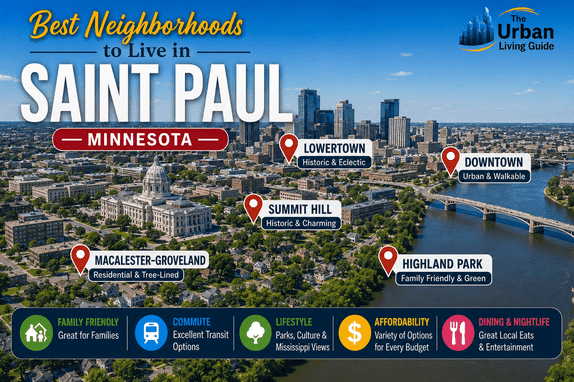
Saint Paul Neighborhoods Decoded – Historic Charm Meets Everyday Livability
Saint Paul doesn’t have the same flashy reputation as its twin across the river, but residents who’ve lived in both cities will often tell you Saint Paul wins on character. The city sits along the Mississippi River bluffs with a street grid shaped by history — Victorian rowhouses, grand cathedral parishes, and ethnic enclaves that have held together across generations. If you’re searching for where to live in Saint Paul, the answer depends heavily on what you value: walkable arts districts, affordable starter homes, top-tier school access, or proximity to the University of Minnesota and major employers like Ecolab, Securian Financial, and HealthPartners.
Unlike Minneapolis’s more uniform layout, Saint Paul’s neighborhoods each carry a distinct personality. This guide cuts through the noise to help you match the right area to your actual lifestyle and budget.
Best Areas in Saint Paul, Minnesota at a Glance
| 🏠 Best for Families | Highland Park — top schools, quiet streets, walkable commercial strip |
| 💼 Best for Young Professionals | Lowertown — arts district, light rail access, loft-style living |
| 💰 Best Affordable Area | Hamline-Midway — central location, low rents, strong community |
| 🏙️ Best Luxury Area | Summit Hill — Victorian mansions, Summit Avenue grandeur |
| 🌊 Best for Outdoor Access | West 7th — river bluff trails, close-in living, emerging scene |
📺 Watch this video to explore different neighborhoods and areas in Saint Paul before choosing where to live.
Top Neighborhoods in Saint Paul, Minnesota
1. Summit Hill – Saint Paul’s Grand Historic Address
Summit Hill runs along Summit Avenue, one of the longest stretches of intact Victorian residential architecture in the United States. The neighborhood sits above downtown Saint Paul, with Cathedral of Saint Paul marking its eastern edge and the Mississippi River gorge to the south. Many residents prefer this area because of the rare combination of architectural prestige and genuine walkability — Grand Avenue offers a mile of independent restaurants, bookshops, and boutiques steps from stately front porches.
- Housing: Primarily large Victorian and Craftsman single-family homes. Purchase prices typically range $450K–$900K+. Rental inventory is limited; 1BR apartments average $1,200–$1,500/month.
- Commute: Approximately 15–18 minutes to downtown Saint Paul via Summit or Grand Avenue. Metro Transit Route 63 runs along Grand Avenue.
- Nearby: Cathedral of Saint Paul, Macalester College (10-min walk from the western end), Mississippi River bluff trails, Grand Avenue retail strip.
Who it’s best for: Established professionals and families who want Saint Paul’s most prestigious address without leaving city limits. One thing people love about Summit Hill is that the neighborhood feels genuinely timeless — it looks almost exactly as it did a century ago.
⚠️ Drawback: Limited parking in the denser blocks near Grand Avenue. The housing stock is beautiful but old — maintenance costs on Victorian-era homes can be significant.
2. Highland Park – The Reliable Family Neighborhood
Highland Park occupies the southwest corner of Saint Paul, bounded by the Mississippi River to the south and Ford Parkway through its commercial spine. It’s the neighborhood most often recommended to families relocating to Saint Paul — strong schools, safe streets, and a walkable retail district that includes a Trader Joe’s on Ford Parkway, a Lunds & Byerlys, and enough restaurants to cover any Tuesday night. Many newcomers arriving in Saint Paul with school-age children choose Highland Park within their first month of researching.
- Housing: A mix of post-war single-family homes and newer infill construction. Purchase prices range $350K–$600K. 2BR apartments run $1,300–$1,700/month.
- Commute: About 20 minutes to downtown Saint Paul via Ford Parkway and Shepard Road. Limited direct transit — most residents commute by car.
- Nearby: Highland National Golf Course, Mississippi River bluff parkland, St. Catherine University (5-min drive), Ford Site redevelopment (new housing, park, and retail district opening 2025–2026).
Who it’s best for: Families prioritizing schools and safety above all else. If you’re relocating with school-age children, Highland Park consistently ranks among the best areas in Saint Paul for families.
⚠️ Drawback: Car dependency is real here — transit options are limited compared to more central neighborhoods, and Ford Parkway can back up during evening rush.
3. Lowertown – Saint Paul’s Creative Downtown Core
Lowertown sits at the eastern end of downtown Saint Paul, centered on Mears Park and bounded by the Green Line light rail to the south. It’s the city’s answer to Minneapolis’s North Loop — warehouse buildings converted into lofts, a thriving arts community anchored by Northern Warehouse Artists’ Cooperative on Prince Street, and CHS Field (home of the Saint Paul Saints) just blocks away. Renters often consider this area when they want downtown energy with more affordable price points than Minneapolis.
- Housing: Primarily loft apartments and condo conversions in historic warehouse buildings. 1BR rents average $1,200–$1,600/month. Ownership condos start around $200K–$350K.
- Commute: Green Line light rail connects Lowertown directly to downtown Minneapolis in approximately 30 minutes. Walking distance to most downtown Saint Paul employers.
- Nearby: Mears Park (summer concerts, farmers market), CHS Field, Union Depot transit hub, Metro State University (5-min walk).
Who it’s best for: Young professionals and remote workers who want true urban living at a lower cost than comparable Minneapolis neighborhoods. Many newcomers to the Twin Cities who work in both cities choose Lowertown for its Green Line access to both downtowns.
⚠️ Drawback: Lowertown can feel quiet — even empty — on weekday evenings and winter weekends. It thrives in warmer months but lacks the all-season density of Uptown or North Loop.
4. Hamline-Midway – Affordable, Central, and Underrated
Hamline-Midway runs along the Green Line corridor between downtown Saint Paul and the University of Minnesota, anchored by Snelling Avenue and University Avenue. It’s genuinely affordable by Twin Cities standards and sits at the geographic center of the metro — a 15-minute Green Line ride to downtown Minneapolis, a 10-minute ride to downtown Saint Paul. The neighborhood is home to Hamline University and draws a mix of students, young families, and long-time residents.
- Housing: Mostly older single-family homes and duplexes, many renter-occupied. 1BR rents average $950–$1,250/month — among the lowest in a well-connected Saint Paul neighborhood.
- Commute: Green Line at Hamline Station or Snelling Station. About 10–12 minutes to downtown Saint Paul, 15–18 minutes to downtown Minneapolis by rail.
- Nearby: Hamline University, Allianz Field (Minnesota United FC soccer, a 5-min walk from Snelling Station), Midway Shopping Center, Rosedale Center (10-min drive north).
Who it’s best for: Budget-conscious renters, students, and remote workers who want central access to the entire Twin Cities metro. For remote workers who need flexibility, Hamline-Midway’s Green Line access makes it one of the smartest low-cost locations in the region.
⚠️ Drawback: Parts of the University Avenue corridor still show the disruption from Green Line construction years — the streetscape is improving but uneven. Some blocks require careful research before leasing.
5. West 7th – Emerging, Affordable, River-Adjacent
West 7th Street (also called Fort Road) stretches southwest from downtown Saint Paul toward Fort Snelling, following the Mississippi River bluffs. It’s one of Saint Paul’s oldest residential corridors — working-class historically, increasingly attracting buyers and renters priced out of Summit Hill and Highland Park. One thing locals increasingly recommend about West 7th is the access to the river: the Lilydale Regional Park trail system and Cherokee Park bluff overlooks are within easy walking or biking distance.
- Housing: Older single-family homes, bungalows, and duplexes. Purchase prices range $250K–$425K — some of the best starter-home value in the city. 1BR rents average $900–$1,200/month.
- Commute: About 8–12 minutes to downtown Saint Paul by car or bus via West 7th Street. Metro Transit Route 54 runs frequently.
- Nearby: Xcel Energy Center (Minnesota Wild, concerts — 10-min walk from the near end), Science Museum of Minnesota, Cherokee Park bluff overlooks, Fort Snelling State Park (15-min drive).
Who it’s best for: First-time buyers and value-focused renters who still want proximity to downtown. This area works best if you’re comfortable with a neighborhood that’s in transition — the upside potential is real, but full revitalization is still in progress.
⚠️ Drawback: Commercial amenities are thinner than other neighborhoods — grocery options are limited within walking distance, and the entertainment strip on West 7th is concentrated near the arena end.
Best Neighborhoods in Saint Paul, Minnesota – Quick Comparison
| Neighborhood | Vibe | Avg. 1BR Rent | Commute to DT | Best For |
|---|---|---|---|---|
| Summit Hill | Historic / Upscale | $1,200–$1,500 | 15–18 min | Established buyers, prestige seekers |
| Highland Park | Family / Suburban | $1,300–$1,700 | 20 min | Families, school-focused movers |
| Lowertown | Urban / Creative | $1,200–$1,600 | Walking | Young professionals, arts lovers |
| Hamline-Midway | Affordable / Central | $950–$1,250 | 10–12 min | Budget renters, students |
| West 7th | Emerging / River | $900–$1,200 | 8–12 min | First-time buyers, value seekers |
Final Thoughts
The best neighborhoods in Saint Paul, Minnesota each serve a different kind of mover. Summit Hill delivers historic prestige; Highland Park wins on family livability; Lowertown is where urban energy meets lower cost; Hamline-Midway offers the most transit connectivity per dollar; and West 7th is the smart play for buyers who want value and river access before prices catch up.
If you’re weighing Saint Paul against Minneapolis, the honest comparison is this: Saint Paul gives you more space, more character, and lower cost — Minneapolis gives you more density, more nightlife, and more transit options. Many Twin Cities newcomers end up in Saint Paul and wonder why they didn’t look here first.
Frequently Asked Questions
What is the safest neighborhood in Saint Paul?
Summit Hill and Highland Park consistently report the lowest crime rates in Saint Paul. Both are predominantly owner-occupied, residential, and well-maintained. Lowertown is safe within the immediate arts district but requires more awareness after dark on peripheral blocks.
What are the best neighborhoods in Saint Paul for young professionals?
Lowertown is the top pick — urban energy, loft housing, and Green Line access to Minneapolis. Summit Hill near Grand Avenue is a strong second for those who want a more established neighborhood feel with walkable amenities.
Where should families live in Saint Paul?
Highland Park is the standard recommendation for families, with strong schools, safe streets, and the Ford Parkway retail corridor. Summit Hill near Macalester College is also excellent, particularly for families who value walkability alongside school quality.
What is the most affordable neighborhood in Saint Paul?
West 7th and Hamline-Midway offer the lowest rents in Saint Paul’s connected neighborhoods — averaging $900–$1,250/month for a one-bedroom. Both have real tradeoffs but deliver genuine value for budget-conscious renters.
Is Saint Paul a good place to live in 2026?
Yes. Saint Paul offers lower housing costs than Minneapolis, a strong job market anchored by employers like Ecolab, Securian Financial, and HealthPartners, and a city character that rewards residents who explore beyond first impressions. The Green Line has made the city far more connected to the broader Twin Cities metro than it was a decade ago.
Explore More
Planning your Saint Paul move? Here are more detailed guides from The Urban Living Guide:
- Living in Saint Paul, Minnesota
- Cost of Living in Saint Paul, Minnesota
- Best Neighborhoods in Minneapolis, Minnesota