
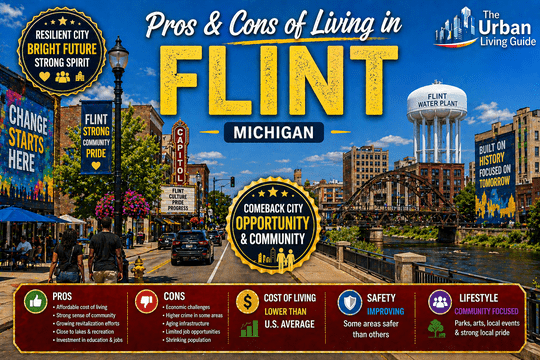
Flint Has a Reputation — But Does It Tell the Whole Story?
Mention Flint to most Americans and the water crisis comes up within seconds. It’s a narrative that has followed this Michigan city for years, shaping perceptions in ways that are sometimes fair and often incomplete. But the pros and cons of living in Flint, Michigan go well beyond a single chapter in its history.
Flint is a city actively rebuilding — with dirt-cheap housing, a tight-knit community, and a resilience that’s hard to find anywhere else. If you’re considering a move here, this is the honest, unfiltered breakdown you need.
📺 A few Flint residents have documented their daily life here in ways that might genuinely shift your perspective — worth checking out before forming an opinion.
Advantages of Living in Flint
1. Housing Costs That Are Almost Unbelievable
Flint offers some of the most affordable housing in the entire Midwest. Many residents appreciate being able to own a home — not just rent — on a modest income, something that feels increasingly rare in today’s market.
2. Strong Sense of Community and Local Pride
There’s a resilience culture in Flint that outsiders often underestimate. One thing people often mention is how tight and supportive the community feels — neighbors actually know each other, local organizations are active, and civic pride runs deep.
3. Access to Michigan’s Natural Beauty
Flint sits within easy reach of lakes, state parks, and outdoor recreation areas across mid-Michigan. For nature lovers, the surrounding landscape offers genuine outdoor value that bigger cities simply can’t match.
4. Growing Small Business and Arts Scene
Downtown Flint has seen a quiet but real revival. Independent coffee shops, local breweries, art galleries, and community markets have started reclaiming spaces that were once abandoned — a sign of grassroots momentum.
5. Low Cost of Living Across the Board
Beyond housing, everyday expenses — groceries, dining, utilities — run noticeably lower than Michigan’s bigger metros. Many residents appreciate stretching their income further without sacrificing basic quality of life.
Challenges of Living in Flint
1. The Water Infrastructure Legacy
Some newcomers find it challenging that the water crisis, while officially addressed, still casts a long shadow. Many long-term residents continue using filtered or bottled water out of habit and lingering distrust — an understandable reality that new movers should be aware of.
2. High Crime Rate
Flint consistently ranks among the higher-crime cities in Michigan. Neighborhood selection is critical — some areas are stable and community-driven, while others carry genuine safety risks that require serious consideration.
3. Economic Struggles and Job Market Limitations
The decline of the auto industry left deep economic scars. Some newcomers find it challenging that job opportunities — particularly in professional sectors — are limited compared to Detroit, Grand Rapids, or Ann Arbor.
4. Population Decline and Urban Vacancy
Decades of outmigration have left visible marks — vacant lots, abandoned buildings, and shrinking public services. The city is working to address this, but the effects of long-term population loss are hard to hide.
5. Limited Retail and Entertainment Options
For a city of its history, Flint’s retail infrastructure is thin. Major shopping, dining variety, and entertainment options often require a drive to surrounding suburbs or nearby Lansing.
Who Should Consider Living in Flint?
Flint works well for budget-conscious homebuyers looking to build equity fast, community-driven individuals who want to be part of a city’s recovery story, and remote workers whose income comes from outside the local economy. Artists and creatives drawn to affordable space and an emerging scene may also find it appealing.
Who should think twice? Job seekers in competitive professional fields, families prioritizing school quality and safety, and anyone needing robust urban amenities will likely find better options elsewhere in Michigan.
Final Verdict – Is Flint Right for You?
Flint is not for everyone — and it doesn’t pretend to be. But for the right mover, the pros and cons of living in Flint, Michigan reveal a city with genuine upside: rock-bottom costs, community depth, and a rebuilding momentum that’s easy to miss if you only read the headlines. Go in informed, choose your neighborhood carefully, and Flint might surprise you.
FAQs
Is Flint, MI safe to live in?
Safety varies significantly by neighborhood. Some areas are stable and community-oriented, while others have elevated crime rates. Thorough neighborhood research before committing is strongly recommended.
Is the water in Flint safe to drink now?
Officially, Flint’s water infrastructure has been replaced and meets safety standards. However, many residents still use filtered water as a personal precaution — a nuance worth understanding before moving.
What is the cost of living in Flint compared to Detroit?
Flint is notably more affordable than Detroit across housing, rent, and general expenses — making it one of the most budget-friendly cities in Michigan for those prioritizing low cost of living.
What salary do you need to live comfortably in Flint?
A single person can live reasonably comfortably on $40,000–$50,000 annually given Flint’s low housing and living costs — well below what comparable lifestyles require in larger Michigan cities.
Is Flint, MI good for families?
It depends heavily on priorities. Affordability is a real advantage, but public school performance and safety concerns are factors families need to weigh carefully before deciding.
Is Flint making a comeback?
Slowly but genuinely, yes. Downtown investment, community organizations, and small business growth point to real — if gradual — progress. Whether that momentum continues is something to watch.
Explore More with The Urban Living Guide
- 📍 Living in Flint, Michigan
- 💰 Cost of Living in Flint, Michigan
- 🏘️ Best Neighborhoods in Flint, Michigan