

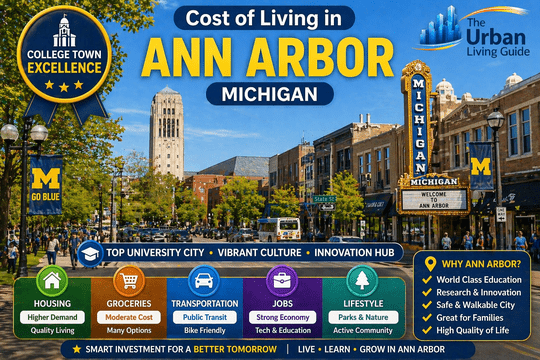
Ann Arbor occupies a unique position in Michigan’s housing landscape — it’s the state’s most expensive mid-size city, and the University of Michigan is almost entirely responsible for that. The cost of living in Ann Arbor, Michigan runs noticeably higher than Detroit, Grand Rapids, or Lansing, driven by relentless student and faculty housing demand that keeps vacancy low and rents elevated year-round. If you’re relocating here for work, academics, or lifestyle — this guide gives you the honest numbers.
The city-specific insight that shapes everything: Ann Arbor’s rental market doesn’t follow normal seasonal patterns. Most leases turn over in August around the academic calendar, which means competition spikes mid-summer and landlords hold firm on pricing. Planning your move outside that window — October through February — gives you more negotiating room.
Average Monthly Cost in Ann Arbor
Ann Arbor is a genuine budget stretch compared to most Michigan cities. Here’s a realistic monthly picture:
- Single person: Around $2,600–$3,200/month
- Couple: Typically $3,800–$5,000/month
- Family (2 adults, 2 kids): Around $5,500–$7,200/month including childcare
These figures reflect comfortable living — not luxury, not survival mode.
📹 Watch this video for an honest look at what your monthly budget actually gets you in Ann Arbor before you commit to the move.
Housing Costs in Ann Arbor
Housing is where Ann Arbor’s cost premium is most visible — and most felt. The University of Michigan campus creates a permanent demand floor that doesn’t soften even when the broader Michigan market cools. Central campus, downtown, and Old West Side neighborhoods command the highest rents, while areas further from campus like Burns Park, Pittsfield Township, and the eastern corridors offer better value for non-student residents.
- Studio: $1,100–$1,600/month
- 1-bedroom: $1,400–$1,950/month
- 2-bedroom: $1,800–$2,600/month
- 3-bedroom/family home: $2,400–$3,500/month
Many people relocating to Ann Arbor for non-university jobs are genuinely surprised by how quickly rent eats into what looked like a competitive salary offer. Locals often point out that a $75,000 salary in Ann Arbor stretches less comfortably than the same income would in Grand Rapids or Lansing — the housing cost gap is that meaningful. If you’re not tied to campus proximity, the Ypsilanti and Saline areas just outside the city offer rents 25–35% lower with reasonable commute times.
Utilities & Internet
Utility costs in Ann Arbor are close to the Michigan average — the main variable, as elsewhere in the state, is winter heating.
- Electricity + Gas + Water: Typically $140–$220/month
- Winter peak (Dec–Feb): Can reach $240–$300/month in older buildings
- Internet (Comcast/AT&T/WOW): Around $50–$80/month
- Monthly average combined: Budget $190–$290/month
Newer apartment buildings near campus tend to include some utilities in rent — worth confirming before comparing listings on price alone.
Grocery & Food Costs
Grocery costs in Ann Arbor run slightly above Michigan averages — the concentration of higher-income residents and the proximity to campus supports a premium retail mix.
- Single person: Around $300–$420/month
- Family of 4: Typically $700–$950/month
Whole Foods, Plum Market, and Trader Joe’s are well-represented here, which nudges average spend upward. Budget-conscious shoppers use Meijer and Kroger to keep costs in line. The restaurant scene is strong and diverse — a college city with 50,000+ students ensures there’s always an affordable option alongside the upscale spots. Dining out averages $15–$25 per person at a mid-range restaurant.
Transportation Costs
Ann Arbor is among Michigan’s more walkable and bikeable cities, particularly near campus. The TheRide bus system is functional, and many residents in central neighborhoods genuinely manage without a car — especially students and university employees.
- Car ownership (insurance + fuel + maintenance): $320–$540/month
- Auto insurance: $100–$160/month — lower than Detroit, competitive with Grand Rapids
- TheRide bus pass: Around $60–$70/month
- Parking (downtown/campus): $80–$180/month if applicable — a real cost many overlook
If you’re coming from a city like Chicago or DC where transit is robust, Ann Arbor’s walkability will feel familiar in the core but limited once you move further out. For families and anyone living beyond the central neighborhoods, a car remains essential.
Healthcare & Insurance
Ann Arbor benefits from world-class healthcare infrastructure — Michigan Medicine (University of Michigan Health System) is one of the top academic medical centers in the country, and that reputation attracts strong ancillary providers across the city.
- Employer-sponsored plan: Typically $150–$300/month employee contribution
- Marketplace individual plan: Around $260–$520/month
- Urgent care visit: $110–$190 without insurance
- University employee benefits: Generally above average — a real draw for UM staff
For anyone employed by the university or its health system, benefits packages tend to offset some of the city’s higher living costs.
Other Living Expenses
A few additional costs that add up quickly in Ann Arbor’s lifestyle-forward environment:
- Gym membership: $30–$70/month (campus rec facilities available to UM affiliates at lower cost)
- Childcare (per child): $1,100–$1,600/month — among Michigan’s highest, reflecting the city’s income level
- Entertainment & dining out: $150–$300/month depending on lifestyle
- Personal care & clothing: $100–$160/month
Ann Arbor’s cultural calendar is genuinely rich — Michigan Theater, the Ann Arbor Art Fair, live music, and Big Ten sports. Many events are free or low-cost, which partially offsets the city’s higher baseline expenses.
Cost Comparison — Ann Arbor vs Nearby Cities
Ann Arbor is consistently the most expensive option in the Michigan comparison set — but the gap varies by category.
- vs Detroit: Ann Arbor is 30–40% more expensive on housing; groceries and utilities are broadly similar
- vs Grand Rapids: Housing in Ann Arbor runs 25–35% higher; overall monthly cost in Ann Arbor is meaningfully more
- vs Lansing: Lansing is significantly more affordable across housing and transport; Ann Arbor offers more amenities in return
- vs Chicago: Surprisingly competitive — Ann Arbor’s housing costs approach Chicago’s mid-tier neighborhoods, without Chicago’s transit advantages
Micro insight: The Detroit-to-Ann Arbor commute (roughly 45 minutes on US-23) has made hybrid work a cost arbitrage play — some residents work Ann Arbor jobs while renting in Ypsilanti or even Detroit suburbs, saving $400–$600/month on housing.
Is Ann Arbor Expensive or Affordable?
Straightforwardly: Ann Arbor is expensive by Michigan standards, and moderately expensive by national standards. The living expenses in Ann Arbor reflect a city punching above its size — strong job market, elite university, high median income, and lifestyle amenities that most cities its size can’t match.
The cost is justified for the right profile of resident — university employees, healthcare professionals, and remote workers with strong incomes will find the quality of life genuinely excellent. For entry-level workers or single-income households, the math gets harder. Ann Arbor rewards earning power more than almost any other city in Michigan.
Who Can Afford to Live Comfortably
- Singles earning $60,000–$75,000+/year can live comfortably, with some discipline around housing choice
- Couples on combined $90,000–$120,000 can afford a solid 2-bedroom, maintain vehicles, and save meaningfully
- Families need $110,000–$140,000+ combined to cover Ann Arbor’s childcare costs, housing, and two cars without ongoing financial stress
- University of Michigan employees often benefit from housing assistance programs and above-average benefits that meaningfully offset the city’s cost premium
Who May Find Ann Arbor Expensive?
Ann Arbor’s cost pressure is concentrated but real for specific groups.
Graduate students and postdoctoral researchers face a genuine affordability squeeze — stipends and fellowship income have not kept pace with Ann Arbor’s rent increases, and many are pushed into shared housing well into their late twenties. Service industry workers and retail employees face the sharpest income-to-rent mismatch in the city — wages in those sectors don’t reflect Ann Arbor’s cost structure. And anyone moving here without a housing plan during the August lease-turnover crunch can find themselves either overpaying or scrambling — the summer rental market moves fast and rewards preparation.
FAQs
What is the cost of living in Ann Arbor, Michigan in 2026? A single person typically needs $2,600–$3,200/month for comfortable living, covering rent, groceries, transport, and utilities. Families of four should budget $5,500–$7,200/month.
Is Ann Arbor the most expensive city in Michigan? Among mid-size cities, yes — the cost of living in Ann Arbor, Michigan is consistently higher than Detroit, Grand Rapids, and Lansing, driven primarily by university-fueled housing demand.
Do I need a car to live in Ann Arbor? Not necessarily if you live near campus — Ann Arbor is walkable and bikeable in the core, and TheRide bus system is functional. For families or anyone outside central neighborhoods, a car is still the practical choice.
What salary do I need to live comfortably in Ann Arbor? Singles need roughly $60,000–$75,000/year. Couples should target $90,000–$120,000 combined. Families with children need $110,000–$140,000+ to manage housing, childcare, and vehicles without financial stress.
Is renting in Ann Arbor worth it compared to nearby cities? It depends on your reason for being there. If you’re working at UM or Michigan Medicine, the proximity premium makes sense. If your job allows flexibility, living in Ypsilanti or a Detroit suburb and commuting saves $400–$600/month on rent alone.
🔗 Explore the complete Living in Ann Arbor, Michigan guide with The Urban Living Guide