

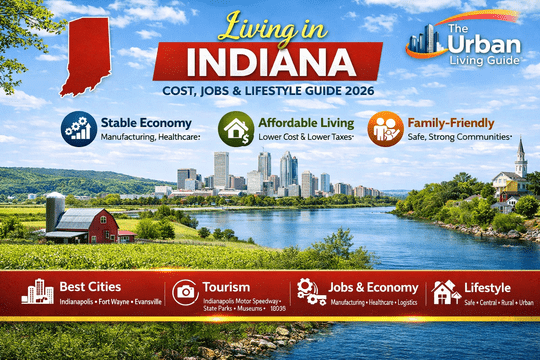
Living in Indiana: Crossroads of America, Manufacturing Resilience & Affordable Midwestern Lifestyle in 2026
Settling comfortably into Indiana in 2026 is about positioning yourself at the functional and logistical center of the Midwestern United States. Often referred to as the “Crossroads of America,” the state serves as a massive junction for national freight, manufacturing, and commerce. As a long-term local resident will tell you, the Hoosier State offers a living proposition that favors stability and purchasing power: the combination of a robust, recession-resistant manufacturing base and a cost-of-living profile that consistently outperforms national averages.
From the high-velocity urban sprawl and corporate innovation of Indianapolis to the picturesque, rolling agricultural landscapes of the Wabash River Valley and the academic influence of Bloomington, everyday life here is characterized by a strong work ethic, deep-rooted community ties, and a population of approximately 6.8 million residents.
Whether you are navigating the high-speed transit networks connecting the Midwest to the South or enjoying a weekend in the pristine Hoosier National Forest, life in Indiana offers a practical, high-value experience for families and professionals. For official administrative guidelines, state tax filings, and civic resources, residents frequently consult the Official State of Indiana Portal.
| Quick Facts Snapshot: Indiana (2026) | |
|---|---|
| Time Zone | Eastern Time Zone (ET / UTC-5, Daylight Saving UTC-4) |
| State Population | Approx. 6.8 Million (Consistent growth in central and northern suburban belts) |
| State Income Tax | Flat individual income tax rate of 3.05% (with local county options) |
| Median Home Price | $230,000 – $380,000+ (High affordability compared to regional neighbors) |
| Average Rent Range | $1,000 – $1,900+ per month (Dependent on downtown Indy vs. regional hub access) |
| Sales Tax Baseline | 7.0% state-wide base with no local sales tax additions |
What It Is Really Like to Live Here (The Macro Reality & Cultural Identity)
Living in Indiana requires mastering a lifestyle that blends Midwestern practicality with a surprisingly active cultural and sporting life. Locals quickly understand that day-to-day existence depends entirely on your specific region: the central urban corridor (Indianapolis) is a high-growth, professional-centric environment, while the northern and southern regions are deeply shaped by industrial innovation and agricultural traditions.
Unlike states with singular, homogeneous cultural identities, Indiana thrives on the tension between its historic role as an industrial heavyweight and its current identity as an emerging leader in life sciences and technical logistics. Long-term residents accept the reality of the four-season Midwestern climate and the reliance on personal vehicles, but they trade this for a cost-of-living profile that consistently allows for high-quality single-family homeownership.
Explore regional heritage and lifestyle guides via the Indiana Destination Development Corporation.
- Cultural Vibe: A powerful melting pot driven by strong basketball (Hoosier Hysteria) and auto-racing heritage, a deeply ingrained appreciation for community-scale events, and a resilient, blue-collar-to-white-collar professional evolution.
- Pace of Life: Distinctly balanced—ranging from the high-energy, stadium-filled weekends of Indianapolis to the quiet, community-focused pace of suburban and rural towns across the state’s agricultural plains.
- The Resident Trade-Off: Newcomers recognize that while the state is not a coastal tourism hub, it offers unmatched fiscal stability, a transparent business climate, and a neighborly atmosphere that makes long-term settlement highly attractive for working professionals.
Regional Diversity, Geography & Economic Zones
Because Indiana spans from the industrial dunes of Lake Michigan to the rolling hills of the Ohio River Valley, its geography encompasses starkly contrasting zones that dictate entirely separate daily living experiences.
Metropolitan Hubs & Industrial Corridors
- Central Indiana (Indianapolis/Carmel): Encompassing the state capital and its affluent northern suburbs, serving as the nerve center for healthcare administration, insurance, and professional services.
- The Northwest Industrial Zone (Lake County/Gary): Heavily integrated into the Chicago metropolitan economy, characterized by massive steel production, heavy manufacturing, and intense rail and port activity.
- Northeast Indiana (Fort Wayne): A historic and rapidly revitalizing industrial region focusing on advanced manufacturing and high-tech defense systems.
Agricultural, River & Southern Belts
- The Southern Ohio River Valley: Featuring Evansville, this region is defined by deep river-port logistics, a growing medical hub, and a slower-paced, Southern-leaning community culture.
- The Bloomington & South-Central Region: Defined by the academic influence of Indiana University, featuring lush, hilly landscapes and a burgeoning tech-startup scene.
Infrastructure, Power Grids, Water Systems & Transport Networks
Sustaining 6.8 million residents demands massive investments in highway durability, regional water management, and an integrated transit network that supports one of the nation’s most active logistics pipelines.
Water Resources & Watersheds
- River & Aquifer Management: Major access points along the Wabash, Ohio, and White rivers support municipal utilities and critical manufacturing water-cooling needs. Learn more via the Indiana Department of Environmental Management.
Power Generation & Energy Frameworks
- Diverse Grid Mix: Electrical infrastructure is managed by utilities such as Duke Energy Indiana and AES Indiana, utilizing a diverse portfolio of coal-to-gas transition generation, renewables, and nuclear integration.
Statewide Transit, Rail, Air & Port Connectivity
- Global Aviation: International and domestic travel is anchored by the Indianapolis International Airport (IND), widely regarded as a model of efficient transit design.
- Transit & Freight: IndyGo operates an expanding bus rapid transit (BRT) and local bus network in Indianapolis, while the state remains a premier national rail and highway freight corridor (linking I-65 and I-70).
Statewide Economy, Job Markets & Major Industries
Indiana maintains a powerful economic footprint, serving as a primary manufacturing and distribution nerve center for the Midwest and the country.
- Economic Powerhouse: Consistently ranking as a top-tier state for manufacturing output, cementing its role in the global supply chain.
- Dominant Sectors: Advanced automotive production, medical device/life science manufacturing, logistics, information technology, and agribusiness.
- Corporate Footprint: Headquarters for giants such as Eli Lilly and Company, Cummins Inc., Anthem, and Allison Transmission. Monitor economic development via the Indiana Economic Development Corporation.
Salary Realities Across Economic Corridors
- Metropolitan Potential: Specialized roles in pharmaceutical manufacturing, engineering, and data analysis in Indianapolis command professional salaries that frequently exceed $90,000 to $140,000+ depending on tenure and expertise.
- Regional Wage Variance: Manufacturing, logistics, and healthcare support roles in regional cities like Evansville or Fort Wayne align well with national medians, provided the significant cost-of-living advantage is factored into the calculation.
Cost of Living Realities & Housing Market Variance
Living in Indiana is defined by high financial efficiency. While prime suburban neighborhoods in Indianapolis or Bloomington see higher demand, the overall state market remains exceptionally accessible compared to any major coastal or regional neighbor.
| Expense Category | Cost Range / Index Reality |
|---|---|
| Housing (Indy vs. Rural) | $1,300–$2,200+ rent in Indy/Carmel; $800–$1,300 in regional hub cities |
| Utilities & Heating | Moderate; energy rates are stable, though winter heating requires seasonal budget prep |
| Transportation | Dependent on car ownership; low fuel taxes compared to regional states |
| Groceries & Goods | Reflects lower national medians due to regional agricultural supply chains |
State Tax Climate, Business Environment & Government Policies
Indiana operates under a robust, highly pragmatic fiscal model characterized by low taxation and a focus on keeping regulatory burdens manageable for businesses and households. Review tax compliance guidelines via the Indiana Department of Revenue.
- Tax Structure: Maintains a flat income tax rate, providing predictable, straightforward financial planning for all residents.
- Property Tax Pressures: Local school districts and municipal governments rely on property tax assessments, resulting in predictable annual obligations that are managed via constitutional caps.
Legal & Lifestyle Governance Quirks
- Driver Licensing: Legal mandates require new residents to secure an official Indiana driver’s license and transfer vehicle registrations at a Bureau of Motor Vehicles (BMV) office within 60 days.
- Open Government: Access to public agency documentation is managed through the state’s Access to Public Records Act (APRA).
Climate, Weather Extremes & Natural Geography
Indiana experiences a classic four-season humid continental climate, marked by cold, snowy winters and hot, humid summers.
- Seasonal Variations: Northern counties experience more lake-effect snow influence, while the southern regions have milder, slightly longer summers.
- Environmental Realities: Residents maintain seasonal preparedness for spring thunderstorm activity and occasional extreme temperature shifts.
- Natural Landmarks: From the sand dunes of the Indiana Dunes National Park to the rolling limestone bluffs of Southern Indiana.
Insurance Cost Realities (Disaster & Weather Risks)
- Storm Exposure: Homeowners insurance policies account for typical Midwestern severe weather patterns, including hail and wind protection.
- Flood Coverage: Low-lying properties situated near major rivers often require supplemental flood insurance underwriting to mitigate riverine flood risks.
Education Systems & Major Healthcare Networks
Access to world-class academic institutions and advanced medical complexes anchors Indiana’s institutional and intellectual prestige.
- Higher Education Framework: Home to research giants including Purdue University, Indiana University, and University of Notre Dame.
- Advanced Healthcare: Elite networks like IU Health and the Ascension St. Vincent system provide groundbreaking clinical care across the state. Review public health standards via the Indiana Department of Health.
Culture, Outdoor Recreation & Lifestyle Shifts
Daily life in Indiana spans unmatched sporting events, community-centric festivals, and pristine natural reserves.
- Outdoor Living: Hiking in Turkey Run State Park, mountain biking in Brown County, and enjoying the recreational waters of Patoka Lake.
- Arts & Entertainment: A global sports capital anchored by the Indianapolis 500, professional football and basketball franchises, and a thriving museum and gallery scene. Explore state tourism via Indiana State Parks.
Relocation & State Residency Essentials
- BMV Compliance: New residents must secure an official Indiana driver’s license and transfer vehicle registrations at a Bureau of Motor Vehicles office within 60 days of establishing permanent residency.
- Voter Registration: Eligible citizens can register to vote via the Indiana Election Division portal or at local county clerk offices.
Major Counties and Rural Living Realities in Indiana
- Marion County: The high-density urban, economic, and political nucleus of the state.
- Allen County: The massive manufacturing and commercial hub serving the northeast.
- Monroe County: The educational, intellectual, and cultural heart of the state, anchored by Bloomington.
Major Regional Hubs and Cities to Explore
Major Urban Hubs at a Glance
| City / Hub | Primary Economic Driver | Vibe & Lifestyle Profile |
|---|---|---|
| Indianapolis | Finance, Healthcare, Tech | Fast-paced, global-facing, transit-central |
| Fort Wayne | Manufacturing, Industry | Resilient, affordable, community-focused |
| Evansville | Healthcare, Logistics | Balanced, regional-hub, riverfront |
| South Bend | Higher Education | Historic, academic, revitalized |
| Bloomington | Education, Tech | Intellectual, innovative, walkable |
Detailed Breakdown of Key Regional Hubs
Indianapolis — The Crossroads Urban Engine
As the state’s sprawling economic hub, Indianapolis is defined by massive scale, diverse residential pockets, and a sports/business economy that refuses to slow down. It’s for those who want the “Big City” experience in the Midwest, with access to professional sports, healthcare, and high-end dining.
Fort Wayne — The Resilient Industrial Gateway
Fort Wayne pairs a proud manufacturing heritage with a booming regional healthcare and service campus. It offers a friendly, accessible culture with highly competitive real estate values.
Evansville — The Southern Riverfront Hub
Located on the Ohio River, Evansville pairs stunning architecture with a massive medical campus and revitalized industrial river districts. It offers a Southern-leaning culture with highly stable living costs.
South Bend — The Academic and Innovation Anchor
Famous as the home of the University of Notre Dame, South Bend combines deep collegiate history with world-class healthcare centers and universities, providing a balanced, family-friendly environment.
Bloomington — The Intellectual Enclave
Bloomington is where you go for a deep academic and tech-innovation connection. It is the pragmatic choice for those who value higher education, professional research, and a community that emphasizes culture over corporate flash.
Pros and Cons of Making Indiana Your Home
| Advantages (Pros) | Systemic Drawbacks (Cons) |
|---|---|
| One of the lowest costs of living in the U.S. | Severe, humid summer climate |
| Extremely affordable home ownership | Heavy reliance on personal motor vehicles |
| World-class central national logistics | Fewer entertainment/arts hubs vs. coastal cities |
| Flat income tax and stable business environment | Vulnerability to seasonal storms and weather events |
| Strong industrial and healthcare job base | Limited public transit outside urban centers |
Frequently Asked Questions About Living in Indiana
Is Indiana a good state to live in?
Yes, especially if you prioritize economic stability, high housing affordability, and proximity to major regional job markets in manufacturing, logistics, and healthcare.
What is the actual cost of living in Indiana?
It is remarkably low. Housing, groceries, and services are significantly cheaper than in almost any other region in the U.S., allowing for excellent purchasing power.
Which region or city is best to settle down in?
It depends on your goals: Indianapolis offers high-growth career paths, Bloomington provides an intellectual/university vibe, and smaller regional cities offer unmatched affordability for families.
Does Indiana have high taxes?
The tax burden is relatively low, featuring a flat income tax, which is a major factor in the state’s popularity for residents looking to keep more of their take-home pay.
How safe is everyday life across the state?
Safety is exceptionally high in suburban and rural Indiana, while the major urban hubs follow standard national metropolitan trends.
What industries dominate Indiana’s job market?
Advanced manufacturing, automotive production, global logistics/distribution, life sciences, and healthcare administration drive the state’s economy.
What is the weather like?
Expect four distinct seasons: hot, humid summers and cold, snowy winters, providing a true seasonal experience for those who appreciate variety.
Explore Detailed City Guides Across Indiana
At The Urban Living Guide (TULG), our core mission is to provide deeply researched regional insights and city-level navigation tools to help you evaluate your relocation options with total confidence. To discover what daily life, housing patterns, and local economies look like across our featured municipal centers throughout the Hoosier State, explore our comprehensive resident hub guides below:
- Living in Indianapolis, Indiana
- Living in Fort Wayne, Indiana
- Living in Evansville, Indiana
- Living in South Bend, Indiana
- Living in Bloomington, Indiana
Whether you are comparing career prospects in the Indianapolis tech sector or evaluating lifestyle shifts in the historic university towns, our editorial team remains dedicated to delivering research-backed, data-driven frameworks to support your relocation and residency decisions with complete clarity.