

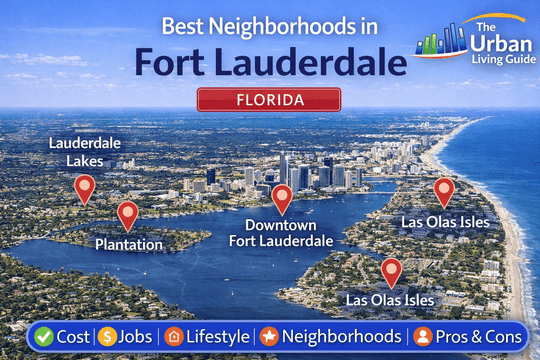
Best Neighborhoods in Fort Lauderdale, Florida: Venice of America Living, Deepwater Canals & Inland Enclaves in 2026
Covering approximately 36.3 square miles of land area along Florida’s Gold Coast, the City of Fort Lauderdale functions under the commission-manager governance of the City of Fort Lauderdale while serving as the principal county seat and economic hub of Broward County. Housing an incorporated city population of approximately 183,000 residents and anchoring a broader regional metropolitan footprint of over 1.96 million people, the “Venice of America” is globally celebrated for its intricate network of over 165 miles of inland waterways, premier yachting basins, sandy Atlantic coastline, and expanding financial services sector. Relocating across this coastal metropolis requires evaluating localized tidal elevations, maritime bridge restrictions, Atlantic hurricane patterns, and regional transportation grids overseen by the Broward Metropolitan Planning Organization.
Residential living in Greater Fort Lauderdale presents distinct lifestyle environments, separating deepwater boating isles and high-rise riverfront arts corridors from historic oak-canopied suburban cities and accessible central residential basins. Inbound movers continuously balance direct access to primary regional employment anchors—such as the Downtown Fort Lauderdale Financial District, the Cypress Creek Business Hub, aerospace operations near Fort Lauderdale-Hollywood International Airport (FLL), and marine industrial hubs around Port Everglades—against daily commute corridors.
Choosing the right neighborhood defines your daily commute along major transportation arteries like Interstate 95, Interstate 595 (Port Everglades Expressway), Florida’s Turnpike (State Road 91), US Route 1 (Federal Highway), and the Intercoastal Waterway (ICW), while shaping your family’s access to municipal services, waterfront boat ramps, and public school systems.
Watch this video to explore popular neighborhoods, coastal corridors, and residential communities across Fort Lauderdale:
Best Areas to Live in Fort Lauderdale at a Glance in 2026
| Neighborhood Name | Location | Distance from Core (Downtown) | Development Status | Transit Connectivity | Cost Level | Best Fit For |
|---|---|---|---|---|---|---|
| Coral Ridge | Northeast Coastal Corridor | Approximately 4 miles northeast | Established Waterfront Suburban | Moderate (BPT Buses, US-1, Oakland Park Blvd) | High-to-Premium | Families, Boaters & Country Club Members |
| Downtown Fort Lauderdale (Las Olas & Flagler Village) | Central Riverfront Core | 0 miles (Urban Center) | High-Density Mixed-Use Urban Core | Exceptional (Brightline, Water Taxi, I-95, Broward Blvd) | High-to-Premium | Young Professionals, Tech Workers & Creatives |
| Las Olas Isles | East Riverfront / Intracoastal | Approximately 1.5 miles east | Historic Deepwater Canal Enclave | Moderate (Automobile/Yacht-centric, Las Olas Blvd) | Ultra-Premium | Mega-Yacht Owners, Executives & Luxury Buyers |
| Plantation | Central-West Metro (Incorporated City) | Approximately 8 miles west | Established Master-Planned Suburban | High (I-595, Turnpike, University Dr) | Mid-Range | Suburban Families, Corporate Commuters & Medical Staff |
| Lauderdale Lakes | Central Inland Basin (Incorporated City) | Approximately 6 miles northwest | Established Multicultural Infill | High (BCT Transit Routes, Turnpike, Oakland Park Blvd) | Accessible / Budget-Friendly | First-Time Homebuyers, Budget Renters & Seniors |
Best Neighborhoods in Fort Lauderdale Discussed in Detail
Coral Ridge — Tree-Lined Coastal Sanctuary, Country Club Living & Boating Basins
Situated in the northeastern sector of Fort Lauderdale along the western shores of the Intracoastal Waterway, Coral Ridge is one of South Florida’s most sought-after upscale residential enclaves. Developed predominantly from the 1950s onward, the neighborhood is framed by Sunrise Boulevard to the south and Commercial Boulevard to the north. Centered around the prestigious 18-hole championship fairways of the Coral Ridge Country Club and featuring an extensive system of ocean-accessible finger canals, the community delivers a serene suburban lifestyle with rapid access to both top-rated schools and coastal beaches.
- Housing: Real estate spans restored mid-century single-story ranch homes, custom modern Mediterranean estates, dry-lot residences, and multi-million dollar deepwater waterfront homes with private yacht docks along the Middle River and canals. Single-family home prices typically range around $850,000 to $4,500,000+, while luxury condominium and townhome rentals average $2,600 to $4,500 per month.
- Safety & Crime Rate: Patrolled by the Fort Lauderdale Police Department (FLPD) District 1 Command, Coral Ridge consistently records low property and violent crime rates, supported by proactive neighborhood civic associations and regular mobile patrols.
- School District & Education Quality: Governed by Broward County Public Schools (BCPS), containing top-performing public institutions such as Bayview Elementary School (consistently rated among the highest-performing elementary schools in Florida) and Fort Lauderdale High School (featuring an authorized Cambridge AICE program), alongside premier private academies like Pine Crest School in nearby Fort Lauderdale.
- Walkability & Daily Conveniences: The central spine along US Route 1 (Federal Highway) and Oakland Park Boulevard is commercially dense, offering convenient access to the Coral Ridge Mall (featuring Target and HomeGoods), The Fresh Market, Publix, and boutique dining. Interior residential streets remain quiet and pedestrian-friendly.
- Parks & Green Spaces / Pet-Friendliness: Exceptional natural recreation anchored by the 180-acre Hugh Taylor Birch State Park (featuring freshwater lagoons, coastal hammocks, and beach access across A1A), George English Park (providing public boat ramps, kayak rentals, and tennis courts), and Bayview Park. Highly pet-friendly with walkable sidewalk grids.
- Parking & Traffic Congestion: Wide two-car residential garages, paved circular driveways, and open street parking throughout residential blocks. Commuter traffic slows along Federal Highway (US-1) and the Sunrise Boulevard Bridge during peak drive times.
- Noise Levels & Vibe: Tranquil, refined, and family-oriented, characterized by shaded palm-lined streets, quiet canal waterways, and low ambient traffic sounds.
- Medical Facilities & Hospitals: Direct 8-minute access to comprehensive emergency and specialized cardiac care at Holy Cross Health on Federal Highway and Imperial Point Medical Center (Broward Health).
- Transit Connectivity: Road travel connects quickly via US-1, Oakland Park Boulevard, and Sunrise Boulevard, providing a 10-minute drive to Downtown Fort Lauderdale and 5 minutes to the beach, supported by Broward County Transit (BCT) Route 10 and 11.
- Affordability: High-tier coastal price structure; waterfront property acquisitions carry premium valuations and mandatory flood insurance requirements, balanced by strong long-term real estate stability.
- Who It’s Best For: Families seeking premier public elementary school zoning at Bayview, avid boaters requiring dockage with quick ocean access, golf enthusiasts, and medical professionals.
- Drawbacks: High home purchase entry barriers, fixed-bridge height restrictions on certain interior canals limiting large sailboats, and peak-hour traffic along US-1.
Downtown Fort Lauderdale — High-Rise Arts Nexus, Flagler Village & Riverwalk Living
Centering along the historic banks of the New River, Downtown Fort Lauderdale is the central legal, financial, administrative, and artistic engine of Broward County. Defined by the bustling pedestrian boulevard of Las Olas Boulevard, the scenic Fort Lauderdale Riverwalk, and the trendy arts-and-technology warehouse conversion hub of Flagler Village (FATVillage), downtown delivers true vertical coastal living. Urban modernization and master planning are guided through city initiatives and the Downtown Development Authority (DDA) of Fort Lauderdale.
- Housing: Dominated by modern luxury high-rise condominium towers along the river (such as 100 Las Olas, Las Olas Grand, and Nu River Landing), converted industrial brick lofts, and contemporary podium mid-rise apartment communities in Flagler Village. Condominium purchase valuations typically range around $340,000 to $2,200,000+, while modern 1-bedroom apartment rentals average $2,150 to $3,450 per month.
- Safety & Crime Rate: Patrolled by the FLPD Central District Command and supported by downtown safety ambassadors. The Las Olas commercial strip and Riverwalk promenade maintain safe, well-illuminated pedestrian environments, though late-night property incidents and bicycle theft occur near peripheral nightlife and transit stations.
- School District & Education Quality: Governed by BCPS, containing choice public options such as Virginia Shuman Young Elementary (a recognized Montessori magnet school) and Stranahan High School, alongside higher-education campuses anchored by Florida Atlantic University (FAU) Fort Lauderdale Campus and Broward College Downtown.
- Walkability & Daily Conveniences: Outstanding walkability (Walk Score of 89-93/100). Residents comfortably walk to grocery markets including Publix Super Market at GreenWise Market and The Fresh Market, indie coffee shops in Flagler Village, live Broadway shows at the Broward Center for the Performing Arts, and the NSU Art Museum.
- Parks & Green Spaces / Pet-Friendliness: Exceptional riverfront public spaces along the linear Fort Lauderdale Riverwalk, Smoker Park, Huizenga Plaza, and Peter Feldman Park in Flagler Village. Highly pet-friendly with rooftop dog lounges across luxury residential towers.
- Parking & Traffic Congestion: Assigned garage parking spaces typically add $125 to $225 per month for apartment tenants. Street parking is strictly metered, with traffic slowdowns common on Broward Boulevard, Federal Highway, and Andrews Avenue when the New River railroad drawbridges open for freight and Brightline trains.
- Noise Levels & Vibe: Vibrant, high-energy, and cosmopolitan, filled with sidewalk dining chatter, riverboat horns, live music at outdoor venues, and active weekend art walk crowds.
- Medical Facilities & Hospitals: Direct 5-minute access to the region’s flagship Level I Trauma Center and teaching hospital at Broward Health Medical Center on South Andrews Avenue.
- Transit Connectivity: Unmatched regional transit hub centered at the Brightline Fort Lauderdale Station (providing high-speed passenger rail to Miami, West Palm Beach, and Orlando), the Fort Lauderdale Water Taxi, Broward County Transit Central Bus Terminal, and rapid vehicular on-ramps to Interstate 95 and I-595. Long-distance air travel is accessible via Fort Lauderdale-Hollywood International Airport (FLL) located just 4 miles south.
- Affordability: Mid-to-high urban price profile; competitive price-per-square-foot metrics relative to Miami high-rises are balanced by monthly HOA assessments and garage parking fees.
- Who It’s Best For: Corporate professionals, attorneys, healthcare specialists at Broward Health, tech remote workers, Brightline commuters traveling to Miami or West Palm Beach, and urbanites seeking a walkable lifestyle.
- Drawbacks: Higher residential parking costs, periodic New River railroad drawbridge delays, and weekend nightlife noise along commercial avenues.
Las Olas Isles — World-Class Yachting Enclave, Deepwater Canals & Unrestricted Ocean Access
Stretching east of Downtown Fort Lauderdale toward the Atlantic barrier island, Las Olas Isles is an internationally acclaimed luxury waterfront community composed of a series of parallel finger islands jutting into the New River Sound and the Intracoastal Waterway. Characterized by expansive deepwater canals with no fixed bridges to the ocean, private superyacht dockage, and grand multi-million dollar custom architecture, Las Olas Isles represents the pinnacle of luxury maritime living in North America. The community operates under City of Fort Lauderdale municipal administration.
- Housing: Real estate stock is exclusively composed of custom architectural mansions, modern glass waterfront estates, grand Mediterranean Revival palaces, and boutique ultra-luxury waterfront condominiums along Las Olas Boulevard and individual isles (such as Seven Isles, Idlewyld, Nurmi Isles, and Venice Isles). Single-family waterfront purchase prices typically range around $2,800,000 to $25,000,000+, while luxury residential leases average $6,500 to $18,000 per month.
- Safety & Crime Rate: Patrolled by the FLPD District 1 Command and monitored by FLPD Marine Units along the waterways, the isles maintain very low crime rates, supported by dead-end peninsula street layouts with minimal pass-through traffic and private residential surveillance networks.
- School District & Education Quality: Governed by BCPS, with students zoned to Harbordale Elementary School and Fort Lauderdale High School, alongside proximity to prestigious private college preparatory academies like Pine Crest School and St. Thomas Aquinas High School.
- Walkability & Daily Conveniences: The western end of the isles provides pedestrian and bicycle access to the upscale boutiques, sidewalk cafes, art galleries, and fine dining establishments lining Las Olas Boulevard, while daily errands are served by nearby grocers including Publix and The Fresh Market.
- Parks & Green Spaces / Pet-Friendliness: Immediate access to the oceanfront recreation at Fort Lauderdale Beach Park and the Las Olas Oceanside Park (The LOOP), featuring open event lawns, farmers’ markets, and fitness hubs, alongside boating access through the Fort Lauderdale International Boat Show epicenter at Bahia Mar. Highly pet-friendly with quiet residential cul-de-sac walking paths.
- Parking & Traffic Congestion: Expansive private multi-car motor courts, private garages, and deepwater dock moorings keep residential streets clear. Road traffic slows along Las Olas Boulevard during tourist seasons and major boating events.
- Noise Levels & Vibe: Serene, exclusive, and nautical, punctuated by gentle canal wakes, seabreeze, and quiet private evenings.
- Medical Facilities & Hospitals: Direct 8-to-10 minute vehicular access to emergency trauma care at Broward Health Medical Center on Andrews Avenue.
- Transit Connectivity: Road travel via Las Olas Boulevard connects west into Downtown and east to State Road A1A; waterway transit is widely utilized via private vessels and the Fort Lauderdale Water Taxi network.
- Affordability: Ultra-premium price structure across property valuations, ad valorem taxes, private dock maintenance, and windstorm/flood insurance premiums.
- Who It’s Best For: Superyacht and sailboat owners requiring deepwater dockage with zero fixed bridge clearances to the Atlantic, high-net-worth executives, global investors, and luxury homebuyers.
- Drawbacks: High capital entry barrier for homeownership, mandatory coastal flood insurance requirements across all canal properties, and seasonal King Tide street flooding on low-lying isles.
Plantation — Established Master-Planned Suburbia, Corporate Campuses & Canopy Trees
Situated in central-western Broward County just west of Florida’s Turnpike, the incorporated municipality of Plantation (named after the historic Everglades plantation company) is celebrated for its lush urban tree canopy, expansive park systems, and balanced suburban lifestyle. Governed under its own municipal charter via the City of Plantation Official Portal, the city balances established master-planned residential communities (such as Plantation Acres, Central Park, and Jacaranda) with major corporate business headquarters along University Drive and Pine Island Road.
- Housing: Real estate spans classic 1970s and 1980s single-story CBS ranch-style single-family homes on spacious half-acre lots, custom equestrian properties in Plantation Acres, gated golf villas in Plantation Preserve, and modern garden-style apartment communities. Single-family purchase prices typically range around $440,000 to $920,000, while rental apartments average $1,750 to $2,800 per month.
- Safety & Crime Rate: Protected by the dedicated Plantation Police Department, the city consistently maintains violent and property crime rates below county benchmarks, supported by responsive municipal emergency dispatch and active neighborhood watch associations.
- School District & Education Quality: Governed by BCPS, containing top-rated public options such as Central Park Elementary, Plantation High School (featuring International Baccalaureate programming), and premier private institutions like American Heritage School (nationally recognized for STEM and National Merit scholars).
- Walkability & Daily Conveniences: While residential tracts are automobile-dependent, commercial town centers like Plantation Walk and The Fountains along University Drive provide walkable open-air retail, grocers like Publix and Whole Foods Market, and casual dining.
- Parks & Green Spaces / Pet-Friendliness: Exceptional municipal recreation managed by the city, including the 90-acre Central Park (featuring Olympic swimming complexes, multi-sport fields, and roller hockey rinks), Plantation Preserve Golf Course & Clubhouse (featuring public walking trails and an Audubon bird sanctuary), and the Happy Tails Dog Park.
- Parking & Traffic Congestion: Wide two-car residential garages, large private driveways, and ample open parking across shopping plazas. Commuter traffic slows along Interstate 595, University Drive, and Pine Island Road during morning and evening rush hours.
- Noise Levels & Vibe: Serene, grounded, and family-oriented, characterized by birdsong, tree-canopied streets, and quiet residential evenings.
- Medical Facilities & Hospitals: Direct emergency medical coverage provided within municipal borders by HCA Florida Westside Hospital on West Broward Boulevard.
- Transit Connectivity: Unmatched highway connectivity at the crossroads of Interstate 595, Florida’s Turnpike, State Road 84, and Interstate 75, offering a 12-minute drive to Downtown Fort Lauderdale and 15 minutes to FLL Airport.
- Affordability: Balanced mid-range cost tier; delivers substantially larger interior square footage, private yards with pools, and established tree canopy per dollar compared to eastern coastal enclaves.
- Who It’s Best For: Growing families prioritizing school quality, corporate employees working at regional business headquarters (American Express, DHL, Magic Leap), and buyers seeking spacious suburban properties.
- Drawbacks: Heavy rush-hour traffic along I-595 heading east toward the coast, automobile dependence for daily errands, and greater distance from Atlantic coastal beaches.
Lauderdale Lakes — Central Inland Basin, Diverse Heritage & Budget-Conscious Living
Covering approximately 3.6 square miles in the central urban basin of Broward County just northwest of Downtown Fort Lauderdale, the incorporated municipality of Lauderdale Lakes (known as the “We Care City”) is one of the region’s most culturally diverse and budget-accessible communities. Governed through the City of Lauderdale Lakes Official Website, the city is celebrated for its strong Caribbean-American cultural presence, active senior residential communities, and affordable single-family starter subdivisions along Oakland Park Boulevard and State Road 7 (US-441).
- Housing: Real estate inventory consists of established 1960s–1970s single-story concrete block ranch starter homes on generous lot sizes, multi-family garden condominiums, active 55+ senior housing communities, and value-oriented rental apartments. Single-family purchase prices typically range around $260,000 to $420,000, while rental apartments average $1,350 to $1,950 per month.
- Safety & Crime Rate: Patrolled by the Broward County Sheriff’s Office (BSO) District 4 Substation. While property crime rates are moderate near commercial corridors along State Road 7, interior residential blocks maintain stable, tight-knit community networks.
- School District & Education Quality: Governed by BCPS, containing neighborhood institutions such as Oriole Elementary School, Lauderdale Lakes Middle School, and nearby Boyd H. Anderson High School (offering an International Baccalaureate Magnet program).
- Walkability & Daily Conveniences: Moderate pedestrian walkability along commercial corridors on Oakland Park Boulevard and US-441, home to authentic Caribbean supermarkets, Jamaican bakeries, international grocers, and community retail centers.
- Parks & Green Spaces / Pet-Friendliness: Municipal recreation is anchored by the Vincent Torres Memorial Park (featuring multi-sport gymnasiums, swimming pools, youth sports pavilions, and walking tracks), Canal Pointe Park, and Otis Wallace Park.
- Parking & Traffic Congestion: Plentiful private residential driveway and open street parking. Easy on-ramps provide quick access to Florida’s Turnpike (Commercial and Sunrise Blvd exits) and State Road 7, allowing straightforward commuting across Broward County.
- Noise Levels & Vibe: Community-centered, multicultural, and lively, shifting from active daytime commercial business avenues to quiet residential evenings in established subdivisions.
- Medical Facilities & Hospitals: Direct emergency medical coverage provided within municipal borders by HCA Florida Woodmont Hospital on University Drive and Florida Medical Center on Oakland Park Boulevard.
- Transit Connectivity: High-frequency public transit provided by Broward County Transit (BCT Routes 18, 19, 72, and 81) and the Lauderdale Lakes Community Bus Shuttle connecting directly to regional commercial and medical hubs.
- Affordability: Greater Fort Lauderdale’s most accessible entry-level homeownership and rental price tier, offering lower purchase barriers and manageable monthly living overhead.
- Who It’s Best For: First-time homebuyers, budget-conscious renters, real estate investors, retirees, and commuters seeking central Broward County access at attainable price points.
- Drawbacks: Pockets of higher property crime near commercial strips, variable public school test ratings across individual campuses, and older residential housing stock requiring renovation.
Comprehensive Neighborhood Pros and Cons Comparison
| Neighborhood | Core Advantages (Pros) | Core Limitations (Cons) |
|---|---|---|
| Coral Ridge | Top-rated Bayview Elementary zoning; ocean-accessible canal boating docks; country club golf amenities; low crime rates. | High single-family purchase pricing; fixed-bridge height limits on interior canals; peak-hour traffic on US-1. |
| Downtown Fort Lauderdale | Direct Brightline high-speed passenger rail; walkable dining on Las Olas and Riverwalk; proximity to Broward Center for Performing Arts. | Elevated monthly apartment parking fees; New River railroad drawbridge delays; weekend nightlife street noise. |
| Las Olas Isles | Deepwater canals with zero fixed bridges to the ocean; multi-million dollar custom estates; walking distance to Fort Lauderdale Beach. | Ultra-premium real estate valuations; high windstorm and flood insurance premiums; seasonal King Tide road flooding. |
| Plantation | Lush tree canopies and large half-acre lot sizes; premier American Heritage School; central highway crossroads (I-595, Turnpike); 90-acre Central Park. | Heavy peak-hour commuter congestion along I-595; automobile dependence for daily errands; 8-mile distance to coastal beaches. |
| Lauderdale Lakes | Greater Fort Lauderdale’s most accessible entry-level home and rental prices; central Broward County positioning; diverse community culture. | Pockets of elevated property crime; variable public school ratings; older housing stock requiring renovation. |
How You Decide Which Neighborhood Is Best For You
Selecting your ideal neighborhood in Greater Fort Lauderdale requires balancing your gross household finances with daily workplace destinations, lifestyle preferences, and coastal flood zone resilience. Because Fort Lauderdale is characterized by natural waterways, Intracoastal channels, and regional expressways, your chosen location dictates whether your daily commute relies on east-west arterial highways like I-595 and Oakland Park Boulevard or on direct high-speed passenger rail via the Brightline Fort Lauderdale Station. Marine industry executives working near Port Everglades, corporate professionals in Downtown, and healthcare workers at Broward Health Medical Center should prioritize close-in eastern neighborhoods like Coral Ridge, Downtown, or Las Olas Isles to eliminate daily cross-county highway delays.
Beyond transportation corridors, evaluate essential municipal utility and environmental realities. South Florida experiences high summer electricity demands due to air conditioning usage during extended heat waves exceeding 90 degrees Fahrenheit, making utility reliability through Florida Power & Light (FPL) and municipal water services an important factor. In addition, prospective homebuyers evaluating waterfront properties in enclaves like Las Olas Isles or Coral Ridge must evaluate FEMA flood zone designations (Flood Zone X vs. AE/VE), sea wall maintenance conditions, and coastal windstorm insurance premiums. Prior to executing a residential lease or property closing, verify high-speed fiber broadband availability (such as AT&T Fiber or Xfinity Gigabit) and check Broward County school assignment boundaries.
Frequently Asked Questions About Fort Lauderdale Neighborhoods
Which neighborhood in Fort Lauderdale is considered best for families with school-age children?
Coral Ridge and Plantation are widely regarded as the premier family communities in Greater Fort Lauderdale. Coral Ridge offers access to the top-performing Bayview Elementary School alongside safe, tree-lined residential streets. Plantation provides spacious single-family homes with large yards, top-rated private institutions like American Heritage School, and expansive community parks like Central Park.
What is the most walkable neighborhood in Fort Lauderdale where you can live without a car?
Downtown Fort Lauderdale (including the Las Olas Riverwalk and Flagler Village arts districts) offers the highest walkability in Broward County, boasting an 89+ Walk Score. Residents can complete all daily errands on foot, walk to grocery markets like Publix and GreenWise Market, access restaurants and cultural venues, and utilize Brightline high-speed rail and the Fort Lauderdale Water Taxi for regional transit.
What are the safest residential neighborhoods to live in within Fort Lauderdale?
Coral Ridge, Las Olas Isles, and Plantation consistently report the lowest violent and property crime rates in the metropolitan area. Las Olas Isles benefits from isolated peninsula layouts with minimal pass-through traffic, while Coral Ridge and Plantation maintain active community watch programs and dedicated police patrols.
What are the most affordable neighborhoods for homebuyers and renters in Greater Fort Lauderdale?
Lauderdale Lakes and surrounding central inland communities provide the most budget-friendly housing opportunities in the area. In Lauderdale Lakes, buyers and renters can secure single-family starter homes and garden condominiums at price points significantly lower than eastern coastal enclaves or western master-planned developments.
How bad is traffic congestion when commuting across Fort Lauderdale?
Commuting along Interstate 95 or Interstate 595 during peak morning and evening rush hours typically takes between 25 and 45 minutes across Broward County. In addition, surface street traffic near Downtown Fort Lauderdale can experience brief delays when the New River railroad drawbridges lower for Brightline trains or when coastal bascule bridges open for marine traffic.
Do all waterfront homes in Fort Lauderdale have ocean access without fixed bridges?
No, ocean accessibility varies depending on canal location. Las Olas Isles is world-famous for having zero fixed bridge restrictions between its deepwater canals and the Atlantic Ocean via Port Everglades, making it ideal for mega-yachts and sailboats. Conversely, certain interior canals in Coral Ridge and inland waterways have fixed bridge height limits that accommodate only lower-profile powerboats.
Which Fort Lauderdale neighborhood is best for healthcare professionals working at Broward Health?
Downtown Fort Lauderdale, Rio Vista, and Flagler Village provide the fastest and most convenient commutes to Broward Health Medical Center, allowing physicians, nurses, and medical fellows to reach the hospital campus within a 3-to-7 minute drive, bike ride, or walk down South Andrews Avenue.
Know More About the City
The Urban Living Guide creates deeply researched, practical, and informative city relocation resources designed to help individuals, working professionals, and families navigate complex urban landscapes. By analyzing municipal infrastructure, hyper-local zoning patterns, commuter realities, and housing markets, our guides provide actionable insights so you can make confident, data-backed decisions when moving to major metropolitan areas.
Explore our comprehensive guides to the Fort Lauderdale metropolitan region:
- Living in Fort Lauderdale, Florida
- Cost of Living in Fort Lauderdale, Florida
- Pros and Cons of Living in Fort Lauderdale, Florida
- Moving to Fort Lauderdale, Florida
Follow The Urban Living Guide for ongoing regional insights, neighborhood developments, and expert local coverage across Greater Fort Lauderdale and Florida’s Gold Coast.