

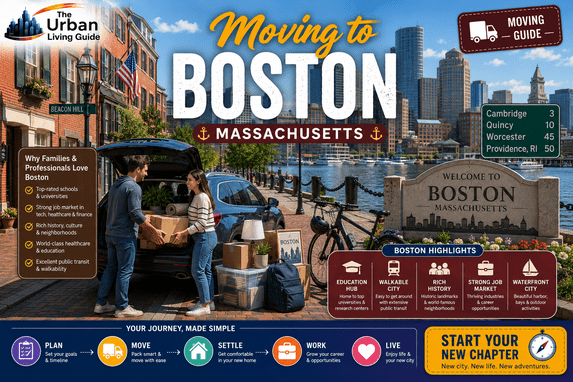
Moving to Boston, Is It Expensive, Competitive, and Completely Worth It – Your 2026 Relocation Guide
Let’s be direct about one thing: moving to Boston is not for the financially unprepared. This city is among the most expensive rental markets in the entire United States — sitting just behind New York City and San Francisco in terms of housing costs. But if your career, education, or life goals are pointing you here, Boston delivers something no other American city quite replicates. It is a city where world-class hospitals, elite universities, a booming biotech corridor, and centuries of American history all exist within a walkable, transit-connected urban core. People move here for a reason — and most of them stay far longer than they planned.
The median home sale price in Boston hit $825,000 in January 2026, and a one-bedroom apartment now averages $3,417 per month. Those numbers are real, and your relocation budget needs to absorb them before you book the moving truck. The good news is that once you understand how this city works — its lease cycles, its neighborhoods, its transit grid — settling in becomes far more manageable than the sticker shock suggests.
Watch this video by a popular local vlogger to experience Boston’s city vibes more closely before your move.
Moving to Boston, Massachusetts – Where Are You Moving From?
Your relocation experience in Boston changes significantly depending on where you’re starting. Someone driving up from Providence with a two-bedroom apartment’s worth of furniture has a very different challenge than someone shipping everything cross-country from Phoenix. Distance shapes cost, logistics, and your adjustment timeline — so it helps to be clear-eyed about what your specific move involves.
-
- Same-State Move (within Massachusetts): Easiest on logistics. If you’re coming from Worcester, Springfield, or the suburbs, a local moving company can typically handle everything in a single day. Budget $400–$900 for a professional crew. The biggest variable is parking access at your Boston destination — always check for city-required moving permits in advance.
- Interstate Move (Northeast corridor — NY, CT, RI, NH): Mid-range complexity. Most movers complete this in one day with a medium truck. Budget $1,200–$2,500 depending on volume. Be very specific with your moving company about Boston’s narrow streets and September 1st availability — they book up months in advance.
- Long-Distance or Cross-Country Move: This is where planning becomes critical. Full-service movers from California or Texas can run $4,000–$9,000+. Consider what’s worth shipping versus selling and replacing. Temporary housing in Boston – think Extended Stay America or a furnished Airbnb — may be necessary for the first two to four weeks while you finalize your lease.
If you’re moving from a smaller city or town, the density of Boston’s neighborhoods can feel jarring at first. Coming from a larger metro like Chicago or LA? You’ll adjust faster than you think — though the winter will still catch you off guard.
🎯 Who Should Move to Boston?
Boston is best suited for people who are moving for the specific opportunities the city offers rather than simply looking for a large metro area. As one of the world’s leading centers for healthcare, biotechnology, higher education, research, and technology, Boston attracts ambitious professionals, students, and families seeking long-term career and educational advantages. While the cost of living can be high, many residents consider the access to top employers, universities, and cultural institutions well worth the investment.
-
- Ideal for healthcare, biotech, life sciences, and technology professionals
- Home to major employers and institutions including Massachusetts General Hospital, Brigham and Women’s Hospital, and Dana-Farber Cancer Institute
- Strong opportunities within the Kendall Square innovation and startup ecosystem
- Excellent choice for graduate students, researchers, academics, and postdoctoral professionals
- Home to world-renowned universities including Harvard, MIT, Boston University, and Northeastern University
- Appeals to young professionals who value walkability, public transit, networking, and career growth
- Attractive for families seeking strong schools and established communities
- Popular neighborhoods for families include Jamaica Plain and West Roxbury, while nearby suburbs such as Newton, Brookline, and Lexington remain highly desirable
⚠️ Who May Struggle in Boston?
Boston offers tremendous opportunities, but it is not the right fit for everyone. The city’s high housing costs, limited parking, and challenging winters can create obstacles for newcomers who are not prepared for them. Understanding these realities before moving can help you avoid costly surprises and determine whether Boston aligns with your budget and lifestyle.
-
- People on tight budgets may find Boston’s housing costs difficult to manage
- Renting often requires significant upfront expenses, including first month’s rent, last month’s rent, a security deposit, and sometimes a broker fee
- New residents can face move-in costs ranging from $9,000 to $12,000 for higher-priced apartments
- Drivers may struggle with limited parking availability and expensive garage fees
- Residential parking permits are often required in many neighborhoods
- Boston’s historic street layout can make daily driving more frustrating than in newer cities
- Winters can be challenging, with annual snowfall typically ranging from 43 to 49 inches
- Major snowstorms can occasionally bring significant disruptions during the winter season
- Remote workers who do not need daily access to Boston may find nearby cities such as Worcester or Lowell more affordable alternatives
Moving Process & Transportation Planning
Boston has one quirk that no other major American city has: September 1st is a city-wide moving day. Approximately 70% of Boston’s rental leases expire on August 31st, driven by the academic calendar of dozens of universities. The result is that early September is simultaneously the most expensive, most chaotic, and most availability-constrained moving window in the city. Moving companies book up months in advance. Truck rental availability collapses. If you have any flexibility in your timeline, avoid this window completely. The sweet spot for smoother, cheaper Boston moves is October through April.
-
- Local Boston moves: $350–$900 for a one to two bedroom with a two-person crew
- Interstate moves from nearby states: $1,200–$3,500 depending on distance and volume
- Cross-country moves: $4,000–$9,500+ with full-service movers
- Truck rental: 16-foot trucks run $150–$250/day locally; book at least 6–8 weeks ahead for September
- Moving permits: Required for most Boston streets — file with the Boston Transportation Department at least 72 hours in advance, free of charge
- MBTA monthly pass: $90/month covering bus, subway, and commuter ferry — skip the car if you can
The MBTA is currently undergoing a $9.6 billion capital improvement program, with a new digital signal system for the Red and Orange Lines expected to eliminate up to 70% of current delay points by end of 2026. Public transit is genuinely getting better here.
Housing Strategy Before and After Moving
The Boston housing market has effectively eliminated the starter home segment. By 2025, fewer than three municipalities in Greater Boston had median single-family prices below $500,000. For most people arriving in Boston, renting is the practical starting point — and even renting requires serious financial preparation. The standard Boston lease requires first month, last month, and a security deposit upfront, plus a broker’s fee of up to one full month’s rent. On a $3,000/month apartment, that means $9,000–$12,000 before you’ve turned on a single light switch.
-
- Arrive with a short-term rental buffer: Book a furnished Airbnb or Extended Stay America for two to four weeks. This gives you time to tour apartments in person before signing anything.
- Avoid signing leases sight-unseen: Boston has a well-documented rental scam problem. If you cannot tour in person, use a licensed local broker with verifiable reviews.
- Neighborhood research matters enormously: South Boston appeals to young professionals for its waterfront energy. Jamaica Plain offers more diversity and a lower price floor. Charlestown combines historic character with family appeal. East Boston — directly across the harbor via Blue Line — is increasingly popular with buyers due to its multi-family housing stock and relative affordability.
- Timing your lease to avoid September: If your employer gives you start date flexibility, a November or January move-in can save you $200–$400/month on the same unit.
📦 Storage & Setup Essentials
Moving to Boston often requires extra planning because many apartments are located in triple-decker homes, historic buildings, and older residential neighborhoods where storage space can be limited. New residents are often surprised to find that some units have smaller rooms, narrow staircases, or limited closet space compared to newer developments in other cities.
-
- Public Storage and CubeSmart offer storage options throughout Boston and nearby suburbs
- Storage units can fill quickly during the busy September moving season
- Booking storage 6–8 weeks in advance is recommended for summer and fall moves
- Eversource provides electricity and gas service across much of the Greater Boston area
- Eligible households may qualify for seasonal energy-saving programs and utility discounts
- Internet service is commonly available through Comcast Xfinity and RCN/Astound
- Typical internet costs range from $60–$100 per month
- Most utility services can be activated within a few days of move-in
- Scheduling internet installation before arrival can help avoid delays during your first week
A little preparation before moving day can make settling into Boston significantly easier, especially during the city’s busiest relocation periods.
First Few Weeks After Moving — The Reality Check
Most people who move to Boston describe the first month as a mix of genuine excitement and quiet financial dread. The city delivers — the restaurant scene, the walkability, the career energy, the cultural depth — but the cost reality lands fast. Your commute will probably work better than expected (the MBTA, for all its delays, covers most of the city well), but your grocery bill, your restaurant tabs, and the sheer weight of that $9,000+ move-in cost will hit simultaneously. Give yourself a 90-day adjustment window before drawing conclusions.
- Commute realities: The Red, Green, Orange, and Blue Lines cover most neighborhoods. Rush hour delays are real but improving. Budget 30–50 minutes for most cross-city trips.
- Winter preparation: Buy quality winter boots and a serious coat before November. This is not optional in Boston.
- The ‘Boston left’: Drivers here turn left at intersections before oncoming traffic moves. It’s technically illegal and universally practiced. Adjust your driving expectations.
- Community adjustment: Boston neighborhoods have genuine local identity. Give yourself time to find yours.
📌 Things to Know Before Moving
Boston has a few quirks that often catch newcomers off guard. While the city offers excellent career opportunities and public services, understanding local regulations, transportation realities, and everyday costs can make your transition much smoother.
- Massachusetts does not charge sales tax on groceries or clothing purchases under $175
- New residents must convert their out-of-state driver’s license to a Massachusetts driver’s license within 30 days of establishing residency
- The current driver’s license conversion fee is approximately $115
- Vehicle registration typically requires proof of Massachusetts auto insurance
- Residents with heat pump systems may qualify for seasonal utility discount programs through their energy provider
- Parking can be limited and expensive in many neighborhoods, so it should be included in your monthly budget from the start
- Public transportation is often more practical than driving for many Boston residents
- Winter weather preparation is essential, especially for those relocating from warmer climates
Understanding these local requirements and costs ahead of time can help you avoid unexpected expenses and settle into Boston more confidently.
🍁 Local Insights & Lifestyle Feel
Boston offers a lifestyle that feels distinctly different from most American cities. The changing seasons play a major role in daily life, with spring walks along the Charles River Esplanade, colorful autumn scenery around Boston Common, and a summer calendar filled with festivals, outdoor concerts, and waterfront events. Residents tend to embrace the city’s history, traditions, and strong sense of community.
-
- Spring and fall are widely considered the most beautiful times of the year
- The Charles River Esplanade and Boston Common are popular gathering places for residents
- Summer brings outdoor concerts, festivals, and the famous Esplanade Fourth of July Celebration
- Sports culture is deeply rooted in the city, with passionate support for the Boston Celtics, Boston Bruins, Boston Red Sox, and New England Patriots
- Neighborhoods such as the South End, Seaport District, and East Cambridge are known for their vibrant dining scenes
- The city is highly walkable, and many residents rely on public transit rather than owning a car
- Historic architecture, universities, and cultural institutions contribute to Boston’s unique atmosphere
For many residents, Boston’s blend of history, walkability, sports culture, seasonal beauty, and urban energy is what makes the city such a rewarding place to call home.
Quick Moving Checklist
Getting organized before your Boston move will save you real money and serious stress. The September 1st phenomenon alone means that procrastinating on logistics can cost you hundreds of dollars in last-minute truck rentals or moving company premiums.
30 Days Before:
-
- Research neighborhoods and lock in your target area
- Book your moving company or truck rental — do NOT wait if moving July–September
- Apply for Boston street moving permit (free, via Boston Transportation Dept)
- Begin apartment search and schedule in-person tours
- Book short-term furnished housing for arrival buffer
- Start decluttering — Boston apartments are smaller than most markets
- Notify your current utility providers of move-out date
1 Week Before:
-
- Confirm moving company booking and get written confirmation
- Pack non-essentials and label boxes by room
- Transfer financial accounts to Massachusetts-accessible branches
- Contact Eversource to set up electricity and gas service
- Schedule internet installation (Comcast Xfinity or RCN) for move-in week
- Prepare $9,000–$12,000 in liquid funds for move-in costs
Moving Day:
-
- Confirm parking permit is posted
- Do a final walkthrough of old residence and photograph any damage
- Verify all utilities are active before movers leave
- Get building super or landlord contact info immediately
- Locate nearest MBTA stop and test your commute route
✅ Final Verdict: Should You Move to Boston in 2026?
Boston is one of the most rewarding cities in the United States for people who have a clear reason for being there. Whether you’re pursuing opportunities in healthcare, biotechnology, higher education, research, or technology, the city provides access to world-class institutions, strong career pathways, and a highly educated professional network. However, these benefits come with some of the nation’s highest housing and living costs.
-
- Excellent opportunities in healthcare, biotech, technology, and research
- Home to globally recognized institutions such as Harvard University, MIT, and Massachusetts General Hospital
- Strong public transit, walkability, and historic urban character
- High housing costs and significant upfront moving expenses
- Challenging winters and limited parking in many neighborhoods
- Best suited for those with a stable income, job offer, or educational opportunity
For many residents, Boston’s combination of career access, academic excellence, cultural richness, and long-term growth potential makes the investment worthwhile. Those who arrive with a solid financial plan and realistic expectations often find Boston to be one of the most fulfilling places to build a career and future.
FAQs — Moving to Boston, Massachusetts
How much does it cost to move to Boston?
Plan for $9,000–$12,000 in move-in costs for a standard rental (first, last, security, broker fee). Moving truck or professional movers add $400–$9,000 depending on distance.
What is the average rent in Boston in 2026?
A one-bedroom apartment averages $3,417/month. Studios run around $2,892 and two-bedrooms around $4,268. Prices vary significantly by neighborhood.
Is public transportation reliable in Boston?
The MBTA covers most of the city adequately. Delays occur, especially on older Green Line sections, but a $9.6 billion capital upgrade is underway. Most residents commute without a car.
When is the worst time to move to Boston?
August and early September. About 70% of leases turn over on September 1st, creating extreme competition for movers, trucks, and apartments. October through April is significantly easier.
Is Boston a good city for remote workers?
Boston is excellent for remote workers who want urban access — but financially demanding. Many remote workers choose nearby Worcester or Lowell for significantly lower housing costs with commuter rail access to Boston when needed.
Helpful Local Resources Before Moving
Before your move, spending time with Boston’s official resources will save you from avoidable surprises — especially around parking permits, utility enrollment, and transit planning. These are the sources locals and experienced relocators actually use:
- City of Boston Official Website – Moving permits, resident parking, trash pickup schedules, and new resident registration all start here.
- MBTA – Plan your commute, buy monthly passes, and check the real-time status of capital improvement projects before your arrival.
- Eversource Energy — eversource.com: Start electricity and gas service and enroll in the new seasonal heat pump discount program (saves average $540/winter).
- Massachusetts RMV — mass.gov/rmv: New residents have 30 days to convert their driver’s license. The RMV portal handles scheduling and documentation requirements.
Explore More With The Urban Living Guide
If you want to dig deeper into what daily life in Boston actually looks like, these guides cover the city from every angle that matters to someone planning a real move:
- Living in Boston, Massachusetts
- Cost of Living in Boston, Massachusetts
- Pros and Cons of Living in Boston, Massachusetts
- Best Neighborhoods in Boston, Massachusetts