

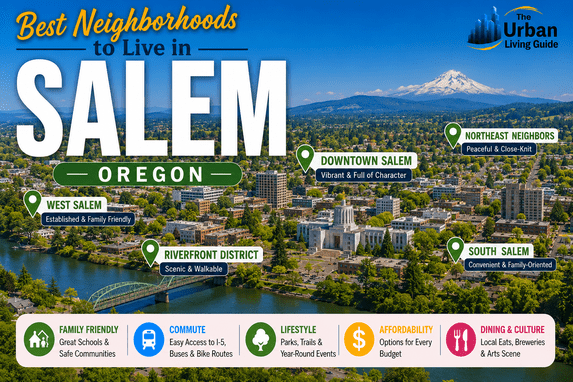
Best Neighborhoods in Salem, Oregon – State Capital Living, Willamette Valley Roots, and Real Value (2026)
Salem gets overlooked because it sits between Portland (47 miles north) and Eugene (64 miles south) — but that’s exactly what makes it worth considering. As Oregon’s state capital with a population of roughly 175,000, Salem’s economy is anchored by state government, Salem Health, Chemeketa Community College, Willamette University, and a significant food processing and agriculture sector tied to the Willamette Valley. Home prices run 35–45% below Portland for comparable quality, and the city’s improving downtown and strong school options make it one of Oregon’s best-value mid-size cities in 2026. The best neighborhoods in Salem, Oregon serve everyone from state employees to families to budget-conscious buyers priced out of the Portland metro.
Best Areas in Salem, Oregon at a Glance
| 🏠 Best for Families | South Salem — top schools, newer homes, quiet streets |
| 💼 Best for Young Professionals | Downtown Salem — walkable, state government access, improving scene |
| 💰 Best Affordable Area | West Salem — across the bridge, competitive prices, good connectivity |
| 🏙️ Best Luxury Area | South Salem Hills — wooded lots, valley views, executive homes |
| 🌿 Best for Outdoor Access | Keizer / Riverfront — Willamette River access, trail systems |
📺 Watch this video to explore different neighborhoods and areas in Salem before choosing where to live.
Top Neighborhoods in Salem, Oregon
1. Downtown Salem – The Capital Core Rebuilding Its Identity
Downtown Salem centers on Court Street and Commercial Street SE, within walking distance of the Oregon State Capitol, Willamette University, and the revitalized Riverfront Park along the Willamette. The Salem Saturday Market and a growing independent dining scene along Liberty Street signal a downtown genuinely improving after years of stagnation. For anyone working in state government or Willamette University, the walk-to-work math here is undeniable.
- Housing: Apartments, condos, and historic row conversions. 1BR rents average $1,100–$1,500/month. Condos from $220K–$400K.
- Commute: Walking distance to Oregon State Capitol and Willamette University. About 50–60 minutes to Portland via I-5 off-peak.
- Nearby: Oregon State Capitol, Willamette University, Riverfront Park, Salem Saturday Market, Hallie Ford Museum of Art.
Who it’s best for: State employees, Willamette University staff, and remote workers who want Salem’s most walkable urban option. Many newcomers arriving for state agency roles choose downtown to avoid a car commute entirely.
⚠️ Drawback: Downtown Salem still has visible recovery work ahead — some blocks feel underdeveloped. Evening activity outside the market season is limited.
2. South Salem – The Family Benchmark
South Salem stretches along Commercial Street SE south toward Kuebler Boulevard, a collection of established and newer residential subdivisions feeding into Salem-Keizer School District’s strongest schools — South Salem High School and Sprague High School both draw strong reputations. It’s the neighborhood most consistently recommended to families relocating for Salem Health or state government positions.
- Housing: Mix of 1970s–1990s homes and newer construction. Purchase prices range $340K–$580K. 2BR rents average $1,400–$1,800/month.
- Commute: About 15–20 minutes to downtown Salem. 55–65 minutes to Portland via I-5.
- Nearby: Bush’s Pasture Park (rose garden, trails — 10-min drive), Salem Golf Club, Pringle Creek trail, South Salem retail corridor on Commercial Street.
Who it’s best for: Families prioritizing school quality and suburban stability. South Salem is the standard answer when people ask about the best areas in Salem, Oregon for raising kids.
⚠️ Drawback: Car dependency is total. The southern subdivisions lack walkable character — it’s suburban in the truest sense.
3. West Salem – Affordable, River-Adjacent, Underrated
West Salem sits across the Marion Street Bridge on the western bank of the Willamette, technically part of Salem but with a distinct small-town feel along Edgewater Street NW. Home prices are consistently lower than comparable East Salem neighborhoods, and the Willamette River access from Wallace Marine Park — one of Salem’s best parks — is genuinely exceptional. Among the best neighborhoods in Salem, Oregon for value buyers, West Salem consistently gets overlooked.
- Housing: Older single-family homes and some newer developments. Purchase prices range $290K–$480K. 1BR rents average $1,000–$1,350/month.
- Commute: About 10–15 minutes to downtown Salem via the bridge. 55–60 minutes to Portland.
- Nearby: Wallace Marine Park (Willamette River access, sports fields), Eola Hills Wine Region (10-min drive), Edgewater Street dining strip, West Salem High School.
Who it’s best for: First-time buyers and value renters who want Willamette River access and lower prices than East Salem. The Eola Hills wine country proximity is a genuine lifestyle bonus most residents didn’t expect when they moved here.
⚠️ Drawback: Bridge dependency creates a bottleneck — the Marion Street Bridge backs up during peak commute hours, adding meaningful time to the downtown crossing.
4. South Salem Hills – Views, Space, Executive Calm
Above South Salem toward the Eola-Amity Hills, larger custom homes on wooded and hillside lots carry panoramic views across the Willamette Valley. It shares South Salem’s school feeds and adds privacy, space, and a prestige address that Salem’s flatter neighborhoods can’t offer.
- Housing: Custom single-family homes. Purchase prices range $520K–$950K+. Very limited rentals.
- Commute: About 20–25 minutes to downtown Salem. 60–70 minutes to Portland.
- Nearby: Eola Hills Wine Region (15-min drive), Baskett Slough National Wildlife Refuge, South Salem retail (15-min drive), Bald Peak State Scenic Viewpoint.
Who it’s best for: Salem Health physicians, senior state officials, and established buyers who want Oregon valley views at prices that would buy a fraction of comparable real estate in Portland or Eugene.
⚠️ Drawback: Total car dependency. Steep hillside roads demand caution in winter. Daily errands require intentional planning.
5. Keizer – Practical, Affordable, North Salem Neighbor
Keizer is technically its own city immediately north of Salem along the Willamette, but functions as Salem’s most practical northern suburb — well-connected via River Road N, affordable, and home to the Keizer Rapids Park riverfront. It’s straightforward suburban living at Salem’s most competitive prices.
- Housing: Primarily single-family homes from the 1980s–2000s. Purchase prices range $290K–$460K. 1BR rents average $1,000–$1,300/month.
- Commute: About 10–15 minutes to downtown Salem via River Road N. 50–60 minutes to Portland.
- Nearby: Keizer Rapids Park (Willamette River access), Keizer Station retail hub, McNary Golf Club, Chemeketa Community College (15-min drive).
Who it’s best for: Budget buyers and renters who need Salem proximity without Salem’s higher-demand neighborhood prices. Straightforward, functional, and underpriced relative to what it delivers.
⚠️ Drawback: Limited neighborhood identity beyond its suburban function. Walkability is poor — car essential for everything.
Best Neighborhoods in Salem, Oregon – Quick Comparison
| Neighborhood | Vibe | Avg. 1BR Rent | Commute to Capitol | Best For |
|---|---|---|---|---|
| Downtown Salem | Urban / Walkable | $1,100–$1,500 | Walking | State workers, Willamette University |
| South Salem | Family / Suburban | $1,400–$1,800 (2BR) | 15–20 min | Families, Salem Health staff |
| West Salem | River / Affordable | $1,000–$1,350 | 10–15 min | Value buyers, outdoor lovers |
| South Salem Hills | Luxury / Views | Limited rentals | 20–25 min | Established buyers, physicians |
| Keizer | Practical / Budget | $1,000–$1,300 | 10–15 min | First-time buyers, budget renters |
Final Thoughts
The best neighborhoods in Salem, Oregon reward movers who stop treating the city as a Portland afterthought and evaluate it on its own terms. Downtown and South Salem cover the urban and family ends respectively. West Salem and Keizer deliver genuine value. South Salem Hills offers Willamette Valley prestige at prices the rest of Oregon can’t match.
Salem’s core advantage in 2026 is simple: Oregon living — valley scenery, mild climate, outdoor access — at prices 35–45% below Portland, with a downtown that’s improving rather than declining.
Frequently Asked Questions
What is the safest neighborhood in Salem?
South Salem Hills and South Salem report the lowest crime rates — predominantly owner-occupied, stable demographics.
Best neighborhoods for young professionals?
Downtown Salem — walkable, close to state employers, and improving fastest.
Where should families live in Salem?
South Salem for schools and infrastructure. West Salem for families prioritizing river access and value.
Is Salem affordable?
Very — home prices run 35–45% below Portland for comparable quality across all neighborhood types.
Is Salem good to live in 2026?
Yes — stable state government employment, improving downtown, Willamette Valley access, and genuine affordability make Salem one of Oregon’s most underrated cities.
Explore More
Planning your Salem move? Here are more detailed guides from The Urban Living Guide: