

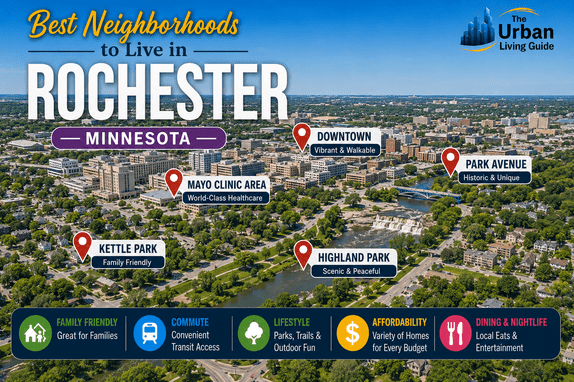
Best Neighborhoods in Rochester, Minnesota – Where You Live Shapes How You Work and Relax
Rochester is one of those cities that surprises people. Most know it as the home of Mayo Clinic — one of the world’s leading medical centers and the city’s dominant employer — but residents quickly discover that Rochester is a fully functioning city with distinct neighborhoods, strong schools, and a quality of life that punches well above its population of roughly 125,000. The city has been undergoing deliberate expansion through the Destination Medical Center (DMC) initiative, a $5.6 billion economic development plan designed to transform downtown and surrounding areas through 2040.
If you’re relocating for a Mayo Clinic position, a role at IBM Rochester, or simply moving to a mid-size Minnesota city with low unemployment and high livability, picking the right neighborhood matters more than the city’s compact size might suggest. This guide covers the best areas in Rochester, Minnesota for every kind of mover.
📺 Watch this video to explore different neighborhoods and areas in Rochester before choosing where to live.
Best Areas in Rochester, Minnesota at a Glance
| 🏠 Best for Families | Pill Hill — established, quiet, top-rated schools near Mayo |
| 💼 Best for Young Professionals | Downtown Rochester — walkable, DMC-fueled growth, new rentals |
| 💰 Best Affordable Area | Northwest Rochester — newer suburbs, competitive rents, good schools |
| 🏙️ Best Luxury Area | Pill Hill / Dunn’s Creek — custom homes, wooded lots, prestige addresses |
| 🌿 Best for Outdoor Access | Southeast Rochester — trail systems, Silver Lake, open space |
Top Neighborhoods in Rochester, Minnesota
1. Downtown Rochester – The DMC Transformation Zone
Downtown Rochester is the city’s most rapidly evolving area, driven by the Destination Medical Center initiative. The core runs along Broadway Avenue from Civic Center Drive south to College Drive, with Soldiers Field park anchoring the western edge. What was once a quiet medical-adjacent downtown is now gaining genuine residential density — new apartment towers, the Berkman Apartments complex, expanded dining along First Street SW, and the pedestrian-connected Mayo Clinic campus all within walking distance.
- Housing: Primarily newer apartment buildings and condo towers. 1BR rents average $1,300–$1,800/month. Ownership condos start around $250K–$400K.
- Commute: Walking distance to Mayo Clinic main campus and IBM Rochester shuttle routes. Most downtown employers are within a 5–10 minute walk.
- Nearby: Peace Plaza, Rochester Civic Theatre, Soldiers Field Veterans Memorial, Whole Foods Market on Broadway, Silver Lake Park (10-min walk).
Who it’s best for: Medical fellows, residents, and professionals working on or near the Mayo Clinic campus who want zero commute. Many newcomers arriving in Rochester for Mayo fellowships or nursing positions choose downtown specifically to walk to work through the skyway system in winter.
⚠️ Drawback: Downtown Rochester is still maturing as a residential neighborhood — evening and weekend activity outside of Peace Plaza and a few restaurant clusters can feel thin compared to a full urban neighborhood. Construction noise from DMC projects is ongoing.
2. Pill Hill – Rochester’s Established Prestige Address
Pill Hill is Rochester’s most historically significant residential neighborhood, sitting directly west and southwest of the Mayo Clinic campus along Second Street SW and Fourth Street SW. The name comes from its long history as home to Mayo physicians and medical staff — and that identity has never really changed. The streets are lined with large homes, mature trees, and a quietness that reflects a neighborhood where most residents are senior professionals with long roots.
- Housing: Predominantly large single-family homes, many custom-built. Purchase prices typically range $450K–$1.2M+. Rental inventory is very limited; the area skews heavily owner-occupied.
- Commute: 5–10 minute walk or short drive to Mayo Clinic main campus. Quick access to US Highway 52 for commutes south or north.
- Nearby: Assisi Heights (historic landmark, walking trails), Soldiers Field Golf Course, Rochester Art Center, Graham Park, Olmsted Medical Center (5-min drive).
Who it’s best for: Established Mayo Clinic physicians, surgeons, and senior administrators who want to walk or bike to the Mayo campus and live in Rochester’s most prestigious residential corridor. Locals often recommend Pill Hill to anyone who asks where the city’s most stable, long-term neighborhoods are.
⚠️ Drawback: Very limited rental availability — this is almost exclusively a buyer’s market. First-time movers or short-term Rochester residents on medical contracts may find few options here.
3. Northwest Rochester – The Affordable Family Stronghold
Northwest Rochester has emerged as the go-to area for families and value-seeking buyers over the past decade. The neighborhood sprawls north and west of US Highway 14 across subdivisions developed largely from the 1990s through today, anchored by Apache Mall to the south and the Rochester International Airport corridor to the west. It lacks the character of older city neighborhoods but delivers consistently on the factors families prioritize: newer construction, attached garages, good school feeds, and reasonable prices.
- Housing: Primarily newer single-family homes and townhomes. Purchase prices range $280K–$480K. 2BR apartment rents average $1,100–$1,500/month in complexes along West Circle Drive NW.
- Commute: About 15–20 minutes to Mayo Clinic main campus via US Highway 52 or Broadway Avenue N. Limited transit — car commuting is the norm.
- Nearby: Apache Mall, Quarry Hill Nature Center (15-min drive), Rochester Community and Technical College (RCTC), Cascade Lake Regional Park, Costco on West Frontage Road NW.
Who it’s best for: Families relocating to Rochester who prioritize newer construction, school quality, and value. If you’re relocating with school-age children and want a predictable suburban environment with competitive Rochester pricing, Northwest Rochester consistently delivers.
⚠️ Drawback: Car dependency is total here — there’s no meaningful walkability, and the suburban grid offers little in the way of neighborhood identity or walkable daily amenities.
4. Southeast Rochester – Trails, Space, and Silver Lake Access
Southeast Rochester is the city’s most park-connected residential quadrant, anchored by Silver Lake to the north, Quarry Hill Nature Center to the west, and the expanding trail network that runs along Bear Creek and Cascade Creek. The area has a mix of older established neighborhoods near the lake and newer subdivisions pushing toward the Marion Road SE corridor. Many residents prefer this area because of the outdoor access — Silver Lake Park offers year-round recreation, and the trail system connects to much of Rochester’s 85+ miles of bike and pedestrian paths.
- Housing: A mix of older ranch-style homes near Silver Lake and newer construction further southeast. Purchase prices range $260K–$500K. 1BR rents average $1,050–$1,400/month.
- Commute: About 10–15 minutes to downtown and Mayo Clinic via Broadway Avenue S or US Highway 63. Metro Transit Rochester City Lines serve major corridors.
- Nearby: Silver Lake Park (paddleboats, geese, running paths), Quarry Hill Nature Center and Cave, Rochester Public Library (10-min drive), Hy-Vee on Broadway Avenue S.
Who it’s best for: Outdoor-oriented residents, remote workers who want space and nature access, and families looking for a quieter alternative to the northwest. This area works best if you value trail access and open space over nightlife proximity.
⚠️ Drawback: Older housing stock near Silver Lake means higher maintenance considerations. Some blocks lack sidewalks, making the neighborhood less walkable than the trail access might suggest.
5. Kutzky Park – Historic Character at an Accessible Price
Kutzky Park sits just southwest of downtown Rochester between West Center Street and Soldiers Field, one of Rochester’s oldest platted residential neighborhoods. It’s a genuine urban neighborhood by Rochester standards — tree-canopied streets, 1920s–1940s bungalows and Craftsman homes, a neighborhood association with real teeth, and a 10-minute walk to both Soldiers Field and Mayo Clinic. Renters often consider this area when they want character, central location, and rents below downtown towers.
- Housing: Primarily older single-family homes and duplexes. Purchase prices range $200K–$380K — strong value for the location. 1BR rents average $950–$1,300/month.
- Commute: About 10-minute walk or 5-minute drive to Mayo Clinic campus. Downtown Rochester is a 10–12 minute walk via Second Street SW.
- Nearby: Soldiers Field Regional Park (golf, veterans memorial, tennis courts), Kutzky Park green space, Olmsted County History Center, Central Park Rochester.
Who it’s best for: Budget-conscious buyers and renters who want a genuine neighborhood feel close to Mayo Clinic without downtown tower prices. Many newcomers to Rochester on multi-year Mayo contracts choose Kutzky Park as their first owned home in the city.
⚠️ Drawback: Older homes mean deferred maintenance is common — buyers should budget for updates. Street parking can be competitive on blocks near the Soldiers Field event complex on busy days.
Best Neighborhoods in Rochester, Minnesota – Quick Comparison
| Neighborhood | Vibe | Avg. 1BR Rent | Commute to Mayo | Best For |
|---|---|---|---|---|
| Downtown Rochester | Urban / Growing | $1,300–$1,800 | 5–10 min walk | Fellows, residents, no-commute seekers |
| Pill Hill | Prestige / Quiet | Limited rentals | 5–10 min walk | Senior Mayo staff, established buyers |
| Northwest Rochester | Suburban / Family | $1,100–$1,500 | 15–20 min drive | Families, value buyers |
| Southeast Rochester | Outdoor / Mixed | $1,050–$1,400 | 10–15 min drive | Nature lovers, remote workers |
| Kutzky Park | Historic / Central | $950–$1,300 | 10 min walk | Budget buyers, long-term renters |
Final Thoughts
The best neighborhoods in Rochester, Minnesota map directly onto your reason for being in the city. If you’re here for Mayo Clinic, the walk-to-work logic of Downtown Rochester, Pill Hill, or Kutzky Park makes immediate sense. If you’re relocating a family, Northwest Rochester delivers the suburban fundamentals at prices that feel reasonable against a Mayo or IBM salary. And if outdoor access matters as much as square footage, Southeast Rochester gives you both.
Rochester is growing in a deliberate, planned way — the Destination Medical Center investment is real, and the city in 2030 will look noticeably different than it does today. Getting into the right neighborhood now, while prices remain competitive relative to Minneapolis and Saint Paul, is the move many long-term residents say they wish they’d made earlier.
Frequently Asked Questions
What is the safest neighborhood in Rochester, Minnesota?
Pill Hill and the areas around Soldiers Field consistently report the lowest crime rates in the city. Both are predominantly owner-occupied and benefit from the stable, professional demographic tied to Mayo Clinic.
What are the best neighborhoods in Rochester for families?
Northwest Rochester is the standard family recommendation — newer homes, good school feeds, and competitive pricing. Southeast Rochester is a strong alternative for families who want outdoor access alongside suburban stability.
How close are Rochester’s neighborhoods to Mayo Clinic?
Downtown Rochester and Pill Hill are walking distance — 5–10 minutes on foot. Kutzky Park is a 10-minute walk. Northwest and Southeast Rochester require a car commute of 15–20 minutes.
Is Rochester, Minnesota affordable compared to Minneapolis?
Significantly more affordable. Average home prices in Rochester run 30–40% lower than comparable Minneapolis neighborhoods, and rental rates are similarly lower across all neighborhood types.
Is Rochester a good place to live in 2026?
Yes — Rochester consistently ranks among the best mid-size cities in the US for quality of life. Low unemployment (driven by Mayo Clinic and IBM Rochester), strong schools, low cost of living relative to coastal cities, and the ongoing DMC investment make it a compelling place to put down roots.
Explore More
Planning your Rochester move? Here are more detailed guides from The Urban Living Guide:
- Living in Rochester, Minnesota
- Cost of Living in Rochester, Minnesota
- Pros and Cons of Living in Rochester, Minnesota