

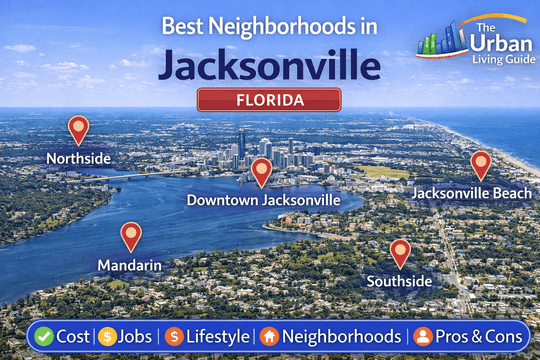
Best Neighborhoods in Jacksonville, Florida: First Coast Living, Coastal Beaches & Riverfront Pockets in 2026
Covering an immense 747 square miles of land area across Northeast Florida, the consolidated City of Jacksonville represents the largest municipality by geographic land area in the contiguous United States. Operating under the unified consolidated county-city governance of the City of Jacksonville within Duval County, the metropolitan core houses approximately 990,000 residents and anchors a broader First Coast regional footprint exceeding 1.68 million people.
Defined by the winding northward flow of the massive St. Johns River, coastal Atlantic barrier islands, naval aviation installations, and sprawling pine flatwoods, Jacksonville delivers unmatched residential space, deepwater port logistics, and diverse residential districts. Relocating across the First Coast requires evaluating localized river basin microclimates, drainage watersheds, high summer humidity, and transportation networks overseen by the North Florida Transportation Planning Organization.
Residential living in Greater Jacksonville presents pronounced geographic contrasts, separating high-density urban riverfront skyscraper districts and barrier island surf enclaves from historic oak-canopied residential enclaves and fast-growing master-planned suburban commercial corridors.
Inbound movers consistently balance direct daily access to primary corporate employment epicenters—such as the Downtown Financial Core, the Southside / Deerwood Park Office Center, the Mayo Clinic Florida Campus, and major military commands at Naval Air Station Jacksonville (NAS Jax) and Naval Station Mayport—against regional commute distances. Selecting the right neighborhood defines your daily route across major transportation arteries, including Interstate 95, Interstate 295 (Jacksonville Beltway), Interstate 10, State Road 202 (J. Turner Butler Boulevard / JTB), and US Route 1 (Philips Highway), while shaping your family’s access to municipal services, coastal waterways, and public school systems.
Watch this video to explore different neighborhoods, coastal corridors, and residential communities across Jacksonville:
Best Areas to Live in Jacksonville at a Glance in 2026
| Neighborhood Name | Location | Distance from Core (Downtown) | Development Status | Transit Connectivity | Cost Level | Best Fit For |
|---|---|---|---|---|---|---|
| Mandarin | Far South Duval County | Approximately 15 miles south | Established Oak-Canopied Suburban | Moderate (JTA Buses, I-295, San Jose Blvd) | Mid-Range | Families, Boaters & Suburban Homebuyers |
| Downtown Jacksonville (Northbank & Southbank) | Central Riverfront Core | 0 miles (Urban Center) | High-Density Riverfront Urban Core | Exceptional (JTA Skyway, Water Taxis, I-95, I-10) | Mid-Range | Corporate Staff, Medical Fellows & Urbanites |
| Jacksonville Beach | Atlantic Coastal Barrier Island | Approximately 17 miles east | Established Coastal Resort Urban | Moderate (SR-202 / JTB, A1A, Beach Blvd) | High-to-Premium | Surfers, Healthcare Executives & Beach Lovers |
| Southside (Town Center & Baymeadows) | Southeast Central Basin | Approximately 10 miles southeast | Modern Master-Planned Infill & Retail Hub | High (I-295, SR-202, US-1) | Mid-to-High Range | Corporate Commuters, Students & Young Families |
| Northside | Northern Duval Basin / Airport Corridor | Approximately 9 miles north | Developing Suburban / Industrial Logistics | High (I-95, I-295, SR-9B, US-17) | Accessible / Budget-Friendly | First-Time Homebuyers, Logistics Staff & Renters |
Best Neighborhoods in Jacksonville Discussed in Detail
Mandarin — Historic Banyan Groves, St. Johns Riverfront & Established Suburbia
Nestled along the eastern banks of the expansive St. Johns River in southernmost Duval County, Mandarin is celebrated for its historic oak-shaded roads, preserved riverfront marinas, and family-oriented residential charm. Named in the 19th century for its production of Satsuma mandarin oranges and famously home to author Harriet Beecher Stowe, the community operates under City of Jacksonville municipal governance. Mandarin features mature residential subdivisions like Julington Creek borders, Beauclerc, and Arrowhead, combining peaceful natural settings with convenient commercial shopping along San Jose Boulevard.
- Housing: Architectural inventory spans 1970s and 1980s brick ranch-style single-family homes on spacious half-acre lots, custom multi-million dollar deepwater riverfront estates along Mandarin Road, and modern gated subdivisions. Single-family purchase prices typically range around $380,000 to $1,450,000+, while modern apartment rentals average $1,550 to $2,450 per month.
- Safety & Crime Rate: Patrolled by the Jacksonville Sheriff’s Office (JSO) Zone 3 Command, Mandarin consistently ranks among the safest residential submarkets in Duval County, with low rates of violent crime and active community watch associations.
- School District & Education Quality: Governed by Duval County Public Schools (DCPS), containing top-performing public institutions such as Mandarin High School (featuring an authorized Medical and Veterinary Science Magnet program), Mandarin Middle School, and Crown Point Elementary.
- Walkability & Daily Conveniences: Interior residential subdivisions are automobile-dependent, but dense commercial centers along San Jose Boulevard (SR 13) provide walkable retail access to Trader Joe’s, Publix Super Markets, Whole Foods Market, and local waterfront seafood bistros.
- Parks & Green Spaces / Pet-Friendliness: Exceptional riverfront recreation anchored by the 22-acre Walter Jones Historical Park (featuring historic 1870s homesteads, boardwalks along river marshes, and moss-draped nature trails), Mandarin Park (offering boat launch ramps, tennis courts, and fishing piers), and Chuck Rogers Park. The neighborhood is exceptionally pet-friendly with quiet residential lanes.
- Parking & Traffic Congestion: Wide multi-car residential driveways and spacious garages provide stress-free parking throughout. Peak morning commuter bottlenecks concentrate along San Jose Boulevard and the on-ramps to the Buckman Bridge (I-295) heading westbound toward NAS Jacksonville.
- Noise Levels & Vibe: Serene, grounded, and peaceful, characterized by whispering Spanish moss canopies, river breezes, and quiet residential evenings.
- Medical Facilities & Hospitals: Direct emergency medical infrastructure supported by the Baptist Emergency at Mandarin on San Jose Boulevard and nearby comprehensive acute hospital care at Baptist Medical Center South on Old St. Augustine Road.
- Transit Connectivity: Served by the Jacksonville Transportation Authority (JTA) express bus routes, with rapid highway connectivity via Interstate 295 (East and West Beltways) and US Route 1.
- Affordability: Balanced mid-range cost tier; offers larger residential lot sizes, private docks, and mature trees per dollar compared to northern Florida coastal strips.
- Who It’s Best For: Growing families seeking strong public schools, boating and water sports enthusiasts, military officers stationed at NAS Jax, and buyers prioritizing tree-shaded privacy.
- Drawbacks: Substantial 15-to-20-mile highway commute into Downtown Jacksonville during rush hours, personal vehicle reliance for daily errands, and high homeowners insurance on older riverfront properties.
Downtown Jacksonville — Urban Riverfront High-Rises, Arts District & Business Core
Positioned along the scenic north and south banks of the St. Johns River, Downtown Jacksonville represents the legal, governmental, financial, and cultural heart of Northeast Florida. Comprising distinct districts including the Northbank Central Business District, the historic Cathedral District, the emerging Brooklyn and Riverside border corridor, and the Southbank Medical and Riverwalk district, downtown delivers urban high-rise living. Municipal development and waterfront activation are guided through city planning and the Downtown Vision Jacksonville alliance.
- Housing: Dominated by luxury glass high-rise condominium towers (such as The Peninsula, The Strand, and Berkman Plaza), converted historic brick lofts, and contemporary podium apartment mid-rises along Riverside Avenue. Condominium purchase valuations typically range around $240,000 to $850,000, while modern 1-bedroom rental apartments average $1,450 to $2,350 per month.
- Safety & Crime Rate: Patrolled by the JSO Zone 1 Command and supported by dedicated Downtown Ambassador patrols. The Riverwalk promenades and Northbank corporate core maintain safe pedestrian foot traffic, though late-night property incidents occur in peripheral commercial blocks.
- School District & Education Quality: Governed by DCPS, featuring premier magnet educational institutions such as the nationally top-ranked Stanton College Preparatory School (ranked among America’s best public high schools) and LaVilla School of the Arts, alongside higher-education campuses anchored by Florida State College at Jacksonville (FSCJ) Downtown Campus.
- Walkability & Daily Conveniences: Outstanding walkability (Walk Score of 82-86/100). Residents comfortably walk to the Riverside Arts Market under the Fuller Warren Bridge, local grocers like Publix Super Market at Brooklyn Station, Broadway shows at the Jacksonville Center for the Performing Arts, and NFL games at EverBank Stadium (home of the Jacksonville Jaguars).
- Parks & Green Spaces / Pet-Friendliness: Exceptional riverfront public spaces along the 3-mile paved Jacksonville Riverwalk (Northbank and Southbank), James Weldon Johnson Park, and Treaty Oak Park (home to a massive 250-year-old historic live oak). Highly pet-friendly with dog-friendly river paths.
- Parking & Traffic Congestion: Assigned garage parking spaces typically add $75 to $150 per month for residential tenants. Street parking is metered, with traffic building along the Main Street Bridge, Acosta Bridge, and Hart Bridge during stadium events and peak business hours.
- Noise Levels & Vibe: Vibrant, historic, and evolving, filled with riverboat horns, outdoor dining chatter, stadium game-day crowds, and live music at waterfront amphitheaters.
- Medical Facilities & Hospitals: Direct emergency medical and academic healthcare anchored within the district by UF Health Jacksonville (featuring the region’s only adult and pediatric Level I Trauma Center) on 8th Street and Baptist Medical Center Jacksonville on the Southbank.
- Transit Connectivity: Regional multi-modal transit centered at the JTA Jacksonville Regional Transportation Center at LaVilla (JRTC), offering the free automated JTA Skyway monorail, St. Johns River Taxis, high-frequency bus lines, and direct vehicular access to Interstate 95 and Interstate 10.
- Affordability: Mid-range urban price structure; offers some of the most competitive price-per-square-foot condominium and apartment rental values among major Florida downtowns.
- Who It’s Best For: Corporate banking professionals (Fidelity National, FIS), attorneys, medical residents at UF Health and Baptist, sports fans, and urbanites seeking walkable riverfront living.
- Drawbacks: Ongoing urban infill construction transitions, lower pedestrian foot traffic during weekday evenings outside event zones, and bridge traffic bottlenecks.
Jacksonville Beach — Coastal Surf Culture, Oceanfront Pier & Active Island Living
Stretching along the Atlantic Ocean on the barrier island east of the Intracoastal Waterway, the incorporated municipality of Jacksonville Beach (known locally as “Jax Beach”) is the premier coastal community of Northeast Florida. Operating under its own independent municipal government via the City of Jacksonville Beach Official Portal, the city offers white-sand beaches, active surf breaks, oceanfront dining, and a relaxed coastal lifestyle centered around 1st Street and 3rd Street (A1A).
- Housing: Real estate stock features oceanfront luxury high-rise condominium towers, renovated coastal mid-century bungalows, modern multi-story architectural beach homes, and multi-family duplexes east of A1A. Single-family purchase prices typically range around $580,000 to $3,200,000+, while rental apartments and beach flats average $1,950 to $3,800 per month.
- Safety & Crime Rate: Protected by the dedicated Jacksonville Beach Police Department (JBPD). Residential streets maintain a safe, vigilant neighborhood environment, while the central oceanfront bar and entertainment strip near Beach Boulevard experiences elevated nightlife-related incidents on warm summer weekends.
- School District & Education Quality: Governed by DCPS, hosting highly regarded coastal public schools such as Seabreeze Elementary School, San Pablo Elementary, and Fletcher High School.
- Walkability & Daily Conveniences: Outstanding pedestrian and cruiser-bicycle walkability (Walk Score of 85-90/100 along the coast). Residents easily stroll to the Jacksonville Beach Pier, oceanfront cafes, surf shops, local breweries, and grocers like Trader Joe’s on 3rd Street and Publix.
- Parks & Green Spaces / Pet-Friendliness: Exceptional coastal recreation anchored by 4 miles of wide Atlantic coastline, Oceanfront Park, South Beach Park and Sunshine Playground (featuring tennis courts, splash pads, and skate parks), and Cradle Creek Preserve (offering coastal marsh boardwalks). Extremely pet-friendly with designated off-season and morning dog beach hours.
- Parking & Traffic Congestion: Residential driveways and private garages are essential, as public beach parking lots fill rapidly on sunny weekends. Commuter traffic builds westward along J. Turner Butler Boulevard (SR-202) and Beach Boulevard (US-90) during weekday rush hours.
- Noise Levels & Vibe: Energetic, coastal, and outdoor-oriented, characterized by breaking ocean waves, beach cruiser bicycle chatter, and lively evening outdoor patio dining.
- Medical Facilities & Hospitals: Direct 8-minute highway access to the world-renowned academic medical research and specialty healthcare campus at Mayo Clinic Florida on San Pablo Road, alongside Baptist Medical Center Beaches on 13th Avenue South.
- Transit Connectivity: Roadway connectivity via JTB (SR-202), Beach Boulevard (US-90), Atlantic Boulevard (SR-10), and A1A, offering a 25-minute drive into Downtown Jacksonville and 15 minutes to St. Johns Town Center.
- Affordability: High-tier coastal price profile; property valuations, windstorm insurance, and coastal flood premiums are offset by direct ocean access and island lifestyle benefits.
- Who It’s Best For: Surfers, outdoor beach fitness enthusiasts, healthcare professionals at Mayo Clinic, remote executives, and families seeking an active coastal community.
- Drawbacks: Elevated property insurance costs in coastal wind zones, summer tourist parking congestion, and rush-hour bottlenecks crossing the Intracoastal Waterway bridges.
Southside (Town Center & Baymeadows) — Modern Commercial Hub, St. Johns Town Center & Infill Living
Covering an expansive suburban basin in southeastern Duval County, Southside is the primary economic, retail, and commercial growth engine of modern Jacksonville. Anchored by the upscale open-air retail epicenter of the St. Johns Town Center and the corporate office complexes of Deerwood Park, Southside offers master-planned subdivisions, gated lakefront condominium communities, and garden-style apartment developments. Operating under City of Jacksonville municipal administration, Southside provides central regional positioning and convenience.
- Housing: Real estate stock features modern master-planned single-family tract homes, luxury townhome developments, and upscale mid-rise apartment communities along Gate Parkway and Baymeadows Road. Single-family purchase prices typically range around $350,000 to $750,000, while modern apartment rentals average $1,450 to $2,300 per month.
- Safety & Crime Rate: Patrolled by the JSO Zone 3 Command. Master-planned developments and gated communities maintain low violent crime rates, while high-traffic commercial retail parking lots experience typical property-related incidents.
- School District & Education Quality: Governed by DCPS, hosting strong public options such as Twin Lakes Academy and Atlantic Coast High School, alongside higher-education campuses anchored by the University of North Florida (UNF) on JTB.
- Walkability & Daily Conveniences: The open-air village at St. Johns Town Center is highly walkable, featuring over 175 designer storefronts (Apple, Tiffany & Co., Nordstrom), specialty grocers like Sprouts Farmers Market and Publix, and fine steakhouses.
- Parks & Green Spaces / Pet-Friendliness: Outstanding municipal open spaces including the 300-acre Fort Family Regional Park on Baymeadows Road (featuring lighted tennis centers, youth soccer fields, and fishing lakes), Deerwood Rotary Children’s Park, and hiking trails through the UNF Nature Sanctuary. Highly pet-friendly with numerous dog parks.
- Parking & Traffic Congestion: Wide two-car residential garages and expansive commercial plaza parking. Significant highway congestion occurs daily at the intersection of Interstate 295 and J. Turner Butler Boulevard (SR-202) during morning and evening rush hours.
- Noise Levels & Vibe: Modern, fast-paced, and suburban, characterized by active retail shoppers, university student energy, and quiet residential subdivisions.
- Medical Facilities & Hospitals: Direct emergency medical coverage provided within the district by Ascension St. Vincent’s Southside Hospital on Belfort Road and Baptist Medical Center South.
- Transit Connectivity: Unmatched highway connectivity at the crossroads of I-295 (East Beltway), SR-202 (JTB), I-95, and US-1 (Philips Highway), allowing a 12-minute drive to Downtown and 12 minutes to the Atlantic beaches.
- Affordability: Balanced mid-range price tier; delivers modern energy-efficient construction, community swimming pools, and central positioning at competitive price points.
- Who It’s Best For: Corporate professionals working in Deerwood Park, university students and faculty at UNF, healthcare workers, and buyers seeking modern conveniences with central beach and downtown access.
- Drawbacks: Heavy commuter traffic along JTB and Gate Parkway, reliance on personal vehicles outside the Town Center core, and higher density in multi-family rental corridors.
Northside — Logistics Corridor, Natural Preserves & Affordable Suburban Living
Encompassing the vast geographical territory north of the St. Johns River and extending to the Nassau County line, Northside is one of Jacksonville’s most expansive, historic, and budget-accessible residential sectors. Anchored by major transportation assets including Jacksonville International Airport (JAX), international marine terminals at JAXPORT, and the River City Marketplace, Northside combines rapid master-planned suburban expansion along Yellow Bluff Road and Dunn Avenue with preserved coastal wetlands along the Timucuan Ecological and Historic Preserve.
- Housing: Real estate consists of newly constructed single-family master-planned subdivisions (such as Yellow Bluff Landing and Oceanway), mid-century single-story ranch homes on multi-acre rural parcels, and value-oriented apartment complexes. Single-family purchase prices typically range around $260,000 to $480,000, while rental apartments and homes average $1,250 to $1,850 per month.
- Safety & Crime Rate: Patrolled by the JSO Zone 5 and Zone 6 Commands. While older industrial commercial strips experience higher property crime rates, newer master-planned residential tracts in Oceanway and near the airport maintain safe, family-centered environments.
- School District & Education Quality: Governed by DCPS, containing neighborhood institutions such as First Coast High School, Oceanway Middle School, and specialized public charter academies.
- Walkability & Daily Conveniences: Designed around major commercial power centers like River City Marketplace, offering retail shopping at Regal Cinemas, Lowe’s, Walmart Supercenter, Publix, and casual family dining along City Center Boulevard.
- Parks & Green Spaces / Pet-Friendliness: World-class natural recreation anchored by the 46,000-acre Timucuan Ecological and Historic Preserve, Betz-Tiger Point Preserve, the oceanfront beaches of Little Talbot Island State Park, and the 120-acre Jacksonville Zoo and Gardens on the Trout River.
- Parks & Green Spaces / Pet-Friendliness: Plentiful private residential driveway parking, two-car garages, and open shopping center parking. Commuter traffic moves steadily along Interstate 95 and Interstate 295 (North Beltway), with minor slowdowns near port freight logistics corridors.
- Noise Levels & Vibe: Spacious, rustic, and developing, shifting from quiet residential subdivisions and coastal pine forests to steady logistics activity near airport corridors.
- Medical Facilities & Hospitals: Direct emergency medical coverage provided within the district by UF Health North, featuring a modern hospital campus and bed tower on Max Leggett Parkway.
- Transit Connectivity: Unrivaled highway and aviation connectivity: immediate access to I-95, I-295, US-17, and State Road 9B, offering an 8-minute drive to Jacksonville International Airport and 15 minutes to Downtown.
- Affordability: Jacksonville’s most accessible entry-level homeownership and rental price tier, offering larger lot acreage, new construction warranties, and lower price-per-square-foot metrics.
- Who It’s Best For: First-time homebuyers, logistics and aerospace workers, airport personnel, military families, and buyers seeking larger acreage near outdoor eco-preserves.
- Drawbacks: Greater travel distance to Atlantic beach communities, variable school performance metrics across non-magnet public campuses, and industrial pass-through freight truck traffic along certain arterial roads.
Comprehensive Neighborhood Pros and Cons Comparison
| Neighborhood | Core Advantages (Pros) | Core Limitations (Cons) |
|---|---|---|
| Mandarin | Historic oak canopies and river views; top-ranked Mandarin High; low crime rates; spacious lots and boating marinas at Mandarin Park. | 15-mile commute to Downtown; rush-hour traffic bottlenecks across the Buckman Bridge (I-295); vehicle dependence. |
| Downtown Jacksonville | Direct pedestrian access to the Jacksonville Riverwalk and Brooklyn Publix; free JTA Skyway transit; top-ranked Stanton Prep nearby; NFL games at EverBank Stadium. | Ongoing urban development transitions; elevated monthly apartment parking fees; lower street foot traffic during non-event weekday evenings. |
| Jacksonville Beach | Direct Atlantic Ocean beach access; active surf and bike culture; walkable dining on 1st Street; 8-minute commute to Mayo Clinic Florida. | High property and flood insurance costs; summer tourist parking congestion; bridge traffic delays crossing the Intracoastal Waterway. |
| Southside | Premier shopping at St. Johns Town Center; central highway crossroads (I-295, JTB, I-95); proximity to UNF and Deerwood Park office parks. | Heavy peak-hour commuter traffic along J. Turner Butler Boulevard; higher density in multi-family rental corridors; car dependence. |
| Northside | Jacksonville’s most affordable home and rental pricing; new construction master-planned subdivisions; 8-minute drive to JAX Airport; access to Timucuan Preserve. | Longer travel distance to Atlantic beaches; variable public school ratings across non-magnet schools; industrial freight truck traffic. |
How You Decide Which Neighborhood Is Best For You
Selecting your ideal neighborhood in Greater Jacksonville requires balancing your gross household finances with daily workplace destinations, family schooling preferences, and coastal flood zone resilience. Because Jacksonville covers nearly 750 square miles bisected by the wide expanse of the St. Johns River and the Intracoastal Waterway, your chosen location dictates whether your daily commute involves crossing bridge bottlenecks like the Buckman Bridge (I-295), Fuller Warren Bridge (I-95), or Hart Bridge. Healthcare professionals at the Mayo Clinic, corporate employees at Deerwood Park, naval personnel at NAS Jax, and logistics staff near the airport should prioritize living on their respective side of the river to eliminate daily bridge traffic delays.
Beyond transportation corridors, evaluate essential municipal utility and environmental realities. Jacksonville experiences high summer electricity demands due to air conditioning usage during extended heat waves exceeding 90 degrees Fahrenheit, making municipal utility rates through the Jacksonville Electric Authority (JEA)—one of the largest municipal electric and water utilities in the United States—an important factor. Furthermore, prospective homebuyers must review FEMA flood zone designations (Flood Zone X vs. AE/VE) and property insurance premiums, especially on low-lying coastal enclaves like Jacksonville Beach or riverfront properties in Mandarin. Prior to executing a residential lease or property closing, verify high-speed fiber broadband availability (such as AT&T Fiber or Xfinity Gigabit) and check Duval County school assignment boundaries.
Frequently Asked Questions About Jacksonville Neighborhoods
Which neighborhood in Jacksonville is considered the best for families with school-age children?
Mandarin and Southside are widely regarded as the premier family communities in Greater Jacksonville. Mandarin offers established oak-canopied subdivisions, low crime rates, and access to top-performing public institutions like Mandarin High School. Southside provides modern master-planned communities, extensive parks like Fort Family Regional Park, and close proximity to public and charter educational campuses.
What is the most walkable neighborhood in Jacksonville where you can live without a car?
Downtown Jacksonville (especially surrounding the Brooklyn, Northbank, and Southbank Riverwalk corridors) and Jacksonville Beach offer the highest walkability in the region, both scoring above 82 on Walk Score. Downtown Jacksonville allows residents to walk to grocery stores like Publix at Brooklyn Station, offices, and entertainment venues while connecting to the free JTA Skyway and regional transit center. Jacksonville Beach provides dense pedestrian access to retail, dining, and beaches along 1st and 3rd Streets.
What are the safest residential neighborhoods to live in within Jacksonville?
Mandarin and the barrier island communities of Jacksonville Beach consistently report the lowest violent crime rates in Duval County. Mandarin benefits from active residential watch networks and dedicated JSO Zone 3 patrols, while Jacksonville Beach maintains its own independent municipal police department.
What are the most affordable neighborhoods for homebuyers and renters in Jacksonville?
Northside and parts of Westside provide the most budget-friendly housing opportunities in the metropolitan area. On the Northside, buyers and renters can secure newly constructed single-family homes and spacious apartments at price points significantly lower than Southside or coastal beach enclaves.
How bad is traffic congestion when commuting across the St. Johns River bridges?
Commuting across the St. Johns River along the Buckman Bridge (I-295 South), Fuller Warren Bridge (I-95), or Dames Point Bridge (I-295 East) during peak morning and evening rush hours typically takes between 25 and 45 minutes. Living on the same side of the river as your primary workplace significantly reduces daily commute stress.
Do all Jacksonville neighborhoods require flood insurance?
No, flood insurance requirements depend on FEMA flood zone designations and mortgage lender mandates. High-elevation inland neighborhoods across Southside and Northside are predominantly located in Flood Zone X (non-mandatory flood zones), whereas low-elevation barrier island properties in Jacksonville Beach and immediate St. Johns River waterfront homes in Mandarin reside in Zone AE/VE, requiring mandatory flood insurance coverage.
Which Jacksonville neighborhood is best for healthcare professionals working at the Mayo Clinic?
Jacksonville Beach, Southside (Town Center area), and the San Pablo corridor provide the fastest and most convenient commutes to the Mayo Clinic Florida campus, allowing physicians, nurses, and medical researchers to reach the hospital within a 5-to-12 minute drive along J. Turner Butler Boulevard (SR-202) or San Pablo Road.
Know More About the City
The Urban Living Guide creates deeply researched, practical, and informative city relocation resources designed to help individuals, working professionals, and families navigate complex urban landscapes. By analyzing municipal infrastructure, hyper-local zoning patterns, commuter realities, and housing markets, our guides provide actionable insights so you can make confident, data-backed decisions when moving to major metropolitan areas.
Explore our comprehensive guides to the Jacksonville metropolitan region:
- Living in Jacksonville, Florida
- Cost of Living in Jacksonville, Florida
- Pros and Cons of Living in Jacksonville, Florida
- Moving to Jacksonville, Florida
Follow The Urban Living Guide for ongoing regional insights, neighborhood developments, and expert local coverage across Greater Jacksonville and Florida’s First Coast.