

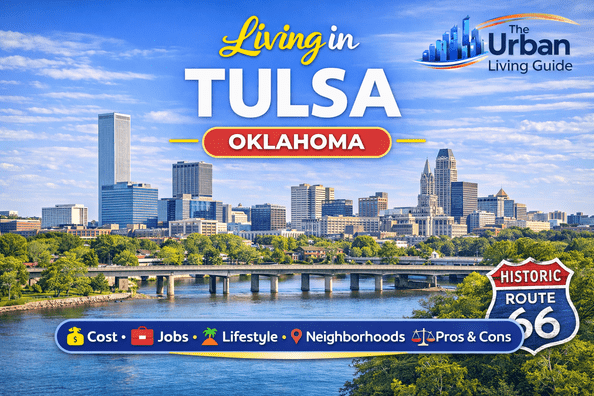
Beyond Its Oil Legacy, Living in Tulsa, Oklahoma Brings Music, Architecture, Green Spaces and a Surprisingly Cultured City Life
If you are actively considering living in Tulsa, Oklahoma, you are looking at one of the most uniquely positioned, culturally rich, and architecturally stunning mid-sized cities in the American Midwest. Nestled in the northeastern quadrant of the state along the scenic, winding banks of the Arkansas River, Tulsa feels fundamentally different from the vast, flat plains of western Oklahoma. It is situated in the state’s “Green Country,” an area characterized by rolling hills, dense eastern deciduous forests, and a distinctly lush landscape.
With a metropolitan population exceeding 1 million residents (and around 400,000 within the city limits), Tulsa offers an incredibly rare combination of metropolitan sophistication and quiet, unhurried southern charm. Historically celebrated as the “Oil Capital of the World” during the early 20th-century petroleum boom, that massive influx of wealth left a permanent, beautiful mark on the city. Today, Tulsa boasts one of the most extensive and well-preserved collections of Art Deco architecture in the United States, giving its downtown skyline a classic, vintage elegance that rivals much larger coastal cities.
However, modern Tulsa is no longer just an oil town. Over the last decade, it has aggressively transformed into a vibrant sanctuary for remote workers, tech entrepreneurs, and creatives. Driven by nationally recognized initiatives like the Tulsa Remote program—which actually pays professionals to relocate here—the city has seen a massive influx of coastal talent. Newcomers are drawn by the unbelievably low cost of homeownership, the thriving local music and arts scenes in the Blue Dome District, and access to world-class public amenities like the Gathering Place. For those seeking financial freedom without sacrificing cultural depth, Tulsa is a masterpiece of urban reinvention.
Watch this comprehensive local video tour to experience the daily rhythm, historical architecture, and street-level vibe across Tulsa before you finalize your moving plans.
To ensure your relocation planning is airtight, the statistics, economic insights, and neighborhood breakdowns provided within this guide have been thoroughly verified against official municipal databases, the Tulsa Regional Chamber, and active real estate market analytics.
What Makes Tulsa’s Culture So Distinct and Vibrant
Tulsa operates on a frequency of quiet confidence. It does not boast loudly like massive mega-cities, but it quietly offers amenities, philanthropic wealth, and a creative arts scene that routinely stuns first-time visitors. The city’s identity is deeply rooted in music, history, and community investment.
The core elements defining Tulsa’s distinct character include:
- The Art Deco Heritage: Walking through downtown feels like stepping back into the 1920s. Landmarks like the Boston Avenue Methodist Church and the Philtower Building are architectural marvels that define the skyline.
- The Tulsa Sound: The city has a profound musical legacy, blending rockabilly, country, rock, and blues—championed by legends like Leon Russell and JJ Cale. Live music is a staple of daily life here.
- The Gathering Place: Not just a park, but a $400+ million riverfront masterpiece funded by the George Kaiser Family Foundation. It has been voted the best city park in the United States, offering 100 acres of unprecedented outdoor recreation.
- Historic Greenwood District: Known historically as Black Wall Street, this area is a profound site of African American history, tragedy, and modern reconciliation, standing as a testament to resilience and cultural heritage.
- Tulsa Remote: A pioneering economic program that offers a $10,000 grant and community support to eligible remote workers who move to the city, fundamentally reshaping the local demographic with diverse, out-of-state talent.
Tulsa at a Glance: Essential Relocation Statistics
Before planning your budget and logistics, it is vital to understand the foundational numbers driving the local economy. Here is a snapshot of current real estate and lifestyle metrics:
| Relocation Parameter | Statistical Overview |
|---|---|
| Median Home Value | $200,000 – $240,000 (Substantially higher in Midtown and South Tulsa) |
| Average Monthly Rent | $800 – $1,300 depending on district and amenities |
| Median Household Income | $55,000 – $60,000 (Aviation and Energy sectors average significantly higher) |
| Average Commute Time | 18 to 20 minutes (Consistently ranked among the best in the nation) |
| Primary Transportation Corridors | I-44, Highway 75, Broken Arrow Expressway, Creek Turnpike |
| Tax Climate | Low property taxes, standard state income tax, moderate local sales tax |
Famous Personalities, Athletic Legacies & Major Corporate Brands
Tulsa’s cultural footprint is massive, having nurtured iconic musicians, visionary authors, and leading American corporations. It is a city that builds global influence from the middle of the country.
Legendary figures and cultural icons rooted in the area include:
- Garth Brooks: The legendary, record-breaking country music superstar has deep roots in the Tulsa and greater Oklahoma area.
- Leon Russell: The iconic singer-songwriter and session musician who became the central architect of the famous “Tulsa Sound.”
- S.E. Hinton: The celebrated author who wrote the classic novel The Outsiders while attending high school in Tulsa (the city remains the setting for the book and the famous Francis Ford Coppola film adaptation).
- Bill Hader: The Emmy-winning actor, comedian, and Saturday Night Live alumnus was born and raised in the city.
Economically, the city is dominated by aerospace, energy, and massive retail conglomerates:
- American Airlines Maintenance Base: Tulsa is home to the largest commercial aviation maintenance facility in the world, employing over 5,000 highly skilled aviation professionals.
- Williams Companies & ONEOK: Two massive, Fortune 500 natural gas and energy infrastructure companies headquartered in towering downtown skyscrapers.
- QuikTrip (QT): The beloved, cult-favorite convenience store chain is headquartered here and is heavily involved in local philanthropy.
- BOK Financial Corporation: A top-tier regional financial services company acting as a massive anchor for the downtown business district.
Finding Your Space: The Best Neighborhoods in Tulsa
Tulsa’s residential landscape is incredibly diverse. Whether you want to walk to craft coffee shops from a historic bungalow or prefer a sprawling suburban home in a top-rated school district, the city delivers on all fronts.
| Neighborhood Name | Best For | Vibe & Architectural Style | Estimated Price Range |
|---|---|---|---|
| Midtown & Maple Ridge | Established Families & Executives | “Old Money” historic mansions, winding tree-canopied streets, proximity to Philbrook Museum | $400,000 – $1,500,000+ |
| Brookside (Peoria Ave) | Young Professionals & Foodies | Highly walkable, trendy dining, boutique shopping, mid-century modern homes, vibrant nightlife | $250,000 – $600,000 |
| Cherry Street (15th Street) | Creatives & Young Families | Historic craftsman bungalows, artisan bakeries, weekend farmers markets, bohemian charm | $220,000 – $450,000 |
| Downtown (Arts & Blue Dome Districts) | Remote Workers & Singles | Converted warehouse lofts, live music venues, craft breweries, extremely high walkability | $200,000 – $450,000 (Condos) |
| South Tulsa / Bixby / Jenks | Families & Commuters | Massive master-planned suburbs, top-tier public schools (Jenks and Union districts), modern builds | $280,000 – $700,000+ |
👉 To better understand how the Arkansas River shapes the city’s layout and separates South Tulsa from Midtown, review the interactive map below.
Housing Market Analysis and Rental Economics
The defining advantage of living in Tulsa, Oklahoma is the incredibly low barrier to homeownership. While the Tulsa Remote program has slightly tightened the housing inventory in trendy areas like Brookside and Midtown, the aggregate market remains profoundly affordable compared to national averages.
Current housing and rental data reflect highly accessible figures:
- Studio & 1 Bedroom Apartments: $650 to $1,200 per month (Luxury downtown lofts command the top end of this scale).
- 2 to 3 Bedroom Apartments: $1,100 to $1,600 per month.
- Single-Family Rental Homes: Generally start around $1,500 to $1,800 per month in suburban areas like Broken Arrow or South Tulsa.
- Home Purchasing: The median purchase price sits comfortably around $200,000 to $240,000, allowing ordinary professionals to buy homes with large yards and modern amenities without coastal-level debt.
Job Market: Aerospace, Energy, and the Remote Work Boom
While the shadow of the oil boom still looms large, Tulsa’s modern economy is highly diversified. Aerospace and aviation manufacturing lead the charge. With the American Airlines Maintenance Base and numerous aerospace engineering firms surrounding the Tulsa International Airport (TUL), aviation professionals are in constant demand.
The energy sector remains a monumental force, with Williams, ONEOK, and Helmerich & Payne maintaining massive corporate footprints. However, the most significant shift in recent years has been the intentional cultivation of the tech and remote-work sector. The Tulsa Remote program has injected thousands of high-earning digital professionals into the local economy, sparking a boom in co-working spaces (like 36 Degrees North), local coffee roasters, and downtown development.
Average salaries generally fall between $50,000 and $90,000. Because the cost of daily essentials and real estate is so low, your disposable income stretches incredibly far in this city.
Daily Life, Culture, and the Urban Vibe
Daily life in Tulsa is characterized by its creative pulse and relaxed traffic. Locals do not spend their days stuck in gridlock; instead, weekends are spent exploring the miles of paved cycling trails along the River Parks system or lounging on the sprawling lawns of the Gathering Place.
The culinary and coffee scenes are highly developed for a city of its size. Residents regularly frequent award-winning local roasters like Topeca Coffee and Cirque, or spend Friday nights hopping between craft breweries in the Tulsa Arts District. Live music is the lifeblood of the city—venues like the legendary Cain’s Ballroom (the historic home of Bob Wills and Western Swing) and the massive BOK Center ensure that world-class entertainment is always on the calendar.
Cost of Living: Maximizing Your Budget
If you want to achieve true financial freedom, build wealth, or save for early retirement, Tulsa provides the perfect economic environment.
A typical monthly household budget breaks down roughly as follows:
- Rent / Mortgage Base: $800 to $1,400
- Utilities (Electricity, Water, Trash): $150 to $260 (Air conditioning is heavily utilized from June through September)
- Groceries & Household Goods: $300 to $500
- Transportation (Gas & Insurance): $100 to $150 (Fuel prices are consistently among the lowest in the U.S.)
- Healthcare & Wellness: $200 to $350
Transportation: Highway Networks and Airport Access
Tulsa is famously known as a “20-minute city.” Thanks to an incredibly efficient, well-designed highway grid, you can get almost anywhere in the metropolitan area in 20 minutes or less. The city is highly car-dependent, and while public transit (Tulsa Transit) exists, it is rarely used by standard commuters.
The grid relies heavily on Highway 75 (running north-south), I-44 (running east-west), the Broken Arrow Expressway (BA), and the Creek Turnpike. Traffic is remarkably light compared to Dallas or Houston. For air travel, Tulsa International Airport (TUL) is a small, easy-to-navigate airport, though residents should note that direct flights to certain coastal cities can sometimes be limited, occasionally requiring connections through Dallas or Denver.
Climate Realities: Green Country and Tornado Alley
Tulsa is located in “Green Country,” meaning it receives more rainfall and features more lush, forested terrain than western Oklahoma. The climate is humid subtropical. Summers are intensely hot and humid, with prolonged periods of 90-to-100-degree weather.
Winters are generally mild but can occasionally deliver severe ice storms that knock out power lines due to the heavy tree canopy. The most critical environmental reality, however, is the spring storm season. Situated in Tornado Alley, the city experiences volatile severe weather from April through June. Sirens, weather radios, and storm shelters are standard aspects of local life, and meteorology is taken very seriously by all residents.
Landmarks, Museums, and Entertainment Districts
Tulsa’s philanthropic wealth has endowed the city with cultural institutions that rival major global capitals.
- Philbrook Museum of Art: Housed in a stunning 1920s Italian Renaissance villa formerly owned by oil magnate Waite Phillips, featuring sprawling, meticulously manicured botanical gardens.
- The Gathering Place: A globally awarded 100-acre riverfront park featuring massive playgrounds, lodge buildings, BMX tracks, and kayaking ponds.
- The Golden Driller: A massive, 76-foot-tall statue of an oil worker located at the Tulsa Expo Center, serving as a quirky, iconic symbol of the city’s petroleum roots.
- Route 66: Tulsa is the “Capital of Route 66,” and the city embraces this heritage with neon signs, retro diners, and historical markers stretching across the town.
Higher Education and Academic Institutions
For families, the suburban school districts surrounding the city—specifically Jenks Public Schools, Union Public Schools, and Bixby—are highly acclaimed and often dictate suburban real estate demand.
In terms of higher education, the city is academically robust:
- The University of Tulsa (TU): A highly prestigious, private research university known for its elite engineering, petroleum, and law programs.
- Oral Roberts University (ORU): A large, globally recognized private Christian university featuring striking, futuristic mid-century modern architecture.
- OSU-Tulsa & OU-Tulsa: Regional branches of the state’s major universities providing extensive graduate and professional programs.
Weighing the Realities: Pros and Cons of Relocating
Before making a cross-country move, it is critical to balance the city’s financial perks against its geographic realities.
Primary Advantages of Moving Here:
- Incredible housing affordability and overall low cost of living.
- The financial incentives and community support provided by the Tulsa Remote program.
- World-class public parks, notably the stunning Gathering Place.
- A thriving, authentic local arts and music scene with deep historical roots.
- Zero traffic stress; the “20-minute city” commute is a daily reality.
Notable Challenges to Prepare For:
- The very real stress of spring severe weather and tornado warnings.
- Intensely hot, humid summers that can make outdoor activities uncomfortable in July and August.
- Absolute car dependency due to limited public transportation infrastructure.
- Limited direct flights out of Tulsa International Airport (TUL) for international or coastal travel.
Is Tulsa the Right Move for You?
Tulsa is a hidden gem that is rapidly being discovered. It is the ultimate destination for remote workers, young creatives, and families who want the cultural depth and architectural beauty of a major city without the crushing financial anxiety. The combination of Art Deco history, world-class parks, and deep community investment makes it an incredibly enriching place to live.
However, if you thrive in dense, public-transit-oriented concrete jungles, or if you have severe anxiety regarding spring thunderstorms, the midwestern environment may present a challenge. For those seeking financial freedom, artistic inspiration, and a welcoming community, living in Tulsa, Oklahoma is an exceptionally smart, fulfilling choice.
Real Experiences: Perspectives from Long-Term Residents (5 to 10+ Years)
“Settling in Tulsa eight years ago after finishing school was the best choice I’ve made. The Art Deco architecture downtown is stunning, and having The Gathering Place park right by the river is a total game-changer for weekends. Housing is reasonable, traffic is minimal, and the community has a creative soul that surprises most newcomers.”
[Source: r/tulsa Community Discussions — u/TulsaGreenway02, resident of 8 years]
“The weather can definitely keep you on your toes with sudden spring storms and summer heatwaves. But once you explore the Pearl District, find your favorite local coffee shop, and enjoy the friendly midwestern-meets-southern vibe, Tulsa truly feels like home.”
[Source: Local Resident Panels & Community Forums — Caleb R., Midtown homeowner of 9 years]
Frequently Asked Questions About Living in Tulsa, Oklahoma
What is the Tulsa Remote program and how does it work?
Tulsa Remote is an initiative that offers a $10,000 grant, free desk space at 36 Degrees North, and community support to eligible full-time remote workers who agree to move to Tulsa for at least one year.
Is Tulsa safe to live in?
Like any city, safety varies. Suburbs like Jenks, Bixby, and South Tulsa, as well as Midtown, are highly safe and family-friendly. It is always advised to research specific neighborhoods and consult local crime maps before renting or buying.
How bad are the tornadoes in Tulsa?
Tulsa is in Tornado Alley. While direct hits to the city center are rare, severe thunderstorms and tornado warnings are a regular occurrence in the spring. Residents adapt by having weather radios and utilizing safe rooms or local shelters.
What is the Gathering Place?
It is a massive, privately funded, $400+ million riverfront park. It features unprecedented architecture, immense playgrounds, nature trails, and water activities, completely free to the public, and is considered one of the best parks in America.
How does Tulsa compare to Oklahoma City?
Tulsa is smaller, greener, and often considered more “artsy” and architecturally historic with its Art Deco roots, whereas Oklahoma City feels more expansive, corporate, and politically driven as the state capital.
Explore More Cities in Oklahoma
If you’re exploring more options beyond Tulsa, The Urban Living Guide has covered several other popular cities across Oklahoma. You can also check:
- Living in Oklahoma City, Oklahoma
- Living in Norman, Oklahoma
- Living in Broken Arrow, Oklahoma
- Living in Lawton, Oklahoma
Before deciding if Tulsa is right for you, check out these detailed breakdowns:
- Cost of Living in Tulsa, Oklahoma
- Pros and Cons of Living in Tulsa, Oklahoma
- Best Neighborhoods in Tulsa, Oklahoma
Then explore our complete relocation logistics guide: Moving to Tulsa, Oklahoma
These guides give you a complete picture of what it’s like living across different cities, covering everything from cost of living, housing, and job opportunities to neighborhoods, commute, weather, education, popular places, and major employers.
The Urban Living Guide brings together these local insights in one place, helping you compare cities easily and make a confident, well-informed decision based on your lifestyle and goals.