

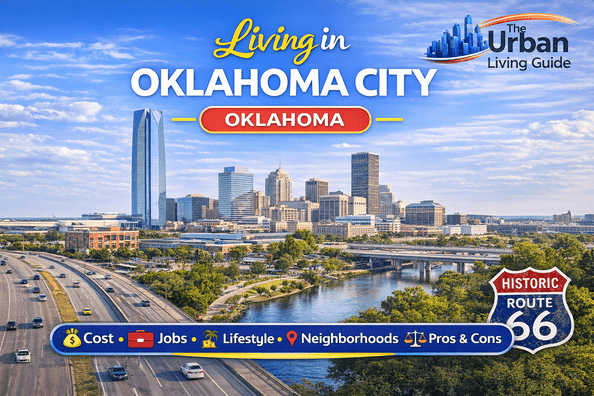
A Modern Downtown Meets Cowboy Country, Making Living in Oklahoma City, Oklahoma Feel More Dynamic Than You Might Expect
If you are actively considering living in Oklahoma City, Oklahoma, you are looking at a metropolitan area currently undergoing one of the most successful urban renaissances in the United States. Situated squarely in the Great Plains along the North Canadian River (locally rebranded as the Oklahoma River), Oklahoma City—commonly referred to simply as OKC—has spent the last three decades transforming itself from a quiet, oil-dependent prairie town into a highly diversified, modern urban center. With a metropolitan population well over 1.4 million, it stands as the political, cultural, and economic capital of the state.
What truly sets OKC apart from other rapidly growing southern and midwestern cities is its revolutionary MAPS (Metropolitan Area Projects) initiative—a series of citizen-voted, debt-free penny sales taxes that have funded billions of dollars in public amenities, including the sprawling 70-acre Scissortail Park, the downtown streetcar system, and world-class riverfront training facilities. Today, professionals, families, and remote workers are moving to the city to capitalize on an exceptionally low cost of living, a booming aerospace and biotechnology sector, and a community-centric culture that honors its deep cowboy and Native American heritage while fiercely building toward the future.
Watch this comprehensive local video tour to experience the daily rhythm, neighborhood architecture, and street-level vibe across Oklahoma City before you plan your move.
To ensure your relocation planning is airtight, the statistics, economic insights, and neighborhood breakdowns provided within this guide have been thoroughly verified against official municipal databases, the Greater Oklahoma City Chamber, and active real estate market analytics.
What Makes Oklahoma City’s Culture So Distinct and Vibrant
Oklahoma City operates with a unique dual identity. It is a place where towering glass corporate skyscrapers cast shadows over historic stockyards where cattle are still auctioned daily. It is this blend of relentless modernity and unapologetic western roots that gives the city its authentic charm.
The core elements defining Oklahoma City’s distinct character include:
- The MAPS Renaissance: The city’s continuous, debt-free investment in itself has completely revitalized downtown, creating vibrant walkable districts, miles of connected bike trails, and the beautiful Myriad Botanical Gardens.
- Crossroads of America: OKC is uniquely positioned at the exact intersection of three major national interstates (I-35, I-40, and I-44), making it a massive national hub for logistics and distribution.
- Deep Western Roots: The city embraces its frontier history, showcased prominently at the National Cowboy & Western Heritage Museum and the Historic Stockyards City.
- The Oklahoma River: Once a dry riverbed, the fully dammed and revitalized river is now a U.S. Olympic and Paralympic Training Site for rowing and canoe/kayak events in the Boathouse District.
- Unmatched Affordability: Despite offering top-tier metropolitan amenities, the city consistently ranks as one of the most affordable large cities in the nation for both housing and everyday consumer goods.
Oklahoma City at a Glance: Essential Relocation Statistics
Before planning your budget and logistics, it is vital to understand the foundational numbers driving the local economy. Here is a snapshot of current real estate and lifestyle metrics:
| Relocation Parameter | Statistical Overview |
|---|---|
| Median Home Value | $230,000 – $260,000 (Substantially higher in premium suburbs like Edmond) |
| Average Monthly Rent | $950 – $1,400 depending on proximity to downtown and district vibe |
| Median Household Income | $60,000 – $65,000 (Aerospace and Energy sectors average $90k+) |
| Average Commute Time | 20 to 24 minutes (Minimal heavy gridlock compared to Dallas or Austin) |
| Primary Transportation Corridors | I-35, I-40, I-44, Kilpatrick Turnpike |
| Tax Climate | Low property taxes, moderate state income tax, slightly higher local sales tax |
Famous Personalities, Athletic Legacies & Major Corporate Brands
Oklahoma City punches well above its weight when it comes to cultural exports, professional athletics, and hosting massive Fortune 500 corporate headquarters, primarily in the energy and tech sectors.
Legendary figures and cultural icons rooted in the area include:
- Wayne Coyne: The eccentric frontman of the Grammy-winning alternative rock band The Flaming Lips, who heavily influences the city’s quirky, creative arts scene.
- Blake Griffin: The highly celebrated NBA superstar and former overall number-one draft pick who was born and raised in OKC.
- Ralph Ellison: The legendary American novelist and author of Invisible Man, who grew up in the Deep Deuce neighborhood of early Oklahoma City.
- Garth Brooks: Though born in Tulsa, the country music megastar’s deep ties to central Oklahoma and the local music scene are a point of massive regional pride.
Economically, the city is dominated by aerospace, tech, and massive energy conglomerates:
- Tinker Air Force Base: The largest single-site employer in the state, serving as a massive logistics, maintenance, and repair hub for the Department of Defense.
- Devon Energy & Chesapeake Energy: Two of the largest independent oil and natural gas exploration companies in the United States, headquartered in towering downtown campuses.
- Paycom: A massive, rapidly expanding provider of online payroll and human resource technology, acting as the anchor for the city’s growing tech sector.
- Oklahoma City Thunder: The city’s crown jewel NBA franchise, which plays at the Paycom Center and acts as the ultimate unifying cultural force for the entire state.
Finding Your Space: The Best Neighborhoods in Oklahoma City
The residential market in OKC is incredibly vast, stretching across multiple counties. You must choose whether you want an urban, walkable lifestyle in the urban core, or a quiet, highly rated school district in the sprawling suburbs.
| Neighborhood Name | Best For | Vibe & Architectural Style | Estimated Price Range |
|---|---|---|---|
| Midtown & Automobile Alley | Young Professionals & Urbanites | Highly walkable, trendy modern apartments, historic brick lofts, artisan coffee shops | $280,000 – $550,000+ (Condos) |
| Edmond (Adjacent Suburb) | Families & Executives | Top-rated K-12 public schools, sprawling master-planned communities, low crime rates | $350,000 – $800,000+ |
| The Paseo Arts District | Creatives & Bohemian Lifestyles | Spanish Revival architecture, vibrant art galleries, vegetarian cafes, colorful historic homes | $250,000 – $450,000 |
| Nichols Hills | Elite Luxury & Established Wealth | Ultra-exclusive enclave, private country clubs, heavily manicured estates, elite security | $800,000 – $3,000,000+ |
| Moore & Norman (South Suburbs) | First-Time Buyers & Students | Highly affordable new construction (Moore) and vibrant college town energy (Norman, home to OU) | $200,000 – $400,000 |
👉 To better understand how expansive the metropolitan area is and how the interstates connect the suburbs to downtown, review the interactive map below.
Housing Market Analysis and Rental Economics
The defining advantage of living in Oklahoma City, Oklahoma is that the dream of homeownership remains fiercely alive. Unlike coastal cities or even nearby Austin and Dallas, ordinary professionals can easily afford spacious properties with front and back yards.
Current aggregate housing and rental data reflect highly accessible figures:
- Studio & 1 Bedroom Apartments: $800 to $1,200 per month (Premium units in Midtown or Bricktown command higher rates).
- 2 to 3 Bedroom Apartments: $1,200 to $1,600 per month across most standard suburban complexes.
- Single-Family Rental Homes: Generally start around $1,500 to $2,000 per month in family-focused areas like Moore, Mustang, or Yukon.
- Home Purchasing: The median sits comfortably around $240,000 to $260,000, making the barrier to entry for first-time buyers remarkably low.
Job Market: Aerospace, Energy, and Biotech Innovation
The days of OKC relying solely on the boom-and-bust cycle of oil are over. Today, aerospace and aviation represent the highest-growth sectors in the region. Tinker Air Force Base employs over 26,000 military and civilian personnel, while the nearby Mike Monroney Aeronautical Center serves as the central training and logistics facility for the FAA.
The energy sector remains a monumental force, with Devon Energy and Chesapeake Energy maintaining massive footprints and offering lucrative corporate careers in engineering, geology, and corporate finance. Additionally, the Oklahoma Health Center campus acts as a premier medical and biotechnology research hub, employing thousands of healthcare professionals.
Average salaries generally fall between $50,000 and $95,000. Because the overhead cost of housing and daily essentials is so low, a $75,000 salary in OKC provides a standard of living that would require well over $120,000 in a coastal market.
Daily Life, Culture, and the Urban Vibe
Daily life in OKC is marked by an unhurried, friendly pace. The local motto is “The Big Friendly,” and it holds true—people generally hold doors, strike up conversations in coffee shops, and maintain a highly community-oriented attitude. Weekends are frequently spent walking through the beautifully landscaped Scissortail Park, attending the massive First Friday gallery walks in the Paseo Arts District, or kayaking on the Oklahoma River.
The culinary scene has exploded over the past decade, moving far beyond classic southern chicken-fried steak. The Plaza District and Uptown 23rd are filled with award-winning craft breweries, authentic Vietnamese cuisine (thanks to a robust local Asian-American population), and upscale farm-to-table dining. During the NBA season, the entire city collectively rallies around the OKC Thunder, turning downtown into a massive sea of blue and orange.
Cost of Living: Maximizing Your Budget
If you want to stretch your dollar to the absolute maximum while still enjoying big-city amenities, OKC is a masterclass in affordability.
A typical monthly household budget breaks down roughly as follows:
- Rent / Mortgage Base: $950 to $1,500
- Utilities (Electricity, Water, Trash): $160 to $280 (High air conditioning reliance in the summer spikes electricity bills)
- Groceries & Household Goods: $300 to $500 (Benefiting from immense local agricultural supply chains)
- Transportation (Gas & Insurance): $100 to $150 (Gas prices here are consistently among the lowest in the nation)
- Healthcare & Wellness: $200 to $350
Highway Networks, Commuting, and Traffic Rhythms
Oklahoma City is geographically massive, sprawling across over 600 square miles. Consequently, it is a strictly car-dependent city. While the downtown area features a sleek, modern streetcar system, it serves primarily as a connector for entertainment districts rather than a regional commuter tool.
The city’s lifeblood is its highway grid. I-35 handles north-south traffic (connecting to Dallas and Kansas City), while I-40 runs east-west. To avoid the downtown interchange mix, many suburban commuters rely on the Kilpatrick Turnpike. While rush hour exists, traffic keeps moving. The average commute is a remarkably breezy 20 to 25 minutes. For long-distance travel, Will Rogers World Airport (OKC) provides highly efficient, stress-free domestic travel.
Climate Realities: The Great Plains and Tornado Alley
When moving to OKC, the weather is the most significant environmental factor you must mentally prepare for. The climate is highly variable and prone to dramatic shifts. Summers are long, dry, and intensely hot, with weeks of triple-digit temperatures that drive residents to indoor air conditioning or local lakes.
Winters can bring sharp cold fronts and occasional ice storms, but the defining feature of central Oklahoma is the spring severe weather season. Located in the heart of “Tornado Alley,” the region experiences highly volatile supercell thunderstorms from April through June. The local media and meteorologists are considered some of the best in the world, and severe weather preparedness—including knowing your shelter plan and having weather radios—is an ingrained, mandatory part of local life.
Landmarks, Museums, and Entertainment Districts
Oklahoma City does not lack in heavy-hitting cultural institutions and entertainment venues.
- Oklahoma City National Memorial & Museum: A breathtakingly profound, solemn, and beautifully designed memorial honoring the victims, survivors, and rescuers of the 1995 Murrah Building bombing. It is the emotional heart of the city.
- Bricktown Entertainment District: A revitalized warehouse district featuring a mile-long navigable canal, water taxis, and dozens of restaurants and bars.
- National Cowboy & Western Heritage Museum: The premier institution in the country dedicated to preserving and exhibiting the history and art of the American West.
- Omni Oklahoma City Hotel: A massive, striking addition to the downtown skyline offering luxury accommodations right next to Scissortail Park.
Higher Education and Academic Institutions
For families, the public school landscape is highly dependent on your zip code. Suburban districts like Edmond Public Schools and Deer Creek are exceptionally highly rated and drive significant housing demand in those areas.
In terms of higher education, the region is highly academic:
- University of Oklahoma (OU): Located just 20 minutes south in Norman, this massive flagship university deeply influences the entire metro’s culture and workforce.
- Oklahoma City University (OCU): A prestigious private institution situated near the urban core, renowned for its performing arts and law programs.
- Oklahoma State University-OKC (OSU-OKC): Providing essential technical training and applied degree programs directly feeding the local workforce.
Weighing the Realities: Pros and Cons of Relocating
Before packing a moving truck, it is crucial to balance the massive financial benefits of the city against its geographical realities.
Primary Advantages of Moving Here:
- Incredible cost of living and a highly accessible path to homeownership.
- A booming, diversified job market anchored by aerospace, energy, and defense.
- World-class civic amenities funded by the MAPS tax initiatives (parks, streetcars, riverfronts).
- Extremely low traffic congestion compared to similarly sized metropolitan areas.
- A genuinely friendly, unpretentious, and community-driven social atmosphere.
Notable Challenges to Prepare For:
- The very real stress of spring severe weather and tornado season.
- Massive urban sprawl resulting in absolute car dependency.
- Intensely hot, dry, and windy summer months that limit comfortable outdoor recreation.
- A flat, landlocked geography that lacks mountains or ocean beaches for weekend getaways.
Final Verdict: Is Oklahoma City the Right Move for You?
Oklahoma City is an absolute triumph of urban planning. It is an ideal relocation destination for young professionals seeking homeownership, families wanting safe, high-quality suburban school districts, and anyone tired of the crushing financial weight of coastal living. The city proves that you do not have to sacrifice modern amenities, great coffee, or professional sports just to afford a comfortable life.
However, if you require a dense, public-transit-oriented lifestyle, demand oceanfront views, or experience high anxiety regarding severe weather, the Great Plains environment may feel overwhelming. For those who want spacious skies, friendly neighbors, and unparalleled economic stability, living in Oklahoma City, Oklahoma is a remarkably smart and rewarding choice.
Real Experiences: Perspectives from Long-Term Residents (5 to 10+ Years)
“Moving to the Plaza District nine years ago from a coastal city gave my family incredible financial breathing room. We bought a historic home for a fraction of what coastal markets cost, and the local food and arts scene downtown has exploded. Summers get very hot and you always keep an eye on the sky during storm season, but the quality of life here is fantastic.”
[Source: r/oklahoma Community Discussions — u/OKCLocalResident, resident of 9 years]
“The big reality check for newcomers is realizing how spread out OKC is—you definitely need a reliable car to get around. However, the energy around downtown on Thunder game nights, the friendliness of the neighbors, and the short commutes make it an amazing place to build a stable life.”
[Source: Local Resident Panels & Community Forums — Sarah H., OKC homeowner of 10 years]
Frequently Asked Questions About Living in Oklahoma City, Oklahoma
What exactly are the MAPS projects everyone talks about?
MAPS (Metropolitan Area Projects) is a highly successful, citizen-voted 1-cent sales tax program that has operated for decades to fund massive city improvements debt-free, including Scissortail Park, the streetcar, and the Paycom Center.
How real is the tornado threat in daily life?
It is a serious reality during the spring months. While the statistical odds of your specific home being hit are very low, the threat requires residents to be weather-aware, possess a shelter plan, and rely on local meteorologists during storm events.
Is the downtown area actually walkable?
Yes, the urban core has transformed drastically. Districts like Midtown, Automobile Alley, Bricktown, and Deep Deuce are highly connected, pedestrian-friendly, and accessible via the OKC Streetcar.
What salary is needed to live comfortably in Oklahoma City?
Because of the exceptionally low housing costs, a household salary of $50,000 to $90,000 per year allows for a very comfortable lifestyle, including homeownership and discretionary spending.
Is it hard to find a job outside of the oil industry?
Not anymore. While energy is still massive, the largest growth sectors are now aerospace, defense (Tinker AFB), biotechnology, and specialized technology companies like Paycom.
Explore More Cities in Oklahoma
If you’re exploring more options beyond Oklahoma City, The Urban Living Guide has covered several other popular cities across Oklahoma. You can also check:
- Living in Tulsa, Oklahoma
- Living in Norman, Oklahoma
- Living in Broken Arrow, Oklahoma
- Living in Lawton, Oklahoma
Before deciding if Oklahoma City is right for you, check out these detailed breakdowns:
- Cost of Living in Oklahoma City, Oklahoma
- Pros and Cons of Living in Oklahoma City, Oklahoma
- Best Neighborhoods in Oklahoma City, Oklahoma
Then explore our complete relocation logistics guide: Moving to Oklahoma City, Oklahoma
These guides give you a complete picture of what it’s like living across different cities, covering everything from cost of living, housing, and job opportunities to neighborhoods, commute, weather, education, popular places, and major employers.
The Urban Living Guide brings together these local insights in one place, helping you compare cities easily and make a confident, well-informed decision based on your lifestyle and goals.