

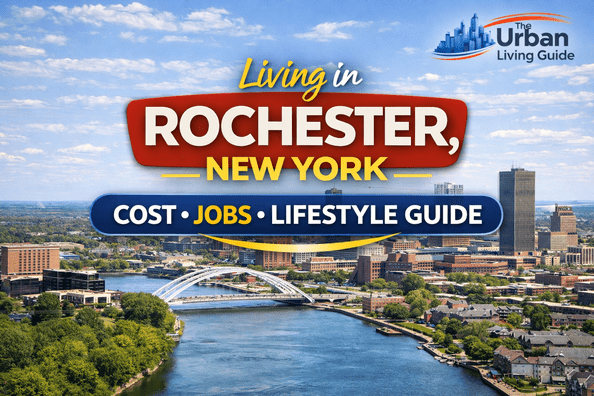
From Kodak Heritage to Lilac Festivals: What Life in Rochester, New York Really Costs in 2026
Stretching along the southern shore of Lake Ontario in western New York, Living in Rochester, New York offers a compelling blend of historic manufacturing innovation, world-class higher education, and a relaxed lakeside lifestyle. As the third-largest metropolitan area in the state after New York City and Buffalo, Rochester supports a city population of roughly 210,000 residents, while the greater metropolitan region exceeds 1 million people. Historically famous as a global center for optics and photography as the birthplace of Kodak, Xerox, and Bausch + Lomb, the city has successfully reinvented its economy around healthcare and technological research.
Relocating to the Flower City provides an appealing escape from the exorbitant housing pressures of coastal metropolitan areas while maintaining robust career opportunities. Propelled by massive anchor institutions like the University of Rochester and Rochester Regional Health, the local economy supports a stable, educated workforce that values affordability and cultural depth. However, thriving here requires adjusting to classic upstate New York winters driven by lake-effect snow patterns. Whether you are seeking a vibrant urban-suburban fusion in Park Avenue or a peaceful family setting in Brighton, Rochester delivers an exceptional quality of life.
What Makes Rochester So Popular & Unique
Rochester commands regional and national appeal because it seamlessly pairs rich industrial heritage with vibrant cultural traditions and beautiful natural landscapes. From hosting the world-famous Rochester International Jazz Festival and the historic annual Lilac Festival at Highland Park to offering miles of scenic Erie Canal trails, the city balances intellect with outdoor recreation. For newcomers looking to access municipal services, public utility maps, or community event schedules, the official City of Rochester portal serves as an essential digital gateway.
- Exceptional Higher Education: Home to globally prestigious research institutions, including the University of Rochester and the Rochester Institute of Technology (RIT).
- Unmatched Real Estate Affordability: Median home prices remain remarkably accessible, allowing families and young professionals to achieve homeownership with ease.
- World-Class Cultural Festivals: Celebrated as a premier music and arts destination hosting massive events like the Rochester International Jazz Festival.
- Lakeside Recreation: Immediate proximity to Lake Ontario, the Erie Canal, and the breathtaking wineries of the nearby Finger Lakes region.
Rochester at a Glance: Key Relocation Metrics
Reviewing these baseline statistics can help set realistic expectations for your relocation to Monroe County. These figures reflect current upstate New York market conditions and regional economic benchmarks.
| Metric | Rochester City Data | Metropolitan Context |
|---|---|---|
| City Population | ~210,000 Residents | Exceeds 1 Million across the greater metro area |
| Median Home Price | $230,000 – $320,000 | Significantly below national and coastal averages |
| Average 1BR Rent | $1,100 – $1,400 | Manageable rental entry points across most districts |
| Average Commute | 20 Minutes | Minimal traffic congestion across county expressways |
| Top Industries | Healthcare, Higher Ed, Optics, Tech | Advanced manufacturing, financial services, and retail |
Not sure where the city is? Check the map below to quickly understand its geographic position.
Famous Personalities, Civil Rights Icons & Major Brands in Rochester
Rochester’s cultural history is defined by monumental contributions to social justice, optical engineering, and global corporate innovation, creating a legacy that reaches far beyond upstate New York.
- Historical Icons: The city served as a vital crucible for American civil rights and suffrage, famously home to abolitionist leader Frederick Douglass and women’s rights pioneer Susan B. Anthony. It also produced Academy Award-winning actor Philip Seymour Hoffman.
- Professional Sports: Sports run deep through the community, with devoted fanbases supporting the Rochester Americans (AHL minor league hockey) and the Rochester Red Wings (MiLB minor league baseball).
- Corporate Footprint: The local economy is historically tied to world-changing pioneers like Kodak, Xerox, Bausch + Lomb, Paychex, and Wegmans.
Job Market & Business Opportunities with Major Employers
Rochester’s job market has successfully transitioned from a heavy manufacturing monoculture into a sophisticated, knowledge-based economy centered around healthcare administration, higher education, optics research, and professional services. Whether you are conducting scientific research at a university lab or managing corporate logistics, the local employment base offers strong stability.
Major corporate and institutional employers anchoring the regional economy include the University of Rochester, Rochester Regional Health, Paychex, and Wegmans Food Markets. Official economic reference data from the New York State Department of Labor highlights that while salary ceilings are more conservative than in New York City, your overall cost-of-living adjustment provides excellent real purchasing power.
- Entry-level roles: Typically range between $45,000 – $60,000 across administrative, healthcare support, and entry technical positions.
- Mid-career professionals: Generally span $65,000 – $95,000 for experienced nurses, engineers, and corporate analysts.
- Specialized tech and medical roles: Frequently scale to $100,000+, supporting comfortable upper-middle-class living.
Housing & Real Estate Overview in Rochester
Housing affordability stands as one of Rochester’s most powerful competitive advantages for newcomers. In 2026, median home prices across the city and immediate suburbs range comfortably between $230,000 and $320,000. This allows buyers to purchase stunning historic homes, craftsman colonials, or suburban properties for a fraction of what they would cost in downstate New York or New England.
The rental market remains accessible, offering diverse options across urban neighborhoods and family-oriented suburbs. Current average monthly rent projections are:
- Studio Apartment: $900 – $1,150
- 1 Bedroom Apartment: $1,100 – $1,400
- 2 Bedroom Apartment: $1,400 – $1,900
- Family Home Rentals: $2,000 – $3,000
Achieving homeownership in Rochester is entirely realistic for middle-income earners, making it a premier destination for individuals looking to build long-term real estate equity.
Best Neighborhoods in Rochester: Finding Your Ideal Community
Choosing the right neighborhood in Rochester defines your daily commute, social life, and architectural surroundings. Each district offers an entirely unique character. Neighborhood insights are based on local housing trends, safety reports, and resident surveys. The table below outlines the most prominent residential zones.
| Neighborhood / Category | Location, Pricing & Community Overview |
|---|---|
| Park Avenue (Lively & Walkable) | A vibrant, highly walkable neighborhood featuring historic homes, independent boutiques, sidewalk cafes, and a bustling arts-oriented community atmosphere. |
| Corn Hill (Historic & Scenic) | One of the city’s oldest and most picturesque residential districts, situated right along the Genesee River with beautifully preserved 19th-century architecture. |
| South Wedge (Creative & Trendy) | A progressive, creative community known for independent restaurants, craft cocktail bars, local coffee shops, and active neighborhood grassroots groups. |
| Highland Park (Scenic & Residential) | Surrounded by the famous Olmsted-designed park system, offering stunning arboretums, lilac gardens, and quiet, stable residential tree-lined streets. |
| Brighton (Suburban Family Hub) | An immensely popular first-ring suburb renowned for top-tier public school districts, safe residential developments, and convenient shopping centers. |
What It’s Really Like Living in Rochester (Daily Life & Vibe)
Daily life in Rochester moves at a calmer, more community-focused pace compared to major east coast megalopolises. Residents enjoy a relaxed routine filled with visits to local farmers markets, walks through Frederick Law Olmsted parks, and casual dining in neighborhood commercial districts like Park Avenue. The city’s compact geographic scale eliminates the punishing gridlock found in downstate metros, giving people their evenings back.
Summer and autumn bring an explosion of outdoor energy, featuring neighborhood art festivals, outdoor concerts, and weekend trips to the nearby Finger Lakes region for wine tasting and hiking. When winter arrives, locals embrace the snowy climate with winter sports and cozy community traditions. The combination of affordability, intellectual stimulation, and natural beauty creates an exceptionally balanced lifestyle.
Watch a recent video by a popular vlogger to understand daily life and vibes in Rochester:
Cost of Living in Rochester: Monthly Expenses & Salary Needs
Rochester offers a highly favorable cost of living that sits comfortably below the national average. Cost estimates are derived from official statistics and city-level cost databases. To maintain a secure, comfortable standard of living and achieve homeownership, an individual professional should target a salary of $60,000+, while households generally require $85,000+.
- Average Rent: ~$1,200 average across typical 1BR apartments.
- Monthly Utilities: $140 – $210 (Covering electricity, heating, and water).
- Groceries & Household Goods: Slightly below the national average.
- Transportation: Moderate monthly expenses for local transit or vehicle operation.
- Healthcare Costs: Aligned with national benchmarks, backed by world-class local health systems.
Transportation, Commute Dynamics & Transit Realities
Getting around Rochester is refreshingly simple and efficient. Key transit elements include:
- City Bus System: Operated by the Regional Transit Service (RTS), providing reliable bus routes across city neighborhoods and inner suburbs.
- Regional Connectivity: Easy access to Amtrak rail services and the Greater Rochester International Airport (ROC) for domestic travel.
- Short Commutes: The average daily commute time is an exceptionally manageable 20 minutes each way.
- Car Preference: While public transit serves urban corridors well, many residents prefer personal vehicles to navigate suburban shopping and winter weather.
Weather Patterns, Seasonal Realities & Climate Factors
Rochester experiences distinct four-season weather influenced heavily by its northern geography:
- Spring: Mild and rainy, bringing the city’s famous lilac bushes and arboretums back to brilliant color.
- Summer: Warm, pleasant, and sunny, offering ideal conditions for enjoying Lake Ontario beaches and outdoor park concerts.
- Autumn: Crisp, cool weather accompanied by breathtaking foliage across upstate New York state parks.
- Winter: Cold with regular snowfall totals driven by regional winter storms, requiring proper vehicle winterization and snow tires.
Education, Schools & Major Universities
Education serves as a massive economic and intellectual pillar for the entire region. Rochester hosts prestigious higher education institutions such as the University of Rochester, the Rochester Institute of Technology (RIT), and Nazareth University. For families navigating K-12 schooling, neighborhood options vary, with suburban districts like Brighton offering exceptional public school performance.
Medical Facilities, Hospitals & Healthcare Systems
Access to advanced, cutting-edge healthcare is one of Rochester’s strongest community assets. The metropolis is home to world-class medical institutions, including the University of Rochester Medical Center (URMC) and Rochester Regional Health networks. These premier hospital systems provide exceptional specialized care, pediatric units, and comprehensive medical research facilities locally.
Popular Hotels, Cafes, Dining & Culinary Scene
Rochester’s hospitality and culinary scene has expanded dramatically, blending historic brick architecture with innovative dining.
- Popular Hotels: Visitors and executive travelers frequently book stays at standout local properties like The Strathallan Hotel, Hyatt Regency Rochester, or the historic Inn on Broadway.
- Cafes & Social Hubs: Independent coffee roasters and artisan bakeries thrive in Park Avenue, South Wedge, and the East End District, acting as vibrant remote-work hubs.
- Restaurants: From upscale farm-to-table dining and historic diners to a booming local craft brewery culture, Rochester offers a diverse and welcoming culinary identity.
Sightseeing, Cultural Spots & Tourist Attractions
Residents live surrounded by remarkable cultural museums, scenic waterways, and historic American landmarks.
- High Falls Waterfall: A stunning 96-foot waterfall cascading through the historic industrial core of downtown Rochester.
- George Eastman Museum: The world’s oldest photography museum housed in the historic mansion of Kodak’s founder.
- Strong National Museum of Play: A world-class, interactive museum celebrating the history and exploration of play.
- Finger Lakes Region: Located just south of the city, offering world-class wineries, pristine lakes, and gorgeous hiking gorges.
Financial Realities: Pros and Cons of Living in Rochester
Every city requires compromise. Here is the unvarnished reality for anyone planning a move to Monroe County in 2026:
Pros:
- Exceptionally affordable housing and rental markets compared to major U.S. metros.
- World-class higher education institutions and robust research universities.
- A thriving healthcare sector offering stable, high-paying career opportunities.
- Abundant access to nature, Lake Ontario, and the Finger Lakes wine country.
- Short, stress-free daily commutes with minimal traffic congestion.
Cons:
- Cold winters featuring heavy seasonal snowfall requiring winter preparation.
- A smaller overall job market and salary ceiling compared to coastal hubs.
- A more modest late-night nightlife and entertainment infrastructure.
- Aging municipal infrastructure in certain older urban pockets.
- Upstate New York property tax burdens that require careful budgeting.
Who Is Rochester Ideal For (and Who Should Avoid It?)
Ideal For: First-time homebuyers seeking market entry, healthcare professionals, academic researchers, families wanting safe suburban schools, and outdoor enthusiasts who love lakes and wine country.
Who Should Avoid It: Individuals who despise cold snowy winters, corporate professionals requiring ultra-high finance salaries, and those craving massive coastal mega-city nightlife.
Real Experiences: Perspectives from Long-Term Residents (5 to 10+ Years)
Data gives you the metrics, but daily life gives you the truth. Here is what veteran locals have to say about navigating Rochester:
“Buying a charming historic home near Park Avenue for what a down payment costs in Boston or New York City felt like an absolute cheat code. The winters get long and grey by February, but the food scene, the indie coffee shops, and being twenty minutes from the Finger Lakes makes up for it tenfold.”
[Source: r/Rochester Community Discussions]
“If you’re in healthcare or tech, the job market here is surprisingly resilient. My commute across town is fifteen minutes, which gave me hours of my life back every week. It’s a smart, creative city that punches way above its weight class.”
[Source: Local Neighborhood Survey Threads]
Frequently Asked Questions About Living in Rochester, New York
Is Rochester, New York expensive to live in?
No, Rochester is widely considered one of the most affordable metropolitan areas in New York State, offering median home prices between $230,000 and $320,000.
What salary do you need to live comfortably in Rochester?
A single adult typically requires around $60,000 annually to live comfortably, while families generally need $85,000+ depending on housing choices and lifestyle.
Is Rochester safe to live in?
Safety varies significantly by neighborhood. Stable residential areas like Brighton, Park Avenue, and Corn Hill are widely considered safe and family-friendly.
Can you live in Rochester without a car?
While the RTS bus system serves urban neighborhoods well, most residents prefer owning a vehicle to navigate suburban errands and winter weather effectively.
What are the best neighborhoods for families in Rochester?
Brighton offers top-tier public schools, while Park Avenue and Highland Park provide walkable streets, historic homes, and strong community engagement.
How close is Rochester to the Finger Lakes?
The northern tip of the Finger Lakes region is located just a 30-to-40-minute drive south of Rochester, providing instant access to wineries and scenic hiking.
🔗 Explore More Cities in New York
If you’re exploring more options beyond Rochester, The Urban Living Guide has covered several other popular cities in New York. You can also check:
- Living in New York City, New York
- Living in Buffalo, New York
- Living in Albany, New York
- Living in Syracuse, New York
Before moving to Rochester, make sure you check:
- Cost of Living in Rochester, New York
- Pros and Cons of Living in Rochester, New York
- Best Neighborhoods in Rochester, New York
For everything you need in one place, read our complete guide: Moving to Rochester, New York
These guides give you a complete picture of what it’s like living across different cities, covering everything from cost of living, housing, and job opportunities to neighborhoods, commute, weather, education, popular places, and major employers.
The Urban Living Guide brings together these local insights in one place, helping you compare cities easily and make a confident, well-informed decision based on your lifestyle and goals.