

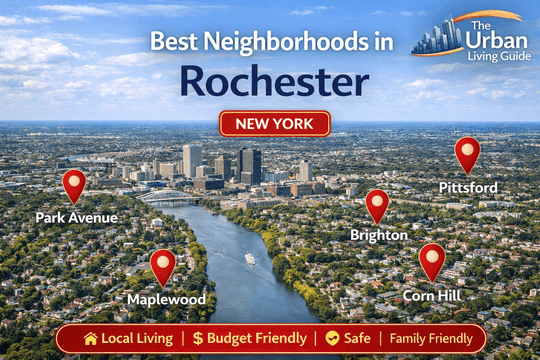
Best Neighborhoods in Rochester, New York: Historic Parkways, Canal Towns & Flower City Pockets in 2026
Covering approximately 35.8 square miles of land area along the southern shore of Lake Ontario bisected by the Genesee River in Monroe County, the City of Rochester operates under the mayor-council municipal administration of the City of Rochester. Housing a municipal core population exceeding 211,000 residents and anchoring a broader Finger Lakes regional metropolitan area of over 1.09 million people, “The Flower City” serves as a premier national center for optical imaging, photonics, higher education, medical sciences, and advanced manufacturing.
Relocating across Western New York requires evaluating neighborhood reinvestment trends, lake-effect winter precipitation patterns, and regional commuter highway networks overseen by the New York State Department of Transportation. Inbound movers consistently balance direct access to primary regional employers—including the University of Rochester Medical Center (URMC), Rochester Regional Health, corporate technology hubs, and academic campuses at the University of Rochester and the Rochester Institute of Technology (RIT)—against daily commute times across major expressways like Interstate 490, Interstate 390, Interstate 590, the Inner Loop, and New York State Route 104.
Watch this video to explore different neighborhoods, suburban corridors, and residential communities across Rochester:
Best Areas to Live in Rochester at a Glance in 2026
| Neighborhood Name | Location | Distance from Core (Downtown) | Development Status | Transit Connectivity | Cost Level | Best Fit For |
|---|---|---|---|---|---|---|
| Park Avenue | East Avenue Corridor | Approximately 1.5 miles east | Historic Walkable Arts & Dining Core | Exceptional (RTS Bus Network, I-490, East Ave) | Mid-to-High Range | Young Professionals, URMC Fellows & Creatives |
| Brighton | Southeast Suburban Ring (Town) | Approximately 4 miles southeast | Established Tree-Canopied Suburban | High (I-390, I-590, Monroe Ave) | Mid-to-High Range | Families, Medical Staff & University Faculty |
| Pittsford | Southeast Outer Suburbs (Village/Town) | Approximately 7.5 miles southeast | Historic Master-Planned Canal Village | High (I-490, I-90 / NYS Thruway, NY-31) | Ultra-Premium | Corporate Executives, Luxury Buyers & Families |
| Maplewood | Northwest River Basin | Approximately 3 miles northwest | Historic Olmsted-Planned Infill | High (Lake Ave, NY-104, RTS Buses) | Accessible / Budget-Friendly | First-Time Homebuyers, Renters & Value Seekers |
| Corn Hill | Southwest Riverfront Core | Approximately 0.5 miles southwest | Preserved Victorian Historic Landmark | Exceptional (Genesee Riverway Trail, I-490, Ford St) | Mid-to-High Range | Urbanites, Architecture Enthusiasts & Downtown Staff |
Best Neighborhoods in Rochester Discussed in Detail
Park Avenue — Walkable Cultural Epicenter, Victorian Flats & Independent Bistros
Stretching along Park Avenue between Alexander Street and Culver Road in southeast Rochester, the Park Avenue Neighborhood is widely regarded as the city’s most vibrant and pedestrian-friendly enclave. Operating with civic stewardship from the Park Central Neighborhood Association within the City of Rochester, the district is defined by preserved turn-of-the-century architecture, tree-lined side streets, independent coffee roasters, art galleries, and acclaimed sidewalk dining.
Bordering the prestigious cultural institutions of the Neighborhood of the Arts (NOTA) and the mansions along East Avenue, Park Avenue delivers a lively, car-optional lifestyle popular with young professionals and healthcare specialists.
- Housing: Architectural inventory features restored 19th-century Victorian single-family homes, classic Rochester double-decker apartment flats, converted brick carriage houses, and modern boutique condominium infill. Property purchase prices typically range from $220,000 to $540,000+, while 1-to-2-bedroom rental flats average $1,250 to $2,100 per month.
- Safety & Crime Rate: Patrolled by the Rochester Police Department (RPD) Eastside Section. Park Avenue maintains high pedestrian activity and safe commercial corridors, though non-violent opportunistic property larceny and bicycle thefts occur on busier residential blocks.
- School District & Education Quality: Governed by the Rochester City School District (RCSD), containing nearby magnet options like School of the Arts (SOTA), alongside prestigious private institutions like The Harley School and higher education at the nearby Eastman School of Music.
- Walkability & Daily Conveniences: Outstanding pedestrian walkability (Walk Score of 88-92/100). Residents easily stroll to indie bookshops, artisan bakeries, cocktail lounges, local markets, and grocers including Wegmans on East Avenue and the historic Rochester Public Market located a short bike ride north.
- Parks & Green Spaces / Pet-Friendliness: Direct access to the landscaped grounds of the George Eastman Museum, Memorial Art Gallery (MAG) Sculpture Park, and nearby recreation at the 150-acre Cobbs Hill Park (featuring reservoir walking loops, tennis courts, and skyline sunset views). Exceptionally dog-friendly.
- Parking & Traffic Congestion: Street parking is strictly managed through alternate-side parking regulations to allow for city snowplows during winter; off-street driveway parking adds substantial property value. Commuter traffic slows along Park Avenue and Monroe Avenue during weekend dining peaks.
- Noise Levels & Vibe: Energetic, creative, and social, filled with outdoor patio dining conversations, university fellows, and active neighborhood events like the annual Park Avenue Summer Art Festival.
- Medical Facilities & Hospitals: Direct 5-to-7 minute drive to comprehensive healthcare networks at the University of Rochester Medical Center (Strong Memorial Hospital) and Highland Hospital on South Avenue.
- Transit Connectivity: Served by high-frequency Regional Transit Service (RTS) Bus Routes (including Route 11 and Route 12), offering rapid 5-minute transit into Downtown Rochester, with immediate vehicular access to Interstate 490 (Exits 17 and 18).
- Affordability: Mid-to-high urban pricing tier for Monroe County; strong rental demand from university and medical fellows maintains solid real estate appreciation.
- Who It’s Best For: Young professionals, URMC medical residents, design creatives, culinary enthusiasts, and buyers seeking an active urban community.
- Drawbacks: Limited street parking during winter snow bans, older historic home heating overhead, and high rental competition during peak academic turnover in August.
Brighton — Top-Ranked Public Schools, Academic Enclaves & Suburban Tree Canopies
Situated directly southeast of the Rochester city limits in central Monroe County, the incorporated town of Brighton operates under its own municipal administration via the Town of Brighton Official Portal. Developed throughout the 20th century around premier residential subdivisions (such as Home Acres, Council Rock, and Roselawn), Brighton is celebrated for its mature oak canopies, exceptionally low crime rates, and proximity to major universities and healthcare campuses.
The town provides an established suburban setting with well-maintained public parks, making it the top destination for relocating physicians, academic researchers, and growing families.
- Housing: Real estate stock spans classic 1920s–1940s brick Tudors, Colonial Revival single-family estates, Mid-Century Modern ranches, and contemporary luxury townhomes. Single-family purchase prices typically range from $260,000 to $680,000+, while residential rentals average $1,450 to $2,600 per month.
- Safety & Crime Rate: Protected by the dedicated Brighton Police Department, the town consistently records one of the lowest violent and property crime rates in Upstate New York, supported by proactive neighborhood patrols and rapid emergency dispatch services.
- School District & Education Quality: Governed by the nationally acclaimed Brighton Central School District, featuring top-ranked public institutions such as Brighton High School, Twelve Corners Middle School, and French Road Elementary School.
- Walkability & Daily Conveniences: The central commercial hub at Twelve Corners (Monroe Avenue and Elmwood Avenue) is pedestrian-friendly, offering local bakeries, specialty pharmacies, bagel shops, and direct access to Wegmans Supermarket on Monroe Avenue and Trader Joe’s on Pittsford Plaza.
- Parks & Green Spaces / Pet-Friendliness: Exceptional community parklands including Corbett’s Glen Nature Park (featuring scenic waterfall trails and wetlands), Buckland Park, Meridian Centre Park, and walking paths along the historic Erie Canalway Trail. Exceptionally pet-friendly.
- Parking & Traffic Congestion: Plentiful private two-car garages and wide suburban driveways keep residential streets clear. Commuter traffic builds along Monroe Avenue (NY-31) and the I-590 Interchange during morning rush hours.
- Noise Levels & Vibe: Serene, academic, and family-centered, characterized by quiet cul-de-sacs, children riding bicycles, and calm residential evenings.
- Medical Facilities & Hospitals: Unrivaled medical proximity: 4-minute direct access to Strong Memorial Hospital, Golisano Children’s Hospital, and the Wilmot Cancer Institute.
- Transit Connectivity: Outstanding highway positioning at the junction of Interstate 390, Interstate 590, and NY Route 31, providing a 7-minute drive to Downtown Rochester and 10 minutes to Frederick Douglass Greater Rochester International Airport.
- Affordability: Mid-to-high price profile; higher school property taxes are balanced by top-tier public school performance, pristine municipal infrastructure, and strong property values.
- Who It’s Best For: Families prioritizing public education, physicians and medical staff at URMC, university professors, and buyers seeking established suburban neighborhoods close to city amenities.
- Drawbacks: Higher town and school property tax millage rates, heavy shopping traffic along the Monroe Avenue retail corridor, and limited starter-home inventory.
Pittsford — Historic Erie Canal Village, Luxury Estates & Premier Suburban Prestige
Positioned along the historic banks of the Erie Canal in southeastern Monroe County, the town and incorporated village of Pittsford represents the premier luxury suburban community in the Greater Rochester region. Operating under municipal administration through the Town of Pittsford, the community blends 19th-century canal village heritage with prestigious master-planned golf subdivisions and luxury estate developments.
Celebrated for its preserved waterfront boutique shops on North Main Street, fine dining, and tree-lined streets, Pittsford provides an upscale lifestyle with top-tier public education.
- Housing: Real estate is composed of historic 19th-century Federal and Greek Revival homes in the village, custom-built brick luxury estates on multi-acre wooded parcels, and golf-front residences in communities like Oak Hill and Locust Hill. Single-family purchase prices typically range from $380,000 to $1,800,000+, while luxury village apartments average $1,850 to $3,400 per month.
- Safety & Crime Rate: Patrolled by the Monroe County Sheriff’s Office (MCSO) Zone A and supported by town public safety, Pittsford consistently reports negligible violent crime and exceptionally low property crime statistics.
- School District & Education Quality: Governed by the elite Pittsford Central School District, containing top-performing campuses such as Pittsford Mendon High School, Pittsford Sutherland High School, and Barker Road Middle School, alongside higher education at St. John Fisher University and Nazareth University.
- Walkability & Daily Conveniences: The historic Village of Pittsford along Schoen Place is highly walkable, featuring waterfront bistros, ice cream parlors, craft coffee houses, and specialty retail, while the nearby Pittsford Plaza hosts Flagship Wegmans Supermarket, Trader Joe’s, and department stores.
- Parks & Green Spaces / Pet-Friendliness: World-class natural recreation centered along the Erie Canalway Trail (popular for jogging, cycling, and rowing), Mendon Ponds Park (a 2,500-acre county park featuring glacial landforms, hiking, and winter cross-country skiing), Great Embankment Park, and the championship fairways of Oak Hill Country Club (host of multiple PGA Championships). Extremely pet-friendly.
- Parking & Traffic Congestion: Generous two-to-three car garages and expansive circular driveways keep neighborhood lanes clear. Traffic slows along Monroe Avenue (NY-31) and Main Street during afternoon commute hours.
- Noise Levels & Vibe: Refined, quiet, and exclusive, characterized by canal boat horns, manicured estate lawns, and peaceful evenings.
- Medical Facilities & Hospitals: Direct 10-minute drive via I-490/I-590 to Strong Memorial Hospital and Highland Hospital.
- Transit Connectivity: Road travel connects via Interstate 490 (Exit 26), Route 31 (Monroe Ave), and Route 96, offering a 12-minute drive to Downtown Rochester and 8 minutes to the New York State Thruway (I-90 Exit 45).
- Affordability: Ultra-premium price tier for the Upstate New York market; higher real estate acquisition costs and property taxes reflect the community’s premier public schools, safety, and village amenities.
- Who It’s Best For: Corporate executives, legal partners, medical practice directors, golf enthusiasts, and families seeking top-tier public school clusters.
- Drawbacks: High property tax burdens, substantial purchase price entry barriers, and longer driving distances to western Rochester employment centers.
Maplewood — Historic Olmsted Parkways, Rose Gardens & Accessible Riverfront Living
Situated in northwestern Rochester along the western gorge of the Genesee River, the Maplewood Historic District is one of the city’s most architecturally significant and affordable residential neighborhoods. Master-planned in the late 19th and early 20th centuries around the park systems designed by Frederick Law Olmsted, the community centers along Lake Avenue, Maplewood Avenue, and Seneca Parkway. Operating under City of Rochester municipal administration and supported by the Maplewood Neighborhood Association, the area features grand historic homes, scenic river gorges, and budget-accessible starter properties.
The neighborhood provides an affordable entry point for first-time homebuyers and renters seeking character-rich architecture within minutes of major employment hubs.
- Housing: Architectural inventory features grand early 20th-century American Foursquares, Tudor Revival brick residences on Seneca Parkway, Craftsman bungalows, and multi-family duplexes. Single-family purchase prices typically range from $95,000 to $240,000, while rental apartments and flats average $800 to $1,350 per month.
- Safety & Crime Rate: Patrolled by the RPD Westside Section. Residential stability and safety vary from street to street, with the historic Seneca Parkway and Maplewood Park residential tracts maintaining active block clubs and calmer conditions compared to peripheral commercial corridors along Lake Avenue.
- School District & Education Quality: Governed by the Rochester City School District, containing neighborhood institutions such as School 41 and School 7, alongside public charter academies and nearby higher education at Bryant & Stratton College.
- Walkability & Daily Conveniences: Moderate pedestrian walkability along commercial corridors on Lake Avenue and Dewey Avenue, featuring local corner markets, family diners, bakeries, and service shops, with major shopping plazas accessible via NY-104 (West Ridge Road).
- Parks & Green Spaces / Pet-Friendliness: Outstanding natural amenities anchored by the historic Maplewood Park and Rose Garden (featuring over 3,000 rose bushes and the annual Rochester Rose Festival), the Genesee River Gorge Trails (offering dramatic waterfall views at Lower Falls), and direct access to the Genesee Riverway Trail. Exceptionally pet-friendly.
- Parking & Traffic Congestion: Plentiful private residential driveways, detached carriage garages, and open on-street parking. Surface traffic along Lake Avenue and NY-104 moves efficiently with minimal rush-hour delays.
- Noise Levels & Vibe: Community-oriented, historic, and relaxed, shifting from commercial daytime avenues to quiet, shaded residential evenings.
- Medical Facilities & Hospitals: Direct 5-minute access across the river to Rochester General Hospital on Portland Avenue and 10 minutes to URMC.
- Transit Connectivity: High-frequency public transit provided by RTS Bus Routes (Route 22 along Lake Ave) connecting directly to the Downtown Transit Center, with rapid vehicle access to NY-104 and the Lake Ontario State Parkway.
- Affordability: Rochester’s most accessible historic homeownership and rental price tier, offering substantial interior square footage, natural woodwork, and large lots at entry-level pricing.
- Who It’s Best For: First-time homebuyers, historic preservationists on a budget, artists, healthcare workers at Rochester General, and buyers seeking parkland proximity.
- Drawbacks: Pockets of deferred home maintenance, street-by-street variation in property upkeep, variable city school test ratings, and older home mechanical systems requiring modernization.
Corn Hill — Preserved Victorian Charm, Riverfront Promenades & Downtown Proximity
Covering the historic riverfront bend immediately southwest of Downtown Rochester along the Genesee River, Corn Hill (originally known as the Third Ward) is Rochester’s oldest residential neighborhood. Recognized as one of the most intact Victorian residential districts in the nation, Corn Hill operates under city preservation guidelines and is championed by the Corn Hill Neighbors Association. Defined by brick sidewalks, historic gas lamps, restored gingerbread woodwork, and contemporary riverfront townhomes, Corn Hill combines historic charm with a short walk to the central business district.
The neighborhood is popular among urbanites, university staff, and downtown professionals seeking a tight-knit community surrounded by river trails.
- Housing: Real estate stock features exquisitely restored 19th-century Victorian homes (Italianate, Queen Anne, and Gothic Revival styles), historic brick row houses, and modern riverfront townhomes built along Exchange Boulevard. Single-family and townhome purchase prices typically range from $190,000 to $480,000, while rental apartments and carriage flats average $1,150 to $1,850 per month.
- Safety & Crime Rate: Patrolled by the RPD Central Section. Corn Hill benefits from an active neighborhood association, neighborhood security patrols, and high residential cohesion, resulting in lower crime rates than adjacent inner-city districts.
- School District & Education Quality: Governed by the Rochester City School District, containing neighborhood institutions like School 29, while being minutes from higher-education campuses including the University of Rochester River Campus (connected via the river trail pedestrian bridge).
- Walkability & Daily Conveniences: Outstanding pedestrian infrastructure (Walk Score of 82-86/100). Residents comfortably walk across the river into Downtown Rochester for concerts at Blue Cross Arena, local dining, coffee shops, and the vibrant annual Corn Hill Arts Festival.
- Parks & Green Spaces / Pet-Friendliness: Direct pedestrian access to the paved Genesee Riverway Trail (connecting south to the UR campus and north to High Falls), Corn Hill Landing (featuring boat docks, riverfront gazebos, and kayak rentals), and Lunsford Park. Highly pet-friendly with walkable riverside promenades.
- Parking & Traffic Congestion: Private residential driveways, courtyard garages, and permitted on-street parking. Surface street traffic flows smoothly, with rapid access to Interstate 490 (Plymouth Ave / Ford St exits).
- Noise Levels & Vibe: Historic, peaceful, and community-focused, characterized by neighborhood front-porch gatherings, passing river cyclists, and quiet evenings.
- Medical Facilities & Hospitals: Direct 5-minute commute south along the river to Strong Memorial Hospital and Highland Hospital.
- Transit Connectivity: Unrivaled multi-modal transit: 10-minute walk into Downtown Rochester, direct bike trail connectivity, RTS bus routes, and immediate vehicular on-ramps to I-490 and Interstate 390. Rail transit is served via the Rochester Louise M. Slaughter Amtrak Station located 1.5 miles north, with flights via Frederick Douglass Greater Rochester International Airport (ROC) 4 miles southwest.
- Affordability: Accessible mid-range price structure; offers historic architectural pedigree, riverfront views, and downtown convenience at price points substantially lower than larger metropolitan centers.
- Who It’s Best For: University of Rochester faculty and graduate students, downtown corporate and legal professionals, historic architecture lovers, and urban commuters.
- Drawbacks: Limited grocery supermarket options directly within the historic core, competitive housing inventory when historic properties list for sale, and winter heating maintenance on older vintage homes.
Comprehensive Neighborhood Pros and Cons Comparison
| Neighborhood | Core Advantages (Pros) | Core Limitations (Cons) |
|---|---|---|
| Park Avenue | High walkability to dining, cafes, and boutiques; vibrant arts scene near NOTA; direct access to Cobbs Hill Park; 5 minutes to URMC. | Competitive street parking during winter snow bans; older home heating costs; peak-season rental turnover competition. |
| Brighton | Top-rated Brighton Central public school district; dedicated town police; 4-minute commute to Strong Memorial Hospital; Corbett’s Glen park. | Higher property tax millage rates; commercial traffic on Monroe Avenue; limited starter-home inventory. |
| Pittsford | Historic Erie Canal waterfront at Schoen Place; top-performing Pittsford Mendon/Sutherland high schools; luxury estates; lowest crime. | Highest real estate acquisition costs in the region; high property taxes; longer commute to western employment hubs. |
| Maplewood | Rochester’s most accessible historic home pricing; Frederick Law Olmsted parklands at Maplewood Rose Garden; Genesee River Gorge trails. | Street-by-street variance in property upkeep; variable public school performance; older home mechanical systems requiring updates. |
| Corn Hill | Preserved Victorian architecture; direct access to the Genesee Riverway Trail; walkable commute into Downtown Rochester; annual arts festival. | Lack of large grocery supermarkets directly in the core; limited single-family home inventory; historic preservation guidelines. |
How You Decide Which Neighborhood Is Best For You
Selecting your ideal neighborhood in Rochester requires balancing your gross household budget with daily employment destinations, family schooling priorities, and winter weather realities. Because the Rochester metropolitan area is interconnected by express highway loops like Interstate 490, Interstate 390, and Interstate 590, your chosen location dictates whether your daily commute takes 8 minutes via express highway or involves arterial surface driving along corridors like Monroe Avenue or Lake Avenue.
Healthcare professionals and medical fellows at URMC (Strong Memorial) or Rochester Regional Health, professors and researchers at the University of Rochester or RIT, corporate employees in Downtown Rochester, and technology specialists along the photonics corridor should evaluate transit routes to optimize daily convenience.
Beyond commuter corridors, evaluate essential municipal utility and building infrastructure realities. Western New York experiences freezing winter temperatures with lake-effect snowfall, making home heating efficiency, insulation, and utility reliability through Rochester Gas and Electric (RG&E) an important consideration.
In addition, prospective homebuyers evaluating historic Victorian homes in Park Avenue, Corn Hill, or Maplewood should budget for seasonal maintenance and furnace updates, while buyers in Brighton or Pittsford should verify town and school district property tax assessments. Before executing a lease or purchase agreement, verify high-speed fiber broadband availability (such as Greenlight Networks or Spectrum Gigabit) and confirm county school assignment boundaries.
Frequently Asked Questions About Rochester Neighborhoods
Which neighborhood in Rochester is considered best for families with school-age children?
Brighton and Pittsford are widely regarded as the premier family communities in Greater Rochester. Brighton provides access to the top-ranked Brighton Central School District (including Brighton High School) alongside safe, tree-lined residential neighborhoods and quick access to URMC. Pittsford offers elite public education through the Pittsford Central School District (Pittsford Mendon and Sutherland High Schools) paired with historic canal village charm and extensive parks.
What is the most walkable neighborhood in Rochester where you can live without relying heavily on a car?
Park Avenue and Corn Hill offer the highest walkability in Rochester, both scoring above 82 on Walk Score. Park Avenue allows residents to complete daily errands on foot, walk to local cafes, bakeries, art galleries, and grocery markets like Wegmans on East Avenue. Corn Hill offers direct pedestrian and cycling access along the Genesee Riverway Trail into Downtown Rochester and the University of Rochester River Campus.
What are the safest residential neighborhoods to live in within Greater Rochester?
Pittsford and Brighton consistently report the lowest violent and property crime rates in Monroe County. Pittsford benefits from dedicated Monroe County Sheriff patrols and minimal pass-through traffic, while Brighton maintains its own professional municipal police department with rapid emergency response times.
What are the most affordable neighborhoods for homebuyers and renters in Rochester?
Maplewood, the 19th Ward, and parts of North Rochester provide the most budget-friendly housing opportunities in the area. In Maplewood, buyers and renters can secure historic single-family homes and duplex apartments at entry-level price points substantially lower than regional and national averages.
How bad is lake-effect snow when commuting across Rochester neighborhoods?
Lake-effect snowfall in Rochester varies depending on storm tracks off Lake Ontario, but the city and Monroe County operate comprehensive snowplow fleets across major expressways like I-490, I-390, and I-590. Having a vehicle equipped with all-season or winter snow tires ensures dependable travel during winter months.
Which Rochester neighborhood is best for healthcare professionals working at URMC or Strong Memorial?
Brighton, Park Avenue, and Corn Hill provide the fastest and most convenient commutes to the University of Rochester Medical Center (Strong Memorial Hospital and Golisano Children’s Hospital), allowing physicians, medical residents, and nurses to reach the medical campus within a 4-to-8 minute drive, bike ride, or RTS bus trip.
Is Rochester an affordable place to live compared to New York City?
Yes, Rochester’s overall cost of living and housing prices are significantly lower than New York City, offering spacious historic homes, lower rental rates, and large residential lots at a fraction of downstate real estate prices.
Relocation Resources & Living Guides
The Urban Living Guide creates deeply researched, practical, and informative city relocation resources designed to help individuals, working professionals, and families navigate complex urban landscapes. By analyzing municipal infrastructure, hyper-local zoning patterns, commuter realities, and housing markets, our guides provide actionable insights so you can make confident, data-backed decisions when moving to major metropolitan areas.
Explore our regional guides across Rochester and the Finger Lakes region:
- Living in Rochester, New York
- Cost of Living in Rochester, New York
- Pros and Cons of Living in Rochester, New York
Made your decision to move to the Flower City? Read our comprehensive relocation roadmap: Moving to Rochester, New York.
Follow The Urban Living Guide for ongoing regional insights, neighborhood developments, and expert local coverage across Greater Rochester and the state of New York.