

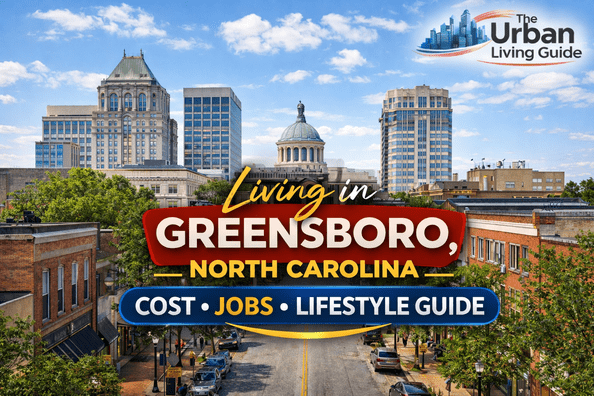
From Piedmont Triad Roots to Aviation Innovation: What Living in Greensboro Actually Feels Like in 2026
Nestled in the heart of North Carolina’s rolling Piedmont Triad region alongside Winston-Salem and High Point, Living in Greensboro, North Carolina offers a peaceful, highly affordable, and community-centered lifestyle compared to the frantic pace of Charlotte or Raleigh. As the state’s third-largest city, Greensboro supports a population of over 300,000 residents, anchoring a thriving metropolitan area exceeding 750,000 people.
Relocating to the Gate City places you in a practical, stable environment that has successfully transitioned from its textile and furniture manufacturing roots into a diverse hub for aerospace, aviation logistics, higher education, and advanced healthcare. Propelled by world-class employers like the Honda Aircraft Company, Cone Health, and the University of North Carolina at Greensboro (UNCG), the local economy supports stable careers while maintaining housing costs well below national averages. However, thriving here requires adjusting to suburban car dependency and a quieter nightlife scene. Whether you want a historic estate in Irving Park or a family-friendly haven in Northwest Greensboro, the city delivers an exceptionally welcoming and practical lifestyle.
What Makes Greensboro So Popular & Unique
Greensboro commands regional attention because it provides an accessible, family-friendly environment with exceptional housing affordability and a central location within North Carolina, putting both the Blue Ridge Mountains and Atlantic beaches within a comfortable few hours’ drive. Centered around its robust educational institutions and expanding aviation sector, the city functions as a welcoming residential anchor for Guilford County. For newcomers looking to access municipal services, utility maps, or community event schedules, the official City of Greensboro portal serves as an essential digital gateway.
- The Piedmont Triad Core: Part of a major economic triad alongside Winston-Salem and High Point, offering interconnected employment markets.
- Aerospace & Aviation Hub: Home to major industrial operations including the Honda Aircraft Company manufacturing campus.
- Exceptional Housing Affordability: Median home prices remain remarkably accessible, allowing families and first-time buyers to build real estate equity easily.
- Academic Excellence: Anchored by major educational institutions like UNCG and North Carolina A&T State University.
Greensboro at a Glance: Key Relocation Metrics
Reviewing these baseline statistics helps establish realistic expectations for your transition to Guilford County. These figures reflect current North Carolina market conditions and regional economic benchmarks.
| Metric | Greensboro City Data | Metropolitan Context |
|---|---|---|
| City Population | Over 300,000 Residents | Exceeds 750,000 across the Piedmont Triad metro area |
| Median Home Price | $300,000 – $360,000 | Significantly below Raleigh and Charlotte real estate medians |
| Average 1BR Rent | $1,100 – $1,400 | Extremely manageable rental entry points across urban and suburban districts |
| Average Commute | 20 – 25 Minutes | Minimal traffic congestion compared to larger North Carolina metropolises |
| Top Industries | Aviation, Healthcare, Logistics, Higher Ed, Manufacturing | Textiles heritage, corporate retail, and distribution services |
Not sure where the city is? Check the map below to quickly understand its geographic position.
Famous Personalities, Civil Rights History & Major Brands in Greensboro
Greensboro’s cultural footprint is heavily shaped by monumental moments in American civil rights history, collegiate athletic excellence, and global aviation and health networks.
- Historical Legacy: Internationally renowned as a historic focal point of the American Civil Rights Movement, famously marked by the 1960 Woolworth’s lunch counter sit-ins.
- Athletic & Cultural Footprint: Home to deep academic traditions at North Carolina A&T State University (the largest HBCU in the nation) and fierce ACC basketball culture.
- Corporate Powerhouses: The regional economy acts as the command center for world-class enterprises like the Honda Aircraft Company, Cone Health, and apparel giant VF Corporation.
Job Market & Business Opportunities with Major Employers
Greensboro features a stable, industrial- and healthcare-driven job market anchored by aerospace manufacturing, regional distribution logistics, and higher education. Whether you are building advanced aircraft structures or practicing clinical medicine, professional opportunities here offer dependable middle-class security.
Key employers driving local prosperity include the Honda Aircraft Company, Cone Health, VF Corporation, and UNCG. Official economic reference data from the North Carolina Department of Commerce highlights that average salaries typically range between $65,000 and $90,000 annually for mid-level professionals, providing solid purchasing power relative to housing costs.
- Entry-level salaries: Typically range between $45,000 – $60,000 across logistics, healthcare support, and entry manufacturing roles.
- Mid-career professionals: Generally span $65,000 – $90,000 for experienced nurses, aerospace technicians, and educators.
- Senior healthcare or specialized engineering roles: Frequently scale to $100,000+, supporting comfortable homeownership across Guilford County.
Housing & Real Estate Overview in Greensboro
Housing affordability stands as one of Greensboro’s most powerful competitive assets for relocating families and professionals. In 2026, median home prices range between $300,000 and $360,000, allowing buyers to acquire historic estates in Irving Park or spacious suburban single-family homes for a fraction of what they cost in Charlotte or Raleigh.
The rental market remains accessible, offering diverse options across urban cores and peaceful suburban fringes. Current average monthly rent projections are:
- Studio Apartment: $950 – $1,200
- 1 Bedroom Apartment: $1,100 – $1,400
- 2 Bedroom Apartment: $1,400 – $1,800
- Family Home Rentals: $1,900 – $2,700+
Achieving homeownership in Greensboro is entirely realistic for middle-income earners, making it a premier destination for individuals looking to build long-term real estate equity without excessive financial pressure.
Best Neighborhoods in Greensboro: Finding Your Ideal Community
Choosing the right neighborhood in Greensboro defines your daily commute, school access, and architectural surroundings. Each district offers an entirely unique character. Neighborhood insights are based on local housing trends, safety reports, and resident surveys. The table below outlines the most prominent residential zones.
| Neighborhood / Category | Location, Pricing & Community Overview |
|---|---|
| Irving Park (Historic & Premium) | One of the most established and prestigious neighborhoods in Greensboro. Features large historic homes, mature tree-lined streets, and proximity to the Greensboro Country Club. Median home price: $600,000+. |
| Lake Jeanette (Upscale Lakeside) | An upscale lakeside community featuring newer executive homes, planned residential developments, and water-recreation access. |
| Northwest Greensboro (Family-Friendly) | Extremely popular among families seeking highly rated public school catchments, safe suburban planning, and modern single-family housing. |
| Downtown Greensboro (Urban Core) | A revitalized urban center offering local craft breweries, independent restaurants, loft apartments, and community entertainment venues. |
| Lindley Park (Academic & Historic) | Located close to UNCG, featuring historic bungalows, walkable streets, and a popular community vibe among younger residents and students. |
What It’s Really Like Living in Greensboro, North Carolina (Daily Life & Vibe)
Daily life in Greensboro feels slower, more practical, and considerably less congested than Raleigh or Charlotte. Commutes are straightforward and manageable, usually hovering around 20 to 25 minutes, and residential neighborhoods are remarkably quiet. The social environment is welcoming, practical, and community-focused rather than corporate-driven or intensely competitive.
Weekends are typically spent attending local college sports games, visiting craft breweries, walking through city parks, or participating in community festivals. While downtown has grown steadily with new dining and entertainment options, nighttime entertainment remains modest. Overall, life here feels stable, comfortable, and oriented toward personal balance rather than fast-paced urban intensity.
Watch a recent video by a popular vlogger to understand daily life and vibes in Greensboro:
Cost of Living in Greensboro: Monthly Expenses & Salary Needs
Greensboro offers a highly favorable cost of living that sits comfortably below national U.S. averages and provides stronger purchasing power than North Carolina’s larger metro areas. Cost estimates are derived from official statistics and city-level cost databases. To maintain a secure, comfortable standard of living and achieve homeownership, an individual professional should target a salary of $65,000+, while households generally require $95,000 to $110,000+.
- Average Rent: ~$1,250 for a typical 1BR apartment.
- Monthly Utilities: $140 – $190 (Covering electricity, water, and heating).
- Groceries & Household Goods: $320 – $400 per month for a single person.
- Transportation: $250+ per month due to necessary personal vehicle operating expenses.
- Healthcare Costs: Varies by employer coverage, supported by major regional networks like Cone Health.
Transportation, Commute Dynamics & Transit Realities
Getting around Greensboro and connecting to the wider Piedmont Triad involves a primarily car-oriented transit network:
- Road Networks & Commuting: Excellent highway connectivity anchored by I-40, I-85, and US-220, keeping average daily commutes around a manageable 20 to 25 minutes.
- Public Transit: GTA (Greensboro Transit Authority) provides local bus service, though options remain limited compared to larger metropolitan networks.
- Airport Connectivity: Piedmont Triad International Airport (PTI) provides convenient domestic and regional flight connectivity right in the Triad.
- Car Dependency: Most residents rely on personal vehicles for daily errands, school drop-offs, and commuting across the Triad region.
Weather Patterns, Seasonal Realities & Climate Factors
Greensboro experiences a pleasant humid subtropical climate featuring four distinct seasons:
- Spring: Mild temperatures and blossoming flora, offering wonderful conditions for exploring parks and outdoor greenways.
- Summer: Hot and humid with daytime temperatures regularly pushing into the upper 80s and 90s.
- Autumn: Crisp, comfortable weather accompanied by stunning fall foliage across Piedmont parks.
- Winter: Mild with very little snowfall and occasional cold snaps.
- Climate Reference: Official meteorological tracking and climate data are provided by the National Weather Service North Carolina region.
Education, Schools & Major Universities
Education serves as a massive intellectual and economic pillar for the entire region. Greensboro hosts prestigious higher education institutions such as the University of North Carolina at Greensboro (UNCG), North Carolina A&T State University, and Guilford College. For families navigating K-12 schooling, neighborhood options vary, with suburban districts in Northwest Greensboro offering strong academic performance.
Medical Facilities, Hospitals & Healthcare Systems
Access to advanced, cutting-edge healthcare is one of Greensboro’s premier community advantages. The city is home to major medical centers and research hospitals, anchored by Cone Health. This premier health network provides comprehensive emergency care, specialized surgical units, and wellness clinics locally across Guilford County.
Popular Hotels, Cafes, Dining & Culinary Scene
Greensboro’s hospitality and culinary scene blends traditional Southern comfort with an expanding local cafe and brewery culture.
- Popular Hotels: Out-of-town visitors and corporate travelers frequently book stays at standout local properties like the Proximity Hotel, O.Henry Hotel, or downtown Marriott properties.
- Cafes & Social Hubs: Independent coffee roasters and artisan bakeries thrive throughout downtown and Lindley Park, acting as popular morning meeting spots.
- Restaurants: From historic local diners and Southern barbecue joints to upscale dining in Irving Park, Greensboro’s food scene is practical, diverse, and welcoming.
Sightseeing, Cultural Spots & Tourist Attractions
Residents live surrounded by interactive science museums, historic gardens, and sprawling recreational parklands.
- Greensboro Science Center: A premier family attraction featuring an aquarium, zoo, museum, and an indoor ropes course.
- Stan Hywet & Local Historic Sites: Rich cultural landmarks celebrating the region’s textile manufacturing and civil rights heritage, including the International Civil Rights Center & Museum.
- Guilford Courthouse National Military Park: A magnificent protected park preserving a major Revolutionary War battlefield with scenic walking trails.
- Emerald Pointe Water Park: A massive seasonal water park offering thrilling slides and wave pools for family recreation.
Regional Trade-offs: Pros and Cons of Living in Greensboro
Every major city requires compromise. Here is the unvarnished reality for anyone planning a move to the Gate City in 2026:
Pros:
- Exceptional housing affordability compared to Charlotte and Raleigh.
- Manageable traffic congestion and short 20-to-25-minute commutes.
- Stable employment sectors in healthcare, aviation, and higher education.
- Family-friendly residential neighborhoods and safe suburban enclaves.
- Central North Carolina location providing easy weekend access to both mountains and beaches.
Cons:
- High car dependency outside of local neighborhood pockets.
- Hot, humid summer weather requiring robust air conditioning.
- A more modest nightlife and entertainment infrastructure than larger hubs.
- Slower economic growth and fewer high-paying tech jobs compared to Raleigh.
- Income disparities across certain urban residential streets.
Who Is Greensboro Ideal For (and Who Should Avoid It?)
- Ideal For: Families seeking long-term affordability, healthcare workers, aviation professionals, educators, retirees, and remote workers wanting space and lower housing pressure.
- Who Should Avoid It: Individuals seeking massive tech ecosystems, corporate high-finance salaries, extensive public transit networks, or a high-energy big-city nightlife scene.
Real Experiences: Perspectives from Long-Term Residents (5 to 10+ Years)
Data gives you the metrics, but daily life gives you the truth. Here is what veteran locals have to say about navigating Greensboro:
“Moving here from up north was an absolute game-changer for our family budget—we bought a gorgeous home in Northwest Greensboro with a huge yard for what a tiny condo costs in bigger cities. Traffic is mild, the people are genuinely kind, and you’re only a couple hours from the beach or the mountains.”
[Source: r/greensboro Community Discussions]
“The job market in healthcare and logistics is very solid, and UNCG and A&T give the city a youthful, energetic pulse during the school year. It doesn’t have Charlotte’s corporate hustle, but that’s precisely why we love living here—it’s peaceful, stable, and truly affordable.”
[Source: Local Neighborhood Survey Threads]
Frequently Asked Questions About Living in Greensboro, North Carolina
Is Greensboro, North Carolina expensive to live in?
No, Greensboro is one of the more affordable mid-sized cities in North Carolina, offering median home prices between $300,000 and $360,000.
What salary do you need to live comfortably in Greensboro?
An annual salary around $65,000 is generally sufficient for a single professional to live comfortably, while families typically require $95,000 to $110,000 to manage household expenses.
Is Greensboro safe for residents and families?
Safety varies by neighborhood; established residential communities like Northwest Greensboro and Irving Park are widely considered very secure and family-friendly.
Can you live in Greensboro without a car?
While the GTA bus system serves urban corridors, many residents prefer owning a vehicle for daily transportation due to suburban layout and limited transit lines.
What are the best neighborhoods for families in Greensboro?
Northwest Greensboro and Irving Park are among the most popular residential areas praised for their excellent local public schools, family parks, and community safety.
How does Greensboro compare to living in Raleigh?
Greensboro is significantly more affordable and slower-paced, whereas Raleigh is larger, more research-focused, and features a much larger technology job market.
🔗 Explore More Cities in North Carolina
If you’re exploring more options beyond Greensboro, The Urban Living Guide has covered several other popular cities in North Carolina. You can also check:
- Living in Charlotte, North Carolina
- Living in Raleigh, North Carolina
- Living in Durham, North Carolina
- Living in Wilmington, North Carolina
These guides offer a comprehensive view of life in different cities, covering key aspects like cost of living, housing, job opportunities, neighborhoods, commute, weather, education, popular spots, and major employers.
The Urban Living Guide brings all these insights together in one place, making it easier to compare cities and choose the one that best fits your lifestyle, priorities, and long-term goals.