

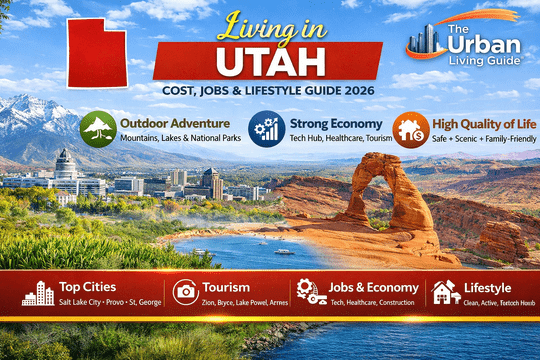
Living in Utah: Silicon Slopes Innovation, Mighty 5 Wilderness & High-Altitude Lifestyle in 2026
Making your home in Utah in 2026 is about reconciling the state’s deep, mountain-bound heritage with a rapidly shifting economic identity that has transformed it into the “Silicon Slopes” of the West. Spanning over 84,899 square miles, Utah is a geography of extremes: from the stark, high-desert basins of the Great Salt Lake to the soaring, jagged peaks of the Wasatch Range and the surreal, red-rock canyons of the Colorado Plateau.
As a long-term local resident will tell you, the Beehive State offers a distinctive living proposition: it is a place where a booming, tech-driven professional economy meets a culture that prioritizes family, community, and an unrivaled connection to the outdoors. From the high-tech corridors of Lehi and Provo to the vibrant urban culture of Salt Lake City and the sun-drenched adventure hubs of St. George, everyday life here is characterized by extreme topographic variety, a population of approximately 3.4 million residents, and a recession-resilient economy anchored by aerospace, software, and massive tourism infrastructure. For official administrative guidelines, state tax filings, and civic resources, residents frequently consult the Official State of Utah Portal.
| Quick Facts Snapshot: Utah (2026) | |
|---|---|
| Time Zone | Mountain Standard Time (MST / UTC-7, Daylight Saving UTC-6) |
| State Population | Approx. 3.4 Million (Significant concentration along the I-15 Front Range corridor) |
| State Income Tax | Flat individual income tax rate of 4.55% |
| Median Home Price | $450,000 – $650,000+ (High variance between Provo/Salt Lake tech hubs and rural southern basins) |
| Average Rent Range | $1,400 – $2,500+ per month (Dependent heavily on transit proximity) |
| Sales Tax Baseline | 4.85% state base, with local city/county surtaxes pushing combined totals between 6.0% and 8.75% |
What It Is Really Like to Live Here in Utah
Living across the Beehive State requires mastering a lifestyle defined by altitude, exploration, and a unique social fabric that balances traditional values with aggressive modern innovation. Locals quickly understand that day-to-day existence depends entirely on your access to the Wasatch Front: a continuous metropolitan corridor where nearly 80% of the state’s population lives, works, and plays.
The macro reality here is one of transformation; once a quiet agricultural and mining state, Utah has become a national tech powerhouse. The resident trade-off is widely accepted by locals: you deal with a competitive, high-cost real estate environment and winter air-quality inversions in the Salt Lake Valley in exchange for unparalleled access to the “Mighty 5” national parks, professional-grade skiing, and a business climate that consistently ranks among the nation’s best. Explore regional recreation, heritage, and tourism insights through the Utah Office of Tourism.
- Cultural Vibe: A powerful, community-driven landscape defined by family-oriented social networks, a burgeoning startup ecosystem (Silicon Slopes), and an deeply ingrained outdoor-recreation ethic.
- Pace of Life: Highly polarized—ranging from the high-velocity, VC-backed hustle of the tech corridor between Salt Lake City and Provo to the slow-paced, seasonal rhythm of southern desert towns and mountain enclaves.
- The Resident Trade-Off: Long-term locals appreciate the robust economy and fiscal stability but remain mindful of the need for water conservation and infrastructure management in an increasingly arid environment.
Regional Diversity, Geography & Economic Zones in Utah
Because Utah encompasses both the high-altitude Rockies and the low-elevation Colorado Plateau, its geography creates distinct living experiences that define where you settle.
Metro Corridors & The Front Range
- The Wasatch Front (Salt Lake/Utah County): The economic engine, housing the majority of the corporate HQs, software manufacturing, biotech clusters, and higher education institutions.
- The Northern Corridor (Ogden/Davis County): A vital secondary zone, balancing affordable suburban residential pockets with critical aerospace and defense-contracting roles.
The Mountain & Red Rock Wilderness
- The High-Country (Park City/Summit County): These areas operate on a separate economic cycle driven by global tourism, luxury real estate, and seasonal migration.
- The Southern Red Rocks (St. George): A distinct region experiencing massive growth, acting as a warmer climate haven for retirees and tourists attracted to the desert landscape.
Infrastructure, Power Grids, Water Systems & Transport Networks in Utah
Sustaining 3.4 million residents in an arid environment requires incredible engineering, a complex water-rights structure, and reliable energy grids.
Water Resources & Watersheds
- The Colorado River Compact: Water security is the state’s highest long-term policy issue. Municipalities manage water rights through advanced conservation efforts and regional storage projects. Learn more via the Utah Division of Water Resources.
Power Generation & Energy Frameworks
- Grid Mix: Electricity is supplied via Rocky Mountain Power and regional cooperatives, utilizing a mix of coal (transitioning toward natural gas) and large-scale solar/wind projects on the western plains.
Statewide Transit, Rail, Air & Port Connectivity
- Global Aviation: International travel is anchored by the Salt Lake City International Airport (SLC), a premier hub for western travel.
- Transit & Freight: UTA (Utah Transit Authority) operates the TRAX light rail and bus system across the Wasatch Front, while I-15 serves as the critical interstate spine for North-South freight distribution.
Statewide Economy, Job Markets & Major Industries in Utah
Utah has shed its image as purely a tourism state, pivoting into a major powerhouse for the “Silicon Slopes” tech movement, which stabilizes wages but increases housing demand.
- Economic Powerhouse: Generating robust state GDP fueled by high-tech manufacturing, aerospace, healthcare diagnostics, and software.
- Dominant Sectors: Software and data services, aerospace defense systems, biotech, renewable energy, and commercial real estate development.
- Corporate Footprint: Major operations for global enterprises like Adobe, Qualtrics, Oracle, and eBay. Monitor economic incentives through the Utah Governor’s Office of Economic Opportunity.
Salary Realities Across Economic Corridors
- Tech & Aerospace Hubs: Roles in data analytics, engineering, and software management in the Lehi-Provo-SLC triangle often range from $85,000 to $145,000+.
- Regional Wage Variance: Tourism and service roles in the mountain resorts remain foundational to the local economy, though housing affordability here is significantly more strained.
Cost of Living Realities & Housing Market Variance
While Utah was historically affordable, rapid population growth has compressed the cost-of-living advantage. It remains mid-tier compared to the national average, but the “hidden” costs—specifically mountain-commute fuel and climate-controlled utilities—often surprise newcomers.
| Expense Category | Cost Range / Index Reality |
|---|---|
| Housing (Metro vs. Mountain) | $1,600–$2,800+ monthly in SLC/Provo; $1,100–$1,700 in secondary regional hubs |
| Utilities | Moderate; high winter heating demands in mountain towns |
| Transportation | Strong car-dependency; toll road costs (Express Lanes) add to monthly overhead |
| Groceries & Goods | Generally aligns with national medians across major grocery networks |
State Tax Climate, Business Environment & Government Policies in Utah
The state’s tax structure is designed to attract commercial investment, characterized by a flat individual income tax rate. Review official compliance instructions via the Utah State Tax Commission.
- Flat Tax Model: The flat income tax rate provides a predictable fiscal environment for businesses and households.
- Business-Friendly: Utah consistently ranks among the most business-friendly states due to its streamlined regulatory environment and proactive development support.
Legal & Lifestyle Governance Quirks
- Vehicle Titling: Legal mandates require new residents to secure an official Utah driver’s license and transfer vehicle registrations at a Division of Motor Vehicles (DMV) location within 30 days.
- Outdoor Stewardship Laws: Strong regulatory protections for public lands and water access influence the state’s cultural approach to recreation.
Climate, Weather Extremes & Natural Geography
Utah is defined by its high-altitude, semi-arid climate, with drastic microclimates determined by mountain elevation.
- Seasonal Variations: High desert summers are hot and dry; winters bring world-class “powder” snow to the mountain resorts and cold temperatures to the valleys.
- The Altitude Factor: Residents must account for higher UV exposure and lower oxygen levels at altitude, particularly when adjusting to mountain life.
Insurance Cost Realities (Wildfire & Weather Risks)
- Wildfire Exposure: Homeowners insurance premiums reflect the increased risk profile of wildland-urban interface areas.
- Flood Risks: Flash-flood potential in desert slot canyons and mountain basins makes supplemental flood insurance a prudent choice for property owners near waterways.
Education Systems & Major Healthcare Networks in Utah
Education and healthcare in Utah are heavily centralized around the Wasatch Front. Explore public health initiatives via the Utah Department of Health & Human Services.
- Higher Education: The University of Utah (including its flagship medical research) and Brigham Young University (BYU) are not just schools; they are primary engines for regional workforce development.
- Urban Healthcare: The Salt Lake corridor features world-class hospitals and research centers, such as the Huntsman Cancer Institute.
Culture, Outdoor Recreation & Lifestyle Shifts in Utah
Daily life here is centered on access to the “Mighty 5” and local recreation. Explore recreation via Utah State Parks.
- Outdoor Living: Hiking the Wasatch trails, world-class skiing at Park City and Alta, and exploring the arid beauty of Zion.
- Culinary Heritage: An emerging culinary scene in Salt Lake City, known for fusion and high-end dining, alongside a deep appreciation for craft beverages.
Relocation & State Residency Essentials
- Driver’s License: Transfer your license within 30 days of establishing domicile.
- Vehicle Registration: Emissions testing is mandatory for specific counties in the Wasatch Front.
- Voter Registration: Easy online enrollment via the Utah Voter Portal.
Major Counties and Rural Living Realities in Utah
- Salt Lake County: The primary urban core and economic heart of the state.
- Utah County: A massive growth corridor driven by the Silicon Slopes tech sector.
- Grand County: Anchored by Moab, representing the state’s adventure and tourism frontier.
Major Regional Hubs and Cities to Explore
Major Urban Hubs at a Glance
| City / Hub | Primary Driver | Vibe & Lifestyle Profile |
|---|---|---|
| Salt Lake City | Tech, Finance | Metropolitan, transit-centric, cultural |
| Provo | Tech, Education | Growth-focused, family-oriented |
| Ogden | Aerospace, Industry | Resilient, outdoor-accessible, affordable |
| St. George | Tourism, Retirement | Sunny, desert-resort, slow-paced |
| Lehi | Tech Manufacturing | Corporate, suburban, fast-growing |
Detailed Breakdown of Key Regional Hubs
Salt Lake City — The Cultural and Economic Anchor
As the urban heart of Utah, Salt Lake City combines global financial interests with an authentic mountain-town energy. It is the premier choice for professionals who need transit connectivity and cultural density.
Provo — The Silicon Slopes Engine
Provo has evolved into a premier tech hub. It offers a dense, community-focused environment that attracts young professionals and families seeking a balance of work and play.
Ogden — The Industrial and Adventure Gateway
Ogden provides a pragmatic, lower-cost alternative to the SLC core, with direct access to the mountains and a strong industrial base.
St. George — The Warm Southern Haven
St. George acts as the southern gateway to the red rocks. It is the primary destination for those prioritizing climate, golf, and retiree-friendly amenities.
Lehi — The Tech-Growth Center
Lehi is the epicenter of the “Silicon Slopes” boom, characterized by rapid suburban development, modern corporate campuses, and a focus on high-skill employment.
Pros and Cons of Making Utah Your Home
| Advantages (Pros) | Systemic Drawbacks (Cons) |
|---|---|
| World-class access to public lands and parks | Increasing housing prices in major metros |
| Robust, rapidly diversifying tech job market | Heavy car-dependency in suburban/rural hubs |
| Clean, family-friendly cultural environment | Winter inversion air-quality issues in valleys |
| High fiscal stability and business-friendly taxes | Limited water resources and climate concerns |
| Safety-oriented suburban neighborhoods | High elevation requires physiological adjustment |
Frequently Asked Questions About Living in Utah
Is Utah a good state to live in?
Yes, Utah consistently ranks among the top states for quality of life, economic growth, and safety, making it a highly attractive destination for modern professionals and families.
What is the actual cost of living in Utah?
It is moderate to high by national standards, particularly in the northern Front Range urban corridor where demand for quality housing remains intense.
Which region or city is best to settle down in?
It depends on your career and lifestyle needs: Salt Lake City for urban professional energy, St. George for climate, and Provo/Lehi for high-growth tech careers.
Are taxes in Utah high?
The state maintains a flat individual income tax rate, providing predictable financial planning, though municipal sales taxes vary by county.
How safe is everyday life across the state?
Utah is statistically one of the safer states in the nation. While urban growth brings typical metropolitan challenges, the suburban and rural regions are exceptionally safe for families.
What industries dominate Utah’s job market?
Software development, data management, aerospace/defense contracting, healthcare diagnostics, and outdoor equipment manufacturing lead the workforce.
What is the weather like?
The state features an arid, high-altitude climate with hot, dry summers and cold, snowy winters. Adaptation to the altitude and winter driving conditions is a standard requirement for residents.
Explore Detailed City Guides Across Utah
At The Urban Living Guide, our core mission is to provide deeply researched regional insights and city-level navigation tools to help you evaluate your relocation options with total confidence. To discover what daily life, housing patterns, and local economies look like across our featured municipal centers throughout the state, explore our comprehensive resident hub guides below:
- Living in Salt Lake City, Utah
- Living in Provo, Utah
- Living in Ogden, Utah
- Living in St. George, Utah
Whether you are comparing career prospects in the Silicon Slopes or evaluating lifestyle shifts near the Mighty 5 national parks, our editorial team remains dedicated to delivering research-backed, data-driven frameworks to support your relocation and residency decisions with complete clarity.