

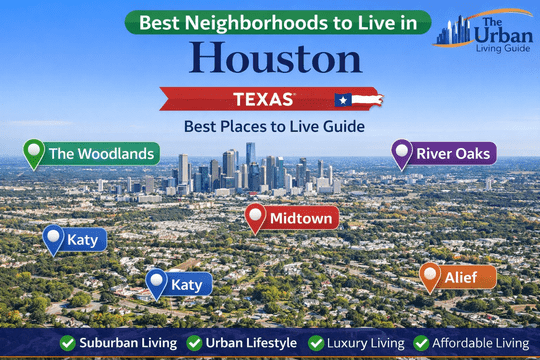
Best Neighborhoods in Houston, Texas: Bayou City Living, Master-Planned Enclaves & Urban Hubs in 2026
Spanning an immense 640 square miles of land area across the Gulf Coastal Plain of southeast Texas, the City of Houston functions under the non-zoned municipal administration of the City of Houston within the broader regional governance of Harris County. Serving a municipal core population exceeding 2.3 million residents and anchoring the Greater Houston metropolitan area with over 7.51 million people, this sprawling economic powerhouse is globally renowned for its energy dominance, aerospace innovation at NASA, the world’s largest medical complex, and rich cultural diversity. Relocating across Space City demands an understanding of unique municipal deed restrictions, localized watershed bayou drainage systems, humid subtropical climate patterns, and multi-layered highway networks managed by the Texas Department of Transportation.
Residential living in Houston is defined by sharp lifestyle distinctions, separating vibrant urban inner-loop corridors from expansive master-planned suburban golf enclaves and historic luxury residential tracts. Inbound movers consistently balance direct daily access to core employment engines—such as the Texas Medical Center (TMC), Downtown Houston Commercial District, Energy Corridor, and Galleria / Uptown District—against peak-hour traffic bottlenecks. Your choice of neighborhood establishes your daily travel patterns across Houston’s concentric highway loops and radials, including Interstate 610 (The Loop), Beltway 8 (Sam Houston Tollway), State Highway 99 (Grand Parkway), Interstate 10 (Katy Freeway), and Interstate 45 (Gulf/North Freeway), while determining your local access to municipal services, regional bayou trails, and top-tier public school districts.
Watch this video to explore popular neighborhoods, master-planned suburbs, and residential districts across Houston:
Best Areas to Live in Houston at a Glance in 2026
| Neighborhood Name | Location | Distance from Core (Downtown) | Development Status | Transit Connectivity | Cost Level | Best Fit For |
|---|---|---|---|---|---|---|
| The Woodlands | Montgomery County (North Metro) | Approximately 30 miles north | Master-Planned Township | Moderate (The Woodlands Express, I-45) | High-to-Premium | Families, Corporate Executives & Nature Lovers |
| Midtown | Inner Loop (Central Grid) | Approximately 1 mile south | High-Density Urban District | Exceptional (METRORail Red Line, I-69) | Mid-to-High Range | Young Professionals, TMC Staff & Urbanites |
| River Oaks | Inner Loop (West Central) | Approximately 4.5 miles west | Historic Luxury Estate Enclave | Moderate (METRO Buses, I-610) | Ultra-Premium | High-Net-Worth Families & Industry Leaders |
| Katy (Greater Katy Area) | West Metro (Harris/Fort Bend County) | Approximately 28 miles west | Master-Planned Suburban Hub | Moderate (Park & Ride Buses, I-10, SH-99) | Mid-Range | Suburban Families & Energy Corridor Commuters |
| Alief | Southwest Outer Loop Basin | Approximately 16 miles southwest | Established Multicultural Infill | High (METRO Bus Lines, Beltway 8, Westpark Tollway) | Accessible / Budget-Friendly | First-Time Homebuyers, Renters & Food Enthusiasts |
Best Neighborhoods in Houston Discussed in Detail
The Woodlands — Piney Woods Master-Planned Haven & Corporate Campus Oasis
Nestled in the lush pine forests of southern Montgomery County, The Woodlands is an internationally acclaimed 28,000-acre master-planned community founded on principles of environmental preservation and self-contained suburban infrastructure. Administered independently through the The Woodlands Township Official Portal, the township is divided into distinct residential villages such as Grogan’s Mill, Cochran’s Crossing, and Creekside Park. Seamlessly combining corporate regional headquarters for major energy firms with walkable waterfront entertainment along The Woodlands Waterway, the community offers an elite standard of living nestled inside nature.
- Housing: Real estate spans custom golf estates, modern waterfront luxury townhomes, and spacious single-family homes on heavily wooded lots. Single-family purchase prices typically range around $450,000 to $2,800,000+, while luxury garden apartment rentals average $1,650 to $2,950 per month.
- Safety & Crime Rate: Patrolled by the Montgomery County Sheriff’s Office in coordination with dedicated township security contracts, The Woodlands consistently registers among the lowest violent and property crime rates in the Greater Houston region.
- School District & Education Quality: Governed primarily by the top-rated Conroe Independent School District (CISD), hosting top-performing public institutions such as The Woodlands High School and College Park High School, alongside premier private options like The John Cooper School.
- Walkability & Daily Conveniences: The central urban hub around The Woodlands Mall, Market Street, and the Waterway is exceptionally pedestrian-friendly, offering upscale outdoor shopping, gourmet grocers like H-E-B Curbside and Whole Foods Market, and live performances at The Cynthia Woods Mitchell Pavilion.
- Parks & Green Spaces / Pet-Friendliness: Unrivaled outdoor infrastructure featuring over 220 community parks, 150 miles of paved multi-use hiking and biking trails, boat rentals on Lake Woodlands, and extensive off-leash dog facilities.
- Parking & Traffic Congestion: Plentiful free surface parking and multi-car garages throughout. Morning commuter congestion builds along southbound Interstate 45 heading into Downtown Houston during peak rush hours.
- Noise Levels & Vibe: Serene, quiet, and family-oriented, with residential lots shielded by dense native pine trees that absorb ambient highway sound.
- Medical Facilities & Hospitals: Direct access to an exceptional regional healthcare hub along St. Luke’s Way, featuring campuses for Memorial Hermann The Woodlands Medical Center, Houston Methodist The Woodlands Hospital, and Texas Children’s Hospital The Woodlands.
- Transit Connectivity: Served by the dedicated The Woodlands Express Park and Ride commuter coach network running non-stop express routes into Downtown Houston, Greenway Plaza, and the Texas Medical Center, with primary highway access via I-45 and SH-99.
- Affordability: Mid-to-high suburban cost tier; elevated property valuations and township property assessments are balanced by comprehensive community amenities and park upkeep.
- Who It’s Best For: Families seeking premier public schools, executives working in northern energy hubs (such as ExxonMobil’s Spring campus), and nature-focused remote professionals.
- Drawbacks: Substantial 30-to-45-mile daily highway commute into central Houston employment centers and strict neighborhood covenant deed restrictions.
Midtown — Pedestrian Urban Corridor & Vibrant METRORail Transit Hub
Located directly between the towering skyline of Downtown Houston and the sprawling medical towers of the Texas Medical Center, Midtown is one of Houston’s most walkable and transit-connected urban districts. Defined by modern multi-story residential mid-rises, historic brick townhomes, and a bustling dining and nightlife scene along Brazos Street and Louisiana Street, Midtown provides dynamic inner-loop urbanism. The community operates under guided civic improvements directed by the Midtown Management District.
- Housing: Dominated by 3-to-4 story modern stucco townhomes, luxury mid-rise podium apartments, and converted lofts. Single-family townhome sale prices typically range around $340,000 to $620,000, while modern 1-bedroom apartment rentals average $1,550 to $2,450 per month.
- Safety & Crime Rate: Patrolled by the Houston Police Department (HPD) Central Patrol Division. While residential blocks near parks are well-trafficked, property crimes such as vehicle break-ins occur around busy bar corridors and near the Wheeler METRORail Transit Center.
- School District & Education Quality: Governed by the Houston Independent School District (HISD), with higher education facilities anchored nearby by Houston Community College Central Campus and direct transit proximity to Rice University and the University of Houston.
- Walkability & Daily Conveniences: Outstanding walkability (Walk Score of 86-90/100). Residents comfortably walk to daily retail essentials like the Midtown Super Target, Randalls, dozens of international cafes, craft cocktail lounges, and indie live music venues.
- Parks & Green Spaces / Pet-Friendliness: Anchored by the scenic 6-acre Midtown Park on Main Street (featuring an interactive water garden, event lawn, and enclosed dog run) and the historic Bagby Park. The neighborhood is exceptionally pet-friendly with patio dining across local cafes.
- Parking & Traffic Congestion: Assigned garage parking is standard for apartment residents; street parking is strictly metered by the city. Surface traffic slows along Elgin Street and Westheimer Road during evening nightlife hours.
- Noise Levels & Vibe: High-energy, youthful, and social, with steady ambient street sounds from patio nightlife, light rail bells, and urban traffic.
- Medical Facilities & Hospitals: Unmatched direct medical connectivity, located just 5 minutes north of the world-renowned Texas Medical Center (TMC), including Houston Methodist Hospital and MD Anderson Cancer Center.
- Transit Connectivity: Unrivaled public light rail transit via the METRORail Red Line (stations at McGowen, Ensemble/HCC, and Wheeler), providing direct 5-to-10 minute transit rides into both Downtown and the Medical Center, with rapid vehicle access to Interstate 69 / US-59 and Interstate 45.
- Affordability: Mid-range inner-loop pricing; offers accessible price-per-square-foot ratios compared to neighboring Montrose or Downtown high-rises.
- Who It’s Best For: Medical residents and healthcare workers at TMC, corporate professionals working downtown, young tech workers, and commuters seeking a transit-oriented lifestyle.
- Drawbacks: Elevated nighttime noise levels around entertainment corridors, occasional street-level vagrancy near transit stations, and smaller private yard footprints.
River Oaks — Historic Architectural Splendor & Premier Luxury Enclave
Widely recognized as Houston’s most prestigious and affluent residential neighborhood, River Oaks spans 1,100 manicured acres within the central inner-loop quadrant south of Memorial Park and Buffalo Bayou. Established in the 1920s as a model master-planned luxury enclave by the Hogg family, the community features grand oak-lined boulevards, historic Southern Colonial mansions, English Tudor estates, and strict architectural oversight maintained by the River Oaks Property Owners Association.
- Housing: Real estate consists of multi-acre historic estates, custom architectural mansions along Inwood Drive and Lazy Lane, and luxury high-rise condominium towers lining the perimeter. Detached home valuations typically range around $1,850,000 to $25,000,000+, while luxury condominium rentals average $3,500 to $10,000 per month.
- Safety & Crime Rate: Patrolled 24/7 by dedicated private security patrols in marked vehicles operating in direct coordination with HPD Central Patrol, giving River Oaks one of the lowest crime profiles in Texas.
- School District & Education Quality: Governed by HISD, zoned to premier public schools such as River Oaks Elementary School (an authorized IB World School) and Lamar High School, complemented by top private college preparatory institutions like St. John’s School.
- Walkability & Daily Conveniences: While estate residential lanes are private and tranquil, the neighborhood is bordered by world-class walkable luxury lifestyle retail at River Oaks Shopping Center on West Gray and the high-fashion open-air boutiques of River Oaks District on Westheimer.
- Parks & Green Spaces / Pet-Friendliness: Immediate proximity to the 1,500-acre Memorial Park (featuring the PGA-tour Memorial Park Golf Course, clay running tracks, and the Eastern Glades nature preserve) alongside pocket parks like River Oaks Park (Pumpkin Park).
- Parking & Traffic Congestion: Effortless private multi-car driveways and motor courts on residential estates. Perimeter traffic builds along San Felipe Street, Westheimer Road, and Kirby Drive during peak commuter hours.
- Noise Levels & Vibe: Exceptionally quiet, secluded, and serene, characterized by massive shaded oak canopies and private gated residences.
- Medical Facilities & Hospitals: Direct 10-minute access to comprehensive healthcare services at Houston Methodist Hospital, Memorial Hermann – Texas Medical Center, and St. Luke’s Health.
- Transit Connectivity: Strategic central roadway positioning between Interstate 610 (West Loop), Memorial Drive, and Interstate 10, allowing 10-minute drives to both Downtown Houston and the Galleria.
- Affordability: Ultra-premium price structure across property acquisitions, ad valorem property taxes, and local upscale consumer goods.
- Who It’s Best For: High-net-worth families, corporate leaders, energy magnates, and buyers seeking historic prestige, security, and elite school zoning.
- Drawbacks: Exceptional capital entry barrier, stringent architectural renovation covenants, and heavy rush-hour volume on surrounding perimeter thoroughfares.
Katy — Suburban Energy Corridor Gateway & Top-Tier Public Education
Positioned along the western expansion corridor of Greater Houston across Harris, Fort Bend, and Waller Counties, the Greater Katy Area represents one of the fastest-growing and most sought-after family destinations in Texas. Anchored by the historic municipality of the City of Katy and renowned master-planned mega-developments like Cinco Ranch, Elyson, Grand Lakes, and Firethorne, Katy delivers a harmonious blend of suburban neighborhood stability, extensive retail power centers, and direct highway links into Houston’s Energy Corridor.
- Housing: Dominated by newer single-family brick and stone suburban homes, lakefront master-planned properties with community pools, and modern garden-style apartment communities. Single-family purchase prices typically range around $320,000 to $750,000, while rental homes and apartments average $1,600 to $2,650 per month.
- Safety & Crime Rate: Patrolled by the Katy Police Department within city limits and the Harris/Fort Bend County Sheriff’s Offices in unincorporated master-planned sectors, maintaining low rates of violent crime and safe residential streets.
- School District & Education Quality: Governed by the nationally acclaimed Katy Independent School District (Katy ISD), recognized as one of the best public school systems in Texas, featuring top-ranked campuses such as Seven Lakes High School, Cinco Ranch High School, and Tompkins High School.
- Walkability & Daily Conveniences: Master-planned communities offer walkable village centers, while daily retail shopping is centered along Grand Parkway (SH-99) and I-10 at Katy Mills Mall, LaCenterra at Cinco Ranch, and extensive supermarket plazas including H-E-B and Trader Joe’s.
- Parks & Green Spaces / Pet-Friendliness: Outstanding recreational infrastructure managed by local municipal utility districts (MUDs), including Mary Jo Peckham Park (featuring fishing lakes and an indoor pool), George Bush Park (featuring 7,800 acres of bayou trails and shooting centers), and dozens of neighborhood waterparks.
- Parking & Traffic Congestion: Wide two-to-three car garages and spacious suburban driveways. Significant highway congestion occurs daily along the Interstate 10 (Katy Freeway) corridor and the Westpark Tollway heading eastbound toward central Houston.
- Noise Levels & Vibe: Relaxed, family-focused, and friendly, filled with youth sports leagues, community events, and peaceful evenings.
- Medical Facilities & Hospitals: Direct medical infrastructure supported by the large regional medical campuses of Memorial Hermann Katy Hospital and Houston Methodist West Hospital located right on I-10.
- Transit Connectivity: Commuter transit is facilitated by METRO Park & Ride express bus services from the Grand Parkway and Kingsland transit centers directly to Downtown and the TMC, supported by highway connections via I-10 and SH-99.
- Affordability: Highly competitive mid-range price point offering exceptional square footage, modern home builds, and premier community amenities per dollar.
- Who It’s Best For: Growing families prioritizing exemplary public schools, energy sector employees working in the Energy Corridor / West Houston, and first-time suburban buyers.
- Drawbacks: Lengthy 25-to-35-mile daily highway commutes to central Houston, recurring local Municipal Utility District (MUD) taxes on newer builds, and heavy commuter traffic on I-10.
Alief — Multicultural Infill Hub, Global Cuisine & Budget-Conscious Living
Covering an expansive southwest Houston basin corridor between the Westpark Tollway and Interstate 69, Alief is one of the most culturally rich, ethnically diverse, and budget-friendly communities in Texas. Renowned for hosting the heart of Houston’s bustling Asiatown District along Bellaire Boulevard, Alief features hundreds of authentic international restaurants, commercial shopping plazas, and established mid-century residential tracts. The community operates under collaborative neighborhood revitalization led by the International Management District.
- Housing: Real estate consists of established 1970s and 1980s single-story brick ranch homes, multi-family apartment communities, and budget-friendly starter townhomes. Single-family purchase prices typically range around $210,000 to $340,000, while rental apartments average $1,050 to $1,650 per month.
- Safety & Crime Rate: Patrolled by the HPD Westside Patrol Division. Property crimes and commercial theft occur at higher rates along major commercial boulevards like Bellaire Boulevard and Bissonnet Street, while interior residential subdivisions maintain stable, tight-knit residential blocks.
- School District & Education Quality: Governed by the Alief Independent School District (Alief ISD), hosting neighborhood campuses like Alief Elsik High School, Alief Hastings High School, and the specialized Alief Early College High School.
- Walkability & Daily Conveniences: High pedestrian and commercial activity along Bellaire Boulevard and Corporate Drive, home to international supermarkets like Hong Kong City Mall, H Mart, traditional dim sum houses, and Vietnamese bakeries.
- Parks & Green Spaces / Pet-Friendliness: Municipal green spaces include the modern 38-acre Alief Neighborhood Center and Park (featuring a state-of-the-art library, community center, skate park, and soccer fields) and driving access to the Arthur Storey Park stormwater wetlands preserve along Brays Bayou.
- Parking & Traffic Congestion: Plentiful residential driveway and street parking. Commercial retail parking lots in Asiatown can be competitive on weekends, with steady commuter flow along Beltway 8 and Highway 6.
- Noise Levels & Vibe: Energetic, grounded, and multicultural, shifting from bustling commercial daytime business avenues to quiet residential evenings.
- Medical Facilities & Hospitals: Direct emergency medical coverage provided within the district by HCA Houston Healthcare West on Richmond Avenue and local community health clinics.
- Transit Connectivity: Excellent public bus transit via high-frequency METRO Bus Routes (such as Route 2 Bellaire and Route 82 Westheimer), alongside direct vehicular access to Beltway 8 (Sam Houston Tollway) and the Westpark Tollway. Air travel is accessible via George Bush Intercontinental Airport (IAH) and William P. Hobby Airport (HOU).
- Affordability: Houston’s most accessible entry-level homeownership and rental price tier, offering substantial residential square footage and accessible monthly living overhead.
- Who It’s Best For: First-time homebuyers, culinary enthusiasts, value-seeking renters, and professionals seeking accessible pricing near the Westchase District and Galleria.
- Drawbacks: Pockets of higher property crime rates, variable school performance metrics across individual campuses, and older residential housing stock requiring renovation.
Comprehensive Neighborhood Pros and Cons Comparison
| Neighborhood | Core Advantages (Pros) | Core Limitations (Cons) |
|---|---|---|
| The Woodlands | Heavily forested natural landscape; top-performing Conroe ISD schools; lowest crime rates; 220+ community parks and Waterway dining. | Substantial 30-mile commute into central Houston; strict township covenant deed restrictions; higher property assessments. |
| Midtown | Direct METRORail Red Line transit into TMC and Downtown; high walkability to dining and Target; vibrant park events at Midtown Park. | Elevated weekend nightlife street noise; property crime concerns near major transit stations; lack of large private yards. |
| River Oaks | Historic architectural prestige; dedicated 24/7 private security patrols; top-ranked River Oaks Elementary; proximity to Memorial Park. | High capital entry barriers; high ad valorem property taxes; peak-hour congestion on surrounding arterial roadways. |
| Katy | Nationally acclaimed Katy ISD public school system; modern master-planned amenities and waterparks; competitive home square footage per dollar. | Heavy rush-hour congestion on I-10 (Katy Freeway); recurring MUD infrastructure taxes; car-dependent suburban lifestyle. |
| Alief | Most budget-friendly homeownership and rental prices; world-class international cuisine in Asiatown; modern Alief Neighborhood Center. | Pockets of elevated property crime; variable school performance ratings; aging mid-century housing inventory. |
How You Decide Which Neighborhood Is Best For You
Choosing your ideal neighborhood in Greater Houston requires balancing your gross household finances with daily workplace locations, family schooling requirements, and flood watershed resilience. Because the Houston metropolitan region spans over 10,000 square miles across multiple counties, your chosen location dictates whether your daily commute relies on heavily traveled freeway arteries like the Katy Freeway (I-10) and I-45 or on direct light rail transit via the METRORail Red Line. Healthcare specialists and researchers working in the Texas Medical Center or corporate personnel based in Downtown Houston should prioritize inner-loop enclaves like Midtown or master-planned suburbs with dedicated METRO Park & Ride transit connectivity to eliminate highway gridlock.
Beyond transportation corridors, evaluate critical municipal utility and environmental realities. Houston experiences humid subtropical summer heat waves exceeding 95 degrees Fahrenheit alongside seasonal tropical storm systems, making electrical grid reliability via CenterPoint Energy and structural flood zone evaluations with the Harris County Flood Control District (HCFCD) crucial factors before purchasing. Ensure you confirm high-speed fiber internet availability (such as AT&T Fiber or Xfinity Gigabit), check municipal utility district (MUD) tax rates in suburban sectors, and verify deed restriction regulations before finalizing a residential lease or property closing.
Frequently Asked Questions About Houston Neighborhoods
Which neighborhood in the Houston area is best for families with school-age children?
The Woodlands and Katy are widely regarded as the top family-friendly communities in Greater Houston. Both areas offer master-planned security, extensive neighborhood parks, and access to two of the highest-rated public school systems in Texas: Conroe ISD and Katy ISD.
What is the most walkable neighborhood in Houston where you can live without a car?
Midtown and Downtown Houston offer the highest walkability in the metropolitan area. Midtown boasts an 86+ Walk Score, allowing residents to walk to grocery stores, pharmacies, and dining while providing direct access to the METRORail Red Line for car-free commutes to the Texas Medical Center and Downtown.
What are the safest residential neighborhoods to live in Houston?
River Oaks and The Woodlands consistently report the lowest crime rates in the region. River Oaks benefits from dedicated 24/7 private security patrol contracts, while The Woodlands maintains proactive policing through the Montgomery County Sheriff’s Office and private township security.
What are the most affordable neighborhoods for homebuyers and renters in Houston?
Alief and parts of Southwest Houston provide the most budget-friendly housing opportunities in the area. Buyers and renters can secure single-family starter homes and spacious multi-bedroom apartments at price points significantly lower than inner-loop neighborhoods or premium northern suburbs.
How bad is traffic congestion when commuting into Downtown Houston from the suburbs?
Commuting from outer suburbs like The Woodlands or Katy into central Houston during peak rush hours typically takes between 45 and 75 minutes each way along I-45 or I-10. Utilizing express commuter coach services like The Woodlands Express or METRO Park & Ride can significantly reduce driving fatigue.
Do Houston neighborhoods have zoning laws?
The City of Houston is famous for being the only major U.S. city without formal municipal zoning laws. Instead, neighborhood land use and aesthetic character are strictly regulated through private deed restrictions, subdivision covenants, and local historic preservation overlays.
Which Houston neighborhood is best for employees working in the Texas Medical Center?
Midtown and the neighboring Museum District / West University corridors provide the fastest and most convenient commutes to the Texas Medical Center, offering direct 5-to-10 minute transit rides via the METRORail Red Line or quick surface street drives.
Know More About the City
The Urban Living Guide creates deeply researched, practical, and informative city relocation resources designed to help individuals, working professionals, and families navigate complex urban landscapes. By analyzing municipal infrastructure, hyper-local zoning patterns, commuter realities, and housing markets, our guides provide actionable insights so you can make confident, data-backed decisions when moving to major metropolitan areas.
Explore our comprehensive guides to the Houston metropolitan region:
- Living in Houston, Texas
- Cost of Living in Houston, Texas
- Pros and Cons of Living in Houston, Texas
- Moving to Houston, Texas
Follow The Urban Living Guide for ongoing regional insights, neighborhood developments, and expert local coverage across Greater Houston and Texas.