

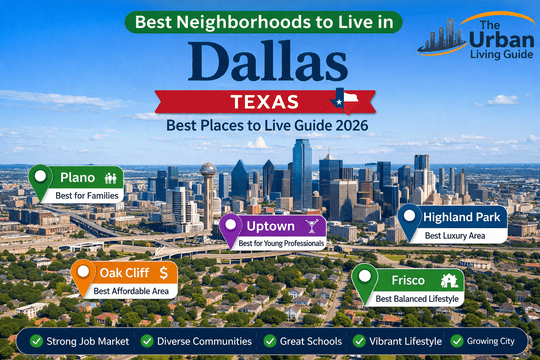
Best Neighborhoods in Dallas, Texas: North Texas Suburbs, Uptown Living & Historic Enclaves in 2026
Spanning approximately 340 square miles of land area across the North Texas prairie, the City of Dallas operates under the council-manager municipal governance of the City of Dallas and anchors the broader regional infrastructure of Dallas County. Housing a municipal core population exceeding 1.3 million residents and anchoring the sprawling Dallas-Fort Worth (DFW) Metroplex with over 8.1 million people, this dynamic economic engine serves as a major national epicenter for telecommunications, banking, aviation, technology, and healthcare logistics. Relocating across North Texas requires navigating a complex patchwork of independent municipal jurisdictions, expansive high-speed tollway networks, clay-heavy expansive soil conditions, and subtropical summer heat corridors managed by regional planning bodies.
Residential living in Greater Dallas presents sharp contrasts between walkable high-density urban entertainment districts, historic tree-canopied estate enclaves, and fast-growing master-planned northern suburbs. Inbound residents routinely balance convenient daily access to major corporate headquarters corridors—including the Downtown Dallas Central Business District, the Platinum Corridor along the Dallas North Tollway, the Telecom Corridor in Richardson, and corporate campuses in Legacy West—against highway travel times. Choosing the right residential pocket defines your daily commute along heavily traveled thoroughfares like Interstate 35E (Stemmons Freeway), US Route 75 (Central Expressway), Interstate 635 (LBJ Freeway), and President George Bush Turnpike (SH 190), while dictating your family’s access to municipal parks, regional transit hubs, and top-tier public school systems.
Watch this video to explore different neighborhoods, suburban corridors, and residential communities across Dallas:
Best Areas to Live in Dallas at a Glance in 2026
| Neighborhood Name | Location | Distance from Core (Downtown) | Development Status | Transit Connectivity | Cost Level | Best Fit For |
|---|---|---|---|---|---|---|
| Plano | Collin County (North Metro) | Approximately 19 miles north | Established Master-Planned Suburban | High (DART Red/Orange Lines, US-75, DNT) | Mid-to-High Range | Families, Corporate Staff & Commuters |
| Uptown Dallas | Central Core (North of Downtown) | Approximately 1 mile north | High-Density Walkable Urban | Exceptional (M-Line Trolley, DART Rail, US-75) | High-to-Premium | Young Professionals, Finance Staff & Urbanites |
| Highland Park | Park Cities (Independent Municipality) | Approximately 4.5 miles north | Historic Luxury Estate Enclave | Moderate (Automobile-centric, DNT, US-75) | Ultra-Premium | High-Net-Worth Executives & Families |
| Frisco | Collin & Denton Counties | Approximately 27 miles north | Booming Master-Planned Tech/Sports Hub | Moderate (Dallas North Tollway, SH-121) | Mid-to-High Range | Relocating Families, Tech Workers & Executives |
| Oak Cliff (Bishop Arts District) | Southwest Central Core | Approximately 3 miles southwest | Historic Arts-Centric Infill | High (Dallas Streetcar, DART Buses, I-35E) | Accessible to Mid-Range | Creatives, First-Time Buyers & Foodies |
Best Neighborhoods in Dallas Discussed in Detail
Plano — Master-Planned Corporate Epicenter & Top-Tier Suburban Haven
Situated directly north of Dallas in southwestern Collin County, the incorporated city of Plano is nationally celebrated as a model master-planned suburb that blends established residential tranquility with high-powered corporate headquarters. Operating under municipal governance via the City of Plano Municipal Portal, the city features mature neighborhood subdivisions like Willow Bend, Kings Ridge, and the bustling urban village of Legacy West. Plano offers an exceptional balance of corporate employment, top-ranked public infrastructure, and preserved greenway corridors.
- Housing: Real estate is dominated by 1980s and 1990s traditional brick single-family homes, modern executive builds, and luxury mid-rise urban apartments near corporate centers. Detached single-family property valuations typically range around $440,000 to $1,350,000, while modern apartment rentals average $1,650 to $2,850 per month.
- Safety & Crime Rate: Patrolled by the independent Plano Police Department, the city consistently ranks among the safest cities of its size in the United States, with low rates of violent crime and responsive community policing.
- School District & Education Quality: Governed by the highly regarded Plano Independent School District (PISD), featuring a unique academy model alongside premier campuses such as Plano West Senior High School and Jasper High School.
- Walkability & Daily Conveniences: The urban villages at Legacy West and The Shops at Legacy along Legacy Drive are exceptionally pedestrian-friendly, featuring boutique shopping, gourmet grocers, artisan bakeries, and the open-air Legacy Hall, while residential subdivisions remain automobile-dependent.
- Parks & Green Spaces / Pet-Friendliness: Outstanding recreational infrastructure anchored by the 800-acre Oak Point Park and Nature Preserve, Bob Woodruff Park (featuring connected hike-and-bike trails), and multiple dedicated dog parks like Jack Carter Dog Park.
- Parking & Traffic Congestion: Wide residential streets, private multi-car garages, and extensive shopping center parking lots. Morning commuter traffic builds along the Dallas North Tollway and southbound US Route 75 (Central Expressway).
- Noise Levels & Vibe: Peaceful, orderly, and family-oriented, characterized by quiet neighborhood cul-de-sacs with low ambient background noise.
- Medical Facilities & Hospitals: Direct emergency medical care is anchored within city borders by Texas Health Presbyterian Hospital Plano, Children’s Medical Center Plano, and the dedicated campus at Baylor Scott & White Medical Center – Plano.
- Transit Connectivity: Excellent public rail transit via the DART Light Rail Red and Orange Lines (stations at Downtown Plano and Parker Road), alongside rapid highway corridors via US-75, SH 121 (Sam Rayburn Tollway), and the President George Bush Turnpike (PGBT).
- Affordability: Competitive mid-range to upper-tier pricing, providing substantial interior square footage, private pools, and larger lot sizes per dollar compared to central Dallas enclaves.
- Who It’s Best For: Families seeking premier public schools, corporate professionals working at major headquarters (such as Toyota Motor North America, JPMorgan Chase, or Capital One), and commuters desiring clean suburban stability.
- Drawbacks: Summer afternoon heat in the prairie basin, vehicle reliance for routine suburban errands, and peak-hour toll expenses on the Dallas North Tollway.
Uptown Dallas — Pedestrian Urban Corridor & Vibrant Lifestyle Center
Positioned immediately north of the Dallas Downtown Arts District, Uptown Dallas is the premier pedestrian-friendly, mixed-use urban district in North Texas. Centered along the historic brick-paved spine of McKinney Avenue, Uptown features luxury high-rise condominium towers, modern podium apartment complexes, and a vibrant social scene filled with rooftop lounges, upscale bistros, and corporate finance offices. The district operates under civic enhancements managed by the Uptown Dallas Public Improvement District.
- Housing: Dominated by luxury high-rise residential towers, converted urban lofts, and 3-to-4 story multi-family apartment communities. Condominium sale prices typically range around $380,000 to $1,800,000+, while modern 1-bedroom apartment rentals average $1,950 to $3,400 per month.
- Safety & Crime Rate: Patrolled by the Dallas Police Department Central Patrol Division and supported by dedicated private Uptown safety bike patrols. Residential streets are safe and active, though nightlife corridors on McKinney Avenue experience late-night property and vehicle break-in incidents.
- School District & Education Quality: Governed by the Dallas Independent School District (DISD), with elementary students zoned to William B. Travis Vanguard/Academy for the Academically Talented and Gifted and Ben Milam Elementary.
- Walkability & Daily Conveniences: Outstanding walkability (Walk Score of 90-94/100). Residents comfortably walk to everyday retail, including Whole Foods Market on McKinney, Foxtrot Market, boutique fitness studios, and hundreds of sidewalk cafes.
- Parks & Green Spaces / Pet-Friendliness: Immediate access to the direct trailhead of the 3.5-mile Katy Trail (the city’s premier paved walking, running, and cycling parkway) and the 5.2-acre Klyde Warren Park built over the Woodall Rodgers Freeway. Uptown is exceptionally dog-friendly with dedicated pet lounges across apartment buildings.
- Parking & Traffic Congestion: Assigned garage parking is necessary, typically adding $125 to $250 per month for renters. Street parking is strictly metered, with heavy traffic slowing down McKinney Avenue and Oak Lawn Avenue during evening entertainment hours.
- Noise Levels & Vibe: High-energy, sophisticated, and social, characterized by active patio dining, vintage trolley bells, and bustling weekend foot traffic.
- Medical Facilities & Hospitals: Direct 5-to-8 minute transit access to major medical centers in the neighboring Southwestern Medical District, including UT Southwestern Medical Center and Parkland Memorial Hospital.
- Transit Connectivity: Direct public transit access via the historic, free-to-ride M-Line Trolley connecting directly into Downtown, supported by the subterranean DART Rail Cityplace/Uptown Station (Red, Blue, and Orange Lines) and quick vehicle on-ramps to US-75 and Woodall Rodgers Freeway. Regional aviation is accessible via Dallas Love Field Airport (DAL) located just 5 miles northwest.
- Affordability: High-tier urban cost structure; premium rents per square foot reflect the neighborhood’s high walkability and central positioning.
- Who It’s Best For: Young corporate professionals, financial analysts, attorneys, medical residents, and remote workers seeking a walkable urban lifestyle with direct Katy Trail access.
- Drawbacks: Higher residential rental rates, weekend nightlife street noise along commercial corridors, and competitive garage parking environments.
Highland Park — Historic Grandeur, World-Class Security & Prestigious Estate Living
Comprising an independent municipal enclave completely surrounded by the City of Dallas alongside neighboring University Park (collectively known as the “Park Cities”), Highland Park represents one of the wealthiest and most prestigious residential communities in the United States. Established in 1913 with a master layout designed by landscape architect Wilbur David Cook, the town features grand tree-lined parkways, historic Spanish Colonial and Georgian mansions, and pristine municipal gardens along Turtle Creek. Local ordinances and emergency services are managed independently through the Town of Highland Park Official Website.
- Housing: Real estate inventory consists of historic multi-million dollar estates, architecturally significant custom mansions along Armstrong Parkway and Beverly Drive, and exclusive luxury condominiums near Lomo Alto Drive. Detached home valuations typically range around $2,200,000 to $22,000,000+, while luxury residential leases average $4,500 to $12,000 per month.
- Safety & Crime Rate: Protected by the dedicated Highland Park Department of Public Safety (HPDPS)—which unifies police, fire, and paramedic services—maintaining average emergency response times under 3 minutes alongside comprehensive townwide security patrols.
- School District & Education Quality: Governed by the nationally acclaimed Highland Park Independent School District (HPISD), consistently ranked among the top public school systems in the country, featuring historic institutions like Highland Park High School and Bradfield Elementary.
- Walkability & Daily Conveniences: The world-renowned Highland Park Village (America’s first open-air master-planned shopping center, constructed in 1931) is exceptionally pedestrian-friendly, featuring luxury designer boutiques, fine dining, and bespoke market services.
- Parks & Green Spaces / Pet-Friendliness: Over 20% of the town’s land area is dedicated to lush manicured parklands, including Lakeside Park (famous for its giant teddy bear sculptures and lily pad bridges along Turtle Creek), Flippen Park, and Prather Park.
- Parking & Traffic Congestion: Wide private motor courts and residential garages keep residential streets clear. Pass-through commuter traffic builds along Preston Road (SH 288) and Mockingbird Lane during peak morning drive times.
- Noise Levels & Vibe: Serene, refined, and private, featuring quiet shaded avenues and immaculately manicured landscaping with minimal ambient city noise.
- Medical Facilities & Hospitals: Direct 6-minute vehicular access to comprehensive healthcare services at Texas Health Presbyterian Hospital Dallas on Walnut Hill Lane and UT Southwestern Medical Center.
- Transit Connectivity: Exceptional roadway positioning between the Dallas North Tollway and US-75 (Central Expressway), allowing 8-minute drives into Downtown Dallas and 10-minute trips to Dallas Love Field Airport.
- Affordability: Ultra-premium price levels across property valuations, ad valorem property taxes, and local upscale lifestyle services.
- Who It’s Best For: High-net-worth families, corporate executives, civic leaders, and buyers seeking architectural pedigree, elite public education, and unparalleled municipal safety.
- Drawbacks: Very high capital barrier to entry for homeownership, strict municipal building and historical preservation codes, and high property tax valuations.
Frisco — Booming Master-Planned Frontier, Sports Capital & High-Tech Corridor
Situated in the rapidly expanding northern sector of the DFW Metroplex across Collin and Denton Counties, Frisco is one of the fastest-growing and most economically vibrant master-planned cities in America. Governed through the City of Frisco Official Portal, the municipality has transformed into a major corporate and athletic capital, housing the world headquarters of the Dallas Cowboys (The Star in Frisco), PGA of America, and major mixed-use developments along the $5 Billion Mile on the Dallas North Tollway.
- Housing: Dominated by newly constructed master-planned communities, spacious two-story brick and stone single-family homes, gated golf properties (such as Stonebriar and Fields), and modern suburban apartment complexes. Single-family purchase prices typically range around $520,000 to $1,850,000+, while modern apartment rentals average $1,700 to $2,900 per month.
- Safety & Crime Rate: Protected by the dedicated Frisco Police Department, consistently ranking as one of the safest cities in the United States, with low rates of violent crime and extensive school resource officer programs.
- School District & Education Quality: Governed by the highly rated Frisco Independent School District (Frisco ISD), celebrated for its “small schools model” designed to maximize student participation across campuses like Reedy High School, Wakeland High School, and Liberty High School.
- Walkability & Daily Conveniences: Master-planned village centers like The Star Entertainment District and Frisco Square provide pedestrian dining, retail, and community plazas, while primary retail shopping centers along Preston Road and Stonebriar Centre Mall cater to all daily needs.
- Parks & Green Spaces / Pet-Friendliness: Exceptional recreational acreage including Frisco Commons Park, Warren Sports Complex, championship golf at Omni PGA Frisco Resort, and specialized facilities at Frisco Ruff Range Dog Park.
- Parking & Traffic Congestion: Wide two-to-three car garages, large suburban driveways, and expansive shopping center parking. Commuter traffic builds along the Dallas North Tollway and State Highway 121 during peak morning commutes toward Plano and Dallas.
- Noise Levels & Vibe: Energetic, modern, and family-focused, dominated by youth sports culture, corporate development, and quiet residential evenings.
- Medical Facilities & Hospitals: Direct medical infrastructure supported by major healthcare campuses along the tollway, including Baylor Scott & White Medical Center – Frisco and Texas Health Hospital Frisco.
- Transit Connectivity: Major highway transit via the Dallas North Tollway, Sam Rayburn Tollway (SH 121), and US Route 380. Long-distance air travel is accessible via Dallas/Fort Worth International Airport (DFW) located 22 miles southwest.
- Affordability: Mid-to-high suburban pricing; property values offer substantial square footage, advanced energy efficiency, and modern community amenities per dollar.
- Who It’s Best For: Growing families prioritizing exemplary public schools and youth sports, tech and corporate executives working along the DNT corridor, and buyers seeking newer construction.
- Drawbacks: Substantial 25-to-35-mile daily highway commute into Downtown Dallas, ongoing construction expansion disruptions, and mandatory highway toll expenses for daily drivers.
Oak Cliff (Bishop Arts District) — Historic Character, Indie Culture & Accessible Charm
Located directly southwest of Downtown Dallas across the Trinity River basin, Oak Cliff is one of the city’s oldest, most culturally rich, and architecturally distinct residential districts. Anchored by the charming, walkable streets of the Bishop Arts District, the neighborhood is famous for its collection of 1920s Craftsman bungalows, independent boutiques, artisan coffee houses, and authentic international dining. Governed under City of Dallas municipal oversight, the community thrives through creative local entrepreneurship supported by the Bishop Arts District Merchant Association.
- Housing: Real estate features restored historic Craftsman bungalows, Prairie-style homes in Winnetka Heights, mid-century ranch homes in Kiest Park, and modern infill townhome developments. Single-family purchase prices typically range around $320,000 to $780,000, while modern 1-bedroom rental apartments average $1,450 to $2,300 per month.
- Safety & Crime Rate: Patrolled by the Dallas Police Department South Central Patrol Division. While the Bishop Arts retail core and historic preservation zones maintain active, safe foot traffic, property crimes and opportunistic theft occur at higher rates in surrounding commercial and transitional blocks.
- School District & Education Quality: Governed by DISD, containing specialized choice programs such as the Rosemont Early Childhood and Lower School and Booker T. Washington High School for the Performing and Visual Arts (accessible via magnet application).
- Walkability & Daily Conveniences: Outstanding pedestrian activity within the Bishop Arts District along Bishop Avenue and 7th Street, featuring indie bookstores, handmade craft shops, local bakeries, and chef-driven dining venues.
- Parks & Green Spaces / Pet-Friendliness: Scenic parklands include Lake Cliff Park (featuring historic walking trails and skyline views), the 248-acre Kiest Park (with extensive soccer, tennis, and baseball complexes), and the rugged nature trails of the Oak Cliff Nature Preserve.
- Parking & Traffic Congestion: Street parking in Bishop Arts is highly competitive on weekends, though residential neighborhoods offer ample street and driveway parking. Highway access onto Interstate 35E (R.L. Thornton Freeway) connects directly to the central core.
- Noise Levels & Vibe: Creative, eclectic, and community-centered, shifting from lively daytime artisan shopping and dining foot traffic to quiet evenings on historic residential side streets.
- Medical Facilities & Hospitals: Direct emergency medical coverage provided within the district by Methodist Dallas Medical Center on Colorado Boulevard, a premier Level I Trauma Center.
- Transit Connectivity: Direct public transit access via the Dallas Streetcar connecting Bishop Arts straight across the river into Downtown Dallas (Union Station), supported by DART Bus Lines and rapid access to I-35E and Interstate 30.
- Affordability: Dallas’s most accessible close-in price tier, offering character-rich historic homes and competitive rental rates within minutes of the urban core.
- Who It’s Best For: Creatives, young professionals, culinary enthusiasts, first-time homebuyers, and buyers seeking historic architectural charm without suburban sterile development.
- Drawbacks: Pockets of higher property crime in transitional blocks, variable public school ratings across non-magnet campuses, and weekend visitor parking congestion in commercial retail zones.
Comprehensive Neighborhood Pros and Cons Comparison
| Neighborhood | Core Advantages (Pros) | Core Limitations (Cons) |
|---|---|---|
| Plano | Top-ranked PISD public schools; exceptionally low crime rates; premier corporate employers in Legacy West; direct DART light rail access. | Suburban car dependence; peak-hour highway delays on US-75; hot summer basin temperatures. |
| Uptown Dallas | Direct access to the Katy Trail and Klyde Warren Park; high walkability to dining and retail; free M-Line Trolley to Downtown. | High monthly rental rates per square foot; elevated weekend nightlife street noise; expensive dedicated apartment parking fees. |
| Highland Park | Historic architectural prestige; dedicated HPDPS emergency response under 3 minutes; top-tier HPISD schools; pristine Turtle Creek parks. | High real estate entry barriers; high ad valorem property taxes; stringent municipal zoning and renovation codes. |
| Frisco | Exemplary Frisco ISD schools; modern master-planned amenities and youth sports hubs (The Star); lowest violent crime rates. | Substantial 27-mile commute to Downtown Dallas; ongoing highway toll expenses; heavy suburban vehicle dependence. |
| Oak Cliff (Bishop Arts) | Charming historic Craftsman bungalows; walkable independent dining in Bishop Arts; direct Dallas Streetcar into Downtown; attainable pricing. | Pockets of elevated property crime in transitional blocks; variable public school ratings; limited visitor parking on weekends. |
How You Decide Which Neighborhood Is Best For You
Selecting your ideal neighborhood in the Dallas-Fort Worth Metroplex requires balancing your gross household budget with daily workplace locations, family schooling preferences, and tollway commuting logistics. Because the DFW region spans over 9,000 square miles across multiple counties, your neighborhood choice dictates whether your daily commute relies on toll corridors like the Dallas North Tollway and President George Bush Turnpike or on direct light rail connections via the DART Rail Network. Professionals working in corporate hubs along Legacy West or the Platinum Corridor should prioritize northern suburbs like Plano or Frisco, while corporate staff and attorneys based in the Downtown Central Business District can minimize transit stress by living in Uptown or Oak Cliff.
Beyond highway routes, evaluate critical municipal utility and environmental realities. North Texas experiences intense summer heat waves exceeding 100 degrees Fahrenheit alongside seasonal severe thunderstorms, making electrical grid reliability under the Electric Reliability Council of Texas (ERCOT) and home foundation stability on regional blackland clay soils essential considerations before purchasing. Ensure you verify high-speed fiber internet availability (such as AT&T Fiber or Frontier Fiber), examine local property tax rates and municipal utility district assessments, and confirm deed restrictions before executing a residential lease or property closing.
Frequently Asked Questions About Dallas Neighborhoods
Which neighborhood in the Dallas area is considered the best for families with school-age children?
Plano and Frisco are widely recognized as the premier family communities in Greater Dallas. Both cities offer exceptional master-planned neighborhoods, extensive community park systems with youth sports facilities, and nationally acclaimed public school districts (Plano ISD and Frisco ISD). For families seeking historic estate living within Dallas proper, Highland Park offers the top-ranked Highland Park ISD.
What is the most walkable neighborhood in Dallas where you can live without a car?
Uptown Dallas is the most walkable neighborhood in the region, boasting a 90+ Walk Score. Residents can easily accomplish daily errands on foot, walk to grocery stores like Whole Foods, access hundreds of restaurants along McKinney Avenue, and utilize the free M-Line Trolley and DART light rail for direct commutes into Downtown Dallas.
What are the safest residential neighborhoods to live in within the Dallas area?
Highland Park, Plano, and Frisco consistently report the lowest violent and property crime rates in North Texas. Highland Park benefits from its unified municipal public safety department, while Plano and Frisco maintain nationally recognized municipal police forces with proactive community patrols.
What are the most affordable neighborhoods for homebuyers and renters near central Dallas?
Oak Cliff (outside the immediate Bishop Arts core) and parts of East Dallas provide the most accessible housing opportunities near the urban center, offering single-family historic bungalows and apartment rentals at price points significantly lower than Uptown, the Park Cities, or northern suburbs.
How bad is traffic congestion when commuting from the northern suburbs into Downtown Dallas?
Commuting from suburbs like Frisco or West Plano into central Dallas during peak morning rush hours typically takes between 40 and 65 minutes each way along the Dallas North Tollway or US-75. Utilizing DART light rail park-and-ride stations in Plano can provide a predictable alternative to highway driving.
Are toll roads necessary for daily commuting in Greater Dallas?
While non-toll highways like US-75, I-35E, and I-30 exist, navigating the northern suburbs (Plano, Frisco, Carrollton) efficiently often requires utilizing the Dallas North Tollway (DNT) or President George Bush Turnpike (PGBT), managed by the North Texas Tollway Authority (NTTA). Budgeting for a TollTag is essential for suburban commuters.
Which Dallas neighborhood is best for employees working in the Southwestern Medical District?
Uptown Dallas and Oak Lawn provide the fastest and most convenient commutes to the Southwestern Medical District (UT Southwestern, Parkland Hospital, Children’s Medical Center), located just a 5-to-10 minute drive or short DART bus ride away.
Know More About the City
The Urban Living Guide creates deeply researched, practical, and informative city relocation resources designed to help individuals, working professionals, and families navigate complex urban landscapes. By analyzing municipal infrastructure, hyper-local zoning patterns, commuter realities, and housing markets, our guides provide actionable insights so you can make confident, data-backed decisions when moving to major metropolitan areas.
Explore our comprehensive guides to the Dallas metropolitan region:
- Living in Dallas, Texas
- Cost of Living in Dallas, Texas
- Pros and Cons of Living In Dallas, Texas
- Moving to Dallas, Texas
Follow The Urban Living Guide for ongoing regional insights, neighborhood developments, and expert local coverage across North Texas and the DFW Metroplex.