
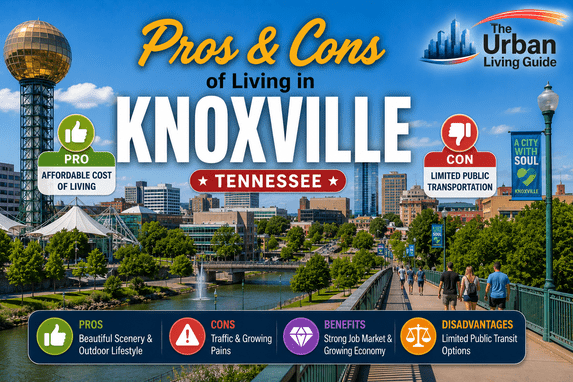
The Pros and Cons of Living in Knoxville Tell a Story Most People Never Hear
Knoxville sits quietly in East Tennessee, nestled between the Great Smoky Mountains and the Tennessee River — and it has somehow avoided the explosive growth and price surges that have transformed Nashville into something unrecognizable. With a population of around 195,000, it’s a city that operates at a human scale, anchored by the University of Tennessee and a downtown that has genuinely reinvented itself over the past decade. But before you start planning the move, the pros and cons of living in Knoxville, Tennessee deserve an honest, ground-level look.
Here’s what life in Knoxville actually feels like — no chamber of commerce filter applied.
📺 Knoxville residents share what drew them here and what still surprises them about daily life in the city.
Pros of Living in Knoxville That Make It Worth Serious Consideration
1. Affordability That Still Holds Up in 2026
Knoxville remains one of the more affordable mid-sized cities in the entire Southeast. Median home prices run significantly below Nashville and Chattanooga, and renters get genuine value for their dollar compared to most Tennessee metro areas. Many residents appreciate that a comfortable lifestyle here doesn’t require stretching finances dangerously thin — a rare quality in today’s housing market.
2. Great Smoky Mountains Literally in Your Backyard
Great Smoky Mountains National Park — the most visited national park in America — sits less than 45 minutes from downtown Knoxville. Hiking, camping, whitewater rafting on the Nantahala, and skiing at Ober Mountain are all within genuine day-trip distance. One thing people often mention is how this outdoor access fundamentally shapes the quality of life here in ways that no city amenity can replace.
3. University of Tennessee Drives Real Cultural Energy
UT Knoxville — with over 35,000 students — gives the city a youthful pulse, research-driven economy, and sports culture that unites the entire region. Neyland Stadium on game day is a genuine Tennessee experience that locals describe as something you have to feel to understand. The university anchors healthcare, research, and education employment that gives the local economy meaningful institutional stability.
4. A Downtown Revitalization That Actually Worked
Market Square, Gay Street, and the Old City district have transformed Knoxville’s downtown into one of the South’s more genuinely charming urban cores. Independent restaurants, craft breweries, live music venues, and weekend farmers markets create a walkable energy that surprises most first-time visitors expecting a sleepy college town.
5. Tennessee’s Zero State Income Tax Advantage
Like all Tennessee cities, Knoxville residents benefit from zero state income tax — a financial reality that meaningfully increases take-home pay, particularly for professionals relocating from California, New York, or Illinois. The cumulative annual savings compound significantly over time.
6. Mild Four-Season Climate Without Extremes
Knoxville enjoys a genuinely moderate climate — mild winters with minimal snowfall, warm summers without Gulf Coast humidity extremes, and spectacular Appalachian autumn foliage that draws visitors from across the region. Outdoor activity remains practical year-round in ways that Midwest and Northeast cities simply cannot offer.
Cons of Living in Knoxville That Deserve Honest Attention
1. Job Market Depth Outside Core Sectors Is Limited
This is the pros and cons of living in Knoxville, Tennessee conversation’s most important caveat for career-focused movers. Outside healthcare, education, manufacturing, and logistics, the private sector job market is relatively thin. Oak Ridge National Laboratory and Tennessee Valley Authority provide significant specialized employment, but professionals in finance, tech, or media will find career ceiling lower than in Nashville or Atlanta.
2. Traffic Has Gotten Noticeably Worse
Knoxville’s road infrastructure was built for a smaller city. I-40, I-75, and the Papermill Drive corridor experience genuine rush hour congestion that has worsened as the city grows. Some newcomers find it challenging that a city Knoxville’s size produces traffic frustration more typically associated with much larger metros.
3. Public Transit Is Almost Nonexistent
Knoxville Area Transit (KAT) operates a basic bus network, but Knoxville is fundamentally and completely car-dependent. There is no meaningful rail or rapid transit infrastructure, and car-free living is not a realistic option for the vast majority of residents outside the immediate downtown core.
4. Conservative Social and Political Environment
Knoxville and East Tennessee broadly lean conservative — more so than Nashville or Memphis. Some newcomers find it challenging that the social and political atmosphere feels significantly different from the progressive urban environments many relocating professionals have come from, affecting everything from local policy to social dynamics.
5. Limited Big-City Cultural Amenities
Despite genuine downtown improvement, Knoxville operates at mid-sized city scale with mid-sized city limitations. Certain specialized healthcare, major professional sports, large concert venues, and big-city cultural institutions require trips to Nashville or Atlanta — a reality that becomes more noticeable after the initial honeymoon period.
Who Finds Knoxville the Right Fit?
Knoxville is an excellent match for outdoor enthusiasts prioritizing Smoky Mountain access, UT-connected academics and researchers, healthcare professionals at UT Medical Center, families seeking affordability with genuine community character, and remote workers who want mid-sized city livability without coastal pricing.
Who should reconsider? Career-driven professionals needing deep private sector opportunity, those requiring robust public transit, and anyone who finds conservative social environments uncomfortable should weigh Knoxville’s trade-offs carefully before committing.
Final Verdict – Is Knoxville Worth the Move?
Knoxville quietly delivers one of the South’s better quality-of-life packages for the right mover. The pros and cons of living in Knoxville, Tennessee lean genuinely positive — particularly for outdoor-first lifestyles, families seeking affordability, and professionals connected to UT or the healthcare sector. It won’t suit everyone, but for those it fits, Knoxville tends to create surprisingly loyal, long-term residents.
FAQs
Is Knoxville, TN safe to live in?
Safety varies by neighborhood. West Knoxville, Farragut, and Bearden are among the safer and more established residential areas. Parts of North Knoxville and certain downtown-adjacent corridors have higher crime activity. Overall, Knoxville sits in a moderate safety range for cities its size — neighborhood research matters here.
What salary do you need to live comfortably in Knoxville?
A single professional can live comfortably on $50,000-$65,000 annually. Families generally need $80,000-$95,000 depending on housing neighborhood, childcare costs, and lifestyle expectations. Tennessee’s zero income tax meaningfully improves effective purchasing power across all income levels.
Is Knoxville cheaper than Nashville?
Yes — meaningfully so. Housing costs in Knoxville run 25-35% lower than comparable Nashville neighborhoods, and overall cost of living is noticeably more accessible. Knoxville represents one of the sharper affordability advantages among Tennessee’s major cities.
Is Knoxville good for families?
Strongly yes for the right profile. Knox County Schools performs reasonably well, suburban neighborhoods like Farragut and Hardin Valley offer excellent family infrastructure, and outdoor access for children is genuinely exceptional. Affordability makes family homeownership realistic at income levels that wouldn’t work in larger Tennessee metros.
How far is Knoxville from Great Smoky Mountains National Park?
Approximately 40-45 minutes from downtown Knoxville to the Gatlinburg park entrance — making it one of the most convenient major cities for regular Smoky Mountain access in the entire region.
Is Knoxville growing?
Yes — steadily and consistently. Knoxville has attracted meaningful population growth driven by Nashville spillover, remote worker relocation, and retirees seeking Appalachian lifestyle at accessible price points. Growth has been measured rather than explosive, which most residents consider a genuine quality-of-life advantage.
Explore More
- 📍 Living in Knoxville, Tennessee — Complete relocation guide covering Smoky Mountain lifestyle, neighborhood character, and what everyday life in Knoxville genuinely offers
- 💰 Cost of Living in Knoxville, Tennessee — Honest breakdown of housing costs, zero income tax reality, and how Knoxville compares to Nashville on real monthly expenses