

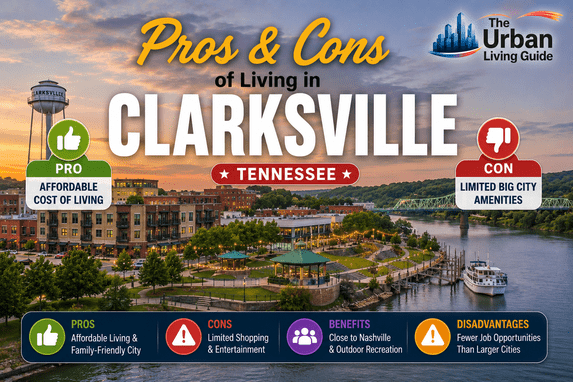
The Pros and Cons of Living in Clarksville Show a City Growing Faster Than Most People Realize
Clarksville doesn’t make many national headlines — and that’s precisely part of its appeal. Sitting on the Cumberland River just 45 miles northwest of Nashville, it has quietly become one of the fastest-growing cities in Tennessee and consistently ranks among the fastest-growing cities in the entire United States. Anchored by Fort Campbell — one of the largest military installations in the country — and increasingly attracting civilians drawn by Nashville proximity at dramatically lower costs, Clarksville is a city in genuine transition. Here’s the honest picture of what life here actually looks like.
Pros of Living in Clarksville That Deserve Serious Attention
1. Housing Affordability That Stands Apart From Nashville
Clarksville offers some of the most accessible home prices in all of Tennessee. Median home prices run 40-50% lower than Nashville, and rental costs give middle-income earners genuine financial breathing room that the state capital simply cannot offer anymore. Many residents appreciate the ability to own a spacious home here at a price point that would buy a modest apartment elsewhere in the region.
2. Fort Campbell Creates Unusual Economic Stability
Fort Campbell — straddling the Tennessee-Kentucky border and home to the 101st Airborne Division (Air Assault) — employs tens of thousands of military personnel, civilian contractors, and support staff. One thing people often mention is how this military anchor gives Clarksville’s economy a recession resistance that pure civilian cities rarely achieve — federal payroll doesn’t disappear during economic downturns.
3. Nashville Access Without Nashville Pricing
Clarksville sits 45 miles from Nashville via I-24 — approximately 45-60 minutes under normal traffic conditions. For remote workers needing occasional city access, or professionals willing to commute selectively, this proximity fundamentally changes the city’s value proposition. Nashville airport, specialized healthcare, and major entertainment are all within practical reach.
4. Austin Peay State University Adds Real Cultural Energy
Austin Peay State University — with over 10,000 students — gives Clarksville an academic presence that softens the purely military character of the city. The university supports arts programming, community events, and a younger population that contributes meaningfully to Clarksville’s evolving downtown identity.
5. Downtown Clarksville Is Genuinely Improving
Public Square, Strawberry Alley Ale Works, and a growing cluster of independent restaurants and shops have created a downtown core with genuine weekend energy. Many residents appreciate that Clarksville’s downtown revival feels authentic rather than manufactured — driven by local business owners rather than outside developers.
6. Outdoor Access Along the Cumberland River
Clarksville Greenway, Liberty Park, and Lake Barkley — within easy driving distance — offer hiking, cycling, fishing, and water recreation that give the city meaningful outdoor lifestyle options. Land Between the Lakes National Recreation Area sits under 60 minutes away for more serious outdoor pursuits.
📺 Clarksville residents — military families and civilians alike — share what daily life here genuinely feels like.
Cons of Living in Clarksville Worth Understanding Before You Commit
1. Job Market Outside Military Sector Remains Thin
The pros and cons of living in Clarksville, Tennessee conversation always surfaces this honestly. Outside Fort Campbell, healthcare, retail, and education, the private sector job market is relatively shallow. Professionals in specialized fields — finance, tech, media — will find career opportunities limited locally, making Nashville commuting or remote work arrangements essentially mandatory for certain career paths.
2. Military Town Transience Creates Community Challenges
Fort Campbell’s presence is an economic asset and a community complexity simultaneously. Military families rotate every 2-3 years by design — creating a transient social fabric that some newcomers find challenging when building lasting friendships and community roots. Some civilians find it challenging that social circles can feel constantly reshuffled rather than deeply established.
3. Public Transit Is Essentially Nonexistent
Clarksville Transit System (CTS) operates limited bus routes that don’t come close to supporting car-free living for any realistic daily routine. Clarksville is completely and fundamentally car-dependent — owning a reliable vehicle isn’t optional, it’s a basic prerequisite for functioning daily life here.
4. Urban Amenities Still Lag Behind Growth Rate
Clarksville is growing faster than its infrastructure and amenity base can comfortably absorb. Some newcomers find it challenging that restaurant variety, specialized retail, cultural institutions, and entertainment options haven’t kept pace with the population surge — creating a city that can feel underdeveloped relative to its actual size of 175,000+ residents.
5. Summer Heat and Humidity Are Significant
Like most of Middle Tennessee, Clarksville experiences genuinely hot and humid summers — July and August regularly push above 90°F with humidity that compounds the discomfort considerably. For movers from Northern or Western states, the summer climate adjustment takes longer than most expect.
Who Finds Clarksville the Right Fit?
Clarksville works exceptionally well for military families and veterans connected to Fort Campbell, Nashville commuters seeking dramatic housing cost reductions, remote workers prioritizing space and affordability over urban amenity density, and first-time homebuyers who need a realistic foothold in the Tennessee market.
Who should reconsider? Career-driven professionals needing deep local private sector opportunity, those who value walkable urban culture and robust transit, and anyone expecting a fully developed city experience at Clarksville’s current stage of growth should weigh expectations honestly.
Final Verdict – Does Clarksville Make Sense for Your Move?
Clarksville is a city that rewards practical, patient movers who understand exactly what they’re choosing. The pros and cons of living in Clarksville, Tennessee ultimately favor those prioritizing homeownership, Nashville access, and financial stability over urban sophistication. It’s not the finished product — but for the right mover, that’s precisely the point. The ground floor of Clarksville’s evolution is still genuinely available, and the fundamentals here are stronger than the city’s modest reputation suggests.
FAQs
Is Clarksville, TN safe to live in?
Safety varies by neighborhood. St. Bethlehem, Sango, and areas along the Highway 41-A corridor are among the safer and more established residential zones. Parts of older downtown-adjacent neighborhoods have higher crime activity. Overall, Clarksville sits in a moderate range for cities its size — specific neighborhood research before committing is genuinely worthwhile.
What salary do you need to live comfortably in Clarksville?
A single professional can live very comfortably on $45,000-$58,000 annually — making Clarksville one of Tennessee’s most financially accessible urban options. Families generally need $72,000-$88,000 depending on housing choices, childcare costs, and whether a Nashville commute adds transportation expenses to the monthly budget.
How far is Clarksville from Nashville?
Approximately 45 miles via I-24 — roughly 45-60 minutes under normal traffic conditions. During peak Nashville rush hour congestion, the drive can extend to 75-90 minutes, which factors meaningfully into daily commuting decisions for those working in the state capital.
Is Clarksville good for military families?
Exceptionally so — the entire city infrastructure has evolved around Fort Campbell’s needs. Military support services, veteran-friendly businesses, housing options near base, and a community deeply familiar with military life make Clarksville one of the more genuinely military-friendly cities in the Southeast.
Is Clarksville growing?
Rapidly and consistently. Clarksville has ranked among the fastest-growing cities in America for multiple consecutive years, driven by Nashville overflow, military family settlement, and remote worker relocation. Infrastructure investment is accelerating but still catching up with population growth.
What is Clarksville, TN known for?
Clarksville is primarily known for Fort Campbell and the 101st Airborne Division, Austin Peay State University, its position as Tennessee’s fifth-largest city, Cumberland River access, and its rapid emergence as one of the South’s fastest-growing mid-sized cities over the past decade.
Explore More with The Urban Living Guide
- 📍 Living in Clarksville, Tennessee — Complete relocation guide covering Fort Campbell community, neighborhood breakdown, and what everyday life in Clarksville genuinely offers
- 💰 Cost of Living in Clarksville, Tennessee — Honest breakdown of housing affordability, Nashville commute costs, and how Clarksville compares to other Tennessee cities on real monthly expenses
- 🏘️ Best Neighborhoods in Clarksville, Tennessee — From St. Bethlehem to Sango — find your right fit based on lifestyle, budget, and proximity to Fort Campbell