

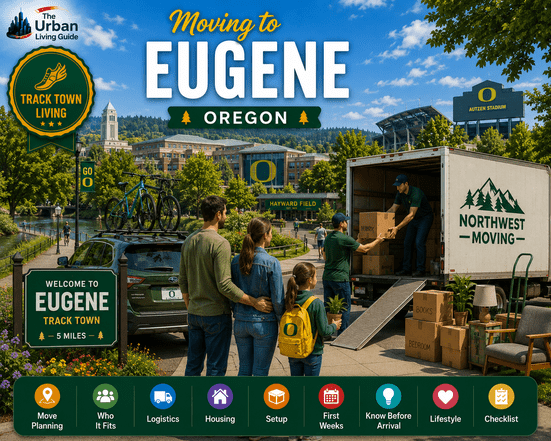
Eugene Is Oregon’s Second City — And the Ducks, the Trails, and the Price Tags Make It Worth the Look
Eugene sits at the southern end of the Willamette Valley, anchored by the University of Oregon and animated by a culture that takes outdoor recreation, local food, and the Oregon Ducks with equal seriousness. Oregon’s second-largest city proper — around 176,000 residents — has a smaller footprint than Portland but a remarkably complete lifestyle proposition: a median home sale price around $468,500, one-bedroom rents starting near $1,200–$1,500/month, and a cost of living that runs 15–20% below Portland while offering the same zero-sales-tax environment and immediate Cascade Mountain access.
Eugene’s economy is genuinely broader than its college-town reputation suggests. PeaceHealth (the region’s largest healthcare system), University of Oregon, Lane Community College, the outdoor recreation industry, and a growing technology sector collectively anchor employment for a city that draws people who want Portland’s values at a more manageable price and scale. The city is also where Nike was founded — Phil Knight ran track here under legendary coach Bill Bowerman at Hayward Field, which remains one of the premier track and field venues in the world and anchors the city’s deep identity as Track Town, USA.
Watch this video by a popular local vlogger to understand Eugene’s atmosphere –
Moving to Eugene, Oregon – Planning by Distance and Origin
Eugene’s position at the southern end of the Willamette Valley on I-5 gives it strong regional connectivity — 110 miles south of Portland and roughly 65 miles north of Roseburg. The Amtrak Cascades train connects Eugene to Portland in about two hours, and Eugene Airport (EUG) offers direct flights to major West Coast hubs.
-
- Same-State Move (from Portland, Salem, or elsewhere in Oregon): The most common Eugene relocation pattern. A local crew handles most volumes in a single day. Budget $800–$2,200. The I-5 corridor is direct and well-served by Oregon moving companies.
- Interstate Move (from California, Washington, Idaho): Eugene is one of Oregon’s most common California transplant destinations, alongside Portland. Budget $2,500–$6,000 from Northern California, $4,000–$9,000 from Southern California. University of Oregon’s academic calendar creates predictable August and September surge in both housing demand and moving company bookings — start early.
- Long-Distance or Cross-Country Move: Full-service movers run $4,500–$11,000. Many cross-country relocators use Eugene as a Portland alternative — arriving with more budget flexibility and finding the city delivers more than expected for the price point.
Eugene’s University of Oregon academic calendar creates a specific August and September surge in housing demand and mover availability. If your timeline has flexibility, a November through March move into Eugene avoids the UO turnover crunch entirely — and Oregon’s off-season moving rates apply, saving real money.
Who Eugene Is Built For
Eugene has a clear value proposition, and the people who fit it tend to become its most enthusiastic advocates.
-
- University of Oregon faculty, staff, and graduate students: UO is Eugene’s largest employer and shapes the city’s intellectual, athletic, and cultural identity. The academic community is embedded into daily life in ways that go well beyond campus — neighborhood events, public lectures, and the Oregon Ducks athletics schedule are genuinely civic, not just institutional.
- Healthcare professionals: PeaceHealth Sacred Heart Medical Center is the region’s flagship healthcare institution and one of Eugene’s largest employers. The city serves as the healthcare hub for a large catchment area including rural southern Willamette Valley — creating real depth in healthcare employment beyond just one hospital system.
- Remote workers and lifestyle relocators: Eugene’s 60,000–$80,000 comfortable living threshold (versus Portland’s $75,000–$100,000) makes it the value play in Oregon for remote workers who want outdoor access, a real food scene, and urban amenities without Portland’s price premium.
- Outdoor and running culture enthusiasts: Eugene’s identity as Track Town, USA is not just history. The Pre’s Trail along the Willamette River is one of the most beloved running trails in the American running community. Hayward Field hosts world-class athletics events. The Cascades are accessible within an hour. The culture takes outdoor activity seriously in a way that shapes daily life.
- Families seeking college-town lifestyle with Oregon values: Eugene’s Saturday Market (one of the longest-running outdoor markets in the country), the arts scene, the Lane Arts Council, and a strong family-oriented culture in neighborhoods like South Eugene and Fairmount make it one of Oregon’s more complete family relocation options outside the Portland metro.
Who May Find Eugene Challenging
Eugene’s limitations are worth naming clearly for people making long-term decisions.
-
- People needing deep corporate or tech job markets: Eugene’s job market, while solid in healthcare and education, is significantly narrower than Portland’s. Tech, finance, corporate services, and entertainment careers will find far more depth in the Portland metro. Eugene works best for people with portable careers, remote flexibility, or employment in the city’s dominant sectors.
- The same Big Dark as Portland: Eugene shares the same Willamette Valley grey winter pattern as Portland — relentless overcast and drizzle from October through June. The same psychological management strategies apply. Eugene’s slightly sunnier summers (warmer, drier than coastal cities) partially offset this, but newcomers from California or the Southwest still face a genuine climate adjustment.
- Limited direct flight connectivity: Eugene Airport (EUG) offers direct flights to major West Coast cities, but long-haul or cross-country routes typically require a connection through Portland, San Francisco, or Seattle. Frequent flyers with broad travel needs may find PDX a more practical hub city.
- Smaller-city scale: Eugene is genuinely smaller than Portland in restaurant variety, nightlife depth, and the sheer density of urban entertainment options. People accustomed to major metro cultural menus will need to adjust expectations — or make Portland a regular destination, which is entirely practical at two hours by Amtrak or car.
Moving Logistics and Transportation
Eugene is physically easy to move into — flat terrain in most residential areas, good I-5 highway access, and no historic-district complications equivalent to Portland’s inner neighborhoods. The main logistical variable is UO academic calendar timing.
-
- Local Eugene moves: $800–$2,200 for standard two to three bedroom moves
- Portland-to-Eugene: typically $1,200–$2,800
- Northern California to Eugene: $2,500–$6,000
- Cross-country moves: $4,500–$11,000 with full-service movers
- UO calendar surge: August and September mover availability tightens significantly — book 6–8 weeks ahead if moving during this window
- Lane Transit District (LTD): Eugene’s bus network is functional and well-organized, covering major residential corridors and the UO campus. Not a substitute for car ownership in outer neighborhoods, but genuinely useful for campus-adjacent addresses
- Amtrak Cascades: Eugene to Portland in approximately 2 hours — a practical option for regular Portland trips without driving
- Eugene Airport (EUG): Direct flights to Portland, San Francisco, Seattle, Los Angeles, and select other West Coast destinations
Housing Strategy in Eugene’s 2026 Market
Eugene’s housing market in 2026 sits at a more accessible price point than Portland — median around $468,500 — while offering the same Oregon lifestyle and outdoor access. The market benefits from the same balanced conditions as Portland without the same level of demand intensity.
-
- South Eugene: The city’s most desirable residential neighborhood — established tree-lined streets, excellent schools, proximity to Spencer Butte and Pre’s Trail. Premium pricing within Eugene’s range.
- Fairmount: The hilltop neighborhood adjacent to UO campus and South Eugene. Victorian homes, genuine neighborhood character, popular with faculty and long-term residents.
- Friendly Street area (South of UO): One of Eugene’s most walkable and bike-friendly corridors. Well-established neighborhood feel with strong community identity.
- River Road / Santa Clara: North Eugene’s working-class neighborhoods — more affordable, car-dependent, offering genuine value for budget-conscious buyers and renters.
- Downtown Eugene: Urban loft and apartment living, walkable to the Saturday Market and 5th Street Public Market. More affordable than Portland’s Pearl District equivalent for similar urban character.
- Short-term housing: Airbnb options in the South Eugene and downtown areas. Extended Stay options available for multi-week arrivals. UO-adjacent furnished apartments exist specifically for academic relocations.
Storage and Setup Essentials
Eugene homes run generously sized compared to Portland’s denser neighborhoods — particularly in South Eugene and the residential corridors south of campus. If you need extra space during your transition, Public Storage and CubeSmart both have Eugene-area locations. For utilities: Eugene Water & Electric Board (EWEB) handles both electricity and water for Eugene city residents — a combined public utility that simplifies setup. NW Natural serves gas. Internet is served by Comcast Xfinity and CenturyLink in most neighborhoods. Total utility costs typically run $200–$300/month for a typical Eugene household — generally lower than Portland given the different housing stock character.
The First Few Weeks in Eugene — The Real Experience
Eugene has a rhythm that reveals itself gradually but consistently rewards people who engage with it. The outdoor and running community is the fastest way to meet people and feel oriented — Pre’s Trail alone introduces you to a social infrastructure that Portland doesn’t replicate. The Saturday Market (April through November, Downtown Park Blocks) is Eugene’s civic heart in a way that makes most newcomers understand the city’s character within their first weekend.
-
- Track Town culture: Even non-runners quickly absorb Hayward Field’s When Eugene hosts major track and field events — as it does annually — the city’s energy transforms in a way that makes the community identity immediately legible.
- UO game days: Oregon Ducks football and basketball generate significant city-wide energy on game days. Not at SEC scale, but genuinely shaping of the city’s social calendar — know the schedule before planning your first-month weekends.
- Portland as a monthly destination: Most Eugene residents make Portland a regular monthly or bi-monthly trip — 2 hours by car or Amtrak — for concerts, specific dining, airport connections, and big-city cultural programming. This rhythm normalizes quickly and makes the smaller Eugene scale feel less limiting.
- Big Dark preparation: Same advice as Portland applies — full-spectrum light therapy lamp, active outdoor engagement even in drizzle, and building a deliberate social and indoor calendar from October through March.
Things to Know Before You Arrive
-
- Driver’s license: Oregon DMV conversion required within 30 days of establishing residency.
- No sales tax: Oregon’s zero-sales-tax applies identically in Eugene — immediate relief on all purchases.
- State income tax: Oregon’s 75%–9.9% applies. Eugene-area incomes tend to run lower than Portland metro, which means more Eugene residents fall in lower brackets where the rate impact is less acute.
- EWEB setup: Contact Eugene Water & Electric Board before your move-in date. As a combined electricity and water utility, one setup call handles both — an efficient process that Eugene residents consistently praise.
- UO academic calendar awareness: If your housing is near campus, the September move-in surge affects parking, traffic, and neighborhood noise levels significantly for two to three weeks each fall. Budget for this in your first-month adjustment expectations.
Local Insights and Lifestyle Feel
-
- Saturday Market (Downtown Park Blocks): Running April through mid-November every Saturday, with Holiday Market in December. One of the longest-running outdoor crafts and farmer’s markets in the country — and genuinely the social and cultural heart of Eugene’s community identity.
- Hayward Field: Rebuilt in 2020 to world-class specifications, Hayward Field hosts NCAA Championships and Diamond League events. The facility and its history are central to Eugene’s Track Town, USA identity in a way that residents feel, not just know intellectually.
- Pre’s Trail: The riverside trail named for Steve Prefontaine — Eugene’s most beloved athletic son — runs along the Willamette River through Alton Baker Park. It’s a running and cycling trail, but it’s also a community commons that most Eugene residents use multiple times per week regardless of athletic ambitions.
- 5th Street Public Market: An indoor/outdoor market district in downtown Eugene with independent restaurants, specialty retailers, and a community character that distinguishes Eugene’s commercial culture from generic suburban retail.
Quick Moving Checklist
Eugene moves are logistically manageable — the main planning priority is avoiding the UO August/September surge if your timeline allows.
30 Days Before:
-
- Choose neighborhood: South Eugene for families and outdoor access, Fairmount for UO proximity and character, Downtown for walkability, River Road for affordability
- Book moving company — 6–8 weeks ahead if moving August or September; off-peak availability is generally excellent
- Contact EWEB for combined electricity and water setup
- Contact NW Natural for gas service if your new home uses gas heating
- Begin housing search with in-person tours — South Eugene inventory moves faster than other neighborhoods
1 Week Before:
-
- Confirm all moving logistics in writing
- Schedule internet installation (Comcast Xfinity or CenturyLink)
- Purchase Northwest Forest Pass ($30/year) before arrival for Cascade Mountain access
- If arriving October–March: prepare for the Big Dark — order a full-spectrum light lamp before you need it
Moving Day:
-
- Photograph old residence before departure
- Confirm EWEB utility active at new address
- Walk Pre’s Trail and visit the Saturday Market in your first week — both orient you immediately to what Eugene is fundamentally about
- Confirm your Oregon DMV appointment is scheduled within 30 days of move-in
The Verdict on Eugene in 2026
Eugene is Oregon’s most underrated relocation destination for the right person. The $468,500 median home price, the Track Town identity, the EWEB combined utility advantage, and the Willamette Valley location put it in a genuinely strong position — especially for people who’ve been priced toward Portland but have flexibility on location. The job market is the honest constraint: Eugene works best for people in healthcare, education, remote work, or the outdoor industry. Come for those reasons, and Eugene tends to be a city people stay in much longer than they initially planned.
FAQs — Moving to Eugene, Oregon
How does Eugene compare to Portland for cost of living?
Eugene runs 15–20% below Portland on most cost measures. Median home price is approximately $468,500 versus Portland’s $535,000. One-bedroom rents start around $1,200–$1,500/month versus Portland’s $1,550 citywide average.
What are Eugene’s main employers?
University of Oregon (largest employer), PeaceHealth Sacred Heart Medical Center, Lane Community College, Lane County government, and a growing outdoor recreation and technology sector.
Is Eugene’s transit system reliable?
Lane Transit District (LTD) provides solid bus coverage, particularly around the UO campus and South Eugene. Car ownership is still necessary for most outer-neighborhood daily life. Amtrak Cascades connects Eugene to Portland in approximately 2 hours.
What is Track Town, USA?
Eugene’s identity as the birthplace of Nike (Phil Knight and Bill Bowerman), home of Steve Prefontaine’s legendary career, and location of the newly rebuilt Hayward Field — one of the premier track and field venues in the world. The running and athletics culture is embedded into daily life in Eugene in genuine ways.
How do I get from Eugene to Portland?
Amtrak Cascades takes approximately 2 hours with multiple daily trains. Driving via I-5 takes about 1 hour 50 minutes in normal traffic. Eugene Airport offers connecting flights for longer trips.
Helpful Local Resources Before Moving
These resources handle the practical foundations of arriving in Eugene:
- City of Eugene: New resident services, permits, and city department contacts.
- Eugene Water & Electric Board (EWEB): Combined electricity and water setup — one call for both services.
- Lane Transit District (LTD): Bus routes, schedules, and passes for getting around Eugene without a car.
- Oregon DMV: Driver’s license conversion required within 30 days of establishing Oregon residency.
Explore More With The Urban Living Guide
These guides cover Eugene from every angle relevant to your relocation decision:
- Living in Eugene, Oregon
- Cost of Living in Eugene, Oregon
- Pros and Cons of Living in Eugene, Oregon
- Best Neighborhoods in Eugene, Oregon