

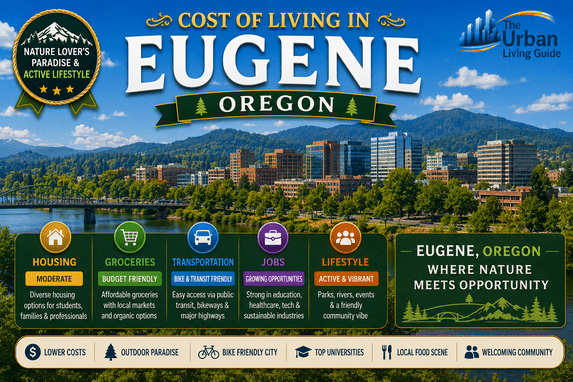
Cost of Living in Eugene, Oregon 2026: Track Town USA Expenses, Willamette Valley Real Estate & Academic Hub Economics
Immersing yourself in the economic rhythm of Eugene—nestled along the southern tip of the lush Willamette Valley and framed by the sprawling campus of the University of Oregon—reveals a distinctive Pacific Northwest community operating in 2026. Whether you are relocating for higher education administration, healthcare careers, or transitioning from high-cost urban centers like Portland or Seattle, this celebrated hub known as Track Town USA offers an eclectic mix of environmental activism, vibrant collegiate sports traditions centered around Autzen Stadium, and endless outdoor recreation.
Evaluating the true cost of living in Eugene, Oregon indicates that while general expenses track slightly above national averages—driven by high local desirability—housing costs remain notably more accessible than coastal metropolitan zones. From vibrant neighborhoods like the Whitaker District and South Hills to transit-friendly pockets near campus, understanding local financial commitments is essential. For official municipal services, zoning notices, and community resources, residents frequently consult the City of Eugene Official Portal.
Average Monthly Expense Breakdown in Eugene, Oregon
Monthly expenditures in Eugene fluctuate depending on household size, lifestyle choices, and exact neighborhood positioning across Lane County. Below is a structured monthly financial breakdown displayed in a clear comparative table format reflecting current economic conditions in 2026:
| Expense Category | Single Adult | Couple | Family of 4 |
|---|---|---|---|
| Housing / Rent | $1,300 – $1,800 | $1,750 – $2,500 | $2,650 – $3,850 |
| Groceries & Provisions | $340 – $450 | $620 – $880 | $1,050 – $1,520 |
| Transit & Commuting | $100 – $210 | $200 – $370 | $340 – $620 |
| Utilities & Connectivity | $160 – $290 | $250 – $410 | $400 – $650 |
| Health & Medical Care | $145 – $350 | $350 – $720 | $700 – $1,350 |
| Childcare & Tuition | $0 | $0 | $1,300 – $2,500+ |
| Leisure & Recreation | $130 – $310 | $260 – $540 | $450 – $850 |
Residents frequently highlight that while managing the overall cost of living in Eugene, Oregon requires accounting for municipal utility rate structures and progressive state tax withholdings, the city’s unique cultural vitality and vibrant arts scene deliver exceptional everyday lifestyle value.
Housing Outlays, Real Estate & Neighborhood Valuations in Lane County
Securing residential property represents the primary financial variable when calculating the cost of living in Eugene, Oregon, spanning historic homes near campus to contemporary multi-family developments in the downtown core. Acquisition pricing and rental rates display considerable variation across local zip codes:
- Studio apartments in modern transit-oriented complexes generally lease between $1,050 and $1,450 per month.
- 1-bedroom units across popular urban enclaves like the Whitaker District range from $1,300 to $1,800 per month.
- 2-bedroom configurations span $1,650 to $2,350 per month, accommodating shared living arrangements and expanding households.
- Detached single-family homes and upscale properties across premier hillside residential districts command monthly rents or mortgage equivalents from $2,500 to $5,200+.
For prospective real estate buyers, the median home listing price across municipal boundaries hovers near $445,000, reflecting strong regional demand. Property owners must also budget for local Lane County property tax assessments, which fund local infrastructure and public library networks.
Watch this video to get a closer look at housing and neighborhood pricing in Eugene, Oregon.
Grocery Markets, Provision Retailers & Dining Expenses
Everyday food consumption and provisioning expenditures track moderately above the national average while offering exceptional local farm-to-table diversity across neighborhood shopping districts:
- Supermarket options feature regional favorites like Market of Choice, Fred Meyer, and the Wandering Goat / local organic co-ops, alongside major national chains.
- Fresh produce, artisanal baked goods, and seasonal items are widely available through the historic Eugene Saturday Market and neighborhood provisioning shops operating throughout Lane County.
- Dining out expenses span a creative culinary landscape; casual neighborhood bistros and local brewpubs average $15 to $27 per person, while premier dining venues scale from $60 to $130+ per person.
School Districts, Childcare Investments & Academic Outlays
Educational planning throughout the municipality involves navigating public school clusters, specialized charter options, and university-linked resources:
- Infant daycares and full-time early childhood facilities typically range between $1,300 and $2,250 per month per child across Lane County.
- Preschool and early learning programs average $900 to $1,600 per month, preparing children for entry into local elementary schools.
- Public education is managed by Eugene School District 4J and Bethel School District, offering diverse educational programs.
- Private and preparatory institutions command annual tuitions scaling from $15,000 to $35,000+.
Lane Transit District Buses, Bike Trails & Transit Financials
Navigating the regional transportation network relies heavily on an integrated public transit framework and extensive bicycle infrastructure:
- Personal automobile upkeep requires factoring in regional fuel pricing, which ranges from $3.30 to $3.90 per gallon, alongside Oregon vehicle insurance policies averaging $1,400 to $2,000 annually.
- Public transit infrastructure is operated by the Lane Transit District (LTD), featuring EmX bus rapid transit corridors and extensive local bus routes, with monthly transit passes costing approximately yer $65.
- Primary commuting arteries rely heavily on I-5, Highway 126, and Highway 99, serving thousands of regional commuters daily.
EWEB Utilities, Seasonal Climate Loads & Energy Budgets
Because the Willamette Valley climate brings wet winters and warm summer months, residential energy consumption requires careful fiscal provisioning:
- Electricity and water services are primarily administered by the municipal Eugene Water & Electric Board (EWEB), with average monthly bills spanning $140 to $280+ for typical apartments and significantly higher for detached single-family dwellings during peak weather extremes.
- Natural gas services provided by NW Natural generally add $60 to $120 per month to household ledgers during winter heating months.
- High-speed broadband connectivity through providers like Comcast Xfinity and CenturyLink Fiber runs between $50 and $90 monthly.
Medical Networks, PeaceHealth & Insurance Premiums
Eugene residents benefit from proximity to premier healthcare infrastructure anchored by established regional medical networks:
- Major medical providers include PeaceHealth Sacred Heart Medical Center, offering comprehensive emergency services, specialized outpatient clinics, and wellness centers.
- Employer-sponsored health coverage typically deducts $125 to $350 per month for individuals and $450 to $900 per month for comprehensive family plans.
- Routine out-of-pocket medical care and specialized specialist visits track closely with regional Pacific Northwest averages.
Alton Baker Park, Cultural Landmarks & Community Leisure
Leisure spending and recreational pursuits reflect an active outdoor lifestyle supported by vast municipal park systems and collegiate sports:
- Popular cultural destinations include the Jordan Schnitzer Museum of Art, Matthew Knight Arena events, and local theatrical productions.
- Outdoor activities feature running and cycling across the Ruth Bascom Riverbank Trail System, exploring Alton Baker Park, and hiking Spencer Butte.
- Fitness club memberships and specialized wellness studios average $50 to $120 per month.
Veterinary Care & Pet-Friendly Suburban Amenities
For pet owners establishing households in Track Town USA, Eugene offers an exceptionally welcoming environment with dedicated animal care and recreation facilities:
- Veterinary care and wellness evaluations average between $55 and $95 per standard checkup across local veterinary clinics.
- Pet insurance premiums for dogs and cats range from $30 to $80 monthly depending on coverage tiers and animal age.
- Dedicated canine recreation is supported by municipal off-leash dog areas, including popular spots at Amazon Park and Emslie Kennedye Dog Park.
Collegiate Game Days, Seasonal Moisture & Municipal Services
Living in this Willamette Valley hub introduces specific logistical and administrative factors affecting annual household budgeting:
- University of Oregon game days require planning for localized traffic congestion and parking adjustments near Autzen Stadium.
- Seasonal dampness and winter rain demand proactive home maintenance, including roof gutter management and moisture control.
- Municipal refuse and recycling services are billed through local utility accounts, ensuring reliable residential waste management.
State Tax Structures & Local Income Assessments
Tax obligations are heavily shaped by Oregon’s unique state-level fiscal policies:
- Oregon state income tax features progressive brackets ranging from 4.75% up to 9.90% across top brackets, representing a notable component of annual financial planning.
- Retail sales tax within Oregon is 0.00%, providing immediate savings on everyday consumer purchases and retail goods.
- Lane County property tax rates feature effective residential rates averaging roughly 1.15% to 1.35% of assessed market value annually.
Financial Viability: Is Eugene Worth the Investment?
- Exceptional Outdoor Recreation: Residents gain immediate access to river trails, hiking bluffs, and extensive urban parklands.
- Zero Retail Sales Tax: Everyday consumer purchases and major retail buys are exempt from state sales taxes.
- Vibrant Collegiate Energy: A thriving university community provides rich cultural events, sports traditions, and continuing education.
- Calculated Trade-Offs: Progressive income tax brackets and municipal utility rate structures require diligent financial planning, but the Eugene experience remains uniquely rewarding.
Segment Analysis: Financial Pressures and Affordability Demographics
Analyzing economic positioning reveals distinct experiences across different household income tiers within the municipality:
Who May Find Eugene Expensive
Entry-level service personnel, university students living independently, and renters entering newly constructed luxury apartment complexes near campus may encounter significant financial pressure. When factoring in Oregon’s progressive income tax rates and competitive housing valuations, modest entry-level salaries can experience noticeable monthly budget compression.
Who Can Afford It Comfortably
Conversely, established university faculty, healthcare specialists from PeaceHealth, remote corporate earners, and dual-income households find Eugene exceptionally manageable. Individuals and households earning annual incomes upward of $110,000 to $150,000+ can comfortably acquire real estate in premier neighborhoods like the South Hills, fund robust retirement accounts, and fully enjoy the region’s cultural offerings without severe fiscal strain.
South Hills vs. Whitaker District and Suburban Springfield: Expense Comparison
Comparing upscale South Hills against artistic Whitaker District and adjacent Springfield highlights key lifestyle choices:
| Cost Parameter | South Hills (Hillside Enclave) | Whitaker District (Creative Core) | Downtown Eugene (Urban Core) | Springfield (Adjacent City) |
|---|---|---|---|---|
| Housing (1-2 BHK Rent) | $1,700 – $2,600 | $1,350 – $1,950 | $1,250 – $1,800 | $1,150 – $1,650 |
| Parking & Vehicle Fees | Free Garage / Driveway | Street / Permit Parking | $120 – $220/mo | Free Garage / Driveway |
| Transit & Commute Access | Driving corridors & winding roads | Bike-friendly & bus lines | LTD bus rapid transit walkable | I-5 access & commuter routes |
| School District Zoning | Eugene School District 4J | District 4J school zones | District 4J school clusters | Springfield Public Schools |
| Shopping & Dining | Quiet residential parks | Breweries, food carts & bakeries | Downtown restaurants & cafes | Historic downtown & retail parks |
| Utilities & Taxes | EWEB rates & county taxes | EWEB rates & county taxes | EWEB rates & county taxes | Lower SUB utility rates |
| Car Dependency | High (Mandatory Vehicle) | Low (Highly Walkable) | Low (Transit Connected) | Moderate (Car Recommended) |
Strategic Insight: Professionals seeking scenic hillside views frequently prefer properties in the South Hills for architectural space, while budget-conscious households or first-time buyers often look across the river to neighboring Springfield for significantly lower utility and housing costs.
Smart Budgeting Strategies for Eugene Households
Optimizing monthly expenditures while maintaining comfort across Track Town USA is achievable through targeted financial habits:
- Leverage the Lane Transit District (LTD) bus network for daily commuting across urban corridors to reduce personal vehicle wear and parking expenses.
- Utilize EWEB energy efficiency rebates and winter weatherization programs to smooth out electricity surges during wet, chilly months.
- Incorporate local farmers’ markets and neighborhood grocery specials to manage monthly household food provisioning budgets effectively.
- Take advantage of municipal green spaces like Alton Baker Park and the Ridgeline Trail system to enjoy complimentary weekend leisure activities.
- Invest in home moisture control and dehumidification equipment to mitigate long-term maintenance costs associated with Willamette Valley rainfall.
- Maximize pre-tax commuter benefit accounts through your employer to lower taxable income while covering public transit expenses.
- Explore weekday happy hours and local food cart pods around the city rather than dining out during peak weekend hours.
- Engage with community tool libraries across Lane County to minimize expenses related to home maintenance equipment.
Local Resident Realities: Perspectives from Long-Term Community Members
“Living in the Whitaker District gave our family incredible walkability to local cafes and food cart pods, and our monthly expenses remain very manageable compared to what our friends pay in Portland.” — Sarah T., Whitaker resident of 7 years (Feedback sourced from Willamette Valley urban living forums & community boards)
“Buying our home in the South Hills was a fantastic long-term investment, but Lane County property assessments and EWEB winter heating bills definitely require careful annual financial planning.” — Michael R., South Hills homeowner of 11 years (Feedback sourced from Eugene neighborhood association reviews)
Frequently Asked Questions About Living Costs in Eugene, Oregon
How does the overall cost of living in Eugene compare to the national average?
The overall cost of living in Eugene tracks roughly 8% to 12% above the national average. While progressive income tax brackets and housing valuations require careful financial planning, the absence of statewide retail sales tax provides notable relief on daily consumer purchases.
What is the average monthly rent for a 1-bedroom apartment in Eugene?
A standard 1-bedroom apartment in Eugene typically leases between $1,300 and $1,800 per month. Rental pricing fluctuates based on proximity to the University of Oregon campus or commercial districts like the Whitaker District.
Are utility bills expensive during extreme weather months in Eugene?
Utility bills experience predictable seasonal shifts driven by winter heating needs and wet weather conditions. Combined household utilities average $160 to $290 monthly, which can be effectively managed through EWEB conservation programs.
Is personal vehicle ownership necessary for navigating daily life in Eugene?
While LTD bus rapid transit and extensive bike trails provide excellent urban transit links, many residents living across suburban Lane County rely on personal automobiles for regional errands.
What annual salary is recommended for a single adult to live comfortably in Eugene?
A single adult earning an annual income between $70,000 and $90,000 can live comfortably in Eugene, easily covering rent, transit passes, healthcare provisions, and recreational outings without severe financial compression.
How do property taxes impact home buyers in Lane County?
Property tax assessments in Eugene average roughly 1.15% to 1.35% of assessed market value annually. Prospective home buyers benefit from local homestead provisions that moderate primary residence tax burdens over time.
Looking for More Information on Eugene? Explore Additional Guides
Want to explore further? At The Urban Living Guide (TULG), we have covered different topics related to daily living and relocation needs to help you make informed decisions. Whether you are researching neighborhoods, weighing pros and cons, or planning your eventual move, check out these helpful resources:
- Living in Eugene, Oregon
- Pros and Cons of Living in Eugene, Oregon
- Best Neighborhoods in Eugene, Oregon
Ready to make your decision? Explore our complete guide here: Moving to Eugene, Oregon.
Follow The Urban Living Guide (TULG) for comprehensive USA city details, neighborhood spotlights, and financial insights across all major metropolitan areas.