

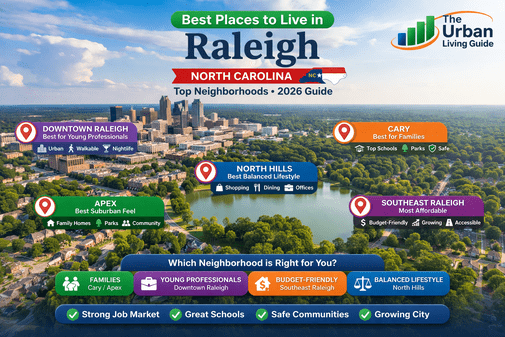
Best Neighborhoods in Raleigh, North Carolina: Oak City Enclaves, Research Triangle Hubs & Historic Districts in 2026
Covering approximately 149.6 square miles of land area across the rolling forested hills of the eastern Piedmont in Wake County, the capital municipality of Raleigh operates under the council-manager governance of the City of Raleigh. Housing an incorporated municipal core population exceeding 480,000 residents and anchoring the booming Research Triangle metropolitan area of over 2.1 million people, the “City of Oaks” stands as a premier national powerhouse for technology innovation, life sciences research, state government, venture capital, and higher education.
Relocating across the Research Triangle requires evaluating highway loop commuter patterns, mature hardwood oak canopies, and regional public transit systems operated by GoRaleigh and GoTriangle. Inbound movers consistently balance direct access to primary regional employers—including state legislative complexes downtown, major technology campuses across the 7,000-acre Research Triangle Park (RTP), corporate headquarters for Red Hat, Martin Marietta, Bandwidth, and extensive medical healthcare networks anchored by UNC Health Rex Hospital and WakeMed Raleigh Campus—against daily transit commutes across Interstate 440 (The Cliff Benson Beltline), Interstate 540 (Northern Wake Expressway), Interstate 40, Wade Avenue, and US Route 1 (Capital Boulevard), with global air links via Raleigh-Durham International Airport (RDU).
Join an authentic local tour to explore the vibrant dining districts, historic tree-canopied streets, and distinctive residential neighborhoods across Raleigh, North Carolina:
Key Residential Areas in Raleigh at a Glance in 2026
| Neighborhood | Location | Distance to State Capitol | Development Status | Transit Connectivity | Cost Level | Best Fit For |
|---|---|---|---|---|---|---|
| Downtown & Glenwood South | Central Urban Core | 0 mi (Core) | High-Density Mixed-Use & Entertainment | Exceptional (GoRaleigh Station, Union Station, I-40) | High-to-Premium | Young Professionals, Tech Staff & State Workers |
| Historic Oakwood | East Downtown Ridge | ~0.8 mi east | Preserved 19th-Century Victorian Landmark | High (GoRaleigh Bus Lines, Person St, Edenton St) | High-to-Premium | Architects, Preservationists & State Officials |
| North Hills (Midtown) | North Beltline Corridor | ~5 mi north | Master-Planned Mixed-Use Innovation | Exceptional (I-440 Beltline (Exit 8), Six Forks Rd) | High-to-Premium | Corporate Executives, Families & Shoppers |
| Five Points & Hayes Barton | Northwest Inner Core | ~2 mi northwest | Historic 1920s Prestigious Suburban | High (Glenwood Ave, Wade Ave, I-440) | Ultra-Premium | Medical Directors, Law Partners & Families |
| Brier Creek | Northwest County Line | ~15 mi northwest | Master-Planned Golf & Tech Suburb | High (I-540, US-70 / Glenwood Ave, I-40) | Mid-to-High | RTP Tech Workers, Airport Staff & Commuters |
Detailed Breakdown of Prominent Raleigh Neighborhoods
Downtown & Glenwood South — High-Rise Living, Warehouse Arts & Tech Corporate Hubs
Covering the central commercial grid surrounding the historic North Carolina State Capitol and the bustling nightlife corridor of Glenwood South, Downtown Raleigh serves as the governmental, legal, financial, and cultural engine of the Research Triangle. Governed under City of Raleigh municipal administration and championed by the Downtown Raleigh Alliance (DRA), the urban core blends historic brick warehouse conversions in the Warehouse District with sleek modern glass skyscraper condominiums and corporate headquarters along Fayetteville Street.
The district provides a true walkable urban lifestyle within steps of state government complexes, world-class museums, live concert amphitheaters, and acclaimed southern culinary destinations.
- Housing: Architectural inventory features contemporary high-rise luxury condominium towers (such as The Dillon, PNC Plaza, and The Edison Lofts), restored industrial brick lofts in the Warehouse District, and modern podium mid-rise apartments. Condominium purchase valuations typically range from $310,000 to $1,250,000+, while 1-bedroom rental apartments average $1,650 to $2,850 per month.
- Safety & Crime Rate: Patrolled by the Raleigh Police Department (RPD) Downtown District and supported by visible uniformed Downtown Raleigh Safety Ambassadors. High pedestrian foot traffic along Fayetteville Street and Glenwood Avenue maintains safe conditions, though standard urban vigilance is advised regarding vehicle larcenies in commercial parking garages.
- School District & Education Quality: Governed by the highly regarded Wake County Public School System (WCPSS), containing nearby public magnet campuses such as Wiley Magnet Elementary and Needham B. Broughton High School (celebrated for its Global Studies and International Baccalaureate programs), alongside higher education at William Peace University and nearby North Carolina State University (NC State).
- Walkability & Daily Conveniences: Outstanding pedestrian walkability (Walk Score of 90-95/100). Residents walk to over 100 local restaurants, craft cocktail lounges, independent coffee houses, and major grocery supermarkets including Weaver Street Market on Hargett and Publix Super Market at Peace Raleigh.
- Parks & Green Spaces / Pet-Friendliness: Municipal recreation is anchored by the historic 4-acre Moore Square, Nash Square, the 308-acre Dorothea Dix Park (Raleigh’s flagship destination park featuring skyline views, sunflower fields, and festival lawns), and Pullen Park (the 5th oldest operating amusement park in the United States). Exceptionally pet-friendly.
- Parking & Traffic Congestion: Assigned parking garage spaces add $125 to $225 per month; on-street parking is regulated through city meters. Surface traffic moves smoothly, with slight slowdowns along McDowell Street and Dawson Street during peak state government commute hours.
- Nearby: 15-minute drive to Research Triangle Park (RTP), 18 minutes to Raleigh-Durham International Airport (RDU), and 5 minutes to NC State University’s Centennial Campus.
- Noise Levels & Vibe: High-tempo, cosmopolitan, and energetic, filled with tech professionals, state legislative staff, live music along Glenwood South, and lively weekend farmers markets.
- Medical Facilities & Hospitals: Direct 5-minute drive to WakeMed Raleigh Campus (Level I Trauma Center) on New Bern Avenue and 8 minutes to UNC Health Rex Hospital on Blue Ridge Road.
- Transit Connectivity: Unmatched regional transit access centered at the GoRaleigh Central Station and passenger rail service at Raleigh Union Station (Amtrak Carolinian and Piedmont lines), with rapid roadway access to Wade Avenue, I-40, and I-440.
- Affordability: High-tier urban price profile; elevated price-per-square-foot metrics reflect the neighborhood’s premier walkability, cultural amenities, and employer proximity.
- Who It’s Best For: Young tech workers at Red Hat, state government attorneys, software developers, design creatives, and urbanites seeking a vibrant car-optional lifestyle.
- Drawbacks: Monthly residential parking garage fees, late-night weekend noise along Glenwood South entertainment strips, and limited inventory of detached single-family homes with large yards.
Historic Oakwood — 19th-Century Victorian Mansions, Grand Oak Canopies & Person Street Dining
Covering approximately 20 square blocks immediately east of the state government district, Historic Oakwood is celebrated as Raleigh’s oldest intact residential neighborhood and its premier historic preservation showpiece. Developed between 1870 and 1910 following the Civil War, the community operates under city historic overlay guidelines and is championed by the Society for the Preservation of Historic Oakwood.
The neighborhood is defined by grand Victorian mansions, Gothic Revival cottages, gaslamp-style streetlights, mature willow oak canopies, and the thriving independent culinary corridor along North Person Street.
- Housing: Real estate stock consists almost exclusively of preserved late 19th-century Queen Anne Victorians, Second Empire mansions, historic Craftsman bungalows, and charming wood-frame cottages. Single-family purchase prices typically range from $480,000 to $1,650,000+, while residential rental flats average $1,750 to $3,200 per month.
- Safety & Crime Rate: Patrolled by the RPD Downtown District. Oakwood consistently maintains a safe, stable residential environment with strong community engagement, resulting in below-average violent crime rates.
- School District & Education Quality: Governed by WCPSS, containing nearby public magnet campuses such as Conn Magnet Elementary School (Active Learning & Global Studies), Moore Square Magnet Middle School, and Enloe Magnet High School (renowned for gifted and talented academic tracks).
- Walkability & Daily Conveniences: Outstanding pedestrian walkability (Walk Score of 86-90/100). Residents stroll along shaded brick sidewalks to craft bakeries, artisan ice cream parlors, wine bars, indie pharmacies, and local grocers along North Person Street.
- Parks & Green Spaces / Pet-Friendliness: Municipal recreation is anchored by Oakwood Park, Oakwood Dog Park, and the 72-acre historic grounds of Historic Oakwood Cemetery (a scenic arboretum parkland open for walking). Exceptionally pet-friendly.
- Parking & Traffic Congestion: On-street parking along narrow residential streets is common; properties with private driveways or carriage houses command premium prices. Surface traffic on Edenton Street and Person Street moves steadily.
- Nearby: 3-minute walk to the North Carolina State Legislative Complex, 16 minutes to Research Triangle Park (RTP), and 20 minutes to RDU International Airport.
- Noise Levels & Vibe: Historic, cultured, and community-centered, characterized by front-porch gatherings, garden tours during the annual Historic Oakwood Candlelight Tour, and peaceful evenings.
- Medical Facilities & Hospitals: Direct 4-minute drive east to WakeMed Raleigh Campus on New Bern Avenue.
- Transit Connectivity: Served by GoRaleigh Bus Routes (Routes 15 and 15L), offering a 3-minute ride into downtown transit stations, with quick vehicular access to New Bern Avenue and US-401 (Capital Blvd).
- Affordability: High-tier price profile for Wake County; premium acquisition costs reflect historic preservation status, mature tree canopies, and walking access to the capital.
- Who It’s Best For: Historic home preservationists, architects, state officials, corporate attorneys, medical staff, and buyers seeking 19th-century architectural character.
- Drawbacks: High purchase entry costs, older home heating and plumbing maintenance, and strict historic district exterior architectural renovation guidelines.
North Hills (Midtown) — Master-Planned Innovation District, Open-Air Luxury & I-440 Beltline
Positioned along the northern arc of the Interstate 440 Beltline at Six Forks Road, North Hills (widely celebrated as Raleigh’s “Midtown”) is one of the Southeast’s most successful mixed-use, master-planned corporate and residential districts. Developed by Kane Realty Corporation, the neighborhood operates under City of Raleigh municipal administration and is guided by the Midtown Raleigh Alliance.
Centered around the Main District, Lassiter District, and Park District, North Hills seamlessly combines Fortune 500 corporate glass office towers with open-air luxury retail, premier dining, luxury residential mid-rises, and established mid-century residential subdivisions.
- Housing: Real estate stock features modern luxury high-rise and mid-rise apartment communities (such as The Alexan, Park Central, and The Dartmouth), contemporary executive townhomes, and established 1960s–1980s brick ranch and colonial homes in surrounding tracts. Single-family purchase prices typically range from $450,000 to $1,450,000+, while luxury rental apartments average $1,750 to $3,400 per month.
- Safety & Crime Rate: Patrolled by the RPD North District and supported by 24/7 private security patrols throughout the Midtown commercial core, maintaining one of the lowest crime profiles in the city.
- School District & Education Quality: Governed by WCPSS, containing top-performing public institutions such as Brooks Global Studies Magnet Elementary, Carroll Magnet Middle School, and Sanderson High School.
- Walkability & Daily Conveniences: Outstanding mixed-use walkability (Walk Score of 88-92/100 within the Midtown core). Residents walk to over 130 premier retailers, department flagships, boutique cinemas at the Regal North Hills, artisan coffee houses, and grocers including Harris Teeter Supermarket, Target, and Total Wine & More.
- Parks & Green Spaces / Pet-Friendliness: Municipal recreation is anchored by the open-air Midtown Park (featuring live summer beach music concerts and farmers markets), North Hills Park, Shelley Lake Park (featuring paved lakeside loops), and direct access to the Capital Area Greenway System. Exceptionally pet-friendly.
- Parking & Traffic Congestion: Plentiful underground structured parking decks and private residential garages keep roads clear. Commuter traffic builds along Six Forks Road and the Interstate 440 interchange during morning and evening rush hours.
- Nearby: 8-minute drive into Downtown Raleigh, 14 minutes to Research Triangle Park (RTP), and 15 minutes to RDU International Airport.
- Noise Levels & Vibe: Polished, cosmopolitan, and social, filled with corporate executives, shoppers on open-air plazas, and quiet residential evenings in surrounding single-family streets.
- Medical Facilities & Hospitals: Direct 4-minute drive via St. Albans Drive to Duke Health Raleigh Hospital on Executive Drive.
- Transit Connectivity: Major highway positioning along Interstate 440 (Exit 8) and Six Forks Road, offering non-stop highway travel across Raleigh, supported by GoRaleigh Bus Routes (Routes 8 and 24L).
- Affordability: High-tier suburban and midtown price profile; higher real estate values reflect premier mixed-use shopping convenience, high safety ratings, and central highway access.
- Who It’s Best For: Corporate executives working in Midtown office towers, tech commuters to RTP, upscale shoppers, and families seeking safe, amenity-dense neighborhoods.
- Drawbacks: Higher housing acquisition costs, heavy shopping traffic around the Six Forks Road intersection on weekends, and limited entry-level starter home inventory.
Five Points & Hayes Barton — Historic Streetcar Village, Grand Georgian Estates & Elite Raleigh Charm
Covering the rolling elevated ridges northwest of downtown where five historic streets converge (Glenwood Avenue, Whitaker Mill Road, Fairview Road, and 30103), Five Points and the adjacent Hayes Barton subdivision represent the pinnacle of historic luxury and architectural prestige in Raleigh. Developed in the 1920s as a premier residential streetcar community by developer Allen J. Barbee, the neighborhood operates under City of Raleigh municipal administration.
The neighborhood is defined by majestic willow oak canopies, multi-million dollar Georgian and Tudor Revival stone estates, walkable neighborhood village bistros, and iconic neighborhood movie landmarks along Glenwood Avenue.
- Housing: Real estate features multi-million dollar historic brick Georgian Revivals, English Tudors, Colonial Revival estates, custom Craftsman bungalows, and upscale luxury infill properties in Hayes Barton, Bloomsbury, and Roanoke. Single-family purchase prices typically range from $680,000 to $3,800,000+, while residential rentals average $2,100 to $4,500 per month.
- Safety & Crime Rate: Patrolled by the RPD Northwest District. Five Points and Hayes Barton consistently record some of the lowest violent and property crime rates in Wake County, supported by high residential stability and active community watch associations.
- School District & Education Quality: Governed by WCPSS, containing top-ranked public schools such as Joyner Magnet Elementary School, Daniels Magnet Middle School (Oberlin), and Broughton Magnet High School, alongside prestigious private academies nearby like Ravenscroft School and St. David’s School.
- Walkability & Daily Conveniences: Outstanding village walkability (Walk Score of 84-88/100 around the Five Points intersection). Residents walk to the historic 1942 Rialto Theatre, artisan bakeries, craft coffee shops, neighborhood taverns, local hardware stores, and grocers including Harris Teeter on Oberlin and Trader Joe’s.
- Parks & Green Spaces / Pet-Friendliness: Municipal recreation is anchored by Roanoke Park, Fallon Park (featuring shaded creek paths connecting to the Capital Area Greenway), and nearby walking trails through Kiwanis Park. Exceptionally pet-friendly.
- Parking & Traffic Congestion: Plentiful private residential driveways, detached carriage garages, and open on-street parking. Surface traffic along Glenwood Avenue and Wade Avenue moves smoothly into downtown.
- Nearby: 4-minute drive into Downtown Raleigh, 12 minutes to Research Triangle Park (RTP), and 14 minutes to RDU International Airport.
- Noise Levels & Vibe: Serene, refined, and historic, characterized by mature tree canopies, children riding bicycles, and quiet residential evenings.
- Medical Facilities & Hospitals: Direct 5-minute drive west via Wade Avenue to UNC Health Rex Hospital on Blue Ridge Road.
- Transit Connectivity: Road travel connects quickly via Glenwood Avenue, Wade Avenue, and Interstate 440, supported by GoRaleigh Bus Routes (Route 6).
- Affordability: Ultra-premium price tier; represents one of the most historically prestigious and high-value residential zip codes in North Carolina.
- Who It’s Best For: High-net-worth families, corporate law partners, medical surgeons, banking executives, and buyers seeking architectural pedigree in a historic streetcar village.
- Drawbacks: Substantial capital requirements for homeownership, competitive property bidding, and rush-hour traffic slowdowns near the Five Points intersection.
Brier Creek — Master-Planned Golf Living, RTP Proximity & Airport Commuter Hub
Positioned along the northwestern boundary of Wake County adjacent to Durham County and Research Triangle Park, Brier Creek is one of the region’s most practical, modern, and rapidly growing master-planned communities. Operating under City of Raleigh municipal administration and championed by the Brier Creek Community Association, the district centers along Brier Creek Parkway, US Route 70 (Glenwood Avenue), and Interstate 540.
The neighborhood combines championship Arnold Palmer-designed golf course fairways at Brier Creek Country Club with expansive open-air retail power centers, modern single-family subdivisions, and direct 5-minute highway access to both RTP tech campuses and RDU Airport.
- Housing: Real estate stock features modern 2000s–2020s two-story brick and fiber-cement executive single-family homes in master subdivisions (like Brier Creek Country Club and Alexander Crossing), contemporary townhomes, and luxury garden-style apartment communities. Single-family purchase prices typically range from $380,000 to $950,000+, while modern rental apartments average $1,350 to $2,350 per month.
- Safety & Crime Rate: Patrolled by the RPD Northwest District. Brier Creek maintains low violent and property crime rates, supported by modern master-planned street designs and active homeowners associations.
- School District & Education Quality: Governed by WCPSS, containing public campuses such as Brier Creek Elementary School and Leesville Road High School, alongside popular public charter options.
- Walkability & Daily Conveniences: Suburban residential streets are automobile-dependent, but major commercial shopping power centers at Brier Creek Commons host Target, BJ’s Wholesale Club, Homemans, Harris Teeter Supermarket, and diverse casual family dining.
- Parks & Green Spaces / Pet-Friendliness: Municipal recreation is anchored by the private fairways of Brier Creek Country Club, Brier Creek Park & Community Center, and direct driving access to the 5,500-acre William B. Umstead State Park (featuring miles of forested hiking, trail running, equestrian paths, and boating on Big Lake). Exceptionally pet-friendly.
- Parking & Traffic Congestion: Plentiful private attached two-to-three car garages and wide driveways keep neighborhood lanes clear. Commuter traffic builds along US-70 (Glenwood Ave) and on-ramps to Interstate 540 during peak morning rush hours.
- Nearby: 5-minute drive into Research Triangle Park (RTP), 7 minutes to RDU International Airport, and 15 minutes to Downtown Durham.
- Noise Levels & Vibe: Grounded, active, and family-centered, characterized by manicured subdivision lawns, youth sports tournaments, and calm evenings.
- Medical Facilities & Hospitals: Direct emergency medical coverage provided within the district by WakeMed Brier Creek Healthplex on T.W. Alexander Drive and 10 minutes to UNC Health Rex Hospital.
- Transit Connectivity: Unmatched highway positioning at the junction of Interstate 540 (Exit 4), US Route 70, and Interstate 40, supported by GoTriangle Regional Bus Routes (Route 100) connecting straight to RDU Airport and RTP.
- Affordability: Balanced mid-to-high price tier; delivers modern contemporary single-family homes and townhomes with resort golf amenities and dual-city highway convenience.
- Who It’s Best For: Technology software engineers and life sciences researchers working in RTP, frequent business travelers utilizing RDU Airport, golf enthusiasts, and families.
- Drawbacks: Distance from Downtown Raleigh (15 miles), automobile reliance for daily errands outside Brier Creek Commons, and flight approach sound from nearby RDU Airport runways.
Neighborhood Trade-offs: Living Advantages & Drawbacks Across Raleigh, North Carolina
| Neighborhood | Core Advantages (Pros) | Core Limitations (Cons) |
|---|---|---|
| Downtown & Glenwood South | Walkable tech corporate offices (Red Hat); 308-acre Dorothea Dix Park; Raleigh Union Station; vibrant dining and nightlife. | Higher rent and condominium purchase prices; monthly garage parking fees ($125+); weekend late-night noise along Glenwood South. |
| Historic Oakwood | Preserved 19th-century Victorian architecture; shaded willow oak canopies; walkable dining on Person St; 4 minutes to WakeMed. | High purchase entry barrier ($480k+); older home plumbing and radiator heating maintenance; strict historic renovation rules. |
| North Hills (Midtown) | Open-air luxury shopping at North Hills Midtown; direct I-440 Beltline access; top safety ratings; Shelley Lake Park. | Higher purchase pricing; heavy weekend retail traffic along Six Forks Road; limited starter home inventory. |
| Five Points & Hayes Barton | Prestigious historic Georgian stone mansions; top-rated Broughton High feeder; historic Rialto Theatre; 4 minutes to downtown. | Ultra-premium real estate valuations ($680k-$3.8M+); competitive property bidding; rush-hour traffic near Five Points intersection. |
| Brier Creek | 5 minutes to Research Triangle Park (RTP) and RDU Airport; Arnold Palmer golf at Brier Creek CC; 5,500-acre Umstead State Park. | 15-mile commute to Downtown Raleigh; complete automobile dependence; aircraft approach noise from nearby RDU runways. |
Voices of the Community: What Residents Say About Living in Raleigh, North Carolina
“Moving to North Hills from the Washington D.C. area gave us the perfect balance of urban amenities and suburban comfort. We can walk to dinner, movies, and Target in the Midtown district, while my commute to the tech firms in RTP takes less than fifteen minutes along I-40.”
— Jonathan Reynolds, Cloud Solutions Architect (Verified Local Contributor, Reddit r/raleigh Relocation Forum)
“Living in Historic Oakwood feels like stepping back into a tranquil small town with the capital skyline right above the tree line. The towering willow oaks, the neighborhood porch walks, and grabbing coffee on Person Street every morning make this the most charming community in North Carolina.”
— Caroline Strickland, Environmental Policy Analyst (Verified Resident Review, Niche Community Insights)
Finding Your Ideal Residential Fit in the City of Oaks
Selecting your ideal neighborhood in Raleigh requires balancing your household budget with daily workplace destinations, family schooling priorities, and regional highway logistics. Because Wake County is connected by an extensive highway network centered around Interstate 440 (The Beltline), Interstate 540 (Outer Loop), and Interstate 40, your chosen location dictates whether your daily commute relies on local transit via GoRaleigh Bus Routes, walkable sidewalks into Downtown Raleigh or Five Points, or driving across the expressway network into Research Triangle Park or Durham.
Technology software engineers at RTP tech campuses, state government officials at the Capitol complex, healthcare professionals at WakeMed or UNC Health Rex, and faculty at North Carolina State University should evaluate transit corridors to optimize daily convenience.
Beyond transportation corridors, evaluate essential municipal utility and building infrastructure realities. Central North Carolina experiences mild winter temperatures alongside warm, humid summer conditions, making home cooling and heating efficiency through Duke Energy Progress and Dominion Energy (Natural Gas) an important consideration.
In addition, prospective homebuyers evaluating historic Victorian homes in Historic Oakwood or brick bungalows in Five Points should inspect crawl spaces, HVAC systems, and foundations for regional humidity resilience, while buyers in master-planned communities like Brier Creek should verify homeowners association (HOA) reserve funds. Before executing a residential lease or property purchase agreement, verify high-speed fiber broadband availability (such as Google Fiber, AT&T Fiber, or Spectrum Gigabit) and confirm Wake County Public School System assignment boundaries.
Essential Local Insights & FAQs for Raleigh, North Carolina
Which neighborhood in Raleigh is considered best for families with children?
North Hills, Five Points, and Brier Creek are widely regarded as premier family communities in Greater Raleigh. North Hills and Five Points provide access to top-ranked public schools in the Wake County Public School System (such as Broughton High School) alongside safe, tree-lined streets and expansive municipal parks like Shelley Lake and Dorothea Dix Park.
What is the most walkable neighborhood in Raleigh where you can live without relying heavily on a car?
Downtown Raleigh (including Glenwood South and the Warehouse District) and North Hills offer the highest walkability in the city, boasting Walk Scores above 90. Residents can walk to corporate headquarters, grocery stores like Publix and Weaver Street Market, hundreds of restaurants, and connect directly to GoRaleigh transit hubs and Raleigh Union Station.
What are the safest residential neighborhoods to live in within Raleigh proper?
Five Points, Hayes Barton, North Hills, and Brier Creek consistently report some of the lowest violent and property crime rates in Wake County. These neighborhoods benefit from high owner-occupancy, private security patrols, and active community watch associations.
What are the most affordable neighborhoods for homebuyers and renters in Raleigh?
Southwest Raleigh (near NC State), East Raleigh, and parts of University City provide budget-friendly housing opportunities. In these areas, buyers and renters can secure single-family homes and contemporary townhomes at price points significantly lower than inner-beltline historic enclaves.
How bad is traffic congestion when commuting across Raleigh expressways?
Traffic congestion on Interstate 40, Interstate 440 (The Beltline), and Wade Avenue is noticeable during morning (7:30 AM to 9:00 AM) and evening (4:30 PM to 6:30 PM) rush hours heading toward RTP. Utilizing local surface arterials or GoTriangle express buses can provide dependable travel alternatives.
Which Raleigh neighborhood is best for tech professionals working in Research Triangle Park (RTP)?
Brier Creek, Northwest Raleigh, and North Hills provide the fastest commutes to RTP corporate campuses. Brier Creek offers a direct 5-to-8 minute drive to major tech and life sciences campuses along I-540 and I-40.
Is Raleigh an affordable place to live compared to coastal tech hubs?
Yes, Raleigh’s overall cost of living and housing prices are significantly lower than San Francisco, Boston, New York City, and Washington, D.C., offering spacious single-family homes, modern luxury apartments, and large wooded yards at a fraction of coastal real estate costs.
Relocation Resources & Living Guides
The Urban Living Guide creates deeply researched, practical, and informative city relocation resources designed to help individuals, working professionals, and families navigate complex urban landscapes. By analyzing municipal infrastructure, hyper-local zoning patterns, commuter realities, and housing markets, our guides provide actionable insights so you can make confident, data-backed decisions when moving to major metropolitan areas.
Explore our regional guides across Raleigh and the Research Triangle:
- Living in Raleigh, North Carolina
- Cost of Living in Raleigh, North Carolina
- Pros and Cons of Living in Raleigh, North Carolina
Made your decision to move to the City of Oaks? Read our comprehensive relocation roadmap: Moving to Raleigh, North Carolina.
Follow The Urban Living Guide for ongoing regional insights, neighborhood developments, and expert local coverage across Greater Raleigh and the state of North Carolina.