

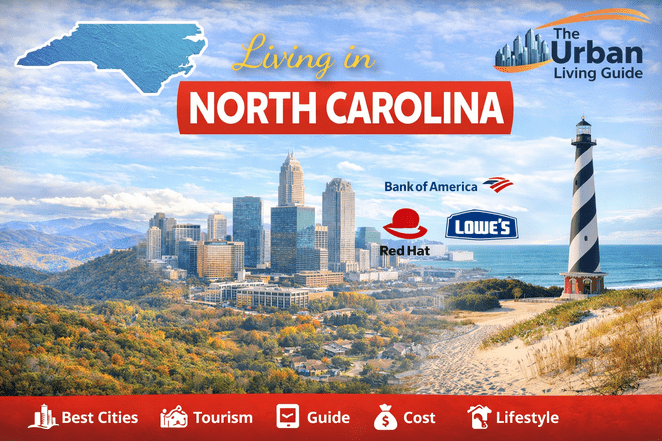
Living in North Carolina: Research Triangle Tech Hubs, Blue Ridge Crests, and Tar Heel State Realities in 2026
Making your home in North Carolina in 2026 means settling into a rapidly expanding southeastern powerhouse spanning over 53,819 square miles, bordered by the wide barrier islands of the Atlantic Ocean coastline and rising westward to the ancient forested ridges of the Appalachian Mountains. As a long-term local resident will tell you, the Tar Heel State is defined by a dynamic cultural and economic transformation. From the gleaming bank towers of Charlotte and the high-tech research labs of the Research Triangle in Raleigh and Durham to the historic maritime ports of Wilmington and the craft-brewery hills of Asheville, everyday life here is characterized by remarkable regional variety, a population surging past 10.8 million residents, and a lifestyle that seamlessly bridges traditional Southern roots with forward-looking innovation. For official state administrative services, business regulations, and civic updates, residents frequently consult the Official State of North Carolina Portal.
| Quick Facts Snapshot: North Carolina (2026) | |
|---|---|
| Time Zone | Eastern Time Zone (ET / UTC-5, Daylight Saving UTC-4) |
| State Population | Approx. 10.8 Million (Ninth-most populous state in the U.S.) |
| State Income Tax | Flat 3.99% personal income tax rate assessed on net individual earnings |
| Median Home Price | $330,000 – $440,000 (Varies noticeably between the Triangle/Charlotte metros and rural eastern counties) |
| Average Rent Range | $1,300 – $2,300+ per month (Dependent heavily on urban core vs. suburban or mountain town locations) |
| Sales Tax Baseline | 4.75% state base, with local county surtaxes pushing combined rates between 6.75% and 7.5% |
What It Is Really Like to Live Here (The Macro Reality & Cultural Identity)
Living across the Tar Heel State requires adapting to a high-growth environment where steady economic opportunity, outdoor recreational access, and traditional Southern hospitality intersect. Locals quickly learn that everyday routines depend entirely on whether you are navigating the high-tech energy of the central Piedmont or enjoying the slower pace of coastal and mountain communities.
- Cultural Vibe: A vibrant blend of progressive research innovation, deep-rooted African American history, classic Southern culinary traditions, and a fiercely passionate college sports culture.
- Pace of Life: Varies sharply—ranging from the fast-paced, corporate finance and biotech rush in Charlotte and the Triangle to the relaxed, front-porch lifestyle of small towns.
- The Resident Trade-Off: Long-term locals accept humid summer heatwaves and coastal hurricane season vigilance in exchange for a moderate cost of living, robust career mobility, and four-season geographic diversity.
Regional Diversity, Geography & Economic Zones
Because North Carolina spans from the Atlantic barrier islands to the highest peaks east of the Mississippi River, its geography is split into distinct zones that dictate completely separate daily living experiences.
The Piedmont Urban Crescents & Coastal Plain
- The Research Triangle (Raleigh-Durham-Chapel Hill): Anchored by Wake County and Durham County, serving as the nation’s premier biomedical, tech research, and higher education powerhouse.
- Greater Charlotte & Mecklenburg County: The financial and banking heart of the Southeast, featuring gleaming corporate headquarters, rapid suburban expansion, and bustling commercial districts.
- The Coastal Plain & Wilmington: A maritime region defined by tidal rivers, historic port infrastructure, and barrier-island beach communities along the Cape Fear River.
The Mountain Highlands & Rural Agricultural Belts
- The Blue Ridge & Great Smoky Mountains: Rugged mountain terrain centered around Asheville, offering rich artistic communities, winding parkways like the Blue Ridge Parkway, and eco-tourism.
- The Eastern Agricultural Plains: Flat rural counties dedicated to extensive poultry, sweet potato, and crop production, offering a quiet, budget-friendly pace of life.
Infrastructure, Power Grids, Water Systems & Transport Networks
Sustaining nearly 11 million residents and accommodating massive interstate migration requires extensive highway grids, reliable power networks, and advanced water management.
Water Resources, River Basins & Coastal Ecosystems
- Major River Basins: The Cape Fear River, Neuse River, and Catawba River sustain municipal drinking water, hydroelectric projects, and agricultural irrigation.
- Watershed Oversight: State environmental agencies manage river flows and wetland preservation across both inland reservoirs and coastal estuaries. Learn more via the North Carolina Department of Environmental Quality.
Power Generation & Regional Grid Integration
- Utility Framework: Electricity is supplied primarily by Duke Energy and regional electric membership cooperatives, utilizing natural gas, nuclear power generation, and rapidly expanding solar capacity.
- Grid Resilience: Utilities execute continuous infrastructure hardening to protect power distribution systems against severe coastal storms and mountain ice events.
Statewide Transit, Rail, Air & Port Connectivity
- Global Aviation Hubs: International travel is anchored by world-class facilities including Charlotte Douglas International Airport (CLT) and Raleigh-Durham International Airport (RDU).
- Interstate Arteries: Heavy commercial transport flows along major multi-lane corridors including I-40, I-85, and I-95.
- Maritime Commerce: Deep-water shipping operations at the Port of Wilmington and Port of Morehead City support international trade logistics.
Statewide Economy, Job Markets & Major Industries
North Carolina maintains one of the most resilient and fastest-growing economies in the United States, fueled by financial services, technology innovation, and advanced manufacturing.
- GDP Powerhouse: Generating robust economic output that positions North Carolina as a premier commercial authority in the American Southeast.
- Dominant Sectors: Commercial banking, financial technology, biotechnology research, software development, aerospace manufacturing, and healthcare administration.
- Corporate Footprint: Global headquarters and major operational bases for industry leaders such as Bank of America, Lowe’s, Duke Energy, and major biotech firms across Research Triangle Park. Track state business development via the North Carolina Department of Commerce.
Salary Realities Across Economic Corridors
- Metropolitan Earning Potential: Banking executives in Charlotte and software engineers or biomedical researchers in the Triangle command professional salaries well above state medians, frequently exceeding $90,000 to $140,000 for experienced specialists.
- Regional Wage Variance: Rural eastern and mountain counties align closer to traditional manufacturing and agricultural pay scales, offset by exceptionally affordable local housing markets.
Cost of Living Realities & Housing Market Variance
North Carolina is widely celebrated for offering a moderate, balanced cost of living that remains lower than coastal technology states while supporting high quality-of-life standards.
- Housing Market Index: While booming urban pockets in Charlotte and Raleigh-Durham see competitive bidding and higher home values, small cities and rural counties offer highly accessible real estate pricing.
- Utility Expenses: Humid summers drive up residential air-conditioning usage, balancing against moderate winter heating demands to keep annual utility expenses near national medians.
- Tax Efficiency: A competitive flat personal income tax rate combined with reasonable property assessment baselines supports stable household financial planning.
| Expense Category | Cost Range / Index Reality |
|---|---|
| Housing (Metro Hubs vs. Rural NC) | $380,000 – $600,000+ in Charlotte/Triangle suburbs; $180,000 – $280,000 in eastern rural counties |
| Utilities & Electricity | Hovering close to national benchmarks, managed through regulated utility providers |
| Transportation & Transit | Moderate fuel pricing, with heavy reliance on personal vehicles for daily commuting across sprawling suburbs |
| Groceries & Goods | Aligning closely with national averages, supported by widespread regional supermarket networks |
State Tax Climate, Business Environment & Government Policies
North Carolina operates under a proactive fiscal structure featuring a competitive flat individual income tax rate and business-friendly tax frameworks.
- Flat Income Tax Structure: Enforces a competitive flat personal income tax rate of 3.99%, keeping state income calculations streamlined and attractive for relocating workers. Review tax guidelines via the North Carolina Department of Revenue.
- Property Tax Assessments: Levied locally by counties and municipalities, meaning effective tax rates vary based on local school district funding needs and county infrastructure budgets.
- Business Regulations: Low regulatory overhead, right-to-work labor laws, and targeted economic development grants make North Carolina a national magnet for corporate expansion.
Legal & Lifestyle Governance Quirks
- Dillon’s Rule State: Local municipal governments possess only those powers expressly granted to them by the state legislature, influencing local ordinance management.
- Open Government Statutes: Enforced through state public records and public meetings laws, guaranteeing transparency across county and municipal bodies.
- Vehicle Registration Deadlines: Legal requirements compelling new residents to obtain a North Carolina driver’s license and register motor vehicles promptly upon establishing residency.
Climate, Weather Extremes & Natural Geography
North Carolina experiences a humid subtropical climate across most of its territory, modified by elevation in the western mountain ranges.
- Seasonal Variations: Summers are long, hot, and humid statewide, while winters are generally mild in the east and central regions with occasional snowfalls in the western highlands.
- Environmental Realities: Residents maintain active disaster readiness for Atlantic tropical storms and hurricanes affecting coastal counties during late summer and autumn.
- Natural Landmarks: From the sweeping sand dunes of the Outer Banks to the dense spruce-fir forests of the Great Smoky Mountains, outdoor recreation defines local life.
Insurance Cost Realities (Hurricane & Storm Risks)
- Coastal Windstorm Riders: Homeowners in coastal counties face specialized windstorm and hurricane deductible requirements on property insurance policies.
- Floodplain Endorsements: Low-lying properties situated near coastal sounds, tidal rivers, or inland floodways require supplemental flood insurance underwriting.
- Property Valuation Adjustments: Rapid real estate appreciation across urban centers has driven up assessed property valuations, increasing annual escrow requirements.
Education Systems & Major Healthcare Networks
Access to world-class research universities and pioneering medical centers serves as a foundational pillar of North Carolina’s institutional prestige.
- Higher Education Framework: Home to legendary academic institutions including Duke University, University of North Carolina at Chapel Hill, and North Carolina State University.
- Advanced Healthcare: Elite medical networks like Atrium Health in Charlotte and UNC Health in Chapel Hill provide pioneering clinical care. Review public health standards via the North Carolina Department of Health and Human Services.
- Public Education Variance: Public school district quality varies by county, with top-tier suburban public schools concentrated in affluent districts across Wake and Mecklenburg counties.
Culture, Outdoor Recreation & Lifestyle Shifts
Daily life in North Carolina blends rich Southern heritage with vibrant modern arts, college sports enthusiasm, and diverse outdoor recreation.
- Outdoor Living: Surfing off Cape Hatteras, hiking Appalachian ridge trails, and weekend camping trips in state parks form regular leisure routines.
- Culinary Heritage: Famed for iconic regional barbecue traditions (Eastern vinegar-style vs. Western tomato-style), farm-to-table dining, and burgeoning craft beverage trails.
- Arts & Entertainment: A vibrant cultural scene anchored by historic downtown districts, world-class museums, and passionate college basketball fandom. Explore statewide tourism through Visit NC.
Relocation & State Residency Essentials
Establishing official legal residency in North Carolina involves straightforward administrative procedures that secure your state-level civic rights and tax compliance.
- Driver’s License Transfer: New residents must visit an NCDV division office to surrender out-of-state credentials and obtain a North Carolina driver’s license promptly.
- Vehicle Registration: Motor vehicles must be inspected for safety and emissions and titled locally within designated statutory timelines.
- Tax Compliance: Establishing primary domicile requires filing resident state income tax returns subject to the uniform 3.99% flat tax rate.
Major Counties and Rural Living Realities in North Carolina
Beyond the major urban centers of Charlotte and Raleigh, North Carolina’s diverse county administrative units and agricultural heartlands maintain distinct community structures.
- Mecklenburg County: The most populous county in the state, housing Charlotte and serving as the primary financial and commercial core.
- Wake County: Centered around Raleigh, representing the administrative, technological, and educational heartbeat of the Research Triangle.
- Durham County: A thriving high-tech and medical research hub anchored by major universities and biotech startups.
- Rural and Agricultural Living: Central and eastern rural counties provide a peaceful, highly affordable lifestyle centered around family farming, local harvest festivals, and close-knit small towns.
Major Regional Hubs and Cities to Explore
Major Urban Hubs and Economic Centers at a Glance
| City / Hub | Primary Economic Driver | Vibe & Lifestyle Profile |
|---|---|---|
| Charlotte | Banking, Finance, Corporate Logistics | Fast-paced, modern skyline, dynamic financial hub, booming suburban growth |
| Raleigh | Technology, Biotechnology, State Government | Educated population, leafy residential neighborhoods, Research Triangle core |
| Durham | Healthcare, Research, Higher Education | Revitalized historic tobacco warehouses, indie food scene, vibrant arts culture |
| Greensboro | Manufacturing, Aviation, Logistics | Stable Piedmont city, affordable real estate, family-oriented environment |
| Wilmington | Coastal Tourism, Maritime Trade, Film | Historic riverfront downtown, immediate beach access, relaxed coastal lifestyle |
Detailed Breakdown of Key Regional Hubs and Cities
Charlotte — The Southeast Financial and Banking Capital
Stretching across the Piedmont plateau, Charlotte serves as the corporate and banking titan of the Carolinas. Life here revolves around professional career growth, modern upscale residential neighborhoods, vibrant culinary districts, and major sports entertainment.
Raleigh — The Research Triangle Tech and Government Hub
Anchored by tree-lined streets and major university research networks, Raleigh offers an intellectual, fast-growing urban environment. Residents enjoy extensive greenway park systems, active technology corridors, and thriving family communities.
Durham — The Revitalized Bull City Innovation Center
Known historically for its tobacco roots, Durham has transformed into a hip, dynamic center for biomedical research and culinary arts. It features stunning historic brick architecture, local music venues, and an energetic, diverse population.
Greensboro — The Piedmont Manufacturing and Family Center
Positioned centrally within the state, Greensboro offers a balanced, budget-friendly urban experience with a stable manufacturing economy, beautiful park reserves, and accessible suburban housing markets.
Wilmington — The Historic Cape Fear Coastal City
Bounded by the Cape Fear River and the Atlantic Ocean, Wilmington combines a picturesque historic downtown riverwalk with immediate access to pristine beach communities like Wrightsville Beach and Kure Beach.
Pros and Cons of Making North Carolina Your Home
| Advantages (Pros) | Systemic Drawbacks (Cons) |
|---|---|
| Affordable cost of living and reasonable housing markets | Intense, humid summer heatwaves lasting several months |
| Robust, diversified job market anchored by tech and finance | Vulnerability to coastal hurricanes and tropical storm systems |
| World-class higher education institutions and advanced medical networks | Rapid population growth leading to traffic congestion in growing metros |
| Breathtaking geographic diversity spanning beaches to mountains | Healthcare access disparities in remote rural and small-town areas |
Frequently Asked Questions About Living in North Carolina
Is North Carolina a good state to live in?
Yes, especially for families, professionals, and remote workers seeking a balanced lifestyle, strong job growth, and housing affordability, provided you manage summer humidity.
What is the actual cost of living in North Carolina?
It sits comfortably below the national average and significantly lower than major coastal states, though popular metro areas like Charlotte and Raleigh see higher housing demand.
Which region or city is best to settle down in?
It depends entirely on your lifestyle goals: Charlotte for corporate banking careers, Raleigh-Durham for tech and research innovation, and Wilmington for coastal living.
Does North Carolina enforce high taxes?
The state maintains a competitive flat personal income tax rate of 3.99%, keeping tax burdens moderate compared to many northeastern states.
How safe is everyday life across the state?
Safety levels vary by municipality; suburban developments and smaller towns offer exceptional security, while specific urban neighborhoods require standard metropolitan awareness.
What industries dominate North Carolina’s job market?
Commercial banking, technology research, biotechnology, healthcare administration, aerospace, and advanced manufacturing drive ongoing statewide employment.
What is the weather like across the state?
North Carolina features hot, humid summers and mild winters statewide, with cooler mountain elevations experiencing more pronounced seasonal shifts.
How do residency rules impact my vehicle and license?
New residents must transfer out-of-state driver’s licenses and register motor vehicles promptly through state DMV registrar locations.
What should I know about North Carolina property taxes?
Property taxes are assessed locally by individual counties and municipalities, allowing for varied tax rates depending on the specific region.
Explore Detailed City Guides Across North Carolina
We have compiled comprehensive resources and detailed guides to help you understand what daily living feels like across different urban hubs and regional centers throughout the state.
- Living in Charlotte, North Carolina
- Living in Raleigh, North Carolina
- Living in Durham, North Carolina
- Living in Wilmington, North Carolina
At The Urban Living Guide , our mission is to deliver research-backed, data-driven insights, lifestyle breakdowns, and practical guidance to help you navigate modern urban living decisions with complete clarity.