
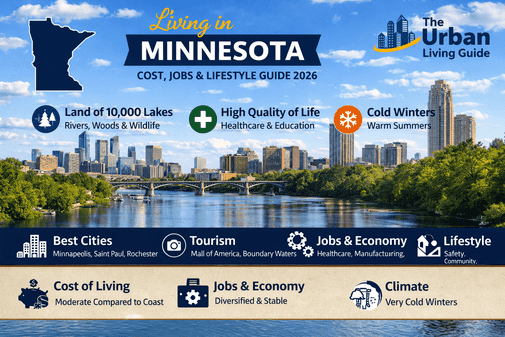
Living in Minnesota – Overview
Minnesota, located in the Midwestern United States, is known for its high quality of life, natural beauty, and strong economy. Often called the “Land of 10,000 Lakes,” the state offers a balance of urban development and outdoor living.
If you’re considering Living in Minnesota, it provides excellent opportunities in healthcare, manufacturing, retail, technology, and education. Cities like Minneapolis and Saint Paul (Twin Cities) are major economic centers.
Compared to states like Tennessee, Minnesota offers higher wages, better public services, and stronger infrastructure, but it comes with colder weather and slightly higher taxes. The state consistently ranks high in education, healthcare, and overall livability.
Many people choose Minnesota because of its stability, safety, and balanced lifestyle, making it ideal for families and professionals.
What Makes Minnesota Unique
Minnesota stands out for its lakes, forests, and rivers, including the Mississippi River, which begins in the state. The geography includes flat plains, wooded areas, and water bodies that shape its identity.
Culturally, Minnesota is known for its friendly communities, strong work ethic, and Scandinavian influence. The state offers a mix of urban culture and outdoor recreation.
Unlike many states, Minnesota combines natural beauty with economic stability, making it one of the best places for long-term living.
🗺️ Explore the map of Minnesota to understand its regions and geography
Location, Geography & Climate
Minnesota has a humid continental climate, meaning:
- Very cold winters (heavy snowfall)
- Warm summers
- Pleasant spring and fall seasons
Northern areas are colder and more forested, while southern regions are more agricultural. The state’s climate is one of the biggest deciding factors for people considering moving here.
Top Cities in Minnesota
- Minneapolis – The largest city, known for business, tech, and cultural life.
- Saint Paul – The state capital, offering government jobs and a quieter lifestyle.
- Rochester – A major healthcare hub, home to the Mayo Clinic.
- Duluth – Scenic city near Lake Superior, ideal for nature lovers.
- Bloomington – A suburban city known for commerce and retail.
Tourism, Attractions & Things to Do in Minnesota
Minnesota offers a mix of natural and cultural attractions:
- Mall of America (Bloomington) – Largest shopping mall in the US
- Boundary Waters Canoe Area – Outdoor adventure
- Lake Superior North Shore – Scenic beauty
- Minneapolis Downtown – Urban culture
- Voyageurs National Park – Nature and wildlife
The state is known for its lakes, parks, and outdoor activities.
Cost of Living in Minnesota
The cost of living in Minnesota is moderate. Housing is more affordable than coastal states but higher than some Midwest states.
Compared to Illinois, Minnesota offers similar costs but better public services in many areas.
Overall, it provides a good balance between cost and quality of life.
Job Market & Economy
Minnesota has a strong and stable economy driven by:
- Healthcare
- Manufacturing
- Retail (Target HQ)
- Technology
The job market is steady, with good opportunities in urban areas.
Major Industries & Economic Strength
Minnesota leads in:
- Healthcare (Mayo Clinic)
- Retail and corporate headquarters
- Manufacturing and agriculture
Compared to many states, Minnesota offers a diversified and stable economy.
Rural Living in Minnesota
Rural Minnesota offers quiet living with strong agricultural roots. Farming includes corn, soybeans, and dairy.
Living costs are lower, making it attractive for families and retirees.
Pros:
- Affordable housing
- Peaceful environment
Cons:
- Harsh winters
- Limited job opportunities
Top Counties in Minnesota
- Hennepin County – Minneapolis region
- Ramsey County – Saint Paul area
- Olmsted County – Rochester (healthcare hub)
- St. Louis County – Duluth region
- Dakota County – Growing suburban area
Infrastructure & Connectivity
Minnesota has strong infrastructure with highways, rail systems, and airports like Minneapolis–Saint Paul International Airport.
Public transport is well-developed in the Twin Cities.
Government, Safety & Policies
Minnesota has higher taxes compared to some states but offers strong public services. Safety levels are generally good, especially in suburban areas.
The state is known for stable governance.
Lifestyle & Culture
Life in Minnesota is balanced and community-focused. Residents enjoy outdoor activities, festivals, and cultural events.
The lifestyle is slower than coastal states but offers high stability.
Education & Healthcare
Minnesota ranks among the top states for education and healthcare. Institutions like the University of Minnesota and Mayo Clinic provide excellent services.
Access is strong across most regions.
Pros and Cons of Living in Minnesota
Pros:
- High quality of life
- Strong healthcare system
- Stable economy
- Natural beauty
- Good education
Cons:
- Very cold winters
- Higher taxes
- Limited public transport outside cities
- Seasonal weather challenges
- Moderate cost of living
Who Should Move to Minnesota
- Families
- Healthcare professionals
- Corporate employees
- Nature lovers
Major Companies & Investments
Minnesota hosts major companies like Target, 3M, Best Buy, General Mills, making it a strong corporate hub.
The state continues to attract investments in healthcare and technology.
Transport & Connectivity (Expanded)
Minnesota offers strong connectivity through roads, rail, and airports. Twin Cities have good public transport systems.
Rural connectivity is decent but less developed.
Final Thoughts
Living in Minnesota offers stability, safety, and a high quality of life. While winters can be harsh, the benefits of strong infrastructure and economic stability make it a great long-term choice.
FAQs
Is Minnesota a good state to live in?
Yes, especially for families and those seeking stability and quality of life.
What is the cost of living in Minnesota?
Moderate, with a good balance of cost and services.
Which city is best in Minnesota?
Minneapolis for jobs, Rochester for healthcare, Duluth for lifestyle.
Does Minnesota have high taxes?
Yes, taxes are higher compared to some states.
Is Minnesota safe?
Generally safe, especially in suburban areas.
What jobs are in demand in Minnesota?
Healthcare, retail, manufacturing, and tech sectors.
How is Minnesota weather?
Very cold winters and warm summers.