

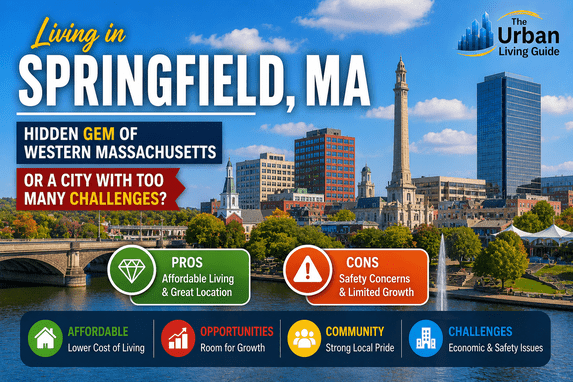
Springfield Sits at the Heart of Western Massachusetts — But Is It the Right Move for You?
Springfield is a city that doesn’t fit neatly into any single narrative. As the largest city in Western Massachusetts and the third-largest in the state, it carries real urban weight — a NBA Hall of Fame, a Connecticut River waterfront, and a deeply rooted Latino community that gives it cultural character unlike anywhere else in New England. But the pros and cons of living in Springfield, Massachusetts also reveal persistent economic challenges that demand honest attention.
This is the full picture — not the chamber of commerce version.
Advantages of Living in Springfield
1. Among the Most Affordable Cities in Massachusetts
Springfield consistently ranks as one of the most affordable urban options in the entire state. Median rents run dramatically lower than Boston or Worcester, and home prices in established neighborhoods offer genuine ownership opportunities for middle and working-income families. Many residents appreciate that a comfortable lifestyle here doesn’t require a six-figure salary — a rarity in Massachusetts.
2. Unique Cultural Identity Rooted in Latino Heritage
Springfield has one of the largest Puerto Rican communities in New England, creating a vibrant cultural identity expressed through food, music, festivals, and neighborhood character. X — the Puerto Rican Cultural Center and the annual Fiesta Patronales — give the city an authentic cultural heartbeat that distinguishes it sharply from most New England cities.
3. Basketball Hall of Fame and Regional Entertainment
Springfield is the birthplace of basketball — Dr. James Naismith invented the sport here in 1891. The Naismith Memorial Basketball Hall of Fame draws visitors year-round and gives the city a genuine cultural landmark. One thing people often mention is the quiet pride residents feel about this piece of American sports history sitting in their backyard.
4. Connecticut River Waterfront and Natural Access
The Connecticut River running through Springfield offers recreational opportunities — kayaking, cycling along the Riverfront Park, and scenic green space that softens the urban environment considerably. Forest Park — one of the largest municipal parks in New England at over 735 acres — gives residents exceptional outdoor access within city limits.
5. Strategic Location in the Pioneer Valley
Springfield sits at the crossroads of I-90 and I-91, offering practical access to Hartford (30 miles south), Boston (90 miles east), and New York City (150 miles southwest). For professionals working regionally or businesses needing distribution access, the location is genuinely strategic.
6. Growing Healthcare and Education Employment
Baystate Medical Center — the largest hospital in Western Massachusetts — is a major employer and economic anchor. Springfield College, Western New England University, and American International College add educational employment and student population that supports local business.
Challenges of Living in Springfield
1. Poverty and Economic Inequality Are Significant
This is Springfield’s defining challenge and cannot be minimized. The city has one of the highest poverty rates in Massachusetts — consistently above 25% — creating visible economic inequality that affects public services, schools, and neighborhood conditions across large parts of the city.
2. Crime Rates Run Above State Averages
Some newcomers find it challenging that Springfield’s violent and property crime rates run meaningfully higher than Massachusetts averages. Neighborhood selection is critical — areas like Forest Park, East Forest Park, and Sixteen Acres feel safe and stable, while North End and parts of South End require genuine caution and research.
3. Public School System Faces Serious Challenges
Springfield Public Schools has operated under state oversight due to persistent performance challenges. For families prioritizing public school quality, this is a significant concern that shapes many housing decisions — often pushing families toward neighboring Longmeadow, Wilbraham, or East Longmeadow.
4. Limited Job Market Depth
Outside healthcare, education, and government employment, Springfield’s private sector job market is relatively thin. Some newcomers find it challenging that career advancement in specialized fields often requires commuting to Hartford or Boston — distances that add up quickly in both time and cost.
5. Urban Decay in Certain Neighborhoods
Decades of economic disinvestment have left visible marks on parts of Springfield. Vacant properties, deteriorating infrastructure, and underfunded public spaces in certain areas create an urban environment that feels stuck between decline and renewal — a tension the city is actively but slowly working through.
📺 Springfield residents give their unfiltered take on life here — genuinely worth a few minutes before you decide –
Who Should Consider Living in Springfield?
Springfield is a practical fit for healthcare professionals at Baystate Medical Center, Latino and Puerto Rican families seeking established community networks, budget-conscious movers prioritizing homeownership over urban amenities, and regional commuters needing central New England access to Hartford and Boston.
Who should think twice? Families prioritizing strong public school options, professionals needing deep private sector career opportunities, and those sensitive to urban safety challenges should carefully evaluate whether Springfield fits their lifestyle and priorities.
Final Verdict – Is Springfield Right for You?
Springfield is a city of genuine contrasts — real affordability and cultural richness alongside persistent economic and safety challenges. The pros and cons of living in Springfield, Massachusetts ultimately depend on what you’re optimizing for. For the right mover — particularly those connected to the healthcare sector or Latino community — Springfield offers something authentic and affordable that Eastern Massachusetts simply cannot match at this price point.
FAQs
Is Springfield, MA safe to live in?
Safety varies significantly by neighborhood. Forest Park, East Forest Park, and Sixteen Acres are among the safer residential areas with established community feel. North End and parts of South End have higher crime concentrations. Thorough neighborhood research before committing is genuinely essential here.
What salary do you need to live comfortably in Springfield?
A single professional can live comfortably on $45,000-$58,000 annually — making Springfield one of Massachusetts’ most financially accessible urban options. Families generally need $70,000-$85,000 depending on housing choices and childcare costs.
How far is Springfield from Boston?
Approximately 90 miles — about 90 minutes by car via I-90 Massachusetts Turnpike. Amtrak service connects Springfield to Boston and New York City, though schedules are limited compared to commuter rail options in Eastern Massachusetts.
Is Springfield good for families?
Affordability and community character work in its favor, but public school performance is a genuine concern. Many families in Springfield use charter school options or relocate to neighboring suburbs like Longmeadow for stronger school district access.
What is Springfield known for?
Springfield is the birthplace of basketball — Dr. James Naismith created the sport here in 1891. The city is also known for its significant Puerto Rican cultural heritage, the Naismith Memorial Basketball Hall of Fame, and Forest Park — one of New England’s largest municipal green spaces.
Is Springfield, MA up and coming?
Slowly and selectively. The MGM Springfield casino brought investment and attention, and waterfront development along the Connecticut River shows genuine progress. However, the pace of revitalization remains uneven and the broader economic challenges are long-term in nature.
Explore More
- 📍 Living in Springfield, Massachusetts — Complete relocation guide covering neighborhoods, cultural identity, and what everyday life in Springfield really looks like
- 💰 Cost of Living in Springfield, Massachusetts — Honest breakdown of rent, groceries, and how Springfield compares to other Massachusetts cities on real monthly expenses