

Moving to Lowell, Massachusetts – Boston’s Affordable Northern Neighbor With a Story Worth Knowing
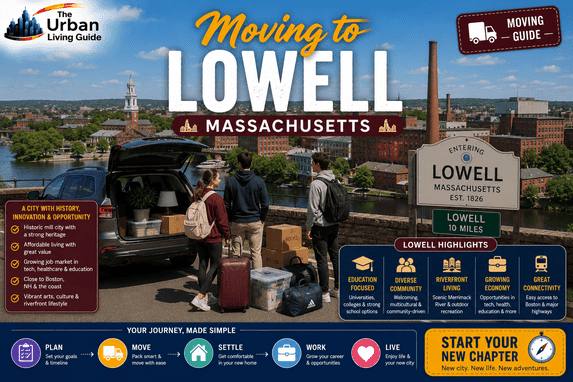
Lowell has been underestimated for most of its modern history, which is ironic for a city that was once the industrial engine of an entire nation. The mill buildings along the Merrimack and Concord rivers — now converted into loft apartments, arts spaces, galleries, and offices — tell the story of a city that keeps finding new versions of itself. In 2026, Lowell is doing it again. The commuter rail to Boston’s North Station runs in 40–50 minutes. The median rent for a one-bedroom runs $1,400–$1,900 — roughly half what you’d pay in Cambridge and $1,500 less than Boston averages. UMass Lowell and Middlesex Community College anchor a year-round academic presence. And the city’s diversity — anchored by one of the largest Cambodian-American communities in the country — creates a cultural texture that most Boston suburbs simply cannot offer.
Lowell is not a perfect city. It has real challenges that any honest guide should name. But for the right person — someone who values historical character, affordable homeownership, reasonable Boston access, and a genuine community rather than just a commuter staging ground — Lowell in 2026 offers a proposition that’s genuinely hard to match anywhere else in northeastern Massachusetts.
Watch this local vlogger’s guide to experience Lowell’s canal district, mill loft conversions, and community life before your move –
Moving to Lowell, Massachusetts – How Your Origin Shapes the Move
Lowell’s location at the confluence of the Merrimack and Concord rivers puts it about 30 miles northwest of Boston — close enough to maintain a Boston connection by commuter rail, far enough to have a completely separate identity and housing market. How your relocation plays out depends heavily on where you’re starting, and the distance matters for both logistics and lifestyle adjustment.
-
- Boston or Greater Boston Move: The most common Lowell relocation scenario in 2026, as Boston-area households price-shop their way north. A local crew handles this in half a day to a full day comfortably. Budget $500–$1,100. Unlike a Boston-to-Worcester move where the commuter math can get complicated, the Lowell commuter rail to North Station is 40–50 minutes and meaningfully faster than the Boston-to-Worcester commuter line — factor in a monthly pass of approximately $200–$250 when calculating your true savings.
- Interstate Move (from NH, RI, CT, NY): Mid-complexity. Lowell’s residential streets are generally truck-accessible, and the city doesn’t carry Boston’s moving permit bureaucracy in most neighborhoods. Budget $800–$2,500 depending on volume and distance.
- Long-Distance or Cross-Country Move: Full-service movers run $3,500–$8,000. Consider arriving with a temporary housing buffer — a furnished Airbnb in Lowell or a nearby Extended Stay — for one to two weeks while you tour in person. Lowell’s rental market moves faster than people expect, particularly for the more desirable mill loft conversions in the downtown canal district.
One thing many newcomers arriving from larger metros notice: Lowell has a neighborhood-by-neighborhood character that’s much more pronounced than in Boston’s more homogenized inner suburbs. Belvidere feels like a different city from the Acre, which feels different from Pawtucketville. Understanding this before you choose an address matters significantly.
🎯 Who Fits Lowell Well?
Lowell is an excellent fit for people looking for a more affordable alternative to Boston while still maintaining access to jobs, education, and urban amenities. The city combines historic character, cultural diversity, and a strong sense of community, making it particularly appealing to first-time homebuyers, students, commuters, and families seeking value within the Greater Boston region.
-
- Great option for first-time homebuyers, with median home prices around $430,000–$439,000
- More affordable than many communities inside Route 128
- Home to UMass Lowell, one of Massachusetts’ fastest-growing public universities
- Attractive for students, faculty, researchers, and university employees
- Popular among Boston commuters willing to use the MBTA Commuter Rail to North Station
- Offers opportunities to build equity while avoiding some of Greater Boston’s highest housing costs
- Known for its converted mill lofts, creative community, and historic architecture
- Home to the nationally recognized Lowell Folk Festival, the largest free folk festival in the United States
- Features a strong Cambodian-American community and one of New England’s most diverse cultural landscapes
- Appeals to families seeking affordability, diversity, and a community-oriented environment
For many residents, Lowell’s biggest advantage is its ability to offer Greater Boston access, homeownership opportunities, cultural diversity, and historic character at a more attainable price point.
⚠️ Who May Find Lowell Challenging?
Lowell offers affordability and community, but it may not be the right fit for everyone. People relocating from larger cities should understand that Lowell operates on a smaller scale, with fewer entertainment options and a greater reliance on personal transportation in many areas.
-
- Crime rates are higher than some nearby suburban communities, making neighborhood research important
- Many residents rely on a car for daily errands and commuting
- Dining, nightlife, and entertainment options are more limited than in Boston or Cambridge
- MBTA Commuter Rail service is useful for commuting but less convenient for late-night travel
- Those expecting a highly walkable, dense urban environment may find Lowell more spread out than anticipated
Lowell works best for people prioritizing affordability, homeownership opportunities, and community over big-city convenience and amenities.
Moving Process and Transportation Planning
Physically moving into Lowell is one of the easier Massachusetts city experiences. Wide residential streets, available truck parking in most neighborhoods, and no city-wide moving permit requirement for most addresses mean the logistics are noticeably more forgiving than in Boston or Cambridge. The one exception is the canal district and downtown area, where historic preservation zoning may create specific loading access requirements for converted mill buildings — check with your building management before move day.
-
- Local Lowell moves: $300–$800 for a one to two bedroom with a professional crew
- Boston-to-Lowell move: typically $500–$1,200 depending on volume and addresses
- Interstate moves from NH, RI, CT: $800–$2,500
- Cross-country moves: $3,500–$8,000 with full-service movers
- Truck rental: widely available without the September-crunch scarcity of Boston; 16-foot trucks run $100–$180/day
- Commuter Rail: Lowell Line to North Station, 40–50 minutes, roughly $200–$250/month for a pass — meaningfully less expensive and faster than the Worcester line
- Car ownership: strongly recommended for daily Lowell life outside the downtown walkable core
- Parking: accessible and stress-free compared to Boston — most residential areas have street parking without residential permit complexity
One transit advantage Lowell has over Worcester: the Lowell commuter rail line is more frequent and the journey to North Station is faster, which makes the commuter math work better for daily Boston workers.
Housing Strategy in Lowell’s 2026 Market
Lowell’s housing market has been appreciating steadily — median home prices have grown around 3.3% over the past year and now sit near $430,000–$439,000. That’s still meaningfully below most Greater Boston suburbs, and the city’s rental market remains accessible by Massachusetts standards: one-bedrooms run $1,400–$1,900 and two-bedrooms average $1,700–$2,300. More than 60% of Lowell’s population rents rather than owns, which means there’s genuine rental inventory in most neighborhoods.
-
- Belvidere: Primarily residential, lower density, considered one of Lowell’s more stable and family-friendly neighborhoods. Tree-lined streets and classic New England homes.
- Highlands: The most populous neighborhood — almost a quarter of the city’s residents live here. A mix of residential types with solid community infrastructure.
- Centralville: North of the Merrimack River, more suburban character. Quieter, car-dependent, but affordable housing stock.
- Downtown / Canal District: Converted mill loft apartments are genuinely unique and move fast. If a loft is on your list, tour early and have a decision framework ready.
- Acre neighborhood: Most densely settled, most culturally diverse, adjacent to downtown. The center of Lowell’s Cambodian community and Southeast Asian food scene.
- Pawtucketville: West of the Concord River, mixed residential and commercial, generally affordable.
- Temporary housing: Airbnb options exist in and around Lowell; Extended Stay America in nearby Chelmsford is a practical option for multi-week arrivals.
📦 Storage & Setup in Lowell
Moving to Lowell is generally straightforward, and storage options are more affordable than in many Greater Boston communities. Housing sizes vary considerably, from spacious converted mill lofts to smaller apartments and traditional multifamily homes, so some newcomers may benefit from temporary storage during their transition.
-
- Public Storage and iStorage offer storage facilities in and around Lowell
- Storage costs are typically lower than those found in nearby Boston-area communities
- Housing ranges from large mill loft conversions to more compact residential units
- Eversource provides electricity and gas service throughout much of the city
- Average monthly utility costs are around $190–$200 for a typical apartment
- Comcast Xfinity is the primary internet provider in many neighborhoods
- Most utility and internet services can be activated within a few days of move-in
- Scheduling internet installation before arrival can help avoid delays during your first week
A little planning ahead can make settling into Lowell easier, especially if you’re relocating from outside Massachusetts.
The First Weeks — What Lowell Actually Feels Like to Live In
Lowell’s daily rhythm takes a week or two to understand, and most people who give it that time come away genuinely attached to it. The morning commuter rail crowd heading to North Station has a consistent, community feel — you see the same faces, people know each other, there’s none of the anonymous mass transit energy of a major city line. The canal district on a weekend afternoon — brewery visits, the Lowell National Historical Park, the Merrimack River walkway — delivers a quality of experience that feels meaningfully more authentic than the polished, commercial character of many Boston-area suburbs.
-
- Commute reality: 40–50 minutes on the Lowell Line to North Station is a legitimate daily commute for Boston workers. Frequency is workable but not subway-level — check the schedule and plan around it rather than assuming trains are frequent.
- Food scene: The Cambodian restaurant concentration in the Acre neighborhood is genuinely excellent and nationally recognized. Lowell has more food depth per capita than most cities its size.
- Arts culture: The Lowell Folk Festival, the New England Quilt Museum, the Whistler House Museum of Art, and the Lowell National Historical Park all contribute to an arts and cultural infrastructure that regularly surprises newcomers.
- Seasons: Same northeastern Massachusetts winters as Boston — 40+ inches of snow is realistic. Lowell’s inland position means temperatures can run slightly colder than the coast.
- Community depth: Lowell’s diversity is one of its genuine strengths. The median age of 33 reflects an unusually young population for a Massachusetts city, which shapes the social energy in positive ways.
📌 Key Things to Know Before Arriving
Before moving to Lowell, there are a few practical details that can make your transition smoother. Understanding local regulations, parking arrangements, and neighborhood dynamics ahead of time can help you avoid common newcomer frustrations.
-
- New residents must obtain a Massachusetts driver’s license within 30 days of establishing residency
- The current license conversion fee is approximately $115
- Massachusetts does not charge sales tax on groceries or clothing purchases under $175
- Parking availability can vary significantly in converted mill buildings and downtown areas
- UMass Lowell has a noticeable influence on nearby neighborhoods, especially during the academic year
- The Lowell National Historical Park offers free tours that provide an excellent introduction to the city’s history and layout
🎭 Local Insights & Lifestyle Feel
Lowell combines historic character, cultural diversity, and a strong sense of community. While it may not receive the same attention as Boston or Cambridge, many residents appreciate its local identity, arts scene, and connection to New England history.
-
- Birthplace of renowned author Jack Kerouac
- Home to the nationally recognized Lowell Folk Festival
- The Lowell National Historical Park showcases the city’s famous canal system and industrial heritage
- Strong local arts, music, and community event scene throughout the year
- Lowell Spinners baseball games remain a popular community activity during the summer
- Convenient access to both Boston and Southern New Hampshire, including Nashua
For many residents, Lowell offers a blend of historic charm, affordability, cultural diversity, and community spirit that is increasingly difficult to find elsewhere in Greater Boston.
Quick Moving Checklist
Lowell moves are logistically manageable, but the neighborhood and housing type decisions require real attention upfront. Spend your research time on those choices — the physical move itself will be the easy part.
30 Days Before:
-
- Research Lowell neighborhoods in depth: Belvidere, Highlands, Centralville, Canal District, Acre, Pawtucketville
- Book moving company or truck — no September crunch pressure, but book early for best rates
- Begin apartment or home search and schedule in-person tours
- Confirm parking access at your target building if looking at canal district mill lofts
- Set up Eversource account for electricity and gas
- Research commuter rail schedule on the Lowell Line — know when trains run before you commit to a commute
1 Week Before:
-
- Confirm all moving bookings in writing
- Pack and label by room — note any items that won’t fit new space for storage decisions
- Schedule Comcast Xfinity internet installation before move-in day
- Prepare move-in funds: typically first month + security deposit; broker fees less standard than in Boston
- Download the MBTA commuter rail app for real-time Lowell Line tracking
Moving Day:
-
- Photograph old residence thoroughly before departing
- Confirm utility activation at new Lowell address
- Get landlord or building contact information and building-specific rules
- Walk the canal district and Merrimack River walkway in your first 48 hours — orienting yourself physically helps enormously
- Locate your nearest commuter rail station and time a test trip to North Station
✅ The Bottom Line on Moving to Lowell
Lowell offers a compelling alternative for people who want access to the Greater Boston region without paying Boston-level housing prices. The city combines affordability, historic character, and commuter rail access, making it especially attractive to first-time homebuyers, commuters, students, and families looking for long-term value.
-
- More affordable housing than many Boston-area communities
- Convenient access to Boston via the MBTA Commuter Rail
- Strong sense of history through the Lowell National Historical Park and canal district
- Homeownership is more attainable than in many parts of Eastern Massachusetts
- Neighborhood research remains important before choosing where to live
- Many residents still rely on a car for daily transportation
For people seeking a balance of affordability, community, historic character, and regional connectivity, Lowell continues to be one of the most practical relocation options in Massachusetts.
FAQs — Moving to Lowell, Massachusetts
How far is Lowell from Boston?
Approximately 30 miles northwest of Boston. The commuter rail from Lowell to Boston’s North Station takes 40–50 minutes. Monthly passes run approximately $200–$250, making it a practical daily commute option.
What is the average rent in Lowell, MA?
One-bedrooms average $1,400–$1,900/month. Two-bedrooms run $1,700–$2,300. Median home purchase price is around $430,000–$439,000 — well below most Greater Boston comparables.
Is Lowell safe to live in?
Safety varies by neighborhood. Belvidere and the Highlands are the more consistently recommended residential areas. The Acre and downtown areas have higher density and require more neighborhood-level research. Crime rates run slightly above national averages, making neighborhood selection important.
What is Lowell known for culturally?
Lowell is the birthplace of Jack Kerouac, home to one of the largest Cambodian-American communities in the United States, the site of the Lowell National Historical Park, and host of the Lowell Folk Festival — the largest free folk festival in the country.
Is Lowell good for first-time homebuyers?
Yes — it’s one of the more accessible homeownership markets in northeastern Massachusetts. Median home prices around $430,000 and more available inventory than Boston-area alternatives make it a strong target for buyers priced out of the inner suburbs.
Helpful Local Resources Before Moving
These resources handle the practical foundations of arriving in Lowell — transit, utilities, health, and city services. Bookmark them before your move date:
- City of Lowell Official Website — City services, parking information, new resident resources, and permit inquiries.
- MBTA Commuter Rail (Lowell Line) — mbta.com: Lowell Line schedule, monthly pass pricing, and real-time train status. Essential for any Boston commuter.
- Lowell National Historical Park — nps.gov/lowe: Free walking tours of the canal system and mill buildings — the best orientation to Lowell a new resident can get, and genuinely worth doing in your first month.
- Eversource Energy — Electric and gas service setup, plus enrollment in the seasonal heat pump discount program for eligible households.
Explore More With The Urban Living Guide
These guides give you the full picture of Lowell living across every dimension that matters for a long-term relocation decision:
- Living in Lowell, Massachusetts
- Cost of Living in Lowell, Massachusetts
- Pros and Cons of Living in Lowell, Massachusetts
- Best Neighborhoods in Lowell, Massachusetts