

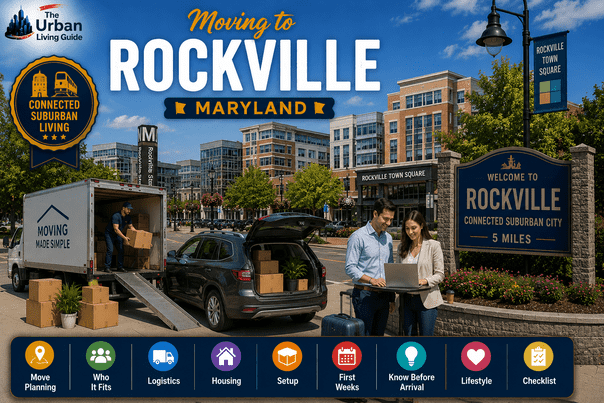
Rockville Is Montgomery County’s Most Connected City — Here’s What Moving Here Actually Costs
Rockville sits at the top of Montgomery County’s Red Line Metro corridor and the bottom of the I-270 biotech and government research spine — a position that makes it one of the most professionally connected suburban cities in the entire D.C. metro area. The National Institutes of Health (NIH) campus sits in neighboring Bethesda, 10 minutes south by Metro. Walter Reed National Military Medical Center is directly to the southeast. The I-270 life sciences corridor runs north through Rockville toward Gaithersburg and beyond. This concentration of federal health, research, and government employment anchors Rockville’s economy — and the housing market prices in every bit of that institutional gravity.
The median home sale price in Rockville runs $650,000–$712,500 in 2026 — with single-family homes averaging $800,000 and condos around $510,000. Average rents: $2,160/month for a one-bedroom downtown, $1,850/month outside the core. Homes in the most competitive pockets sell in 6 days and close at 100.33% of asking price. This is not a market that forgives slow decision-making, insufficient pre-approval, or unrealistic budget expectations. The local median household income of $143,600 gives context for what the market actually reflects.
Watch this video by a local vlogger on 5 reasons why to choose Rockville?
Moving to Rockville, Maryland – Planning Your Move by Distance
Rockville is well-positioned within the regional highway and transit network — I-270, I-495 (the Beltway), MD-355 (Rockville Pike), and both the Metro Red Line and MARC Brunswick Line (at Rockville station) provide multiple D.C. access routes. That connectivity is part of what justifies Rockville’s premium pricing.
- Same-Metro Move (from D.C., Bethesda, Silver Spring, or other MD suburbs): The most common pattern. A local crew handles most volumes in a half to full day. Budget $500–$1,200. Moves tied to NIH, USUHS, or Walter Reed professional starts often involve specific institutional timelines — confirm building elevator access and HOA move-in restrictions well in advance for condo buildings.
- Interstate Move (from Virginia, Pennsylvania, New York, or New Jersey): Mid-range complexity. Budget $1,200–$3,500. Rockville’s residential areas are truck-accessible in most neighborhoods, though King Farm, Fallsgrove, and Town Center condo buildings each have specific move-in coordination requirements.
- Long-Distance or Cross-Country Move: Full-service movers run $4,500–$10,500. Given the tight inventory and fast-moving listings, many cross-country relocators work with a local Rockville buyer’s agent before arrival to identify properties and time offers with their moving logistics.
One logistics note specific to Rockville: condo and apartment moves in the Town Center buildings require advance elevator scheduling — often 48–72 hours minimum notice with the building management. This is non-negotiable in high-rise buildings and should be confirmed before any move is booked.
Who Rockville Is Built For
Rockville’s resident profile is shaped almost entirely by its institutional employment anchors and Metro access. The city works best for specific professional and lifestyle profiles.
-
- NIH, USUHS, and federal health researchers: The National Institutes of Health campus in adjacent Bethesda is one of the world’s largest biomedical research institutions. Rockville’s Red Line access puts NIH’s Medical Center Metro station within a single train ride — making Rockville one of the most practical residential choices for researchers and clinical staff.
- I-270 life sciences and biotech professionals: The I-270 corridor from Rockville through Gaithersburg and beyond hosts one of the densest concentrations of biotech, pharma, and government research employers in the country. Living in Rockville puts most of these employers within a 5–15 minute drive or Metro ride.
- Families targeting Montgomery County Public Schools: MCPS consistently ranks near the top of Maryland statewide assessments. Several schools within Rockville’s attendance boundaries carry nationally recognized reputations. For families where public school quality is a primary relocation driver, Rockville delivers access to one of the strongest public systems in the country without requiring private school tuition.
- Transit-dependent professionals: The Rockville Metro station (Red Line) puts C. Dupont Circle about 30 minutes away, Union Station 40 minutes, and Shady Grove 5 minutes (for MARC transfer). For people who genuinely want car-light or car-free urban living at a suburban price point, Rockville’s transit access is exceptional.
- People who want Montgomery County quality at the accessible edge of its price range: Twinbrook (median $550,000) and Town Center condos ($350,000–$500,000) represent the most accessible price points in Rockville — the rare cases where Montgomery County’s job market and school access come without the county’s most extreme pricing.
Who May Find Rockville Challenging
Rockville’s premium pricing and dense institutional character create limitations for specific profiles.
-
- Budget relocators: The $650,000–$712,500 median is not a soft figure. Rockville is genuinely among Maryland’s most expensive cities to buy into. People without a clear income anchor in the NIH, federal government, or I-270 biotech ecosystem may find the cost-benefit ratio harder to justify versus Frederick or Gaithersburg.
- People expecting walkable urban density everywhere: Rockville has distinct neighborhood pockets — Town Center is genuinely walkable; West End, College Gardens, and Woodley Gardens are suburban and car-dependent. Which version of Rockville you’re moving into matters enormously for daily quality of life.
- Car-free idealists moving to non-Metro-adjacent neighborhoods: If your target address is not within 15–20 minutes walking distance of the Twinbrook or Rockville Metro stations, you’ll need a car for most daily errands regardless of the city’s overall transit reputation.
- Anyone unprepared for fast-moving listings: Rockville homes go pending in 6–16 days depending on the neighborhood and price range. Without pre-approval in hand and a clear decision framework, competitive listings will be under contract before you’ve had time to deliberate.
Moving Logistics and Transportation
Rockville is logistically manageable with advance planning. The main variable is building-specific coordination — particularly for condo and mixed-use buildings in the Town Center area.
-
- Local Rockville moves: $500–$1,200 for a one to two bedroom; higher for multi-floor townhomes in King Farm or Fallsgrove
- Regional interstate moves: $1,200–$3,500
- Cross-country moves: $4,500–$10,500 with full-service movers
- Condo/high-rise elevator scheduling: Confirm 48–72 hours ahead with building management — Town Center buildings enforce move-in windows and require coordination
- WMATA Red Line: Rockville station and Twinbrook station provide direct service to C., Bethesda, Silver Spring, and Shady Grove — the backbone of car-light Rockville life
- MARC Brunswick Line: Rockville station also serves MARC — connecting to Union Station and westward toward Frederick
- I-270 and I-495 (Beltway): Primary highway corridors — I-270 southbound rush hour is the primary commute challenge for non-Metro users
Housing Strategy in Rockville’s 2026 Market
Rockville’s 2026 housing market is defined by strong demand, tight inventory, and fast-moving listings — particularly in the most desirable neighborhoods. The market saw 22.1% price appreciation year-over-year in March 2026 per Redfin — driven partly by low supply, partly by sustained institutional employment demand.
-
- Twinbrook: The strategic entry point. Median around $550,000. Walkable to the Twinbrook Metro station and Rockville Pike. Detached homes at prices that are increasingly rare in Montgomery County. The value play in Rockville’s market.
- Rockville Town Center: Downtown condos ranging $350,000–$500,000. Anchored by Rockville Town Square, with civic events, dining, and daily convenience literally outside the building. Direct Metro access.
- King Farm: A 450-acre planned community in northern Rockville. New-urbanist design, neighborhood amenities, strong demand. Higher price points but popular with families and professionals who want planned-community quality at Rockville scale.
- West End and College Gardens: Established residential neighborhoods. College Gardens benefits from proximity to the main Rockville Metro station. More traditional suburban character — larger lots, older housing stock.
- Fallsgrove: Upscale planned community with luxury townhomes and single-family homes. Single-family homes average $1,150,000; townhomes $725,000. Resort-style amenities; attracts executives and senior government officials.
- Short-term housing: Corporate housing options near NIH and Shady Grove Medical Center exist for multi-week arrivals. Furnished short-term rentals in the Town Center area are available but move fast.
Storage and Setup Essentials
Rockville housing varies significantly by neighborhood era — Fallsgrove and King Farm offer modern generous square footage, while West End and College Gardens run more traditionally sized. If you need extra space, CubeSmart has a Rockville location on Veirs Mill Road. For utilities: Pepco handles electricity for most Rockville neighborhoods ($100–$180/month typical residential); Washington Gas serves natural gas ($50–$150/month); water and sewer billed directly by the City of Rockville ($75–$120/month). Internet is served by Comcast, Verizon Fios, and RCN. Total utilities typically run $305–$600/month for average households.
The First Few Weeks in Rockville — What to Actually Expect
Rockville’s adjustment is usually smooth for people connected to its dominant employment anchors. The NIH and I-270 biotech communities are experienced at integrating new arrivals, and the city’s transit infrastructure reduces daily friction compared to purely car-dependent suburbs.
-
- Red Line commute as a daily discovery: The Metro Red Line’s reliability and coverage genuinely changes how Rockville residents think about D.C. access. Most newcomers who’ve lived car-dependent suburban lives elsewhere describe a period of pleasant surprise at how much of the D.C. metro they can access without a car.
- MCPS school district navigation: School assignment in Montgomery County Public Schools is strictly address-based — the neighborhood name doesn’t determine your school, your specific address does. Use the MCPS assignment tool and verify before finalizing any housing decision with school quality as a factor.
- Rockville Pike (MD-355) commercial density: The Pike is Rockville’s primary commercial corridor and one of the most commercially dense roads in Maryland — every chain, every service, every grocery option accessible along this stretch. Newcomers from smaller cities are sometimes overwhelmed; newcomers from D.C. or Northern Virginia find it familiar.
- Town Center events integration: Rockville Town Square hosts consistent civic programming — ice skating in winter, outdoor dining in summer, local events throughout the year. Connecting with these events is one of the faster ways to develop a sense of place in what can otherwise feel like a purely professional relocation.
Things to Know Before You Arrive
-
- Driver’s license: Maryland MVA conversion required within 60 days of establishing residency.
- Maryland income tax + Montgomery County piggyback: Montgomery County’s local income tax rate is among the higher rates in the state — calculate the combined impact against your specific income before finalizing the financial case for this move versus Frederick County.
- MCPS school assignment: School assignment is address-based, not neighborhood-based. Always verify via the MCPS boundary tool before finalizing any housing decision tied to school quality.
- Building move-in rules: Condo and mixed-use buildings have specific move-in window requirements. Confirm elevator access procedures before booking movers.
- Pre-approval before house hunting: In a market where homes go pending in 6 days, arriving without a strong pre-approval letter is effectively arriving unable to compete. Get this done before touring properties, not after.
Local Insights and Lifestyle Feel
-
- Rockville Town Square: The city’s social civic center — outdoor dining, ice skating, the town farmer’s market, and Rockville’s community calendar concentrated in one walkable district. More lively and genuinely community-feeling than most planned-community town squares in the D.C. suburbs.
- NIH campus walking trail access: The NIH campus in Bethesda has extensive green space and walking trails accessible to the public — a genuine outdoor resource for Rockville residents one Metro stop away.
- Montgomery County Public Library — Rockville Branch: One of Maryland’s better-funded public library systems, with the Rockville branch serving as a significant community resource including extensive programming for children and adults.
- International food corridor on Rockville Pike: The Pike’s density includes one of the most diverse concentrations of Korean, Chinese, Ethiopian, Indian, and Central American restaurants in the D.C. metro area — a genuine daily-life benefit for residents who take food seriously.
Quick Moving Checklist
Rockville moves require strong financial preparation and early booking — the market moves too fast for casual timelines.
30 Days Before:
-
- Get mortgage pre-approval before beginning any serious home search — homes go pending in 6 days in competitive segments
- Choose neighborhood based on Metro access priority vs. space priority: Twinbrook and Town Center for transit, King Farm and Fallsgrove for space
- Verify school attendance zone via MCPS boundary tool — not neighborhood name
- Book moving company and confirm elevator/loading dock coordination for any condo building
- Contact Pepco for electricity, Washington Gas for natural gas
- Arrange short-term housing if arriving without a signed lease or purchase contract
1 Week Before:
-
- Confirm all moving logistics — written confirmation with building management for condo moves
- Schedule internet installation (Comcast, Verizon Fios, or RCN)
- Calculate Montgomery County combined income tax impact against your specific income
- Prepare move-in funds: expect first month + security deposit plus any HOA move-in fees for King Farm or Fallsgrove properties
Moving Day:
-
- Photograph old residence before departure
- Confirm Pepco and Washington Gas active at new address
- Test your Red Line commute to your workplace within the first three days — it will change how you think about car ownership
- Visit Rockville Town Square on your first weekend — the best orientation to the city’s community character
The Verdict on Moving to Rockville in 2026
Rockville is the right relocation for people with a clear institutional anchor — NIH, federal agencies, I-270 biotech, or government research — who want MCPS school access, Red Line Metro connectivity, and a suburban lifestyle that doesn’t sacrifice professional proximity to D.C. The price is real — $650,000–$712,500 median — and the Montgomery County income tax is real. But for the specific population Rockville serves, the combination of institutional job access, top-tier schools, and transit infrastructure is genuinely hard to replicate in the broader D.C. metro at any price point.
FAQs — Moving to Rockville, Maryland
What is the median home price in Rockville in 2026?
$650,000–$712,500, with single-family homes averaging $800,000 and condos around $510,000. Condos in Rockville Town Center start near $350,000 — the most accessible entry point in the city.
Which Rockville neighborhood has the best Metro access?
Twinbrook (Twinbrook Metro station, Red Line) and Rockville Town Center (Rockville Metro station, serving both Red Line and MARC Brunswick Line) offer the strongest transit access. King Farm and Fallsgrove are more car-dependent despite their Rockville address.
How do Montgomery County Public Schools work in Rockville?
School assignment is strictly address-based — verify your specific address via the MCPS online boundary tool before finalizing any housing decision. Rockville’s addresses fall under multiple MCPS attendance zones with significantly different school quality profiles.
Is Rockville good for NIH employees?
Yes — it’s one of the most practical residential choices. The Red Line puts NIH’s Medical Center Metro station a single train ride away from Rockville or Twinbrook stations. Commute from most Rockville neighborhoods to NIH runs 20–35 minutes by Metro.
What are the utility costs in Rockville?
Total utilities typically run $305–$600/month for average households, including Pepco electricity ($100–$180), Washington Gas ($50–$150), water/sewer ($75–$120), and internet ($80–$150). Winter heating costs push toward the higher end for older single-family homes.
Helpful Local Resources Before Moving
These resources handle the practical foundations of arriving in Rockville:
- City of Rockville: New resident services, water/sewer setup, permit information, and event calendar.
- Montgomery County Public Schools (MCPS): School boundary lookup tool, enrollment guidance, and school performance data.
- WMATA (Metro): Red Line schedule, SmarTrip card setup, and commute planning for Rockville and Twinbrook station access.
- Pepco: Electricity service setup for your new Rockville address.
Explore More With The Urban Living Guide
These guides cover Rockville from every angle relevant to your relocation decision:
- Living in Rockville, Maryland
- Cost of Living in Rockville, Maryland
- Pros and Cons of Living in Rockville, Maryland
- Best Neighborhoods in Rockville, Maryland