

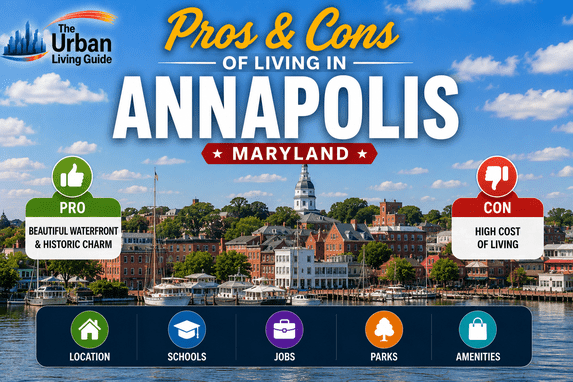
Pros and Cons of Living in Annapolis — Where Sailboats Meet State Politics
Annapolis occupies a unique position in Maryland’s geography and identity — the state capital, a Naval Academy town, a sailing mecca on the Chesapeake Bay, and an affluent suburb all rolled into one compact waterfront city of roughly 40,000 residents. The pros and cons of living in Annapolis, Maryland reveal a place where colonial architecture meets modern government salaries, where summer tourism overwhelms daily life, and where housing costs reflect waterfront prestige more than practical suburban function.
Many residents appreciate that Annapolis offers something genuinely rare — a walkable historic downtown with legitimate nautical culture, stable government employment, and a small-city feel just 30 miles from Washington DC and 45 minutes from Baltimore. But some newcomers find it challenging that the city’s compact geography creates intense competition for limited housing, seasonal tourist crowds saturate the downtown core, and the cost of entry has become prohibitively expensive for anyone without dual professional incomes or inherited wealth.
Here’s what living in Maryland’s capital actually costs and delivers in 2026.
📺 Hear directly from Annapolis residents about navigating life in this historic waterfront city:
What Draws People to Maryland’s Capital – Pros of Living in Annapolis
Genuine Historic Downtown That Functions Daily
Annapolis’s historic district isn’t a preserved museum — it’s a functioning downtown where residents actually live, work, and shop among 18th-century architecture that remains largely intact. Main Street, Maryland Avenue, and the City Dock area offer walkable urban living rare in car-dependent Maryland suburbs. Many residents appreciate that you can genuinely live car-light here if you work downtown or for state government.
Stable Government Employment Anchors Economy
Maryland State Government employs thousands directly in Annapolis, creating job stability that survived recessions and economic cycles that devastated other mid-sized cities. For young professionals specifically, state positions offer competitive salaries, strong benefits, and pension security increasingly rare in private sector employment. The Naval Academy adds another 1,500+ civilian employees to the local job market.
Sailing and Waterfront Culture Is the Real Deal
Annapolis legitimately claims the title “Sailing Capital of America” — not tourism marketing but lived reality. The Chesapeake Bay surrounds three sides of the city, marinas crowd the waterfront, and sailing culture permeates everything from casual conversation to weekend routines. For sailing enthusiasts, living here means water access and community connection unmatched anywhere on the East Coast outside Newport, Rhode Island.
Small-City Safety With Big-City Proximity
Annapolis maintains genuinely low crime rates across most neighborhoods, particularly compared to Baltimore just 30 miles north. Families will find that the combination of small-city safety, strong schools, and proximity to DC and Baltimore job markets creates a quality-of-life package that justifies premium housing costs for those who can afford the entry price.
Exceptional Restaurant Scene for City Size
Annapolis punches well above its weight in dining quality — from Chesapeake Bay seafood institutions like Cantler’s Riverside Inn to fine dining spots that don’t require DC expense accounts. One thing people often mention is how the restaurant density and quality here exceeds what cities twice Annapolis’s size typically offer.
Strong Public Schools in Compact District
Anne Arundel County Public Schools serve Annapolis with generally strong performance, and the compact city geography means most neighborhoods feed into well-regarded elementary and middle schools. Annapolis High School consistently ranks among the county’s better-performing secondary schools, making public education genuinely viable for middle-class families.
The Realities Tourism Brochures Skip – Cons of Living in Annapolis
Housing Costs Rival Major Metropolitan Areas
Some newcomers find it challenging that Annapolis housing costs approach Washington DC suburbs despite being a city of 40,000 residents. Median home prices exceed $550,000-$650,000 for anything in desirable neighborhoods, and waterfront properties easily top $1 million+. Rentals for modest two-bedroom apartments run $2,200-$2,800 monthly — prices that would buy significantly more space in nearby suburbs like Crofton or Severna Park.
Summer Tourism Overwhelms Downtown Living
Annapolis attracts over 4 million visitors annually, and the impact concentrates heavily from May through September. Residents find that downtown parking becomes impossible, restaurants require reservations weeks ahead, and the City Dock area transforms into a crowded tourist destination rather than neighborhood amenity. Some newcomers find it challenging that seasonal crowds fundamentally change daily life patterns for months at a time.
Limited Job Market Outside Government Sector
Beyond state government and Naval Academy-adjacent positions, Annapolis offers minimal local employment density. Tech workers, corporate professionals, and most private sector careers require commuting to DC, Baltimore, or Columbia — making Annapolis functionally a bedroom community despite its capital status. For remote workers specifically, this matters less, but local career growth options remain genuinely limited.
Traffic Congestion on Limited Road Network
Annapolis sits on a peninsula with exactly two bridges (Naval Academy Bridge and Severn River Bridge) connecting the downtown core to surrounding areas. Rush hour backups on Route 50, Rowe Boulevard, and bridge approaches create commute times that feel disproportionate to actual distances. Many residents appreciate the city’s character but find daily traffic frustration genuinely affects quality of life.
Expensive Even by Maryland Standards
Property taxes, utilities, marina fees for boat owners, restaurant prices inflated by tourist demand, and general cost of living all run 15-25 percent higher than comparable Maryland suburbs. Some newcomers find it challenging that the premium for Annapolis living extends beyond housing into nearly every daily expense category.
Limited Diversity and Socioeconomic Mix
Annapolis has become increasingly affluent and homogeneous as housing costs have priced out working-class and middle-income families. The city lacks the socioeconomic and cultural diversity found in Baltimore or even suburban Silver Spring — something that matters to families wanting children exposed to genuinely varied community experiences.
Who Thrives in Annapolis?
Annapolis is an outstanding fit for state government employees and military personnel stationed at the Naval Academy, dual-income professional couples who can afford entry costs and value walkable historic living, sailing enthusiasts for whom water access justifies premium pricing, and empty-nesters downsizing from larger suburban homes seeking maintenance-free downtown living.
Who should reconsider? Single-income families or young professionals unable to afford $600,000+ entry prices, anyone requiring diverse local job market rather than government employment, those sensitive to seasonal tourist saturation affecting daily life, and commuters to DC or Baltimore unwilling to accept traffic congestion on limited road network.
Final Verdict on Annapolis
Annapolis in 2026 is a genuine premium product — beautiful, safe, walkable, and expensive in ways that increasingly exclude anyone without substantial financial resources or government employment anchoring their life here. The pros and cons of living in Annapolis, Maryland ultimately favor affluent professionals who value historic character and waterfront lifestyle enough to accept limited diversity, tourist crowds, and costs that rival major metropolitan areas. Come with realistic financial expectations and appreciation for what small-city capital living actually delivers.
FAQs
Is Annapolis safe to live in?
Yes, very safe across most neighborhoods. Downtown, Eastport, Murray Hill, and West Annapolis all maintain low crime rates typical of affluent small cities.
What salary do you need to live comfortably in Annapolis?
Single professionals need $80,000-$100,000 annually. Families typically require $140,000-$180,000 given median home prices exceeding $600,000 and high cost of living.
Is Annapolis cheaper than Washington DC?
Housing costs 15-20 percent less than comparable DC neighborhoods, but property taxes and daily expenses run higher than most Maryland suburbs. Overall savings are modest.
Is Annapolis good for families?
Excellent if you can afford entry costs. Strong schools, safe neighborhoods, and small-city environment make it family-friendly for affluent households.
How is the job market in Annapolis?
Strong for state government and Naval Academy positions. Very limited outside government sector. Most private sector professionals commute to DC or Baltimore.
Can you live in Annapolis without a car?
Possible if you work downtown or for state government. Most residents need cars for grocery shopping, accessing areas beyond downtown, and weekend activities.
Explore More
- 📍 Living in Annapolis, Maryland
- 💰 Cost of Living in Annapolis, Maryland
- 🏘️ Best Neighborhoods in Annapolis, Maryland