

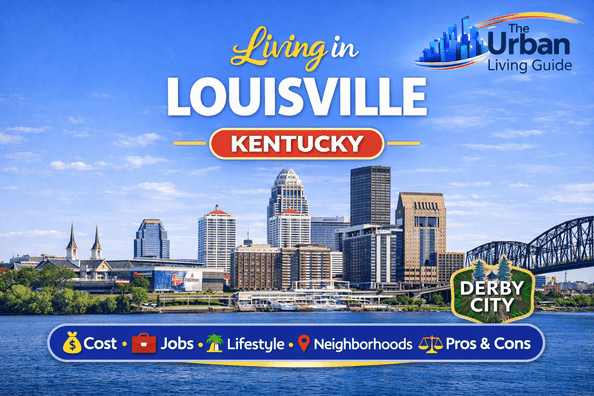
A City Where Horse Racing Meets Food, Music and Neighborhood Culture: Living in Louisville, Kentucky Has Plenty of Character
If you are actively considering living in Louisville, Kentucky, you are looking at a metropolitan area that masterfully straddles the cultural and geographic line between the hardworking, industrial American Midwest and the deeply hospitable, historic South. Situated along the sweeping bends of the Ohio River, Louisville serves as the largest city in Kentucky and acts as the economic anchor for the Kentuckiana region—a seamless blending of Kentucky and southern Indiana communities.
While the city is globally broadcasted for exactly two minutes every May during the legendary Kentucky Derby, reducing Louisville to just a horse racing destination is a massive oversight. The city operates as a quiet powerhouse of global logistics, advanced healthcare management, and American manufacturing. With a metropolitan population exceeding 1.3 million residents, Louisville—affectionately pronounced “Loo-a-vul” by locals—has invested heavily in transforming its urban core and waterfront into highly livable, pedestrian-friendly sanctuaries. The city boasts one of the most remarkable public park systems in the United States, originally designed by Frederick Law Olmsted (the same visionary architect behind New York’s Central Park).
Today, out-of-state professionals, growing families, and young creatives are moving here to capitalize on its incredibly accessible real estate market, a vibrant and globally recognized culinary scene, and a local economy that provides deep, recession-resistant career opportunities. Whether you are spending a Saturday morning walking the tree-lined, Victorian-era streets of Old Louisville, touring the historic distilleries along the Urban Bourbon Trail, or settling into a spacious suburban home in St. Matthews, relocating to Derby City offers a sophisticated, high-quality lifestyle without the crushing financial anxiety of larger coastal metros.
Take a few minutes to watch this comprehensive local video tour to genuinely understand the neighborhood architecture, the historic brick-lined streets, and the daily urban atmosphere across Louisville before you finalize your moving plans.
What Makes Louisville’s Cultural Identity So Distinct
Louisville operates with a fierce sense of local pride. It is a city that heavily champions independent businesses, local artists, and historic preservation. The culture here is deeply intertwined with bourbon, agriculture, and riverfront commerce, resulting in a lifestyle that feels both historically grounded and progressively modern.
The core elements defining Louisville’s distinct character include:
- The Kentucky Derby Legacy: Hosted annually at Churchill Downs since 1875, the Derby is not just a race; it is a month-long civic celebration highlighted by Thunder Over Louisville (one of the largest fireworks displays in North America) and massive community festivals.
- The Bourbon Capital of the World: Over 95% of the world’s bourbon is produced in Kentucky, and Louisville serves as its urban epicenter. The Urban Bourbon Trail weaves through downtown, featuring dozens of historic distilleries, tasting rooms, and speakeasies.
- The Olmsted Parks System: Louisville is home to 17 parks and 6 parkways designed by Frederick Law Olmsted, including the beloved Cherokee Park, providing residents with thousands of acres of heavily wooded, rolling green space right in the city center.
- Historic Architecture: Old Louisville features the largest contiguous collection of Victorian mansions in the United States, offering breathtaking, block-after-block preservation of 19th-century residential architecture.
- The Waterfront Renaissance: The award-winning Waterfront Park has transformed the banks of the Ohio River into an 85-acre green space, reconnecting the urban core to the water and serving as the primary venue for summer concerts and outdoor recreation.
Louisville at a Glance: Essential Relocation Statistics
Before planning your budget and scheduling neighborhood tours, it is vital to understand the foundational numbers driving the local housing and employment economy. Here is a snapshot of current real estate and lifestyle metrics:
| Relocation Parameter | Statistical Overview |
|---|---|
| Median Home Value | $240,000 – $280,000 (Substantially higher in premium eastern suburbs like Anchorage) |
| Average Monthly Rent | $1,000 – $1,500 depending on square footage, school zoning, and neighborhood amenities |
| Median Household Income | $58,000 – $65,000 (Logistics and Healthcare management sectors average significantly higher) |
| Average Commute Time | 20 to 24 minutes (Heavily dependent on Ohio River bridge crossings and I-264 traffic) |
| Primary Transportation Corridors | I-64, I-65, I-71, I-264 (Watterson Expressway) |
| Tax Climate | Moderate property taxes, standard state income tax, local occupational taxes apply depending on the county |
Famous Personalities, Athletic Legacies & Major Corporate Brands
Louisville has a long-standing tradition of producing globally recognized talent, cultural pioneers, and serving as the operational headquarters for massive, industry-defining corporations.
Legendary figures and cultural icons rooted in the area include:
- Muhammad Ali: The legendary, globally revered boxer and humanitarian was born and raised here. The stunning Muhammad Ali Center downtown celebrates his life, principles, and massive impact on the world.
- Jennifer Lawrence: The Academy Award-winning Hollywood actress grew up in Louisville and frequently returns to support local charities and children’s hospitals.
- Hunter S. Thompson: The brilliant and eccentric founder of “Gonzo journalism” was a Louisville native, famously writing the legendary essay “The Kentucky Derby is Decadent and Depraved.”
- Jack Harlow: The multi-platinum rap artist is a fierce advocate for his hometown, frequently referencing Louisville in his music and shooting music videos across local neighborhoods.
- Diane Sawyer: The pioneering broadcast journalist and television anchor began her career in Louisville’s local news stations.
Economically, the city is an absolute titan of logistics, healthcare, and global food service:
- UPS Worldport: The city’s largest employer. This massive, fully automated air logistics hub at the Louisville Muhammad Ali International Airport processes millions of packages daily, anchoring the entire region’s economy.
- Humana: The Fortune 500 health insurance and wellness giant is headquartered in a towering downtown skyscraper, employing thousands of corporate professionals.
- Yum! Brands: The parent company of KFC, Pizza Hut, and Taco Bell operates its global headquarters here, deeply tying the city to international food commerce.
- GE Appliances (a Haier company): Operating massive manufacturing facilities at Appliance Park, providing highly stable blue-collar and engineering careers.
- Ford Motor Company: Operating two massive assembly plants in the city (the Kentucky Truck Plant and Louisville Assembly Plant), solidifying the city’s automotive manufacturing strength.
Finding Your Space: The Best Neighborhoods in Louisville
The residential real estate market in Louisville is heavily defined by its distinct pockets of culture. The city is often divided between the historic, walkable urban core and the sprawling, highly desirable “East End” suburbs.
| Neighborhood Name | Best For | Vibe & Architectural Style | Estimated Price Range |
|---|---|---|---|
| The Highlands | Creatives & Young Professionals | “Keep Louisville Weird” epicenter, incredibly walkable, eclectic dining, historic craftsman homes, mature tree canopies | $300,000 – $650,000 |
| NuLu (East Market District) | Urbanites & Foodies | Ultra-trendy, art galleries, upscale boutique hotels, converted brick lofts, the heart of the modern culinary scene | $350,000 – $700,000+ (Condos/Townhomes) |
| Old Louisville | History Buffs & University Students | Massive Victorian mansions, stained glass, gas-lit walkways, borders the University of Louisville | $200,000 – $800,000 (Highly variable based on renovation) |
| St. Matthews | Established Families & Commuters | Premium suburban living, dense retail corridors, sprawling lawns, highly safe, central access to the Watterson Expressway | $300,000 – $700,000 |
| Norton Commons (Prospect area) | Luxury Buyers & Families | Master-planned “New Urbanism” community, highly walkable, private amphitheaters, pristine new construction | $600,000 – $1,500,000+ |
| Jeffersontown (J-Town) | First-Time Buyers & Logistics Workers | Affordable suburban growth, large industrial parks nearby, excellent parks, highly family-oriented | $220,000 – $400,000 |
👉 To better understand how the Ohio River shapes the border with Indiana and how I-264 loops around the city, review the interactive map below.
Housing Market Analysis and Rental Economics
The defining advantage of living in Louisville, Kentucky is the remarkably high standard of living you can secure for your housing dollar. While premium areas like Anchorage or Norton Commons command luxury pricing, the vast majority of the city remains highly accessible to average earners, especially when compared to nearby metros like Nashville or Chicago.
Current aggregate housing and rental data reflect highly approachable figures:
- Studio & 1 Bedroom Apartments: $900 to $1,400 per month (Luxury developments in NuLu and downtown push the upper boundaries).
- 2 to 3 Bedroom Apartments/Townhomes: $1,300 to $1,800 per month, offering ample space in desirable areas like St. Matthews.
- Single-Family Rental Homes: Generally start around $1,600 to $2,200 per month in the family-focused suburbs.
- Home Purchasing: The median sits comfortably around $240,000 to $280,000. Buyers will find that homes in the South End and Southwest offer incredible starter-home value, while the East End provides sprawling traditional layouts.
Job Market: Logistics, Healthcare, and Corporate Headquarters
Louisville’s economy is a heavily fortified, recession-resistant machine. Because it does not rely solely on one industry, the job market offers stability across multiple educational backgrounds and skill sets.
UPS Worldport is the undeniable king of the local workforce. Beyond just pilots and package handlers, the facility demands thousands of IT professionals, supply chain analysts, and industrial engineers. The city also operates a massive healthcare management sector; with Humana and Norton Healthcare headquartered here, there is a constant, aggressive demand for medical specialists, data analysts, and corporate healthcare administrators.
Advanced manufacturing also plays a vital role. The Ford assembly plants and GE Appliances ensure that skilled tradesmen, robotics technicians, and floor managers can secure high-paying union jobs. Average corporate salaries generally fall between $55,000 and $100,000. Paired with the region’s low cost of living, professionals moving from out of state often find their disposable income drastically increases upon relocating.
Daily Life, Culture, and the Riverfront Vibe
Daily life in Louisville is marked by a deep appreciation for good food, good bourbon, and neighborhood loyalty. The culinary scene here consistently punches above its weight class, earning praise from the James Beard Foundation. Residents regularly spend their weekends grabbing artisan coffee in The Highlands, browsing the massive Logan Street Market, or walking the Big Four Bridge—a spectacular pedestrian bridge that crosses the Ohio River into Jeffersonville, Indiana.
However, the social calendar is entirely dictated by the Kentucky Derby. The entire month of April leading up to the first Saturday in May is consumed by the Kentucky Derby Festival. Offices close early, neighborhoods host massive block parties, and events like the Great Steamboat Race on the river become central to the local identity. Beyond horses, the city has a booming festival culture, hosting massive events like Louder Than Life (a massive rock and whiskey festival) and Bourbon & Beyond.
Cost of Living: Maximizing Your Regional Budget
If you want to live in a highly developed, culturally rich city without the crushing financial pressure of coastal inflation, Louisville is a premier destination.
A typical monthly household budget breaks down roughly as follows:
- Rent / Mortgage Base: $1,000 to $1,600
- Utilities (Electricity, Water, Trash): $150 to $270 (Summer air conditioning demands drive the peaks)
- Groceries & Household Goods: $300 to $500 (Benefiting from extensive regional agricultural supply chains)
- Transportation (Gas, Insurance, Tolls): $120 to $180 (Residents crossing the river into Indiana daily must account for bridge tolls)
- Healthcare & Wellness: $200 to $350
Highway Networks, The River Bridges, and Commuting
Louisville is a geographically sprawling, car-dependent city. While the Transit Authority of River City (TARC) provides bus services, the vast majority of professionals rely on personal vehicles for daily commuting.
The highway grid is affectionately (and sometimes frustratingly) known for the “Spaghetti Junction”—the massive downtown interchange where I-64, I-65, and I-71 converge. Surrounding the city is the Watterson Expressway (I-264), the inner loop that connects the suburbs, and the Gene Snyder Freeway (I-265), the outer loop. A crucial logistical reality for newcomers: crossing the Ohio River involves tolls. The Lincoln, Kennedy, and Lewis and Clark bridges are tolled, requiring a RiverLink transponder to avoid higher pay-by-mail fees. Despite these localized bottlenecks, the average commute remains a very reasonable 20 to 25 minutes.
Climate Realities: The Ohio Valley and Allergy Season
Because Louisville sits deep in the Ohio River Valley, its climate is officially classified as humid subtropical, and the geography creates a very specific atmospheric “bowl” effect.
Summers are intensely hot, sticky, and highly humid, with temperatures frequently sitting in the 90s. Winters are generally moderate, though occasional polar plunges can bring ice storms or light snow. However, the most critical environmental reality newcomers must prepare for is allergy season. Because of the river valley’s topography, pollen and mold get trapped over the city. Louisville consistently ranks as one of the worst cities in the United States for allergy and asthma sufferers. Investing in high-quality home air purifiers and antihistamines is a mandatory part of local life.
Public Schools, The JCPS System, and Higher Education
If you are moving with children, understanding the local school system is paramount. The Jefferson County Public Schools (JCPS) system is massive and highly complex. Rather than strict neighborhood zoning, JCPS utilizes a unique, sometimes controversial student assignment plan and a robust magnet school system. Parents must actively research, apply, and navigate transportation logistics for their children to attend specific specialized academies within the county. Because of this complexity, Louisville also maintains one of the highest concentrations of private and Catholic school enrollments in the country.
For higher education, the city is fiercely proud of the University of Louisville (UofL), a major research institution renowned for its medical, engineering, and business schools—as well as its rabidly supported Cardinal athletics. Additionally, Bellarmine University provides a highly prestigious private liberal arts education nestled in the heart of The Highlands.
Weighing the Realities: Pros and Cons of Relocating
Every city involves lifestyle trade-offs. Before you commit to a long-term lease or a 30-year mortgage, it is vital to balance the cultural charm of the city with the logistical realities of the Ohio River Valley.
Primary Advantages of Moving Here:
- Incredible housing affordability compared to virtually any other major city in the region (specifically Nashville or Cincinnati).
- A massive, highly stable job market anchored by healthcare, global logistics (UPS), and manufacturing.
- An unparalleled local food, bourbon, and festival culture that keeps the social calendar packed year-round.
- World-class green spaces thanks to the historic Frederick Law Olmsted parks system.
- A genuinely friendly, unpretentious southern atmosphere mixed with midwestern practicality.
Notable Challenges to Prepare For:
- The Allergy Bowl: The Ohio River Valley topography makes this one of the most difficult cities in America for severe allergy and asthma sufferers.
- The JCPS School System: The complex public school assignment system can be highly frustrating and logistically difficult for new parents to navigate.
- Bridge Tolls & Traffic: Daily commuting across the Ohio River into Indiana requires paying tolls and dealing with frequent bridge congestion.
- Oppressive Summer Humidity: July and August bring sweltering, sticky heat that forces most recreational activities indoors or to the river.
- Absolute Car Dependency: Despite downtown walkability in specific pockets, navigating the broader metro requires owning a reliable vehicle.
Making Your Decision: Is Louisville Your Ideal Home?
Louisville is an absolute triumph of cultural preservation and modern economic strategy. It is a city that has managed to maintain its deep historical soul while becoming a vital node in global commerce. If you are a young professional looking to buy a historic home without going bankrupt, a foodie who wants to explore the origins of American bourbon, or a family seeking recession-resistant career opportunities in healthcare or logistics, this city is an outstanding destination.
However, if you suffer from severe respiratory allergies, demand a highly integrated subway transit system, or prefer a city where school zoning is simple and purely neighborhood-based, the logistical hurdles here may cause frustration. But for those who value rich traditions, neighborhood loyalty, sprawling parks, and the unmatched thrill of Derby Season, living in Louisville, Kentucky offers a profoundly enriching, high-quality lifestyle that is incredibly hard to replicate anywhere else in the country.
Real Experiences: Perspectives from Long-Term Residents (5 to 10+ Years)
“Moving to the Highlands neighborhood eight years ago was the best choice my family could have made. The historic Victorian homes, the massive tree canopies, and being able to walk to local coffee shops and local pubs in the Highlands or NuLu is incredible. Summers get humid, but the food scene and neighborhood warmth make Louisville feel like a true southern home.”
[Source: r/Louisville Community Discussions — u/HighlandsLocal04, resident of 9 years]
“The big reality check for newcomers is learning to navigate traffic around the Watterson Expressway during rush hour and dealing with Derby week crowds every spring. However, once you embrace the local culture, bourbon tastings, and beautiful parks designed by Frederick Law Olmsted, you realize Louisville offers big-city culture with great financial value.”
[Source: Local Resident Panels & Community Forums — Marcus L., Crescent Hill homeowner of 10 years]
Frequently Asked Questions About Living in Louisville, Kentucky
Does living in Louisville revolve entirely around the Kentucky Derby?
While the entire month of April is consumed by Derby festivals, the rest of the year operates normally. The city shifts its focus to its booming bourbon tourism, massive outdoor music festivals, and University of Louisville athletics.
How bad are the allergies in Louisville?
They are notoriously difficult. Because the city sits in the Ohio River Valley, pollen, mold, and humidity become trapped. It consistently ranks in the top 10 worst U.S. cities for seasonal allergies, so proactive medical management is required.
What is the deal with the JCPS school system?
Unlike traditional districts where you simply attend the school down the street, Jefferson County Public Schools uses a complex assignment and magnet system designed to promote diversity and specialized learning. Parents must actively research and apply for placements.
Do I have to pay to cross the river into Indiana?
If you use the I-65 (Lincoln and Kennedy) or I-265 (Lewis and Clark) bridges, yes, there is an all-electronic toll. However, the I-64 (Sherman Minton) and US-31 (Clark Memorial) bridges remain toll-free alternatives.
What salary is needed to live comfortably in Louisville?
Because of the highly affordable real estate and low overhead costs, a household salary between $55,000 and $90,000 per year allows for a very comfortable lifestyle, including homeownership and dining out.
Explore More Cities in Kentucky
If you’re exploring more options beyond Louisville, The Urban Living Guide has covered several other popular cities across Kentucky. You can also check:
- Living in Lexington, Kentucky
- Living in Bowling Green, Kentucky
- Living in Owensboro, Kentucky
- Living in Covington, Kentucky
Before deciding if Louisville is right for you, check out these detailed breakdowns:
- Cost of Living in Louisville, Kentucky
- Pros and Cons of Living in Louisville, Kentucky
- Best Neighborhoods in Louisville, Kentucky
Then explore our complete relocation logistics guide: Moving to Louisville, Kentucky
These guides give you a complete picture of what it’s like living across different cities, covering everything from cost of living, housing, and job opportunities to neighborhoods, commute, weather, education, popular places, and major employers.
The Urban Living Guide brings together these local insights in one place, helping you compare cities easily and make a confident, well-informed decision based on your lifestyle and goals.