

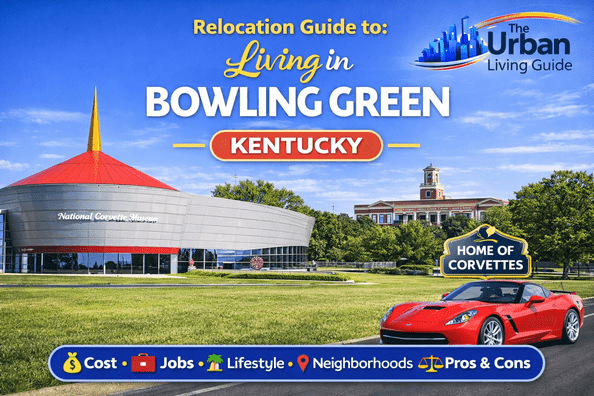
Is Living in Bowling Green, Kentucky Right for You? Cost, WKU, Corvette Jobs & Cave Country Lifestyle
If you are plotting a relocation to the southern part of the Bluegrass State, living in Bowling Green, Kentucky offers a unique mix of high-octane manufacturing and vibrant college-town culture. Situated right along Interstate 65 just north of the Tennessee border, Bowling Green stands as one of the fastest-growing economic and population hubs in Kentucky, currently home to roughly 75,000 residents. What makes this city entirely distinct from other regional hubs is its dual identity: it is simultaneously the home of the globally famous Chevrolet Corvette assembly plant (the exclusive birthplace of America’s sports car) and the sprawling campus of Western Kentucky University (WKU).
While many mid-sized midwestern towns struggle with stagnation, Bowling Green pulses with youthful energy, continuous infrastructure development, and a remarkably resilient blue-collar and academic workforce. Whether you are exploring the subterranean chambers of the Lost River Cave, taking in a weekend event around Fountain Square Park, or securing a spacious suburban home in family-focused pockets like Alvaton, relocating here delivers big-city employment potential combined with small-town southern hospitality.
Take a few minutes to watch this comprehensive local vlogger tour to genuinely understand the neighborhood architecture, commercial corridors, and street-level atmosphere across Bowling Green before you finalize your moving plans.
To ensure your relocation research is built on a solid foundation, the economic metrics, housing insights, and district breakdowns provided within this deep-dive guide have been thoroughly verified against official municipal databases, the Bowling Green Area Chamber of Commerce, and active real estate market analytics.
What Makes Bowling Green’s Cultural Identity So Distinct
Bowling Green operates on a rhythm of steady, industrial progress balanced with collegiate vibrancy. It is a community that takes immense pride in its manufacturing heritage while enthusiastically supporting its student population and local arts initiatives.
The core elements defining Bowling Green’s distinct character include:
- The Corvette Heritage: Bowling Green is the undisputed Mecca for automotive enthusiasts. The Bowling Green Assembly Plant and the adjacent National Corvette Museum draw hundreds of thousands of visitors from around the world annually, giving the local economy a distinct global footprint.
- Western Kentucky University (WKU) Energy: Perched atop “The Hill,” WKU dominates the cultural and economic landscape of the city, bringing diverse student demographics, athletic pride, and cultural arts events to the local community.
- Geological Wonders: The city sits directly atop a massive karst landscape featuring subterranean waterways and sinkholes, most notably highlighted by the historic Lost River Cave, where visitors can take boat tours underground.
- Strategic I-65 Corridor: Positioned squarely between Nashville, Tennessee (about an hour south) and Louisville, Kentucky (about two hours north), Bowling Green acts as a vital manufacturing and logistics nexus.
- Accessible Small-Town Feel: Despite rapid commercial expansion, the city maintains low traffic congestion and a friendly, community-first atmosphere that appeals heavily to families and retirees.
Bowling Green at a Glance: Essential Relocation Statistics
Before planning your budget and scheduling neighborhood tours, it is vital to understand the foundational numbers driving the local housing and employment economy. Here is a snapshot of current real estate and lifestyle metrics:
| Relocation Parameter | Statistical Overview |
|---|---|
| Median Home Value | $220,000 – $260,000 (Substantially higher in master-planned southern suburbs like Alvaton) |
| Average Monthly Rent | $900 – $1,500 depending on square footage, school zoning, and proximity to WKU campus |
| Median Household Income | $52,000 – $60,000 (Automotive engineering and healthcare sectors average significantly higher) |
| Average Commute Time | 15 to 20 minutes (Minimal gridlock compared to major metropolitan hubs) |
| Primary Transportation Corridors | Interstate 65, US-31W (Nashville Road), Campbell Lane (Route 234), Veterans Memorial Parkway |
| Tax Climate | Low property taxes, standard state income tax, local occupational license fees apply |
Famous Personalities, Athletic Legacies & Major Corporate Brands
Bowling Green punches well above its weight class in terms of industrial output, athletic accomplishments, and famous cultural exports that resonate nationwide.
Legendary figures and cultural icons rooted in the area include:
- Duncan Hines: The pioneer of modern baking mixes and restaurant rating guides was born in Bowling Green, and his legacy is celebrated through local culinary events.
- The Smothers Brothers: The legendary comedy and music duo spent formative years in the area and have regional ties to the community.
- Notable WKU Athletics Greats: Figures like NBA star Courtney Lee and legendary basketball coach E.A. Diddle put Bowling Green firmly on the national collegiate sports map.
Economically, the city is an absolute titan of automotive manufacturing, higher education, and regional distribution:
- General Motors (Corvette Assembly Plant): The cornerstone of the city’s heavy industry, employing thousands of high-skill manufacturing and engineering professionals building every Chevrolet Corvette in existence.
- Western Kentucky University: A massive regional anchor employing thousands of faculty, researchers, and administrative personnel while educating over 18,000 students.
- Fruit of the Loom: Maintaining major operational and distribution footprints in the region, anchoring the city’s historic textile and logistics history.
- Med Center Health & TriStar Greenview Regional Hospital: Providing robust, expanding healthcare infrastructure and stable employment across southern Kentucky.
Finding Your Space: The Best Neighborhoods in Bowling Green
The residential real estate market in Bowling Green offers distinct geographic choices, ranging from historic collegiate bungalows to sprawling acreage in the southern countryside.
| Neighborhood Name | Best For | Vibe & Architectural Style | Estimated Price Range |
|---|---|---|---|
| Downtown & Fountain Square | Young Professionals & Urbanites | Historic architecture, walkable dining, boutique shopping, loft apartments near local music venues | $200,000 – $400,000 |
| Alvaton (South of City) | Families & Executives | Highly sought-after school district, quiet rural feel, expansive custom brick homes on large lots | $350,000 – $700,000+ |
| Plano Area | Growing Families & Commuters | Suburban development, family-friendly subdivisions, easy access to I-65 and commercial hubs | $240,000 – $420,000 |
| Briarwood | Established Residents & Retirees | Mature tree canopies, traditional mid-century and split-level brick homes, quiet residential streets | $220,000 – $350,000 |
| Smiths Grove (Nearby Enclave) | Small-Town Seekers | Historic antique shops, rural charm, peaceful community atmosphere just a short drive north | $180,000 – $320,000 |
👉 To better understand how Interstate 65 divides the city and connects Bowling Green to Nashville and Louisville, review the interactive map below.
Housing Market Analysis and Rental Economics
One of the primary drivers of the city’s massive population growth is housing affordability. Unlike larger metropolitan centers where homeownership feels increasingly out of reach, Bowling Green provides a realistic path to buying a property with a spacious yard and modern amenities.
Current aggregate housing and rental data reflect highly approachable figures:
- Studio & 1 Bedroom Apartments: $700 to $1,300 per month (Properties near the WKU campus cater heavily to student populations).
- 2 to 3 Bedroom Apartments/Townhomes: $1,200 to $1,700 per month across standard suburban complexes.
- Single-Family Rental Homes: Generally start around $1,600 to $2,200 per month in family-focused sectors like Plano and Alvaton.
- Home Purchasing: The median purchase price sits comfortably between $220,000 and $260,000. Buyers will find strong value in full-brick construction homes with multi-car garages.
Job Market: Automotive Manufacturing, Healthcare, and Education
Bowling Green’s economy is exceptionally robust for a city of its size. The industrial backbone is anchored by the General Motors Corvette Plant, which provides high-wage manufacturing and precision engineering jobs. This manufacturing presence creates a ripple effect across regional supply chains, logistics, and parts fabrication.
Simultaneously, the public sector and service industries provide deep economic stability. Western Kentucky University and the region’s expanding healthcare networks (Med Center Health) employ thousands of white-collar professionals, researchers, and medical personnel. Average salaries generally range between $45,000 and $85,000. Because the cost of living and property taxes remain low, this income translates into a very comfortable middle-class purchasing power.
Daily Life, Culture, and the Balanced Lifestyle
Daily life in Bowling Green moves at a comfortable, manageable pace. Residents do not lose hours of their day sitting in soul-crushing traffic gridlock. Instead, weekends are frequently spent walking around the historic Fountain Square Park, exploring the extensive trails at Ephram White Park, or grabbing local barbecue and craft coffee in the downtown district.
The community is tightly knit, heavily supported by university events, high school athletics, and seasonal festivals. Car culture is prominent—not just because of the Corvette plant, but due to the active presence of the National Corvette Museum Motorsports Park, which hosts national racing and driving events throughout the year. For those who want the energy of a college town combined with the peace of southern Kentucky’s rolling countryside, Bowling Green hits a sweet spot.
Cost of Living: Maximizing Your Budget
If you want to escape high housing costs without moving to a remote rural area, Bowling Green offers an ideal financial environment.
A typical monthly household budget breaks down roughly as follows:
- Rent / Mortgage Base: $900 to $1,600
- Utilities (Electricity, Water, Trash): $130 to $220 (Summer cooling loads create peak utility bills)
- Groceries & Household Goods: $250 to $450 (Supported by robust local agricultural supply chains and major regional supermarkets)
- Transportation (Gas & Insurance): $100 to $150 (Fuel prices consistently rank below national averages)
- Healthcare & Wellness: $200 to $300
Highway Networks and Commuting Realities
Bowling Green is entirely car-dependent. Public transportation options are minimal, meaning a reliable personal vehicle is required for daily life. Fortunately, the road network is exceptionally well-designed.
The city’s primary lifeline is Interstate 65, which bisects the eastern side of the town and provides straightforward travel south to Nashville or north to Louisville. Within the city, major commercial thoroughfares like Campbell Lane and Nashville Road (US-31W) handle local retail traffic. Rush hours exist around school release times and shift changes at major manufacturing facilities, but severe delays are rare. Most local commutes average a breezy 15 to 20 minutes.
Climate Realities: The Regional Seasons
The local climate is classified as humid subtropical, characterized by four distinct, manageable seasons.
Summers are hot, humid, and long, with daytime temperatures frequently pushing into the upper 80s and 90s from June through August. Winters are generally mild and brief, featuring moderate rainfall and occasional light snowfall that rarely causes extended disruptions. Spring and autumn offer exceptionally pleasant outdoor weather, making them the peak seasons for exploring local caves, parks, and agricultural markets.
Landmarks, Museums, and Recreational Hubs
The city offers several high-profile attractions that draw visitors from across the country while providing regular weekend entertainment for residents.
- National Corvette Museum: A world-class museum celebrating automotive history, complete with interactive exhibits and the famous sinkhole display.
- Lost River Cave: A 7-acre underground adventure park featuring the state’s only underground boat tour and scenic above-ground walking trails.
- Fountain Square Park: The historic downtown center, hosting outdoor concert series, seasonal farmers markets, and local dining patios.
- Basil Griffin Park: A sprawling community park featuring disc golf, walking paths, model airplane fields, and fishing lakes.
Weighing the Realities: Pros and Cons of Relocating
Every city involves lifestyle compromises. Before committing to a move, it is important to weigh the community’s financial and lifestyle advantages against its limitations.
Primary Advantages of Moving Here:
- Exceptional housing affordability and realistic homeownership opportunities for average earners.
- A remarkably stable, growing local economy anchored by automotive manufacturing and higher education.
- Very low traffic congestion and short, stress-free daily commutes.
- A vibrant collegiate atmosphere paired with a safe, family-friendly suburban environment.
- Prime geographic placement right on I-65, offering easy weekend trips to Nashville or Louisville.
Notable Challenges to Prepare For:
- Absolute Car Dependency: Walking or utilizing public transit for daily errands is virtually impossible outside of the immediate WKU campus area.
- Limited Metropolitan Nightlife: While the local restaurant scene is growing, those seeking massive urban nightlife or extensive high-end luxury shopping must travel to Nashville.
- Summer Humidity: July and August bring heavy humidity that makes extended outdoor activities uncomfortably warm during peak afternoon hours.
Evaluating Your Move: Is Bowling Green Your Ideal Home?
Bowling Green has firmly established itself as one of the most promising mid-sized cities in the American South. It successfully combines economic vitality, automotive prestige, and university town energy with the comforting pace of southern Kentucky life. If you are a first-time homebuyer looking to escape inflated coastal real estate markets, a professional seeking stable manufacturing or healthcare careers, or a family prioritizing safe neighborhoods and good schools, this city presents an outstanding value proposition.
However, if you thrive in dense, public-transit-oriented urban environments or require 24/7 big-city entertainment options, the small-city pace may feel limiting over time. But for those who value economic security, community involvement, and the unique cultural identity of the Bluegrass State, choosing to live in Bowling Green offers a balanced, rewarding, and highly stable path forward.
Real Experiences: Perspectives from Long-Term Residents (5 to 10+ Years)
“Moving to Bowling Green ten years ago when I took a position at the GM Corvette Plant was the best decision my family ever made. The town has grown so much with new restaurants and shopping, but it still maintains that friendly, safe small-town feel. Housing is far more affordable than Louisville or Nashville, and weekends at Lost River Cave or Beech Bend Park are fantastic for the kids.”
[Source: r/bowlinggreen Community Discussions — u/BGManufacturingDad, resident of 10 years]
“The big reality check for newcomers is adjusting to the summer humidity and realizing that while BG is growing fast, it’s still a traditional southern Kentucky town at heart. However, once you settle into a neighborhood near WKU or out toward Greenwood, you realize how short the commutes are, how clean the streets are, and how welcoming the locals truly are.”
[Source: Local Resident Panels & Community Forums — Brenda K., Greenwood homeowner of 8 years]
Frequently Asked Questions About Living in Bowling Green, Kentucky
Is Bowling Green, Kentucky expensive to live in?
No, Bowling Green is considered quite affordable compared to national averages. Housing, utilities, and everyday expenses remain below many comparable regional hubs.
What are the primary job sectors in the city?
The strongest job markets are in automotive manufacturing (led by General Motors), higher education (Western Kentucky University), healthcare (Med Center Health), and logistics.
Is Bowling Green considered a safe place to raise a family?
Yes, the city features low violent crime rates, highly active community policing, and peaceful suburban neighborhoods like Alvaton and Plano that are popular with families.
Do I need a car to get around Bowling Green?
Yes, the city is heavily car-dependent with limited public transit options, meaning a personal vehicle is essential for commuting and daily errands.
What is Bowling Green most famous for?
It is internationally renowned as the exclusive manufacturing home of the Chevrolet Corvette and for housing Western Kentucky University.
🔗 Explore More Cities in Kentucky
If you’re exploring options beyond Bowling Green, The Urban Living Guide has covered several other popular cities across Kentucky. You can also check:
- Living in Louisville, Kentucky
- Living in Lexington, Kentucky
- Living in Owensboro, Kentucky
- Living in Covington, Kentucky
Before deciding if Bowling Green is right for you, check out these detailed breakdowns:
- Cost of Living in Bowling Green, Kentucky
- Pros and Cons of Living in Bowling Green, Kentucky
- Best Neighborhoods in Bowling Green, Kentucky
Then explore our complete relocation logistics guide: Moving to Bowling Green, Kentucky
These guides give you a complete picture of what it’s like living across different cities, covering everything from cost of living, housing, and job opportunities to neighborhoods, commute, weather, education, popular places, and major employers.
The Urban Living Guide brings together these local insights in one place, helping you compare cities easily and make a confident, well-informed decision based on your lifestyle and goals.