

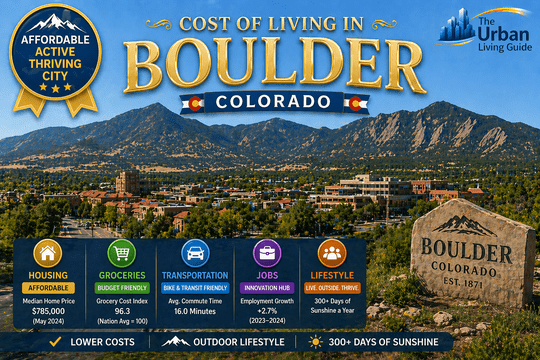
The Real Price of Living in Boulder’s Lifestyle Paradise
Boulder has positioned itself as Colorado’s premium destination — and the cost of living in Boulder, Colorado reflects that uncompromisingly. This is the state’s most expensive mid-size city, driven by CU Boulder’s prestige, a concentration of tech companies and startups, a wealthy demographic base, and a genuinely exceptional natural setting that commands lifestyle premium across every housing segment. Anyone relocating to Boulder deserves clarity on what that premium actually costs month-to-month.
City-specific insight that shapes everything: Boulder’s housing market operates almost independently from the rest of Colorado. Supply is artificially constrained by growth restrictions and geography — the city is hemmed in by mountains and has deliberately limited development. That scarcity dynamic means rents here respond differently to Colorado’s broader economic cycles, holding firm even when other cities soften.
Average Monthly Cost in Boulder
Boulder demands top-tier income to live comfortably. Here’s the realistic picture:
- Single person: Around $4,200–$5,400/month
- Couple: Typically $6,200–$8,000/month
- Family (2 adults, 2 kids): Around $8,500–$11,000/month including childcare
📹 Watch this video for an honest look at what your monthly budget actually needs to be in Boulder before you commit.
Housing Costs in Boulder
Housing in Boulder is legitimately expensive by any national measure. Downtown, Pearl Street corridor, and the neighborhoods immediately adjacent command peak prices, while the northern and southern edges of the city offer marginally better value — though “better value in Boulder” is still premium by any reasonable standard.
- Studio: $1,700–$2,400/month
- 1-bedroom: $2,100–$3,000/month
- 2-bedroom: $2,800–$4,000/month
- 3-bedroom/family home: $3,500–$5,500/month
Many people relocating from Denver are genuinely shocked by Boulder’s rent premium — a 2-bedroom that costs $2,200/month in Denver runs $3,200–$3,800/month in Boulder for comparable space and condition. Locals openly acknowledge that Boulder prices out all but top earners and wealthy transplants — this is intentional city policy. The growth restrictions that make Boulder so livable as a community directly constrain supply and inflate housing costs. If you’re coming from a mid-tier Colorado city like Fort Collins or Colorado Springs, the jump to Boulder’s living expenses in rent alone is $1,000–$1,500/month on a 2-bedroom.
Utilities & Internet
Boulder’s municipal utilities keep rates competitive, but the energy consumption patterns in high-altitude mountain living mean utility bills are higher than lower-elevation Colorado cities.
- Electricity + Gas + Water: Typically $110–$180/month
- Peak winter months: Can reach $200–$270/month
- Internet (Xfinity/Viasat): Around $60–$90/month
- Combined monthly average: Budget $170–$270/month
Grocery & Food Costs
Grocery costs in Boulder run significantly above Colorado and national averages — the concentration of health-conscious, high-income consumers supports premium retail pricing across the board.
- Single person: Around $400–$580/month
- Family of 4: Typically $900–$1,200/month
Whole Foods, Sprouts, and natural food markets dominate Boulder’s retail landscape — budget supermarkets are comparatively scarce. The dining scene is expensive — a mid-range restaurant meal runs $20–$32 per person. Boulder’s reputation as a health and wellness hub means food quality is genuinely high, but you’re paying for it meaningfully on every grocery receipt.
Transportation Costs
Boulder is one of Colorado’s most bikeable and transit-friendly cities — many residents genuinely manage without a car, particularly those near the Pearl Street corridor or with employer shuttle access.
- Car ownership (insurance + fuel + maintenance): $400–$600/month
- Auto insurance: $120–$180/month
- RTD bus system: Around $75–$95/month
- Bike culture: A realistic car-free option for many residents near downtown or CU
The prevalence of ebikes and cycling infrastructure means car ownership, while common, is genuinely optional in ways it isn’t in most Colorado cities.
Healthcare & Insurance
UCHealth Foothills Medical Center provides full-service care, while specialized services and major medical centers are accessible in Denver via direct highway connection.
- Employer-sponsored plan: Typically $190–$350/month employee contribution
- Marketplace individual plan: Around $320–$600/month
- Urgent care visit: $140–$230 without insurance
CU Boulder employees benefit from university benefits packages that help offset the city’s overall cost burden — a genuine financial advantage for that employment segment.
Other Living Expenses
- Gym membership: $50–$120/month — premium fitness culture is strong here
- Childcare (per child): $2,000–$3,000/month — among the highest in the country
- Entertainment & dining out: $300–$500/month depending on lifestyle
- Outdoor recreation: Free access to trails and natural areas, but ski pass costs if engaged with winter sports
Boulder’s outdoor lifestyle is genuinely exceptional and costs nothing to access — the value proposition for outdoor enthusiasts is legitimate despite the high baseline costs.
Boulder Cost of Living vs Colorado Cities
Boulder sits at the absolute top tier:
- vs Denver: Boulder is 40–50% more expensive on housing — a fundamentally different price universe
- vs Fort Collins: Boulder’s rents run 45–55% higher — CU Boulder vs CSU demand difference is substantial
- vs Colorado Springs: Boulder is 70–80% more expensive on housing — no reasonable comparison point
- vs Aurora: Boulder is nearly 3x Aurora’s cost on rent — entirely different financial tiers
Micro insight: Many CU Boulder employees and graduate students actually live in Longmont, Lafayette, or Superior — smaller towns just outside Boulder’s official limits — and commute 15–30 minutes to save $400–$600/month on rent. The housing cost gap is large enough to make this trade-off rational for thousands of Boulder-area workers.
Is Boulder Worth the Premium or Overpriced Mountain Town?
Boulder is expensive because people consistently choose to pay the premium — for the schools, the community, the natural setting, the wellness culture, the intellectual density, and the lifestyle density that money can buy. The cost of living in Boulder, Colorado reflects a city that has achieved a genuine identity and positioned itself as a destination for a specific demographic. It’s not a city for budget optimization — it’s a city for people who have decided Boulder’s qualities are worth the price premium.
Who Thrives and Who Struggles Significantly
Strong fit: High-earning tech workers, CU Boulder employees and researchers, wealthy remote workers, empty nesters, entrepreneurs, wellness-focused professionals.
Faces real pressure: Graduate students and postdocs — Boulder is genuinely unaffordable on stipend income. Entry-level workers and young professionals below $80,000 salary. Families of any size on single incomes under $120,000. Anyone relocating without significant savings or financial backing faces genuine financial stress.
FAQs
What is the cost of living in Boulder, Colorado in 2026? A single person needs $4,200–$5,400/month for comfortable living. Families of four should budget $8,500–$11,000/month covering rent, childcare, groceries, and transportation.
Is Boulder the most expensive city in Colorado? Yes — the cost of living in Boulder, Colorado is higher than Denver, Fort Collins, and every other Colorado city. It’s one of the most expensive mid-size American cities nationally.
Can I live in Boulder without a car? More realistically than most American cities — RTD transit and bike infrastructure make car-free living feasible for residents near downtown or with shuttle access. Many residents do live this way.
What salary do you really need to live comfortably in Boulder? Singles need roughly $100,000–$125,000/year. Couples should target $150,000–$190,000 combined. Families with children need $190,000–$250,000+ to cover Boulder’s housing, childcare, and general living costs without financial strain.
Why is Boulder so expensive compared to other Colorado cities? Growth restrictions, geographic constraints, CU Boulder prestige, tech industry concentration, and high-income demographic all combine to keep housing supply artificially low and prices artificially high — this is partially intentional city policy.
🔗 Explore the complete Living in Boulder, Colorado guide with The Urban Living Guide