
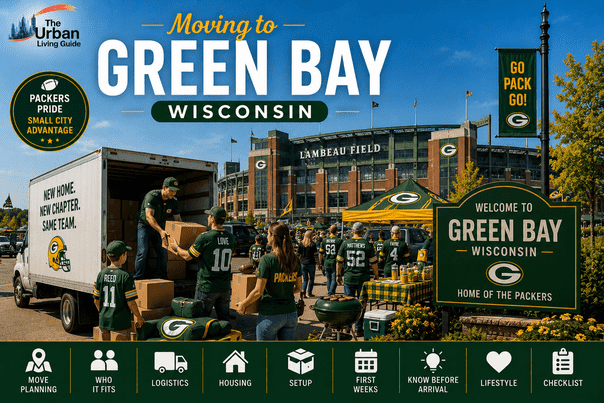
Moving to Green Bay, Wisconsin – Lambeau Field Is Just the Beginning of What This City Offers
Most people outside Wisconsin know Green Bay for exactly one thing: the Green Bay Packers. What they don’t know is that the city behind the team has quietly built a legitimate quality-of-life case that has nothing to do with football. Wisconsin’s third-largest city — population around 107,000 in the city proper within a Brown County metro of 330,000+ — sits at the southern end of Green Bay inlet where the Fox River meets Lake Michigan, with a cost of living that runs 8% below the national average and a housing market that prices the median home at $273,000 as of February 2026 — 37% below the national average.
Green Bay’s housing is 18% cheaper than the U.S. average, utilities are about 16% less pricey, groceries run 2% below the national average, and healthcare services cost 9% less. The average monthly rent sits around $1,084, and the average home value is $276,513, up 6.5% over the past year — meaningful appreciation that confirms real demand without the frenzied overheating of larger markets.
Green Bay’s economy runs on healthcare, paper and packaging manufacturing, food processing, and financial services — a diversified base that has historically insulated the city from the single-sector volatility that makes some smaller cities financially fragile. The average commute time is a remarkably efficient 16.5 minutes — one of the lowest in Wisconsin and significantly below any major metro comparison point. That daily time savings compounds into something tangible over a year.
Watch this famous local vlogger’s video tour of Green Bay’s moving infomration –
Moving to Green Bay, Wisconsin – Planning Your Relocation by Distance
Green Bay sits at the junction of I-43 (running south toward Milwaukee), US-141, and US-41 (running south toward Oshkosh and Milwaukee). Its position in northeast Wisconsin makes it accessible primarily from the south and west — the city’s geographic orientation toward Green Bay inlet and Lake Michigan means most inbound highway traffic arrives from the Fox Valley corridor.
-
- Same-State Move (from Milwaukee, Madison, Appleton, or elsewhere in Wisconsin): The most common Green Bay relocation pattern. A local crew handles most volumes comfortably in a single day. Budget $700–$1,800. Milwaukee to Green Bay via I-43 runs about 115 miles — roughly 1 hour 45 minutes in normal traffic.
- Interstate Move from Illinois (Chicago, Rockford, or Chicago suburbs): Chicago homebuyers searched to move into Green Bay more than any other metro — the most common out-of-state inbound interest Green Bay receives. Budget $1,500–$3,500. The I-94 to I-43 route from the Chicago metro runs about 3 hours to Green Bay in normal traffic.
- Interstate Move from Michigan, Minnesota, or other Upper Midwest states: Budget $1,500–$4,000. Green Bay’s position near Lake Michigan means Upper Michigan residents cross via the Mackinac Bridge corridor — a longer haul but a consistent migration path.
- Long-Distance or Cross-Country Move: Full-service movers run $4,000–$10,000. The affordability story is the primary driver for most long-distance movers — households from California, the Pacific Northwest, and major coastal cities running cost comparisons find Green Bay’s housing math consistently compelling.
Green Bay’s winter logistics variable deserves specific mention: the city averages 45–50 inches of snow annually, and its position at the lake inlet creates specific lake-effect snow patterns. Late spring through early fall provides ideal conditions for moving to the area, as winter relocations require extra planning. If your timeline allows it, May through September is the cleanest move window.
Who Green Bay Is Built For
Green Bay’s resident profile is shaped by its healthcare-anchored economy and its genuinely accessible housing market — a combination that serves several specific profiles particularly well.
-
- Healthcare professionals: Healthcare is Green Bay’s largest employment sector by a significant margin. Bellin Health, HSHS St. Vincent Hospital, ThedaCare, and the broader northeast Wisconsin healthcare network create deep institutional employment that makes this one of the most stable job markets in the state for medical, nursing, and allied health professionals. The combination of strong healthcare salaries and Green Bay’s housing costs creates a financial profile that’s hard to replicate in larger Wisconsin markets.
- Paper, packaging, and manufacturing professionals: Green Bay and the broader Fox Valley remain one of the most significant paper and packaging manufacturing regions in the country — Georgia-Pacific, Procter & Gamble, Schreiber Foods, and dozens of manufacturing operations anchor an industrial employment base that has continuously modernized toward advanced manufacturing and logistics.
- First-time homebuyers on realistic budgets: A $273,000 median home price that’s 37% below national average means homeownership is genuinely within reach on incomes that would require renting indefinitely in Madison or any coastal city. For dual-income households in healthcare, manufacturing, or professional services, the path to owning a home in Green Bay is shorter and less financially stressful than almost anywhere in Wisconsin.
- Remote workers seeking an affordable Great Lakes lifestyle: Green Bay’s combination of Fox River access, the bay inlet, Bay Beach Wildlife Sanctuary, and proximity to Door County creates an outdoor lifestyle proposition that remote workers from higher-cost cities increasingly recognize. The 16.5-minute average commute — which for remote workers translates to almost no daily commute burden — is an underrated daily quality-of-life advantage.
- Packers community and sports-culture households: This is genuinely distinct from most American cities. The Green Bay Packers are the only publicly owned franchise in major American professional sports — a community-ownership structure that creates a civic relationship between the team and residents that professional sports franchises in other markets simply don’t replicate. Game days at Lambeau Field are not just sporting events; they’re community gatherings that shape the city’s identity and social calendar year-round.
Who May Find Green Bay Challenging
-
- People needing a deep corporate or creative job market: Green Bay’s employment ecosystem is strong in healthcare and manufacturing but noticeably thinner in corporate finance, large-company tech, entertainment, and the creative industries. People who need depth in those sectors will find Milwaukee or Madison more productive. Remote workers benefit from Green Bay’s affordability without the job market constraint.
- Urban density seekers: Green Bay is a genuine small city — the restaurant density, nightlife, and cultural programming scale reflects a population of 107,000, not 500,000. The downtown Broadway Street district and the Titletown District adjacent to Lambeau have genuine energy, but people who need a large urban entertainment menu within walking distance will find Green Bay’s offering modest.
- People who underestimate northeast Wisconsin winters: Green Bay’s utility prices are 14% lower than the national average — partly because the infrastructure is efficient, partly because the housing stock is well-insulated out of necessity. Green Bay winters are long and real: sub-zero stretches in January and February, significant snowfall, and a lake-effect influence from Green Bay inlet that can concentrate storm intensity. This is not a city where winter is a season to be surprised by — it requires genuine preparation and an active relationship with the cold.
- Car-free lifestyle aspirants: Green Bay is primarily a driving city. The Green Bay Metro bus system covers basic routes but is not a car replacement for most daily life. Car ownership is effectively required outside the immediate downtown walkable core.
Moving Logistics and Transportation Planning
Green Bay is physically straightforward to move into — flat terrain, wide suburban streets in most residential areas, and none of the permit complexity of Milwaukee or the narrow-street issues of older Midwest cities.
-
- Local Wisconsin moves: $700–$1,800 for standard two to three bedroom moves
- Milwaukee to Green Bay (I-43): typically $1,000–$2,500
- Chicago metro to Green Bay: typically $1,800–$3,500
- Interstate moves from Michigan, Minnesota, Iowa: $1,500–$4,000
- Cross-country moves: $4,000–$10,000 with full-service movers
- Best move timing: May through September; winter moves require weather buffers and proper preparation
- Green Bay Metro Transit: bus system covers major corridors; car strongly recommended for most daily life
- Austin Straubel International Airport (GRB): Green Bay’s commercial airport with direct flights to Chicago O’Hare, Minneapolis, Detroit, and select other hubs — smaller than Milwaukee’s but practical for regional travel
- I-43 south to Milwaukee: approximately 1 hour 45 minutes — a practical distance for occasional Milwaukee trips for concerts, specialized dining, or major airport access via General Mitchell International
- Green Bay to Door County: approximately 1 hour north — one of the most popular weekend destinations in Wisconsin, effectively in Green Bay’s extended backyard
Housing Strategy in Green Bay’s 2026 Market
Green Bay’s housing market in 2026 is balanced and buyer-friendly by Wisconsin standards — homes average 68 days on market, significantly longer than Madison’s or Milwaukee’s tightest segments, giving buyers genuine time to make informed decisions. Hot homes sell for about 2% above list price and go pending in around 42 days — competitive in the best segments but without the panic-buy pressure of larger Wisconsin markets.
-
- Downtown Green Bay / Broadway District: The city’s most walkable and culturally active neighborhood. Renovated lofts, independent restaurants, Fox River access. Appeals to young professionals and people who want genuine urban character at Green Bay’s price point. One-bedrooms run $900–$1,300/month.
- Titletown District (west side near Lambeau): The area around Lambeau Field has been systematically developed into a mixed-use entertainment and residential district. Newer construction, strong community energy on game days, convenient for people who want Packers proximity as part of their daily lifestyle.
- Bellevue and Howard (east and southeast suburbs): Family-oriented suburban communities with newer construction, strong school options, and easy highway access. Popular with families relocating from larger Wisconsin cities who want Green Bay’s affordability with suburban character and school quality.
- De Pere: A separate city immediately south of Green Bay along the Fox River — home to St. Norbert College, with its own charming downtown and community identity. Often preferred by families and professionals who want a smaller-town feel within immediate Green Bay metro access. Consistently recommended by longtime area residents as one of the most livable communities in the metro.
- Allouez and Ashwaubenon: Established inner suburbs with mature trees, older housing stock, and genuine community character. More affordable than newer construction corridors. Ashwaubenon is directly adjacent to Lambeau Field and is technically a separate village — popular with Packers-affiliated households.
- Short-term housing: Airbnb options near downtown and Titletown. Extended Stay options along the US-41 corridor serve multi-week arrivals. Note that Packers home game weekends dramatically affect short-term rental availability and pricing — plan accordingly if your arrival coincides with the schedule.
Storage and Setup Essentials
Green Bay homes — particularly in the suburban corridors and De Pere — tend to run generous in size relative to their price points. Storage is rarely an emergency need here. CubeSmart and Extra Space Storage have Green Bay-area locations. For utilities: WPS (Wisconsin Public Service) handles electricity and gas across most of Green Bay and Brown County — a regional utility with strong infrastructure given the winter demands of northeast Wisconsin. Green Bay Water Utility handles water and sewer. Internet is served by Spectrum and AT&T in most neighborhoods. Utilities in Green Bay run about 16% below the national average — a genuine monthly savings compared to most comparison cities that compounds meaningfully over a full year. Wisconsin’s 5.5% state sales tax applies statewide.
The First Few Weeks in Green Bay — What to Actually Expect
Green Bay’s newcomer experience is shaped almost immediately by the community scale — in a metro of 330,000, social connections form faster and neighborhoods feel more legible than in Milwaukee or Madison. The downtown Broadway District and the Titletown District deliver their character quickly to newcomers who engage with them.
-
- Packers season calendar as civic reality: If you arrive between August and January, the Packers’ schedule becomes your social calendar whether you plan it that way or not. Home games at Lambeau Field reshape traffic, restaurant availability, and the entire city’s energy in ways that are genuinely enjoyable once you understand them rather than fight them. Knowing the schedule before your move is practical advice, not optional.
- Door County discovery: Most Green Bay newcomers make their first Door County trip within their first two months — and most describe it as one of the best surprises their new city delivered. The cherry orchards, cliff-side parks, fishing villages, and Peninsula State Park are within an hour of most Green Bay addresses. This proximity is an ongoing lifestyle asset that doesn’t diminish over time.
- Fox River Trail access: The Fox River State Trail and broader trail network run directly through the metro and connect Green Bay to the broader northeastern Wisconsin trail system. Cycling, running, and winter cross-country skiing are practical daily activities for residents near the trail corridors — not weekend excursions.
- Community warmth: Green Bay has a specific Midwestern community warmth that registers quickly for people arriving from larger or more anonymous cities. Neighbors introduce themselves, local businesses remember regular customers, and the civic culture around the Packers creates a community identity that functions as genuine social infrastructure for newcomers figuring out how to build connections.
Things to Know Before You Arrive
-
- Driver’s license: Wisconsin DMV conversion required within 60 days of establishing Wisconsin residency.
- Wisconsin income tax: Graduated rates running 3.54%–7.65% — applies identically in Green Bay as in Milwaukee or Madison.
- WPS winter heating preparation: Green Bay’s winters justify real attention to your heating system before the first cold snap. If renting an older property, ask specifically about the heating system type and its average winter energy performance — this is standard due diligence in northeast Wisconsin, not excessive caution.
- Packers game day logistics: Home game Sundays (and occasional Monday/Thursday nights) reshape traffic, parking, and restaurant availability across the entire city for a four-to-six hour window. Plan your first month’s schedule with at least a general awareness of the home schedule — the Packers website posts it well in advance.
- Green Bay Area Public School District: Covers most of the city’s residential areas. Private options include Preble High School area Catholic schools and several charter options. Suburban communities like De Pere, Bellevue, and Howard-Suamico have their own school districts that many families specifically target.
Local Insights and Lifestyle Feel
-
- Lambeau Field and the Packers community ownership: The Packers are the only publicly owned, non-profit franchise in major American professional sports. Shareholders are Green Bay community members — over 360,000 shareholders hold stock that cannot be sold for profit. This structure creates a specific civic relationship between the team and the city that no other professional sports market in America replicates. Living in Green Bay means being part of that ownership culture in a way that genuinely shapes social identity.
- Bay Beach Amusement Park: A city-owned amusement park on the bay with ride prices deliberately kept minimal (most rides 25–75 cents) as a public service. One of the most charming and underappreciated urban amenities in Wisconsin — a genuine family gathering point that reflects Green Bay’s specific community values.
- National Railroad Museum: One of the largest railroad museums in the United States — a genuinely excellent institution that most non-Wisconsin residents don’t know exists in Green Bay. Worth visiting in your first month as an orientation to the city’s industrial heritage.
- Bay Beach Wildlife Sanctuary: A free city-owned wildlife sanctuary with over 700 animals, native Wisconsin habitats, and a quality of experience that competes with paid attractions in larger cities. Free admission makes it a genuine daily-use community asset.
- Oneida Nation proximity and cultural presence: The Oneida Nation of Wisconsin has its reservation immediately west of Green Bay and a significant cultural and economic presence in the metro — operating Oneida Casino and Hotel, contributing meaningfully to the regional economy, and maintaining an active cultural programming calendar that Green Bay residents engage with regularly.
Quick Moving Checklist
Green Bay moves are logistically among the most straightforward in Wisconsin — the main planning priority is winter timing and Packers schedule awareness.
30 Days Before:
☐ Choose neighborhood: Downtown/Broadway for urban walkability, De Pere for community character, Bellevue/Howard for suburban family options, Titletown/Ashwaubenon for Lambeau proximity
☐ Book moving company or truck rental — 2–3 weeks ahead is sufficient outside winter peak; avoid scheduling on Packers home game weekends
☐ Contact WPS (Wisconsin Public Service) for electricity and gas setup — ask about winter heating system specifics for older properties
☐ Check Packers home game schedule and avoid move-day conflicts if possible
☐ Begin housing search — Green Bay’s 68-day average on market gives genuine time to research before committing
1 Week Before:
☐ Confirm all moving logistics in writing
☐ Schedule internet installation (Spectrum or AT&T)
☐ Prepare move-in funds — first month plus security deposit; Green Bay’s rental market is accessible and not broker-fee-heavy
☐ If moving October through March: winter vehicle preparation is non-negotiable — snow tires and emergency kit before your first snow event
Moving Day:
☐ Photograph old residence before departure
☐ Confirm WPS utility activation at new address
☐ Walk the Broadway District and the Fox River Trail in your first week — both orient you to Green Bay’s community character
☐ Plan your first Door County day trip within your first two months — it permanently changes how you think about your new city’s outdoor assets
Green Bay in 2026: What the Numbers Say That the Packers Story Doesn’t
Green Bay’s case for relocation is stronger than most national media coverage suggests, and it’s almost entirely independent of football. The $273,000 median home price, the 16.5-minute average commute, the 8–9% below-national-average cost of living, the healthcare employment depth, and the Door County access all point toward a city that rewards people who look past the NFL franchise and see a genuinely livable, financially rational place to build a life. The honest trade-offs — modest urban entertainment density, a serious Wisconsin winter, and a job market that skews toward healthcare and manufacturing — are specific and manageable. For the right household, Green Bay in 2026 consistently delivers more than its national reputation prepares newcomers to find.
FAQs — Moving to Green Bay, Wisconsin
What is the median home price in Green Bay in 2026?
$273,000 as of February 2026, up 4.6% year-over-year. The average home value sits around $276,513 per Zillow data. Green Bay’s median is 37% below the national average — one of the most accessible housing markets among Wisconsin’s major cities.
What is the cost of living like in Green Bay?
Green Bay’s overall cost of living runs 8–9% below the national average. Housing is 16–18% cheaper than the U.S. average, utilities run 14–16% lower, and healthcare costs approximately 9% less. Groceries and clothing track close to national norms.
What are Green Bay’s major employers?
Bellin Health, HSHS St. Vincent Hospital, ThedaCare, Schreiber Foods, Georgia-Pacific, Procter & Gamble, Associated Banc-Corp, and the Green Bay Packers organization itself, which is a significant year-round employer beyond game-day operations.
Do I need to be a Packers fan to live in Green Bay?
No — but understanding that the Packers are a year-round civic institution rather than just a sports team will make you a more prepared resident. Game days reshape the city, the ownership structure creates unique community dynamics, and Packers culture is genuinely woven into daily social life in ways that are easy to engage with regardless of personal sports interest.
How far is Green Bay from Door County?
Approximately 45–60 minutes north depending on your specific starting address. Door County’s cherry orchards, cliff-side parks, fishing villages, and Peninsula State Park are a practical day trip from any Green Bay neighborhood — one of the city’s most consistently cited quality-of-life advantages by long-term residents.
Helpful Local Resources Before Moving
These are the resources Green Bay newcomers actually use for the practical work of arriving:
- City of Green Bay — new resident services, permits, and city department contacts
- Wisconsin Public Service (WPS) — electricity and gas service setup; ask specifically about winter heating system performance for older properties
- Wisconsin DMV — driver’s license conversion required within 60 days of establishing Wisconsin residency
- Green Bay Metro Transit — bus route planning for getting around without a car
- Green Bay Area Public Schools — enrollment information, school boundary lookup, and district resources for relocating families
Explore More With The Urban Living Guide
These companion guides cover Green Bay from every angle relevant to a serious relocation decision:
- Living in Green Bay, Wisconsin
- Cost of Living in Green Bay, Wisconsin
- Pros and Cons of Living in Green Bay, Wisconsin
- Best Neighborhoods in Green Bay, Wisconsin