

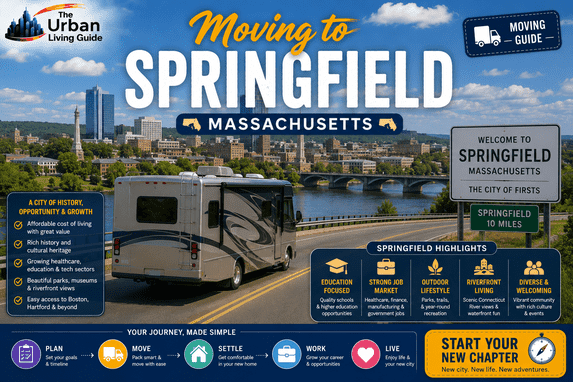
Moving to Springfield, Massachusetts – Western MA’s Underrated Urban Anchor
Springfield sits 90 miles west of Boston and exists, for many people, entirely off the relocation radar. That’s a mistake — and an increasingly costly one for anyone still paying Boston or even Worcester rents when they don’t have to. As the third-largest city in Massachusetts with a population of around 155,000, Springfield offers something genuinely rare in this state: real urban amenities at a price point that doesn’t require a financial intervention. A one-bedroom apartment here averages around $1,100 per month. The median home price sits near $220,000–$237,000. For comparison, that same apartment costs three times as much in Boston and twice as much in Worcester.
But Springfield isn’t just cheap — that framing sells the city short. This is the birthplace of basketball, home to the Basketball Hall of Fame, and a city with legitimate cultural infrastructure: major employers like Baystate Health and MassMutual, the Connecticut River waterfront, and a Pioneer Valley location that puts you within easy reach of the Berkshires, Hartford, and New York. The Pioneer Valley also includes college towns like Amherst and Northampton nearby, creating a regional lifestyle that Springfield residents quietly benefit from.
Watch how locals experience the Pioneer Valley lifestyle through this popular regional vlogger’s city guide — it gives you a grounded look at Springfield’s daily reality.
Springfield, Massachusetts – Understanding Your Move
Moving to western Massachusetts is logistically different from moving to the Boston metro, and that distinction matters for planning. Springfield has no commuter rail connection to Boston — that’s a fundamental factor if any part of your life involves regular Boston trips. For remote workers, retirees, and people employed within the Pioneer Valley itself, that’s irrelevant. For Boston-dependent commuters, it’s a dealbreaker worth acknowledging before the truck is loaded.
- Same-State Move (from Boston or eastern MA): The drive to Springfield on I-90 (Mass Pike) runs about 90 minutes without traffic, longer with it. A professional moving crew from Greater Boston can complete this in a long day. Budget $700–$1,500. If you’re bringing significant furniture volume, consider an interstate-style booking rather than a local crew.
- Interstate Move (from CT, NY, RI, VT): Springfield’s location on I-91 and I-90 makes it highly accessible from neighboring states. Most Northeast interstate moves complete in one day. Budget $800–$2,200. Springfield’s residential streets and suburban neighborhoods are truck-friendly — access is rarely an issue.
- Long-Distance Move (from Midwest, South, or West Coast): Full-service movers run $3,000–$7,500. Springfield’s lower cost of living means your relocation investment recovers faster here than in most Massachusetts cities. Budget a one to two week short-term stay at a local Airbnb or Extended Stay America in the Springfield area while you finalize your housing situation.
One thing that surprises people relocating from larger metros: Springfield operates at a noticeably slower pace than Boston or even Worcester. If you’re coming from a high-density urban environment, the adjustment isn’t bad — it’s just different, and most people describe it as a relief after the first few weeks.
🎯 Who Thrives in Springfield?
Springfield is a strong fit for people seeking affordability without leaving Massachusetts. The city appeals to professionals in healthcare, finance, education, and public services, while offering homeownership opportunities that are increasingly difficult to find elsewhere in the state.
- Ideal for healthcare workers employed by Baystate Health
- Strong opportunities connected to MassMutual and the regional financial sector
- Attractive for first-time homebuyers, with many homes priced around $220,000–$280,000
- Popular among remote workers seeking lower living costs and more space
- Offers access to the Pioneer Valley while remaining affordable
- A practical choice for retirees looking to stretch a fixed income
For many residents, Springfield provides a rare combination of affordability, homeownership potential, and everyday convenience within Massachusetts.
⚠️ Who May Struggle in Springfield?
Springfield offers affordability and homeownership opportunities, but it may not suit everyone. Some neighborhoods require careful research, and the city operates at a slower pace than larger Massachusetts metros.
-
- Neighborhood selection is important, with areas like Forest Park, East Forest Park, and 16 Acres often preferred by families
- Some parts of the city experience higher crime rates than the Massachusetts average
- Most residents rely on a car for daily transportation despite service from the PVTA (Pioneer Valley Transit Authority)
- The city’s location makes frequent commuting to Boston less practical
- Dining, nightlife, and entertainment options are more limited than in larger cities
- Residents often take advantage of nearby destinations such as Northampton, Amherst, and Holyoke for additional cultural and recreational opportunities
Springfield works best for those prioritizing affordability and space over big-city amenities and extensive public transit.
Moving Process and Transportation Planning
Springfield is one of the easier Massachusetts cities to physically move into. I-91 and I-90 (the Mass Pike) run directly through the city, truck access is straightforward in most residential areas, and you won’t face the parking permit battles or narrow-street chaos of Boston or Cambridge. That logistical ease is part of what makes Springfield underrated as a relocation destination — the move itself tends to go smoothly, which gives you mental space to focus on settling in rather than surviving the logistics.
-
- Local Springfield moves: $300–$700 for a one to two bedroom with a professional crew — among the lowest moving costs in the state
- Boston to Springfield: typically $700–$1,500 depending on volume
- Interstate moves (from CT, NY, RI): $800–$2,200
- Cross-country moves: $3,000–$7,500 with full-service movers
- Truck rental: readily available and priced reasonably — none of the September-crunch scarcity you’d face in Boston
- PVTA bus service covers Springfield’s major neighborhoods; car strongly recommended for regional trips
- Peter Pan Bus Lines connects Springfield to Boston, Hartford, New York, and Albany — a useful option for occasional trips without a car
- Bradley International Airport (Windsor Locks, CT) is 20 minutes south — significantly closer and less chaotic than Boston Logan for air travel
Many people relocating from Boston don’t realize how much easier driving becomes in western Massachusetts. Springfield has real traffic at rush hour, but nothing close to the gridlock of I-93 or the Mass Pike east of 128.
Housing Strategy in Springfield
Springfield’s housing market in 2026 remains genuinely accessible by Massachusetts standards — and by most national standards. Fair Market Rents for a one-bedroom run around $1,044, and two-bedrooms around $1,823. The median home purchase price in the low-to-mid $200,000s means that for many renters, buying in Springfield actually pencils out faster than continuing to rent — especially for people coming from markets where homeownership felt permanently out of reach. That said, neighborhood research before signing anything is essential.
- Forest Park and East Forest Park: The most consistently recommended neighborhoods for families. Victorian housing stock, green space access to the 735-acre Forest Park, and strong community feel.
- 16 Acres: Eastern Springfield’s family-friendly suburban neighborhood. Quieter, more car-dependent, but solid housing quality.
- Downtown Springfield: Active redevelopment happening, MGM Springfield casino district has brought some energy, but requires more due diligence on specific blocks.
- Longmeadow and East Longmeadow (suburbs): Just outside Springfield city limits, notably safer, with higher home prices but still well below Boston-area suburbs.
- Airbnb for arrival buffer: Good furnished options exist in Springfield and nearby Northampton — use one to two weeks to tour before signing a lease.
📦 Storage & Setup Essentials
Springfield generally offers larger homes and apartments than many communities in Eastern Massachusetts, giving residents more living space at a lower cost. As a result, storage needs are often less urgent than in denser cities such as Boston or Cambridge, though temporary storage options remain readily available.
- CubeSmart and Public Storage operate facilities throughout the Springfield area
- Homes and apartments often provide more space than comparable properties in Greater Boston
- Eversource and Columbia Gas serve much of the city
- Eligible households with heat pump systems may qualify for seasonal energy-saving programs
- Internet service is commonly available through Comcast Xfinity and Consolidated Communications
- Most utility and internet services can be activated within a few days
- Scheduling internet installation before move-in day is recommended
With a little advance planning, setting up utilities and settling into a new home in Springfield is typically a straightforward process.
The Reality of the First Few Weeks in Springfield
The adjustment to Springfield most often catches people on the activity side rather than the practical side. The housing situation is easier, the cost of living is a relief, and the logistics of daily life run smoother than in larger cities. What takes getting used to is the scale — Springfield is a real city but not a dense one, and filling your social calendar requires more intentional effort than it does in Boston or even Worcester. The Pioneer Valley’s broader network of towns (Northampton is 20 minutes north and has a strong arts and restaurant scene, Amherst adds university energy) quickly becomes part of how Springfield residents think about their lifestyle region rather than just their city.
- Commute reality: Springfield is genuinely car-dependent for most people. PVTA buses exist but schedules are limited. Budget for a reliable vehicle.
- MGM Springfield: The casino resort opened in 2018 and has brought hotel-quality dining, live events, and some nightlife to downtown. Not everyone’s scene, but it’s worth knowing it exists.
- Outdoor access: Connecticut River walking trails, Forest Park, and the Berkshires within an hour — people who love outdoor recreation discover that Springfield’s access to nature is one of the city’s real underrated assets.
- Weather: Western Massachusetts winters can be colder and snowier than coastal Boston. Plan accordingly with proper winter gear and vehicle preparation.
📌 What to Know Before the Move
Springfield has a few practical considerations that are worth understanding before relocating. Taking time to learn the city’s neighborhoods, transportation options, and local regulations can help make your transition much smoother.
-
- Massachusetts has a 6.25% sales tax, though groceries and clothing under $175 are exempt
- New residents must obtain a Massachusetts driver’s license within 30 days of establishing residency
- Bradley International Airport (BDL) is the primary airport for most Springfield residents
- Baystate Medical Center is one of the region’s largest healthcare employers and medical providers
- Neighborhoods vary significantly in character, making in-person visits highly recommended before choosing a home
🎭 Local Insights & Lifestyle Feel
Springfield offers more cultural attractions and community amenities than many newcomers expect. As the largest city in Western Massachusetts, it serves as a regional hub for entertainment, healthcare, history, and recreation while maintaining a lower cost of living than Greater Boston.
-
- Home to the renowned Naismith Basketball Hall of Fame
- The Springfield Museums complex includes art, science, and history museums
- Birthplace of Dr. Seuss (Theodor Geisel) and home to the Dr. Seuss National Memorial Sculpture Garden
- MGM Springfield contributes entertainment, events, and nightlife to the downtown area
- Easy access to the dining and cultural scenes of Northampton, Amherst, and the wider Pioneer Valley
- The Connecticut River Riverwalk provides outdoor recreation and waterfront access
For many residents, Springfield’s blend of affordability, cultural attractions, and regional connectivity makes it an underrated place to live in Massachusetts.
Quick Moving Checklist
Springfield moves are relatively straightforward logistically, but the neighborhood selection piece requires real attention. Get that right first, and the rest tends to fall into place.
30 Days Before:
-
- Choose your target Springfield neighborhood — Forest Park, 16 Acres, or outlying suburbs like Longmeadow
- Book moving company or truck rental — availability is generally good, no Boston-style crunch
- Begin apartment or home search and schedule in-person tours
- Research PVTA routes or confirm you have reliable vehicle access
- Contact Eversource/Columbia Gas for utility setup
- Book short-term housing if arriving without a signed lease (Airbnb or Extended Stay)
1 Week Before:
-
- Confirm moving logistics in writing
- Pack systematically — Springfield homes often have basement or garage storage not available in city apartments
- Schedule internet installation (Comcast Xfinity primary provider)
- Prepare move-in funds: typically first + security deposit; broker fees less common here than in Boston
- Confirm your new address is within a neighborhood you’ve visited in person
Moving Day:
-
- Document old residence with photos before departure
- Confirm all utilities active at new address
- Get landlord contact information and any building-specific rules
- Locate nearest PVTA stop and Peter Pan Bus station for regional travel
- Do a neighborhood walkthrough on foot within the first 48 hours
✅ Final Verdict on Moving to Springfield
Springfield offers something increasingly rare in Massachusetts: the opportunity to enjoy city amenities, homeownership potential, and a lower cost of living without leaving the state. While it may not provide the transit access, job density, or urban energy of Boston, it remains one of the most practical options for people seeking affordability and long-term stability.
-
- More attainable housing than many Massachusetts cities
- Strong employment opportunities through Baystate Health, MassMutual, and regional employers
- Good fit for families, remote workers, retirees, and first-time homebuyers
- Access to the cultural and recreational attractions of the Pioneer Valley
- Neighborhood selection and car ownership remain important considerations
- Lower overall living costs than Greater Boston communities
For those prioritizing affordability, space, and quality of life, Springfield continues to be one of the strongest relocation values in Massachusetts.
FAQs — Moving to Springfield, Massachusetts
What is the average rent in Springfield, MA?
Fair Market Rent for a one-bedroom runs around $1,044–$1,100/month. Two-bedrooms average $1,823. Home purchase prices sit near $220,000–$237,000 median — among the lowest in Massachusetts.
Is Springfield safe to live in?
Safety varies significantly by neighborhood. Forest Park, East Forest Park, 16 Acres, and suburban Longmeadow are consistently considered the safer, more family-friendly options. Research specific neighborhoods before choosing an address.
How do I get from Springfield to Boston?
There is no commuter rail connection. Driving via I-90 (Mass Pike) takes approximately 90 minutes without heavy traffic. Peter Pan Bus Lines offers coach service. This distance is a real consideration for anyone with frequent Boston needs.
What are the main employers in Springfield?
Baystate Health (healthcare), MassMutual (financial services), MGM Springfield (hospitality/entertainment), and various public sector employers including the City of Springfield and public school system.
Is Springfield good for families?
Yes, particularly in the Forest Park, East Forest Park, and 16 Acres neighborhoods. The combination of affordable homeownership, suburban character, and access to Pioneer Valley cultural resources makes Springfield a practical family destination.
Helpful Local Resources Before Moving
These resources help with the practical side of arriving in Springfield — utilities, transit, healthcare registration, and city services. Bookmark them before your move date:
-
- City of Springfield Official Website — New resident services, permit information, and neighborhood resources.
- PVTA (Pioneer Valley Transit Authority) — Local bus routes and schedules for getting around Springfield and connecting towns without a car.
- Baystate Health — Largest regional health system; establish your new provider relationship early after arrival.
- Bradley International Airport — Your practical air travel hub — closer, easier, and less congested than Boston Logan for most destinations.
Explore More With The Urban Living Guide
Want to dig deeper into Springfield before making your decision? These guides cover the city comprehensively: