

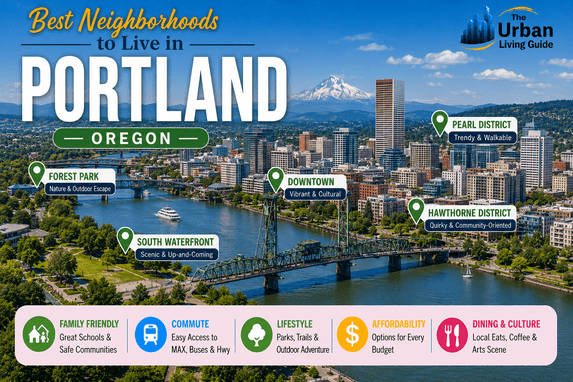
Best Neighborhoods in Portland, Oregon – Bridges, Breweries, and the Right Block for Your Life (2026)
Portland has a reputation that precedes it — progressive politics, craft coffee, Powell’s Books, and enough food carts to feed a small nation. But for anyone actually moving here, the real question isn’t whether Portland is worth it. It’s which Portland you want. The city of roughly 650,000 sits at the confluence of the Willamette and Columbia Rivers, divided into distinct quadrants — NE, NW, SE, SW, and North — each with its own identity, price point, and lifestyle logic. Major employers include Nike (headquartered in nearby Beaverton), Intel, Oregon Health & Science University (OHSU), Providence Health, and a growing tech sector that includes Adidas North America and Vacasa.
The best neighborhoods in Portland, Oregon aren’t about prestige — they’re about fit. This guide matches the right neighborhood to the right mover.
Best Areas in Portland, Oregon at a Glance
| 🏠 Best for Families | Sellwood-Moreland — top schools, quiet streets, Willamette River access |
| 💼 Best for Young Professionals | Pearl District — walkable, MAX light rail, urban density done well |
| 💰 Best Affordable Area | St. Johns — genuine character, improving amenities, North Portland value |
| 🏙️ Best Luxury Area | Northwest District (Nob Hill) — Victorian homes, walkable retail, prestige |
| 🌲 Best for Outdoor Access | Forest Park Neighborhoods — trail access to 5,200-acre urban forest |
📺 Watch this video to explore different neighborhoods and areas in Portland before choosing where to live.
Top Neighborhoods in Portland, Oregon
1. Pearl District – Portland’s Most Walkable Urban Core
The Pearl District sits northwest of downtown Portland, a former warehouse and railyard district transformed into the city’s densest, most walkable residential neighborhood. Powell’s Books on Burnside, the Portland Saturday Market, Jamison Square, and Tanner Springs Park anchor a neighborhood where most daily errands genuinely don’t require a car. The MAX Blue and Red Lines run through Union Station nearby, and Portland Streetcar loops through the Pearl connecting to OHSU and Lloyd District.
- Housing: High-rise and mid-rise condos, loft apartments, newer mixed-use buildings. 1BR rents average $1,600–$2,100/month. Condos purchase from $350K–$700K.
- Commute: 10–15 minutes to downtown Portland on foot. MAX Light Rail to Beaverton (Nike, Intel) in approximately 35–45 minutes.
- Nearby: Powell’s Books, Jamison Square, Portland Saturday Market, Whole Foods on Burnside, Forest Park trailhead (15-min walk).
Who it’s best for: Young professionals and remote workers who want Portland’s most complete urban walkability. Many newcomers arriving for tech or OHSU roles land in the Pearl first for the zero-friction lifestyle.
⚠️ Drawback: Portland’s downtown adjacent neighborhoods have seen elevated property crime and visible homelessness in recent years — the Pearl is better than most, but awareness is part of daily life here. Rents reflect the premium for the location.
2. Northwest District (Nob Hill) – Victorian Walkability at a Premium
Northwest District — locally called Nob Hill — runs along NW 21st and NW 23rd Avenues north of Burnside, a dense corridor of Victorian row houses, independent restaurants, boutiques, and coffee shops that feels like Portland’s most European neighborhood. Forest Park trailheads are a 10-minute walk from most NW District blocks — meaning residents can walk to 5,200 acres of urban forest from a genuinely walkable city street.
- Housing: Older apartments, Victorian conversions, and some newer buildings. 1BR rents average $1,500–$2,000/month. Single-family Victorians purchase from $600K–$1.2M.
- Commute: About 15–20 minutes to downtown Portland on foot or by Portland Streetcar. MAX access via Goose Hollow station.
- Nearby: Forest Park (walking distance), NW 23rd Avenue retail strip, Washington Park and Oregon Zoo, Portland Japanese Garden, Providence Park (Portland Timbers).
Who it’s best for: Professionals and couples who want Portland’s best combination of walkable amenities and outdoor access. One thing people love about Nob Hill is stepping off NW 23rd directly onto a Forest Park trail within minutes.
⚠️ Drawback: Street parking is extremely limited. Older building stock means some apartments lack modern insulation and in-unit laundry — verify before signing.
3. Sellwood-Moreland – Portland’s Family Neighborhood Standard
Sellwood-Moreland sits in southeast Portland along the Willamette River, a quiet, tree-lined neighborhood of Craftsman bungalows and well-kept streets anchored by Sellwood Park, the Springwater Corridor Trail, and the Sellwood Bridge connecting to Lake Oswego and OHSU. It consistently ranks among Portland’s safest neighborhoods and feeds into strong Portland Public Schools elementary options. Among the best areas in Portland, Oregon for families, Sellwood delivers the full package.
- Housing: Primarily Craftsman single-family homes. Purchase prices range $480K–$800K. 2BR rentals average $1,600–$2,100/month.
- Commute: About 20–25 minutes to downtown Portland by car or bus via SE Tacoma Street. 30 minutes to OHSU via Sellwood Bridge.
- Nearby: Springwater Corridor Trail (walking distance), Oaks Bottom Wildlife Refuge, Sellwood Park, Antique Row on SE 13th, Moreland Farmers Market.
Who it’s best for: Families and OHSU staff who want Portland’s quietest, most stable residential neighborhood with river access. Locals consistently recommend Sellwood when families ask where to put down serious roots in Portland.
⚠️ Drawback: Limited direct transit to downtown — most residents commute by car or bike. The neighborhood’s desirability keeps purchase prices firmly above entry-level.
4. St. Johns – North Portland’s Affordable Neighborhood With Real Character
St. Johns sits at Portland’s northern tip where the Willamette and Columbia Rivers meet, anchored by the stunning St. Johns Bridge — one of Portland’s most photographed landmarks — and a walkable commercial strip along N Lombard Street with independent cafes, bars, and a genuine neighborhood farmers market. It’s Portland’s best value play among connected neighborhoods, still affordable relative to SE and NW Portland while carrying a distinct identity that longer-term residents fiercely protect.
- Housing: Older single-family homes, duplexes, and apartments. 1BR rents average $1,100–$1,500/month. Purchase prices range $350K–$580K.
- Commute: About 25–30 minutes to downtown Portland via N Interstate Avenue or MAX Yellow Line from nearby Kenton neighborhood. 30–35 minutes to Nike campus in Beaverton.
- Nearby: St. Johns Bridge, Cathedral Park (under the bridge — one of Portland’s best), Smith and Bybee Wetlands, N Lombard Street dining strip, University of Portland (10-min walk).
Who it’s best for: Budget-conscious renters, University of Portland staff, and buyers priced out of SE Portland who want neighborhood character over polish. The best neighborhoods in Portland, Oregon for value almost always include St. Johns in the conversation.
⚠️ Drawback: The commute to downtown and the Pearl is longer than more central neighborhoods. Some blocks off the main commercial strip remain rough around the edges.
5. Hawthorne / Division – SE Portland’s Creative and Culinary Heart
Hawthorne Boulevard and SE Division Street form Portland’s most celebrated food and culture corridor — Salt & Straw ice cream, Pok Pok (the Thai restaurant that put Portland dining on the national map), independent bookshops, and vintage stores running through a dense grid of Craftsman and Foursquare bungalows in SE Portland. The two streets overlap in the broader Buckman, Hosford-Abernethy, and Richmond neighborhoods — walkable, bikeable, and deeply Portland in identity.
- Housing: Craftsman bungalows, duplexes, and apartment conversions. 1BR rents average $1,300–$1,750/month. Purchase prices range $420K–$720K.
- Commute: About 15–20 minutes to downtown Portland by bus or bike via Hawthorne Bridge. MAX Green Line at Clinton Street connects toward Clackamas and downtown.
- Nearby: Hawthorne Boulevard retail, SE Division Street restaurant row, Ladd’s Addition (historic rose garden neighborhood — 10-min walk), Reed College (15-min drive), Eastbank Esplanade.
Who it’s best for: Creatives, remote workers, and food-obsessed renters who want to be embedded in Portland’s most celebrated street culture. Many newcomers to Portland who’ve researched the city online end up here — the reality matches the reputation.
⚠️ Drawback: Parking and traffic on Division Street weekends is genuinely chaotic. The neighborhood’s popularity has pushed rents noticeably higher over the past five years.
Best Neighborhoods in Portland, Oregon – Quick Comparison
| Neighborhood | Vibe | Avg. 1BR Rent | Commute to Downtown | Best For |
|---|---|---|---|---|
| Pearl District | Urban / Walkable | $1,600–$2,100 | 10–15 min walk | Young professionals, remote workers |
| NW District (Nob Hill) | Victorian / Upscale | $1,500–$2,000 | 15–20 min walk | Couples, Forest Park lovers |
| Sellwood-Moreland | Family / River | $1,600–$2,100 (2BR) | 20–25 min drive | Families, OHSU staff |
| St. Johns | Affordable / Character | $1,100–$1,500 | 25–30 min MAX | Budget renters, first-time buyers |
| Hawthorne / Division | Creative / Culinary | $1,300–$1,750 | 15–20 min bike | Creatives, food lovers |
Final Thoughts
The best neighborhoods in Portland, Oregon reward movers who match lifestyle to location. The Pearl and Nob Hill solve urban walkability. Sellwood is where Portland families put down roots. St. Johns is the value play with genuine soul. Hawthorne and Division is where Portland’s food and creative reputation actually lives on the street.
Portland’s cost of living has risen steadily, but remains meaningfully below Seattle and San Francisco for comparable urban quality. The MAX Light Rail network, Portland Streetcar, and one of America’s best urban cycling infrastructures make car-free living genuinely viable across most of these neighborhoods. For anyone drawn to the Pacific Northwest lifestyle — outdoor access, food culture, progressive community identity — Portland delivers it at a price point the other major West Coast cities can no longer match.
Frequently Asked Questions
What is the safest neighborhood in Portland?
Sellwood-Moreland and Northwest District consistently report Portland’s lowest crime rates among residential neighborhoods. Both are predominantly owner-occupied with stable demographics.
What are the best neighborhoods in Portland for young professionals?
Pearl District for Metro walkability and urban energy. Hawthorne/Division for culture and community at a lower price point.
Where should families live in Portland?
Sellwood-Moreland — consistently Portland’s top family recommendation for schools, safety, and river access. Northwest District is strong for families who prioritize Forest Park proximity.
Is Portland affordable compared to Seattle?
Meaningfully so — average home prices and rents run 15–25% lower than comparable Seattle neighborhoods, though Portland costs have risen significantly over the past decade.
Is Portland a good place to live in 2026?
Portland has faced well-documented challenges around homelessness and downtown recovery — but the residential neighborhoods covered in this guide have remained strong. The city’s outdoor access, food culture, and Nike/Intel/OHSU job anchors continue to attract newcomers who look beyond the headlines.
Explore More
Planning your Portland move? Here are more detailed guides from The Urban Living Guide:
- Living in Portland, Oregon
- Cost of Living in Portland, Oregon
- Pros and Cons Of Living in Portland, Oregon