

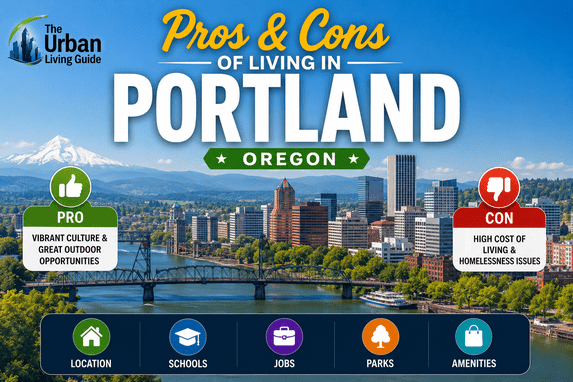
Pros and Cons of Living in Portland — Where Weird Meets Expensive
Portland has spent the past decade watching its reputation shift from quirky creative haven to cautionary tale about urban dysfunction — a city of roughly 650,000 residents where progressive politics, natural beauty, and food culture collide with homelessness crises, downtown deterioration, and cost of living that priced out the artists and service workers who built its character. The pros and cons of living in Portland, Oregon reveal a place fundamentally changed from the city that attracted massive migration in the 2000s and early 2010s.
Many residents appreciate that Portland still offers genuine Pacific Northwest lifestyle — proximity to mountains and coast, no sales tax, thriving food scene, and neighborhood character that distinguishes it from corporate sanitized cities. But some newcomers find it challenging that downtown decay has accelerated, property crime affects daily life across most neighborhoods, and the cost of entry has become prohibitively expensive for anyone without tech salaries or existing wealth.
Here’s what living in Portland actually looks like when the Instagram filters come off.
📺 Portland residents share unfiltered perspectives on the city’s transformation over the past decade:
What Still Makes Portland Appealing – Pros of Living in Portland
Outdoor Access Genuinely Integrated Into Daily Life
Forest Park sits within city limits as America’s largest urban forest, Mount Hood rises 90 minutes east, the Columbia River Gorge offers waterfalls and hiking 30 minutes away, and Oregon Coast beaches sit 90 minutes west. For outdoor enthusiasts, Portland provides mountain, river, and ocean access that requires weekend road trips from most American cities — here it’s genuinely part of weekly routine. Many residents appreciate that you can ski Mount Hood in the morning and hike Forest Park at sunset on the same day.
No Sales Tax Saves Real Money
Oregon has zero sales tax — a financial advantage that compounds significantly over time. Major purchases like cars, furniture, and electronics cost 8-10 percent less than Washington or California, and daily expenses add up to meaningful annual savings. For families specifically, this translates into thousands of dollars remaining in household budgets compared to neighboring states.
Food and Coffee Culture Remains World-Class
Portland’s restaurant scene continues punching well above its population size — from food cart pods offering global cuisine to farm-to-table fine dining that rivals coastal cities. Stumptown Coffee, Coava, and dozens of independent roasters maintain coffee culture that defined the city’s identity. One thing people often mention is how Portland food quality exceeds what cities twice its size typically offer.
Neighborhood Character Still Distinguishes Districts
Hawthorne, Division, Alberta Arts, Mississippi, Sellwood, and St. Johns maintain distinct identities despite gentrification pressures. Independent businesses still cluster in walkable corridors, and neighborhoods feel genuinely different from each other rather than homogenized chain store sameness. For young professionals seeking neighborhood-based urban living, Portland still delivers more authentic character than most West Coast cities.
Strong Bike Infrastructure for American Standards
Portland maintains America’s most extensive urban bike network — protected lanes, bike boxes at intersections, and cultural acceptance of cycling as legitimate transportation rather than recreational activity. For remote workers specifically, this means genuinely car-light urban living remains more feasible here than comparable West Coast cities outside San Francisco.
Tech Job Market Stabilized After Earlier Boom
Intel, Nike, Columbia Sportswear, Adidas North America, and growing tech sector presence from companies like Amazon and various startups create job opportunities beyond service industry. The tech boom that drove 2010s growth has cooled but stabilized, providing career options for professionals seeking West Coast lifestyle without San Francisco or Seattle extremes.
The Challenges Portland Can’t Ignore Anymore – Cons of Living in Portland
Downtown Has Genuinely Deteriorated
Some newcomers find it challenging that downtown Portland — once the city’s pride — has become largely abandoned by residents and workers. Office vacancy exceeds 30 percent, retail closures accelerated post-pandemic, and visible homelessness and drug use create environments where many residents simply avoid downtown entirely. The Pioneer Square area that tourists remember from 2015 barely resembles current reality.
Homelessness Crisis Affects Daily Life Everywhere
Portland’s homeless population approaches 6,000 individuals with visible encampments throughout the city affecting parks, business corridors, and residential streets. This isn’t abstract policy debate — it’s daily navigation around tents blocking sidewalks, human waste on streets, and property crime that forces residents to remove everything from vehicles nightly. Many residents appreciate the city’s compassionate intentions but find the lived reality genuinely affects quality of life.
Property Crime Rates Remain Extremely High
Car break-ins, package theft, catalytic converter theft, and property crime occur at rates that require defensive lifestyle adjustments. Residents leave cars visibly empty, install security cameras, avoid parking on streets overnight, and accept that theft will likely happen eventually. Some newcomers find it challenging that this level of property crime has become normalized rather than addressed.
Housing Costs Climbed While Quality of Life Declined
Median home prices exceed $550,000-$650,000 and average rents hit $1,800-$2,400 for two-bedrooms — prices approaching Seattle despite Portland offering fewer job opportunities and deteriorating urban conditions. For young professionals specifically, the cost-to-benefit ratio has shifted dramatically as Portland charges premium prices while delivering declining services and livability.
Rain Dominates October Through June
Portland receives 36 inches of annual rainfall concentrated heavily from October through June — creating 8-9 months of gray skies, constant drizzle, and limited sunshine. If you’re moving from California, Texas, or the Southwest, the seasonal adjustment to persistent gloom genuinely affects mental health and lifestyle in ways sunshine-state residents struggle to anticipate.
Public Transit Declining Despite MAX System
TriMet MAX Light Rail provides extensive coverage but service quality has declined with safety concerns on trains and platforms driving ridership down. Bus frequency was cut, and the system doesn’t feel safe or reliable enough for many residents to depend on exclusively. Car ownership remains necessary despite Portland’s reputation for transit-friendly infrastructure.
Who Should Still Consider Portland?
Portland works best for outdoor enthusiasts prioritizing mountain and coast access over urban functionality, remote workers with location flexibility who can afford housing without local salary constraints, established creatives with income streams not dependent on local economy, and biking enthusiasts who genuinely embrace two-wheel transportation as lifestyle rather than occasional recreation.
Who should reconsider? Young professionals expecting the Portland of 2010-2015 mythology, families with school-age children facing deteriorating public schools, anyone sensitive to visible urban dysfunction and property crime, service industry workers unable to afford housing on local wages, and those requiring vibrant safe downtown for social and cultural life.
Final Verdict on Portland Today
Portland in 2026 remains a city struggling to reconcile its progressive values with governance failures that have genuinely degraded quality of life for residents across income levels. The pros and cons of living in Portland, Oregon now favor wealthy remote workers and outdoor enthusiasts who can afford insulation from urban dysfunction rather than the creative class and service workers who built the city’s character. Come with eyes wide open about current realities rather than nostalgic reputation, realistic budgets for high costs, and genuine enthusiasm for rain and outdoor lifestyle that still defines the region.
FAQs
Is Portland safe to live in?
Safety varies dramatically. West Hills, Lake Oswego periphery, and some Eastside neighborhoods remain relatively safe. Downtown, Old Town, and many Eastside areas experience high property crime. Violent crime remains lower than many cities but property theft is epidemic.
What salary do you need to live comfortably in Portland?
Single professionals need $70,000-$90,000 annually. Families typically require $110,000-$145,000 given median home prices around $600,000 and costs rivaling Seattle without comparable salaries.
Is Portland cheaper than Seattle?
Housing costs 15-20 percent less than Seattle, but salary opportunities are significantly lower. No sales tax provides advantage over Washington. Overall cost of living comparable when accounting for income differences.
Is Portland good for families? Challenging.
Portland Public Schools struggle with performance and budget issues. Families often choose suburbs like Lake Oswego, West Linn, or Beaverton for better schools. Outdoor access is genuine family advantage.
How bad is Portland rain really?
8-9 months of gray skies and drizzle from October-June. Not heavy downpours but persistent gloom. Seasonal Affective Disorder is real concern. Sunshine lovers struggle significantly with Portland climate.
Can you live in Portland without a car? Possible in certain neighborhoods near MAX lines if working remotely or downtown. Most residents need cars despite bike infrastructure. Transit safety concerns have reduced reliance on public transportation.
Explore More