
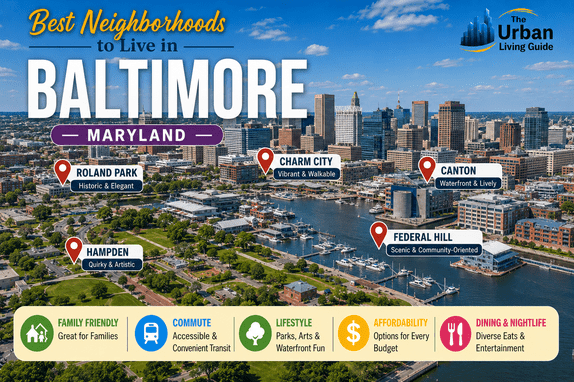
Best Neighborhoods in Baltimore, Maryland – Row Houses, Harbor Views, and Real City Character (2026)
Baltimore is one of America’s most misunderstood cities. The national narrative focuses on its challenges, but residents who actually live here know a different city — one of distinct, fiercely proud neighborhoods, a world-class Inner Harbor, legendary seafood culture built around Chesapeake Bay blue crabs, and a cost of living that delivers genuine urban density at prices that would be laughable in Washington D.C., just 40 miles south. Baltimore’s population of roughly 570,000 anchors a metro of 2.9 million, with a job market driven by Johns Hopkins University, Johns Hopkins Hospital, University of Maryland Medical Center, Under Armour, and one of the East Coast’s busiest ports.
The city’s neighborhood structure is unlike most American cities — Baltimore has over 200 officially recognized neighborhoods, each with its own name, identity, and block-level personality. This guide cuts through that complexity to identify the best areas in Baltimore, Maryland for the people most likely to be moving there: young professionals, medical and academic staff, families, and value-seeking buyers who’ve done the D.C. math and landed here deliberately.
Best Areas in Baltimore, Maryland at a Glance
| 🏠 Best for Families | Roland Park — top private and public schools, tree-lined streets, old-money stability |
| 💼 Best for Young Professionals | Federal Hill — Inner Harbor views, walkable nightlife, strong rental market |
| 💰 Best Affordable Area | Hampden — quirky character, improving amenities, Baltimore’s creative bargain |
| 🏙️ Best Luxury Area | Roland Park / Guilford — grand historic homes, prestige addresses |
| 🎓 Best for Academic/Medical | Charles Village — walking distance to Johns Hopkins, affordable, lively |
📺 Watch this video to explore different neighborhoods and areas in Baltimore before choosing where to live.
Top Neighborhoods in Baltimore, Maryland
1. Federal Hill – Baltimore’s Most Livable Urban Neighborhood
Federal Hill sits on a bluff directly south of the Inner Harbor, named for the hill where Baltimoreans celebrated ratification of the U.S. Constitution in 1788. It’s the neighborhood most often recommended to newcomers arriving in Baltimore — a dense grid of Federal-style row houses on tree-lined streets, a walkable commercial strip along Cross Street, and unobstructed Inner Harbor views from the park at the top of the hill. Many residents prefer this area because it delivers genuine Baltimore character — the row house culture, the marble stoops, the neighborly density — without the rougher edges of other close-in neighborhoods.
- Housing: Primarily Federal-style and Victorian row houses, many renovated to high standard. 1BR rents average $1,400–$1,900/month. Purchase prices range $300K–$600K for a full row house.
- Commute: About 10–15 minutes to downtown Baltimore by foot or bike via Light Street. Charm City Circulator (free bus) runs through the neighborhood. Approximately 45–55 minutes to Washington D.C. via MARC Train from Camden Station.
- Nearby: Inner Harbor and Harborplace (10-min walk), Cross Street Market (renovated food hall), American Visionary Art Museum, Fort McHenry National Monument (10-min drive), M&T Bank Stadium (Baltimore Ravens — 15-min walk).
Who it’s best for: Young professionals and couples who want Baltimore’s most complete urban neighborhood — walkable, safe by city standards, and with enough nightlife and dining on Cross Street to cover most weekends without a car. Many Johns Hopkins Hospital and University of Maryland staff choose Federal Hill for the commute balance between downtown access and neighborhood quality.
⚠️ Drawback: Federal Hill’s popularity means it’s Baltimore’s most competitive rental market — vacancy is low and good units move fast. Parking is the eternal complaint; a reserved spot adds $150–$200/month to your effective housing cost.
2. Fells Point – Historic Waterfront With Genuine Grit
Fells Point is Baltimore’s oldest neighborhood, a 18th-century waterfront district of cobblestone streets, Federal-period brick row houses, and a working waterfront that still feels connected to the city’s maritime history. The Broadway Market, independent bars along Thames Street, and weekend farmers markets give it a lived-in authenticity that newer waterfront developments can’t replicate. One thing people love about Fells Point is that it never fully gentrified — it kept its character, its dive bars, and its mix of long-term residents alongside newer arrivals.
- Housing: Historic row houses and newer condo conversions. 1BR rents average $1,350–$1,800/month. Row house purchases range $280K–$550K.
- Commute: About 15–20 minutes to downtown on foot via Eastern Avenue or the waterfront promenade. Water Taxi connects to Inner Harbor and Canton year-round.
- Nearby: Broadway Market, Thames Street bar district, Patterson Park (10-min walk — Baltimore’s best neighborhood park), Johns Hopkins Hospital (10-min drive), Canton Waterfront Park.
Who it’s best for: Residents who want Baltimore’s most authentic historic character and a genuine social scene. Renters often consider Fells Point when Federal Hill feels too polished — the cobblestones, the maritime atmosphere, and the Thames Street energy offer something more textured.
⚠️ Drawback: Cobblestone streets are charming until you’re driving or cycling over them daily. Weekend nightlife noise on Thames Street and Broadway can be significant — blocks closest to the bar district are loud on Friday and Saturday nights.
3. Charles Village – Baltimore’s Academic Heart
Charles Village runs along North Charles Street north of Johns Hopkins University’s Homewood Campus, anchored by the Baltimore Museum of Art on Art Museum Drive and Wyman Park to the west. It’s the city’s most academic neighborhood — a dense mix of Hopkins students, faculty, hospital staff, and long-term Baltimore residents in brightly painted Victorian row houses. Many newcomers arriving for Johns Hopkins University or Johns Hopkins Hospital positions choose Charles Village because the walk-to-work math is simply undeniable.
- Housing: Victorian row houses, apartment conversions, and student housing complexes. 1BR rents average $1,100–$1,500/month — among the most affordable connected neighborhoods in Baltimore. Purchase prices range $200K–$400K.
- Commute: 5–10 minute walk to Johns Hopkins Homewood Campus. About 20 minutes to downtown Baltimore via Charles Street or the Maryland Transit Administration (MTA) bus.
- Nearby: Baltimore Museum of Art (free admission), Wyman Park, Waverly Farmers Market (Saturday, year-round — 10-min walk), Remington neighborhood dining (10-min walk), Hampden’s The Avenue (15-min walk).
Who it’s best for: Johns Hopkins faculty, graduate students, hospital residents, and anyone in Baltimore’s academic or nonprofit sector who wants to walk to work and pay reasonable rent. Budget-conscious buyers find Charles Village’s row house prices among the city’s best value for the location.
⚠️ Drawback: Student density means the neighborhood dynamic shifts significantly in summer when Hopkins empties out. Some blocks directly adjacent to campus have higher property crime rates — proximity to the university is a significant variable in which specific streets feel most settled.
4. Roland Park – Baltimore’s Premier Family Neighborhood
Roland Park sits in north Baltimore along Roland Avenue, developed in the 1890s as one of America’s first planned suburbs and now a fully urban neighborhood of extraordinary architectural quality. The streets are broad, the homes are large — Tudors, Colonials, Queen Anne Victorians — and the neighborhood feeds into some of Maryland’s most sought-after private schools: Roland Park Country School, Gilman School, and Friends School of Baltimore are all within or adjacent to the neighborhood. Many families relocating to Baltimore from other major cities choose Roland Park specifically to access this school cluster.
- Housing: Primarily large single-family homes. Purchase prices range $500K–$1.5M+. Rental inventory is thin; the neighborhood skews heavily owner-occupied.
- Commute: About 20–25 minutes to downtown Baltimore via Roland Avenue and Charles Street. Light Rail at Cold Spring Lane station is a 10-min walk from parts of Roland Park.
- Nearby: Roland Park Country School, Gilman School, Friends School of Baltimore, Roland Park Pool (summer community hub), Stony Run Trail (wooded greenway — walking distance), Whole Foods on University Parkway.
Who it’s best for: Families relocating to Baltimore who are prioritizing school access above all else — particularly private school access. Locals consistently recommend Roland Park to anyone asking where Baltimore’s most stable, long-term family neighborhoods are.
⚠️ Drawback: The price of entry is Baltimore’s highest for single-family homes. Limited rental inventory means this is primarily a buyer’s neighborhood — short-term or relocating residents on multi-year contracts may find few options.
5. Hampden – Baltimore’s Creative Neighborhood With Room in the Budget
Hampden occupies north-central Baltimore along “The Avenue” (West 36th Street), a commercial strip of independent restaurants, vintage shops, art galleries, and the annual HonFest festival celebrating Baltimore’s working-class heritage. It’s the city’s most self-aware neighborhood — proudly quirky, deeply local, and increasingly attractive to young professionals and creatives who’ve been priced out of Federal Hill and Fells Point. The painted screens on row house windows, the Café Hon diner culture, and the Avenue’s independent retail give Hampden a character that’s genuinely hard to replicate.
- Housing: Baltimore row houses and duplexes, a mix of owner-occupied and rental. 1BR rents average $1,050–$1,400/month — noticeably below Federal Hill and Fells Point. Purchase prices range $200K–$380K.
- Commute: About 15–20 minutes to downtown Baltimore via Falls Road or Maryland Avenue. Johns Hopkins Homewood Campus is a 10-min drive or 25-min bike via Stony Run Trail.
- Nearby: “The Avenue” (West 36th Street) retail and dining, Meadow Mill (mixed-use complex with climbing gym and restaurant), Clipper Mill development, Druid Hill Park (Baltimore’s largest park — 10-min walk), Maryland Zoo in Baltimore.
Who it’s best for: Renters and first-time buyers who want real Baltimore neighborhood character at prices that still make sense. One thing people love about Hampden is that it hasn’t lost its identity in the process of improving — it still feels like Baltimore rather than a sanitized version of it.
⚠️ Drawback: The Avenue brings weekend traffic and parking competition. Some blocks transitioning toward Remington and the southern end of Hampden are still in the early stages of improvement — the neighborhood is directionally positive but uneven block by block.
Best Neighborhoods in Baltimore, Maryland – Quick Comparison
| Neighborhood | Vibe | Avg. 1BR Rent | Commute to Downtown | Best For |
|---|---|---|---|---|
| Federal Hill | Urban / Waterfront | $1,400–$1,900 | 10–15 min walk | Young professionals, couples |
| Fells Point | Historic / Maritime | $1,350–$1,800 | 15–20 min walk | Character seekers, social renters |
| Charles Village | Academic / Affordable | $1,100–$1,500 | 20 min via Charles St | Hopkins staff, grad students |
| Roland Park | Family / Prestige | Limited rentals | 20–25 min drive | Families, private school buyers |
| Hampden | Creative / Value | $1,050–$1,400 | 15–20 min drive | Budget renters, creatives |
Final Thoughts
The best neighborhoods in Baltimore, Maryland each serve a different version of city living. Federal Hill is the reliable all-rounder — walkable, safe, harbor-adjacent, and socially active. Fells Point rewards those who want authenticity over polish. Charles Village makes the walk-to-Hopkins math work better than anywhere else in the city. Roland Park is where Baltimore families put down serious roots. And Hampden delivers the most character per dollar of any neighborhood in the city.
What Baltimore offers across all of these neighborhoods is something increasingly rare in East Coast cities: genuine urban density, architectural character, and cultural identity at a price point that Washington D.C., New York, and Boston simply cannot match. The D.C. commute via MARC Train from Penn Station or Camden Station has made Baltimore a legitimate alternative for remote and hybrid workers who need occasional access to the capital. For anyone willing to look past the headlines and walk the actual streets, Baltimore consistently surprises.
Frequently Asked Questions
What is the safest neighborhood in Baltimore? Roland Park, Federal Hill, and Hampden consistently report the lowest crime rates among Baltimore’s residential neighborhoods. All three are predominantly owner-occupied with stable, long-term demographics. As with any major city, conditions vary significantly by specific block — street-level research before leasing is always worthwhile.
What are the best neighborhoods in Baltimore for young professionals? Federal Hill is the standard recommendation — walkable, safe, harbor-adjacent, and with the strongest rental market for young professionals. Fells Point is a strong alternative for those who want more historic character and social energy. Both are well within commuting range of downtown employers and Johns Hopkins Hospital.
Where should families live in Baltimore? Roland Park is Baltimore’s top family neighborhood by school access, safety, and long-term stability. Families who can’t stretch to Roland Park prices often look at Guilford (adjacent, similar character, slightly more accessible) or Homeland further north on Charles Street.
Is Baltimore affordable compared to Washington D.C.? Dramatically more affordable. Average home prices in Baltimore run 50–60% lower than comparable D.C. neighborhoods, and rental rates are similarly discounted. The MARC Train connection makes Baltimore a genuine option for D.C.-area workers, with a 40–50 minute commute from Penn Station to Union Station.
Is Baltimore a good place to live in 2026? Baltimore offers a quality of urban life — architectural character, neighborhood identity, food culture, and harbor access — that is genuinely undervalued nationally. The city has real challenges, but residents who invest in understanding its neighborhoods find a city with deep character and improving fundamentals. Major anchors like Johns Hopkins, University of Maryland, and the Port of Baltimore provide economic stability that continues to draw newcomers.
Explore More
Planning your Baltimore move? Here are more detailed guides from The Urban Living Guide:
- Living in Baltimore, Maryland
- Cost of Living in Baltimore, Maryland
- Pros and Cons of Living in Rockville, Maryland