
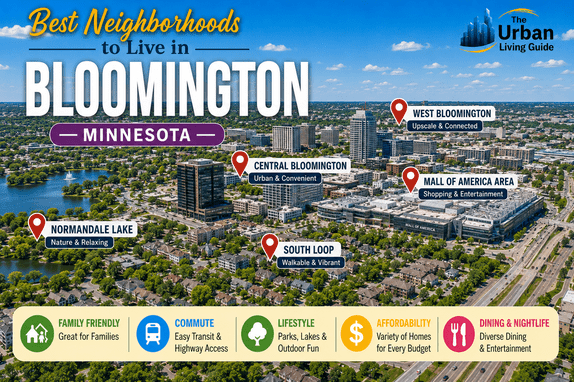
Best Neighborhoods in Bloomington, Minnesota – Suburb With a City Resume (2026)
Most people outside Minnesota know Bloomington for one thing: the Mall of America. But residents know it as one of the Twin Cities’ most strategically located suburbs — sitting directly south of Minneapolis, bisected by Interstate 494, and home to a job market that includes HealthPartners headquarters, the Mall of America employment complex, Toro Company, and a dense corridor of corporate offices along the 494 strip. With a population of roughly 90,000, Bloomington is the fifth-largest city in Minnesota and delivers suburban stability with genuine metro connectivity.
The city divides naturally into two halves: North Bloomington (older, more established, closer to Minneapolis) and South Bloomington (newer developments, more open space, closer to the Minnesota River bluffs and Minnesota Valley National Wildlife Refuge). Knowing which half fits your life is the real starting point for finding the best neighborhoods in Bloomington, Minnesota.
Best Areas in Bloomington, Minnesota at a Glance
| 🏠 Best for Families | South Bloomington / Hyland Hills — top schools, open space, quiet streets |
| 💼 Best for Young Professionals | North Bloomington / Penn-American — 494 corridor access, newer apartments |
| 💰 Best Affordable Area | Central Bloomington — older housing stock, competitive rents, solid location |
| 🏙️ Best Luxury Area | Hyland Hills / Normandale — executive homes, wooded lots, prestige addresses |
| 🌿 Best for Outdoor Access | South Bloomington / River Bluffs — Minnesota Valley wildlife refuge, trail systems |
📺 Watch this video to explore different neighborhoods and areas in Bloomington before choosing where to live.
Top Neighborhoods in Bloomington, Minnesota
1. North Bloomington & Penn-American – Connected, Convenient, and Professionally Practical
North Bloomington runs from the Minneapolis city line south to roughly 98th Street, with the Penn-American district centered on the intersection of Penn Avenue South and American Boulevard. This is where Bloomington’s apartment density is highest — a string of newer complexes along American Boulevard and Old Shakopee Road caters directly to professionals working the 494 corridor or commuting into Minneapolis. The Blue Line light rail (Metro Blue) runs through this zone, with Humphrey Terminal and Mall of America stations providing direct connection to downtown Minneapolis in under 25 minutes.
- Housing: Primarily apartment complexes, townhomes, and some older single-family homes. 1BR rents average $1,300–$1,750/month. Older ranch homes purchase for $280K–$420K.
- Commute: Blue Line to downtown Minneapolis in approximately 22–25 minutes. I-494 access within 5 minutes for car commuters heading to the corporate corridor.
- Nearby: Mall of America (10-min drive or one light rail stop), Minneapolis-Saint Paul International Airport (MSP) (10-min drive), Veterans Memorial Park, Penn Lake Park, Normandale Community College (10-min drive).
Who it’s best for: Young professionals and transplants who want suburban rent prices with genuine Minneapolis connectivity. Many newcomers arriving in the Twin Cities for corporate roles along the 494 strip choose North Bloomington specifically because the Blue Line removes the commute stress entirely.
⚠️ Drawback: American Boulevard corridor can feel generic — heavy traffic, strip mall density, and limited walkable character make this a functional rather than inspiring place to live. The light rail is excellent; the streetscape around it less so.
2. Hyland Hills & Normandale – Bloomington’s Prestige Residential Zone
Hyland Hills occupies the southwest quadrant of Bloomington, built around Hyland Lake Park Reserve — a 1,000-acre regional park with cross-country ski trails, mountain biking, swimming beach, and the Richardson Nature Center. The neighborhood wraps the park’s eastern and northern edges, with large custom homes on wooded lots that feel far removed from suburban cookie-cutter development. Normandale runs adjacent, anchored by Normandale Community College and the Normandale Lake office complex — one of the Twin Cities’ premier suburban business parks.
- Housing: Predominantly executive single-family homes and upscale townhomes. Purchase prices range $450K–$900K+. Rental inventory is limited; 2BR townhomes average $1,700–$2,200/month.
- Commute: About 20–25 minutes to downtown Minneapolis via I-35W. Normandale Lake office campus is literally neighborhood-adjacent for those working there.
- Nearby: Hyland Lake Park Reserve (skiing, mountain biking, swimming — walking distance), Bush Lake Beach, Normandale Community College, Lifetime Fitness on West 84th Street, Edinborough Park (10-min drive into Edina).
Who it’s best for: Established professionals and families who want Bloomington’s best quality of life — park access, strong schools in Bloomington Public Schools ISD 271, and a neighborhood that genuinely doesn’t feel like a suburb from the inside. Locals often recommend Hyland Hills to anyone who asks where Bloomington’s best long-term investment neighborhoods are.
⚠️ Drawback: Car dependency is complete — there’s no transit to speak of, and every errand requires driving. The price of entry is also Bloomington’s highest, which limits accessibility for first-time buyers.
3. Central Bloomington – The Affordable Middle Ground
Central Bloomington covers the city’s geographic midsection, roughly between 86th Street and 98th Street from Lyndale Avenue east to France Avenue. It’s the city’s most established residential core — neighborhoods built in the 1960s and 1970s with ranch-style homes, mature street trees, and a demographic that skews toward long-term homeowners and families who chose Bloomington decades ago and never left. It lacks the polish of Hyland Hills and the connectivity of North Bloomington, but delivers something both miss: genuine affordability with good bones.
- Housing: Primarily older single-family ranch homes and split-levels. Purchase prices range $260K–$390K — Bloomington’s best value for owned square footage. 1BR apartments average $1,100–$1,450/month.
- Commute: About 15–20 minutes to downtown Minneapolis by car via I-35W or Lyndale Avenue. Moderate bus coverage via Metro Transit on major corridors.
- Nearby: Bloomington Civic Plaza, Old Chicago and dining along American Boulevard, South Loop shopping district, Penn Lake Library, Valley Fair (20-min drive south).
Who it’s best for: First-time buyers and families looking for owned square footage at Bloomington’s most competitive price point. If budget is your main concern but you still want Twin Cities metro access and a stable neighborhood with strong community identity, Central Bloomington consistently delivers.
⚠️ Drawback: Housing stock is aging — many homes need updates to kitchens, baths, and mechanical systems. The neighborhood lacks a distinct identity or walkable commercial center, which can feel flat for residents used to more urban environments.
4. South Bloomington & River Bluffs – Open Space, Wildlife, and Room to Breathe
South Bloomington stretches from roughly Old Shakopee Road south to the Minnesota River, where the city’s residential fabric gives way to one of the most remarkable natural features in the metro: the Minnesota Valley National Wildlife Refuge, a 14,000-acre protected corridor running along the river. Neighborhoods here sit on the bluff above the refuge, with trail access that drops into genuine wilderness less than 30 minutes from downtown Minneapolis. Development is sparser here — larger lots, newer construction, and a quieter pace.
- Housing: Newer single-family homes and townhome developments, many built post-2000. Purchase prices range $320K–$550K. 2BR townhome rents average $1,500–$1,900/month.
- Commute: About 25–30 minutes to downtown Minneapolis via I-35W or MN-77 (Cedar Avenue). Cedar Avenue Bus Rapid Transit (BRT) provides faster transit options along the eastern edge.
- Nearby: Minnesota Valley National Wildlife Refuge trail access (walking distance from many blocks), Black Dog Lake wildlife area, Ames Center performing arts venue, South Loop District retail, IKEA on American Boulevard (15-min drive).
Who it’s best for: Outdoor-oriented families and remote workers who want to own newer construction with genuine nature access — without leaving the Twin Cities metro. One thing people love about South Bloomington is the surreal experience of watching bald eagles from a neighborhood that’s still only 20 miles from Minneapolis.
⚠️ Drawback: Distance from the city core means longer commutes and total car dependency. Dining and entertainment options are thin in the immediate area — residents largely rely on driving north toward American Boulevard or across the river to Shakopee.
5. East Bloomington – Quiet, Underrated, and Airport-Convenient
East Bloomington runs from Cedar Avenue east to the Minnesota River corridor, bordered by I-494 to the north and the wildlife refuge to the south. It’s the city’s least-discussed residential zone — lower profile, fewer amenities, but quietly practical for a specific kind of resident: professionals who travel frequently through MSP, families who want good Bloomington school access at lower prices, and buyers priced out of Hyland Hills who still want a single-family home with a yard.
- Housing: Mix of older and mid-generation single-family homes. Purchase prices range $240K–$380K. 1BR rents average $1,050–$1,350/month.
- Commute: Minneapolis-Saint Paul International Airport (MSP) is approximately 8–12 minutes by car — one of the closest residential neighborhoods to MSP in the entire metro. Downtown Minneapolis is 20–25 minutes via I-494 west to I-35W.
- Nearby: Minnesota Valley National Wildlife Refuge eastern trailheads, Bloomington Ice Garden, Valley Natural Foods Co-op (10-min drive), Mall of America (10–12 min drive).
Who it’s best for: Frequent travelers and professionals who value MSP proximity above all else. Renters often consider East Bloomington when they run the numbers and realize the rent savings over North Bloomington largely offset the longer Minneapolis commute.
⚠️ Drawback: Aircraft noise from MSP flight paths is a real factor on the northern blocks — worth testing at different times of day before committing to a specific address. Amenity density is lower than any other Bloomington neighborhood.
Best Neighborhoods in Bloomington, Minnesota – Quick Comparison
| Neighborhood | Vibe | Avg. 1BR Rent | Commute to Minneapolis | Best For |
|---|---|---|---|---|
| North Bloomington / Penn-American | Connected / Apartment-Dense | $1,300–$1,750 | 22–25 min (Blue Line) | Young professionals, commuters |
| Hyland Hills / Normandale | Luxury / Park-Adjacent | $1,700–$2,200 (2BR) | 20–25 min drive | Executives, established families |
| Central Bloomington | Affordable / Established | $1,100–$1,450 | 15–20 min drive | First-time buyers, budget families |
| South Bloomington / River Bluffs | Outdoor / Newer Build | $1,500–$1,900 (2BR) | 25–30 min drive | Nature lovers, remote workers |
| East Bloomington | Quiet / Airport-Convenient | $1,050–$1,350 | 20–25 min drive | Frequent travelers, value buyers |
Final Thoughts
The best neighborhoods in Bloomington, Minnesota reward residents who know what they’re actually optimizing for. North Bloomington solves the commute problem with the Blue Line and keeps rents below comparable Minneapolis neighborhoods. Hyland Hills delivers a quality of life — park access, school quality, neighborhood stability — that justifies its premium. Central Bloomington is where the value play is clearest for buyers. South Bloomington offers something genuinely rare: wildlife refuge trail access from a suburb that’s still firmly within the Twin Cities metro. And East Bloomington is the practical choice for anyone whose life runs through MSP.
What Bloomington gets right across all its neighborhoods is the fundamentals — Bloomington Public Schools ISD 271 is consistently well-regarded, the park system is exceptional, and the city’s location between Minneapolis, the airport, and the 494 corporate corridor means almost no commute in the metro is unreasonable. For anyone considering the Twin Cities and wondering whether to look beyond Minneapolis proper, Bloomington makes a compelling case.
Frequently Asked Questions
What is the safest neighborhood in Bloomington, Minnesota?
Hyland Hills and South Bloomington consistently report the lowest crime rates in the city — both are predominantly owner-occupied, newer construction areas with stable, family-oriented demographics.
What are the best neighborhoods in Bloomington for young professionals?
North Bloomington and the Penn-American district are the clear picks — the Blue Line light rail connection to downtown Minneapolis removes the commute variable entirely, and apartment inventory is the highest in the city.
Where should families live in Bloomington?
Hyland Hills is the top recommendation — proximity to Hyland Lake Park Reserve, strong school access, and genuinely beautiful residential streets. South Bloomington is the strong alternative for families who want newer construction and Minnesota Valley trail access.
Is Bloomington affordable compared to Minneapolis?
Meaningfully so — average 1BR rents in Bloomington run 15–25% lower than comparable Minneapolis neighborhoods, and home purchase prices are significantly more competitive, particularly in Central Bloomington and East Bloomington.
Is Bloomington a good place to live in 2026? Yes — Bloomington offers metro-level connectivity, strong schools, exceptional park access, and a job market anchored by major employers like HealthPartners, Toro Company, and the Mall of America employment complex. The Blue Line expansion and ongoing 494 corridor development continue to strengthen the city’s position in the broader Twin Cities metro.
Explore More
Planning your Bloomington move? Here are more detailed guides from The Urban Living Guide: