

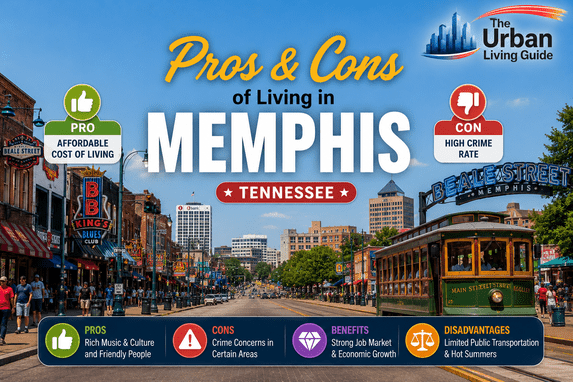
Memphis Has Blues, BBQ, and a Story That’s Completely Its Own — But Is It the Right City for You?
There is no city in America quite like Memphis. Birthplace of the Blues, home of Elvis Presley, and the city where Dr. Martin Luther King Jr. drew his final breath — Memphis carries cultural and historical weight that few cities anywhere can match. Sitting on the eastern bank of the Mississippi River in the far southwest corner of Tennessee, it operates on its own rhythm, its own rules, and its own timeline. The pros and cons of living in Memphis, Tennessee reveal a city of extraordinary soul and very real challenges — a combination that makes it genuinely polarizing among those considering a move.
Here’s the unfiltered ground-level picture.
📺 Memphis locals give their honest, unscripted take on what living in this city actually feels like — worth watching before you decide.
Reasons People Fall in Love With Memphis
1. Cost of Living That’s Genuinely Hard to Beat
The pros and cons of living in Memphis, Tennessee start with one undeniable advantage — affordability. Memphis consistently ranks among the most affordable major cities in the entire United States. Median home prices sit well below $200,000 in many neighborhoods, and rental costs are a fraction of what comparable urban living costs in Nashville, Atlanta, or any Northeastern city. Many residents appreciate the financial breathing room that Memphis pricing creates — a lifestyle that would require significantly higher income almost anywhere else.
2. A Music and Cultural Heritage That’s Irreplaceable
Beale Street, Sun Studio, Graceland, and the Stax Museum of American Soul Music represent just the surface of a cultural identity that shaped American music entirely. Memphis gave the world Blues, Rock and Roll, and Soul — and that creative DNA still runs through the city’s artistic community, live music venues, and neighborhood character in ways that feel authentic rather than museumified.
3. BBQ Culture That’s Taken Seriously as Religion
Memphis-style BBQ is its own distinct tradition — dry rub ribs, pulled pork, and slow-smoked everything. Central BBQ, Rendezvous, and Payne’s Bar-B-Q are institutions, not restaurants. One thing people often mention is how the food culture here — from BBQ to Soul food to a surprisingly diverse restaurant scene — delivers far above what the city’s budget reputation might suggest.
4. FedEx, Healthcare, and Logistics Economy
FedEx — headquartered in Memphis — is one of the largest employers in the region alongside Baptist Memorial Health Care, Methodist Le Bonheur Healthcare, and a significant logistics and distribution sector driven by the city’s position as America’s distribution crossroads. The job market has genuine institutional depth for those in the right sectors.
5. Mississippi River Access and Outdoor Life
Shelby Farms Park — one of the largest urban parks in the United States at over 4,500 acres — sits within city limits and offers trails, lakes, and outdoor recreation that cities ten times Memphis’ size would envy. The Mississippi River itself provides a dramatic natural backdrop that shapes the city’s identity and offers recreational access along the revitalized Memphis Riverfront.
6. Deep Community Roots and Southern Character
Memphis has a community warmth and rootedness that transient, fast-growth cities simply cannot manufacture. Many residents appreciate the genuine neighborliness, the deep African American cultural and artistic community, and a social fabric that feels built over generations rather than assembled last Tuesday.
Where Memphis Asks You to Be Honest With Yourself
1. Crime Is the City’s Most Serious and Persistent Challenge
The pros and cons of living in Memphis, Tennessee cannot be discussed honestly without addressing this directly. Memphis consistently ranks among the highest-crime cities in the United States — both violent and property crime rates run significantly above national averages. Some newcomers find it challenging that safety awareness here isn’t optional background knowledge — it’s a daily operational reality that shapes where you live, shop, and move through the city.
2. Neighborhood Selection Is Absolutely Critical
Memphis is a city of dramatic neighborhood contrasts. East Memphis, Germantown, Collierville, and Midtown are safe, established, and genuinely pleasant. Other parts of the city tell a very different story. Some newcomers find it challenging that the gap between Memphis’ best and most struggling neighborhoods is sharper than in almost any comparable American city — and that getting this decision wrong has real consequences.
3. Public Schools Face Significant Systemic Challenges
Shelby County Schools — which serves Memphis — has faced persistent performance, funding, and governance challenges. Many families navigate toward suburban Germantown, Collierville, or Bartlett school districts specifically for stronger public school options, effectively making suburban living a prerequisite for families prioritizing education.
4. Public Transit Is Extremely Limited
Memphis Area Transit Authority (MATA) covers basic bus routes and operates the famous Main Street Trolley, but the system doesn’t come close to supporting a car-free lifestyle. Memphis is fundamentally a car city — owning a reliable vehicle isn’t optional, it’s a daily necessity for virtually all residents.
5. Brain Drain and Economic Stagnation in Certain Sectors
Memphis has historically struggled to retain young talent and attract the kind of diverse private sector growth that transforms cities. Some newcomers find it challenging that career ceiling in certain professional fields requires eventually leaving for Nashville, Atlanta, or beyond — a pattern that has slowed the city’s broader economic evolution.
Who Finds Memphis the Right Fit?
Memphis works genuinely well for logistics and supply chain professionals with FedEx and distribution sector connections, healthcare workers tied to Baptist or Methodist systems, musicians and creative professionals drawn to authentic cultural roots, budget-conscious movers prioritizing homeownership, and African American families seeking a city with deep, established community and cultural presence.
Who should think carefully? Families prioritizing consistently strong public schools, those needing robust public transit, professionals requiring deep private sector career diversity, and anyone with low tolerance for urban safety challenges should weigh Memphis’ realities with genuine honesty.
Final Verdict – Does Memphis Make Sense for Your Move?
Memphis is not a city for everyone — and it doesn’t pretend to be. The pros and cons of living in Memphis, Tennessee ultimately come down to a personal calculation: can the extraordinary affordability, cultural depth, and community character outweigh the safety challenges and infrastructure limitations for your specific life situation? For the right mover — particularly those in logistics, healthcare, or drawn to authentic American cultural heritage — Memphis offers something genuinely irreplaceable. Go in with clear eyes, choose your neighborhood carefully, and this city can surprise you profoundly.
FAQs
Is Memphis, TN safe to live in?
Safety varies dramatically by neighborhood and requires serious research. East Memphis, Germantown, Collierville, and Midtown near Overton Park are among the safer and more established residential options. Overall city crime statistics are high by national standards — neighborhood selection here is among the most consequential decisions a Memphis mover will make.
What salary do you need to live comfortably in Memphis?
A single professional can live very comfortably on $45,000-$58,000 annually — making Memphis one of the most financially accessible major cities in the South. Families generally need $70,000-$85,000 depending on housing neighborhood, childcare, and whether private school is factored into the budget.
Is Memphis affordable compared to other Tennessee cities?
Significantly more affordable than Nashville across virtually every cost category. Housing in particular is dramatically cheaper — median home prices in Memphis run 40-50% lower than comparable Nashville neighborhoods, making it one of the sharpest affordability contrasts between two major cities in the same state.
What is Memphis most known for?
Memphis is globally known as the birthplace of Blues music, home of Elvis Presley and Graceland, the city of Beale Street, Sun Studio, FedEx headquarters, Memphis-style BBQ, and the site of the National Civil Rights Museum at the Lorraine Motel where Dr. Martin Luther King Jr. was assassinated in 1968.
Is Memphis good for families?
Affordable homeownership and strong community character work in its favor. The key family challenge is public school quality — many families specifically choose suburban addresses in Germantown, Collierville, or Bartlett to access stronger school districts while still benefiting from Memphis metro area employment and pricing.
Is Memphis growing or declining?
Memphis has experienced modest population decline over the past decade as suburban growth outpaces the core city. However, targeted neighborhood revitalization — particularly in Downtown Memphis, South Main, and Midtown — shows genuine momentum that suggests the city’s trajectory is more complex than simple decline narratives suggest.
Explore More
- 📍 Living in Memphis, Tennessee — Complete relocation guide covering Beale Street culture, neighborhood breakdown, and what everyday life in Memphis genuinely demands
- 💰 Cost of Living in Memphis, Tennessee — Detailed breakdown of Memphis housing affordability, groceries, transport costs, and how it compares to Nashville and national averages