

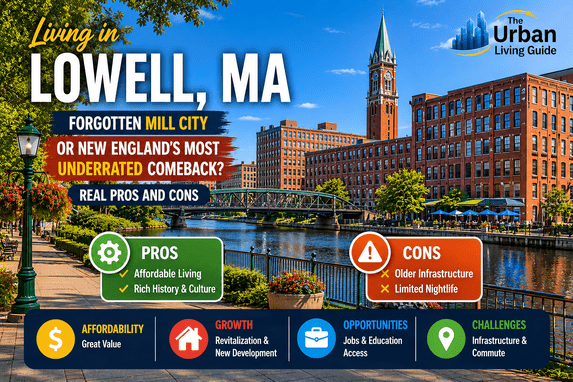
Lowell Doesn’t Make Many Best City Lists — But Maybe It Should Start
Lowell sits 30 miles northwest of Boston along the Merrimack River and carries a history heavier than most American cities its size. Once the beating heart of America’s industrial revolution, it built the nation’s textile economy on the backs of immigrant workers — and then watched that economy disappear entirely. Today, the pros and cons of living in Lowell, Massachusetts tell the story of a city genuinely reinventing itself — imperfectly, unevenly, but with real momentum that deserves honest attention.
Here’s what life in Lowell actually looks like in 2026 — no nostalgia, no spin.
Why Lowell Deserves a Serious Look
1. Housing Affordability That Stands Out in Massachusetts
In a state notorious for crushing housing costs, Lowell stands apart. Median rents run significantly below Boston, Cambridge, and even Worcester, and home ownership remains genuinely attainable for working and middle-income families. Many residents appreciate that Lowell offers something increasingly rare in Massachusetts — the ability to actually build equity without an extraordinary income.
2. One of New England’s Most Genuinely Diverse Cities
Lowell has one of the largest Cambodian communities in the entire United States — a community that arrived as refugees in the 1970s and 1980s and built deep, lasting roots here. Significant Latino, Brazilian, African, and Southeast Asian populations give Lowell an authentic multicultural character that feels lived-in rather than curated. One thing people often mention is how the diversity here isn’t performative — it’s woven into the actual fabric of daily neighborhood life.
3. Lowell National Historical Park — A Genuine Urban Asset
Few cities Lowell’s size have a National Historical Park running through their downtown. The preserved 19th century mill buildings, canal system, and Boott Cotton Mills Museum give Lowell an architectural and cultural depth that most comparable cities simply don’t have. Many residents appreciate living in a city where history isn’t behind glass — it’s the building you walk past every morning.
4. Direct Commuter Rail Connection to Boston
Lowell sits on the MBTA Lowell Line with direct commuter rail service to Boston’s North Station in approximately 45-60 minutes. For Boston workers priced out of the metro area, this connection makes Lowell one of the most financially practical commuter options in all of Greater Boston.
5. University of Massachusetts Lowell Drives Real Economic Energy
UMass Lowell — a legitimate R1 research university — employs thousands, attracts federal research funding, and has invested heavily in downtown revitalization. The university’s presence creates student energy, startup activity, and cultural programming that meaningfully lifts the city’s overall vitality.
6. Arts Scene Built on Genuine Industrial Character
The Lowell Folk Festival — one of the largest free folk festivals in the country — draws massive crowds annually. The converted mill buildings along the canals house artist studios, galleries, and creative businesses that give Lowell an arts identity rooted in authentic industrial character rather than manufactured hipster aesthetics.
📺 Lowell locals give their honest take on what living here really feels like day to day — refreshingly unfiltered.
Where Lowell Still Has Real Work to Do
1. Crime Rates Remain a Legitimate Concern
Some newcomers find it challenging that Lowell’s crime statistics — particularly property crime and certain violent crime categories — run above Massachusetts averages. The situation varies dramatically by neighborhood, but this is not a city where location research can be skipped. Areas around Centralville and parts of the Acre neighborhood require particular attention.
2. Downtown Revitalization Is Real But Incomplete
Lowell’s downtown has improved genuinely and measurably — but pockets of vacancy, struggling retail, and uneven investment remain visible. Some newcomers find it challenging that the gap between Lowell’s potential and its present reality can feel frustratingly wide, particularly after visiting the polished mill district and then turning a corner into something very different.
3. Public School Performance Needs Improvement
Lowell Public Schools serves a high-needs student population and faces the resource and performance challenges common to many Massachusetts gateway cities. School quality varies significantly by building and program. Families often navigate toward UMass Lowell-affiliated magnet programs or charter options — adding complexity to an already important decision.
4. Car Dependency Outside Downtown
While the commuter rail connection to Boston is a genuine asset, getting around Lowell itself without a car is genuinely difficult beyond the downtown core. The local bus network covers basic routes but doesn’t support a comfortable car-free lifestyle for most residents.
5. Stigma and Perception Lag Behind Reality
Lowell has improved meaningfully over the past decade — but its reputation hasn’t fully caught up. Some newcomers find it challenging that the city still carries a rough-around-the-edges image that affects everything from social conversations to property values, even in neighborhoods that have genuinely turned a corner.
Who Finds Lowell the Right Fit?
Lowell works exceptionally well for Boston commuters seeking real affordability, immigrant and multicultural families — particularly Cambodian, Latino, and Brazilian communities — UMass Lowell academics and researchers, artists and creatives drawn to genuine industrial character, and first-time homebuyers who need a foothold in the Massachusetts market without Boston pricing.
Who should think carefully? Families prioritizing consistently strong public schools, professionals needing deep local private sector opportunities, and anyone who values a polished urban environment over an authentic but rough-edged one should weigh expectations carefully.
Final Verdict – Is Lowell the Right Move for You?
Lowell is a city that rewards open-minded, practical movers who can see past surface impressions. The pros and cons of living in Lowell, Massachusetts ultimately favor those who value affordability, genuine diversity, and Boston access over urban polish and easy reputation. It’s not the finished product — but it’s a city actively becoming something worth choosing, and the ground floor of that story is still very much available.
FAQs
Is Lowell, MA safe to live in?
Safety is highly neighborhood-dependent. Belvidere and Pawtucketville are among Lowell’s safer residential neighborhoods with stable community character. The Acre and parts of downtown have higher crime concentrations and require careful research. Choosing the right neighborhood here matters more than in many comparable cities.
What salary do you need to live comfortably in Lowell?
A single professional can live comfortably on $48,000-$62,000 annually — making Lowell one of Massachusetts’ most financially accessible options. Families generally need $75,000-$90,000 depending on housing choices, childcare costs, and school decisions.
How long is the commute from Lowell to Boston?
The MBTA Lowell Line commuter rail reaches Boston’s North Station in approximately 45-60 minutes — one of the more practical Boston commutes available at Lowell’s price point. By car via I-93, expect 45-75 minutes depending heavily on traffic conditions.
Is Lowell good for immigrant families?
Genuinely yes — particularly for Cambodian, Latino, Brazilian, and African communities that have established deep roots here. Community organizations, multilingual services, international grocery stores, and cultural networks are meaningfully present and active.
What is Lowell, MA known for?
Lowell is known as the birthplace of the American Industrial Revolution, its remarkably preserved canal and mill system, the Lowell Folk Festival, a large Cambodian American community, UMass Lowell, and as the hometown of author Jack Kerouac.
Is Lowell, MA up and coming?
Yes — with genuine caveats. UMass Lowell’s downtown investment, mill building conversions, and Boston spillover demand are creating real momentum. The transformation is meaningful but uneven, and the timeline for full revitalization remains long. Early movers are finding real value here.
Explore More
- 📍 Living in Lowell, Massachusetts — Complete relocation guide covering mill city history, neighborhood character, and what everyday life in Lowell really feels like
- 💰 Cost of Living in Lowell, Massachusetts — Honest breakdown of rent, groceries, commuter rail costs, and how Lowell compares to Boston and Worcester on real monthly expenses