

Boulder Has a Reputation That Precedes It — Here’s Whether It’s Actually Deserved
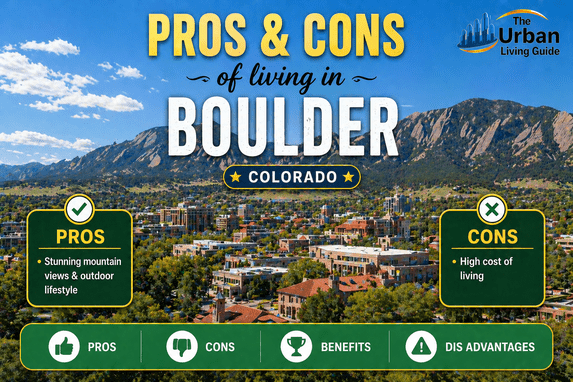
Few cities in America carry as strong an identity as Boulder. Nestled against the Flatirons at the edge of the Rocky Mountains, it’s a city that seemingly has everything — elite university, stunning scenery, progressive culture, and a wellness-obsessed outdoor lifestyle. But the pros and cons of living in Boulder, Colorado reveal a city with some of the sharpest trade-offs on the entire Front Range.
Because Boulder is genuinely extraordinary — and genuinely out of reach for many. Here’s the unfiltered picture.
📺 Locals share what it’s really like living in Boulder — the good, the frustrating, and the expensive.
Advantages of Living in Boulder
1. The Setting Is Simply Unmatched
Boulder sits at 5,430 feet with the iconic Flatirons as a literal backdrop to daily life. Many residents appreciate that the physical beauty here isn’t a weekend destination — it’s your Tuesday morning commute view. Rocky Mountain National Park is under 45 minutes away, and world-class trails begin where the city ends.
2. Outdoor Recreation at an Almost Ridiculous Level
Boulder has over 300 miles of hiking and biking trails within city limits, including the famous Boulder Creek Path. Chautauqua Park, Eldorado Canyon State Park, and Bear Peak offer everything from casual walks to serious technical climbing. One thing people often mention is how fitness and outdoor activity aren’t hobbies here — they’re woven into the daily rhythm of the city.
3. University of Colorado Drives Intellectual Energy
CU Boulder — a flagship R1 research university — gives the city a constant intellectual pulse. Lectures, research events, startup incubators, and a young, curious population create an environment that feels genuinely stimulating beyond typical city life.
4. Thriving Innovation and Startup Ecosystem
Boulder consistently ranks among America’s top startup cities per capita. Google, Twitter, Raytheon, and Ball Aerospace have significant local presences, and the entrepreneurial culture is deeply embedded. Many residents appreciate the access to venture capital networks and a startup community that punches well above its population size.
5. Pearl Street Mall and a Genuinely Vibrant Downtown
Pearl Street Mall — a pedestrian-only stretch of restaurants, independent boutiques, street performers, and coffee shops — is one of Colorado’s most beloved urban spaces. The downtown scene feels alive without feeling overwhelming, a balance many cities completely fail to achieve.
6. Progressive and Wellness-Forward Culture
Boulder leads Colorado in sustainability initiatives, local food sourcing, and wellness culture. Farmers markets, zero-waste programs, plant-based dining options, and an overall health-conscious community create a lifestyle that genuinely attracts a certain kind of mover — and keeps them.
Challenges of Living in Boulder
1. Housing Costs Are Among Colorado’s Highest — By Far
This is Boulder’s defining challenge and it cannot be understated. Median home prices regularly exceed $800,000–$900,000, and rental costs for even modest apartments run significantly higher than Denver or Fort Collins. Some newcomers find it challenging that the city they fell in love with visiting is simply unaffordable to actually live in long-term.
2. The “Boulder Bubble” Is Real
Boulder has a well-earned reputation for existing in its own social and cultural universe. Some newcomers find it challenging that the city’s homogeneity — despite progressive values — means a lack of genuine economic and ethnic diversity. The gap between Boulder’s ideals and its demographic reality is something many residents quietly acknowledge.
3. Limited Ethnic and Economic Diversity
Despite its progressive reputation, Boulder is one of Colorado’s least ethnically diverse major cities. For immigrant families and multicultural communities seeking established networks, the options here are significantly thinner than in Denver, Aurora, or Commerce City.
4. Anti-Growth Policies Create Real Constraints
Boulder has deliberately limited its own growth through strict development policies and a greenbelt that prevents urban sprawl. The result is a beautiful, contained city — and a housing market so constrained that supply can never meet demand, keeping prices permanently elevated.
5. Traffic and Parking Despite Small Size
For a city of just 105,000 people, Boulder’s traffic — particularly on Broadway, 28th Street, and Baseline Road — surprises many newcomers. CU Boulder’s student population and the daily influx of commuters from surrounding cities create congestion that feels disproportionate to the city’s size.
Who Should Consider Living in Boulder?
Boulder is genuinely exceptional for tech entrepreneurs and startup founders, CU Boulder academics and researchers, outdoor athletes and fitness-first movers, and wellness-oriented professionals with strong earning power. Remote workers on high salaries who value natural beauty and intellectual community will find Boulder close to ideal.
Who should think twice? Budget-conscious movers, families needing affordable housing and diverse school environments, and anyone prioritizing ethnic and economic community diversity should carefully weigh whether Boulder’s lifestyle premium is worth the financial reality.
Final Verdict – Is Boulder Right for You?
Boulder is one of America’s most genuinely special cities — and one of its most financially demanding. The pros and cons of living in Boulder, Colorado ultimately come down to a single honest question: can you afford it without stretching yourself dangerously thin? If yes, very few cities in the country offer this combination of natural beauty, intellectual energy, and lifestyle quality. If the budget doesn’t work, Fort Collins or Louisville nearby offer echoes of the Boulder experience at a fraction of the cost.
FAQs
Is Boulder, CO safe to live in?
Yes — Boulder consistently ranks among Colorado’s safest cities. Overall crime rates run well below state averages. The main safety considerations are environmental — wildfire risk in the WUI zones near the Flatirons and occasional flash flooding along Boulder Creek.
What salary do you need to live comfortably in Boulder?
A single professional realistically needs $90,000–$110,000 annually to live comfortably in Boulder without financial strain. Families typically require $150,000+ depending on housing choices and lifestyle expectations.
Is Boulder good for families?
Boulder Valley School District is one of Colorado’s strongest public school systems — genuinely excellent. The challenge is purely financial. Affording family-sized housing in Boulder itself requires significant income, pushing many families to nearby Louisville, Lafayette, or Longmont.
How far is Boulder from Denver?
Approximately 30 miles — about 35–50 minutes by car via US-36. Boulder also connects to Denver via RTD bus rapid transit, making it one of the more transit-accessible suburban cities in the metro area.
Does Boulder have good job opportunities?
Strong in specific sectors — tech, aerospace, research, and startups. Google, Ball Aerospace, Raytheon, and the CU Boulder research ecosystem provide meaningful employment. Outside these sectors, the job market is thinner than its reputation might suggest.
Is Boulder worth the high cost of living?
For the right person — absolutely. Residents consistently report high life satisfaction despite the costs. The outdoor access, intellectual community, safety, and quality of life create something genuinely difficult to replicate elsewhere. The question is purely personal financial fit.
Explore More
- 📍 Living in Boulder, Colorado — Complete relocation guide covering the Flatirons lifestyle, startup culture, and neighborhood breakdown
- 💰 Cost of Living in Boulder, Colorado — Honest breakdown of Boulder’s housing market, groceries, transport, and what your salary realistically covers
- 🏘️ Best Neighborhoods in Boulder, Colorado — From Mapleton Hill to South Boulder — find the right fit based on your lifestyle and budget