

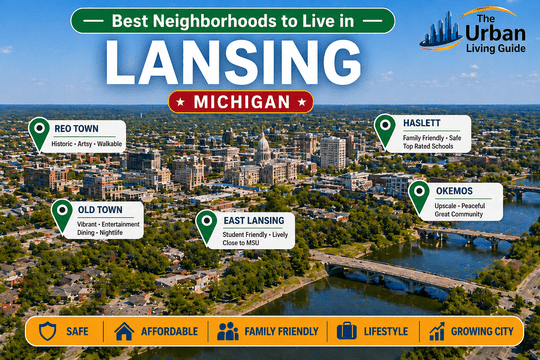
Best Neighborhoods in Lansing, Michigan: Suburban Enclaves, Historic County Seats & Capital City Living in 2026
Covering approximately 36.7 square miles of land area along the Grand River across Ingham, Eaton, and Clinton counties, the incorporated municipality of Lansing operates under the mayor-council governance of the City of Lansing. Housing an incorporated municipal core population exceeding 112,000 residents and anchoring Mid-Michigan’s primary economic, governmental, and cultural gateway within the Greater Lansing metropolitan region (surpassing 540,000 people), the capital city stands as an essential global center for state government administration, automotive manufacturing, higher education, insurance corporate headquarters, and specialized healthcare.
Relocating across the tri-county capital region requires evaluating distinct municipal boundaries, school district tax millages, and multi-modal transit corridors managed by the Capital Area Transportation Authority (CATA) bus network and regional expressways.
Inbound movers consistently balance direct daily access to primary regional employers—including state government offices for the State of Michigan, corporate headquarters for Delta Dental, major automotive facilities like GM Lansing Grand River Assembly, and healthcare systems anchored by Sparrow Hospital (University of Michigan Health) and McLaren Greater Lansing—against daily transit commutes across Interstate 96, Interstate 496 (R.E. Olds Freeway), US Route 127, Grand River Avenue, and Saginaw Highway, with international air travel via Capital Region International Airport (LAN).
Join an authentic local tour exploring the historic capital avenues, university-adjacent towns, and distinctive residential communities across the Greater Lansing, Michigan area:
Key Residential Districts and Suburbs in Greater Lansing at a Glance in 2026
| Community / Area | Location | Distance to Downtown Lansing | Development Status | Transit Connectivity | Cost Level | Best Fit For |
|---|---|---|---|---|---|---|
| Meridian Township (Okemos & Haslett) | Eastern Metro Suburb | ~8 mi east | Polished Suburban & Lake Living | High (Grand River Ave, I-96) | High-to-Premium | Families, IT Professionals & School-Focused Buyers |
| East Lansing (MSU College Town) | East Campus Corridor | ~4 mi east | Vibrant Collegiate & Green Urban | Exceptional (CATA Buses, Bike Lanes) | Mid-to-High | MSU Faculty, Students & Walkability Seekers |
| Downtown Lansing (Core Center) | Capital Riverfront Core | 0 mi (Core Hub) | Urban High-Rise & Historic Grid | Exceptional (CATA Transportation Center, I-496) | Accessible / Mid-Range | State Workers, Museum Lovers & Urban Dwellers |
| Grand Ledge & Delta Township | Western Metro Corridor | ~9 mi west | Commercial Growth & Historic Ledges | High (Saginaw Hwy, I-96) | Mid-Range | Retail Shoppers, Auto Employees & Families |
| DeWitt (Northern Suburb) | Northern Clinton County | ~8 mi north | Expanding Family Neighborhoods | High (US-127, I-69) | High | Commuters Seeking Quiet Family Suburbs |
Comprehensive Breakdown of Living Options Across the Greater Lansing Region
Meridian Township (Okemas & Haslett) — Polished Suburban Living, Top-Tier Schools & Lake Life
Situated on the eastern edge of the metropolitan area along Grand River Avenue and Lake Lansing, Meridian Township—encompassing the premier communities of Okemos and Haslett—is celebrated as one of Mid-Michigan’s most sought-after residential sectors. Operating under local municipal administration, the township offers an upscale suburban environment centered around exceptional educational systems.
The neighborhood features polished corporate neighborhoods, professional IT residents from major employers like Delta Dental, lakeside recreation at Lake Lansing, and high-end residential subdivisions.
- Housing: Real estate stock features spacious contemporary suburban homes, executive custom builds, and luxury McMansions. Purchase prices typically range from $400,000 to $700,000+, with upper-tier luxury properties exceeding that range.
- Safety & Crime Rate: Patrolled by the Meridian Township Police Department. The area maintains some of the lowest crime statistics in the tri-county region, ensuring a secure environment for residents.
- School District & Education Quality: Governed by Okemas Public Schools and Haslett Public Schools, widely recognized among the top-performing academic districts in the state of Michigan.
- Walkability & Daily Conveniences: Suburban layout optimized for vehicle convenience, featuring Meridian Mall retail plazas, grocery centers, and professional service parks along Grand River Avenue.
- Parks & Green Spaces / Pet-Friendliness: Municipal recreation is anchored by Lake Lansing Park, township trails, and community athletic complexes. Exceptionally pet-friendly.
- Parking & Traffic Congestion: Plentiful private multi-car driveways and suburban garage spaces keep residential roads clear. Commuter traffic on Grand River Avenue peaks during rush hours.
- Nearby: 15-minute drive west to Downtown Lansing, 5 minutes to East Lansing, and 25 minutes to Capital Region International Airport.
- Noise Levels & Vibe: Polished, quiet, and family-oriented, characterized by corporate professionals, school carpools, and peaceful suburban evenings.
- Medical Facilities & Hospitals: Convenient access to Sparrow Health specialty clinics and regional medical centers in Lansing and East Lansing.
- Transit Connectivity: Excellent roadway positioning along Grand River Avenue and fast on-ramps to Interstate 96 for regional travel.
- Affordability: Premium price tier for the Lansing metro area; high home values reflect superior school rankings and polished neighborhood infrastructure.
- Who It’s Best For: Families prioritizing elite schools, corporate managers, MSU professors, and tech professionals wanting a polished suburb.
- Drawbacks: Lacks a traditional quaint small-town downtown core and carries higher home purchase price tags.
East Lansing (MSU College Town) — Michigan State University Energy, Green Initiatives & Historic Glen Cairn
Covering the vibrant collegiate community surrounding Michigan State University along Grand River Avenue and Trowbridge Road, East Lansing is celebrated as Mid-Michigan’s premier college town. Championed by the City of East Lansing, the municipality blends a bustling student population exceeding 50,000 with progressive green sustainability initiatives.
The neighborhood is defined by extensive bike lanes, eco-friendly municipal policies, historic character homes in the Glen Cairn district near campus, and lively commercial shopping districts.
- Housing: Real estate stock features historic campus-adjacent character homes, vintage single-family houses in Glen Cairn, and modern student rental complexes. Single-family homes typically range from $300,000 to $700,000.
- Safety & Crime Rate: Patrolled by the East Lansing Police Department and MSU Department of Police and Public Safety, maintaining active oversight across campus and residential sectors.
- School District & Education Quality: Governed by East Lansing Public Schools, offering strong academic programs and exceptional proximity to university educational resources.
- Walkability & Daily Conveniences: Outstanding pedestrian and bicycle walkability (Walk Score of 88/100). Residents walk or bike to campus libraries, downtown dining, and Eastwood Town Center shopping.
- Parks & Green Spaces / Pet-Friendliness: Municipal recreation is anchored by campus arboretums, river trails, and city parks emphasizing green urban living. Highly pet-friendly.
- Parking & Traffic Congestion: Street parking is strictly regulated near campus; residential permit zones protect neighborhoods from student game-day congestion.
- Nearby: Immediate walk to MSU Campus, 10 minutes west to Downtown Lansing, and 20 minutes to Capital Region International Airport.
- Noise Levels & Vibe: Energetic, youthful, and intellectual, filled with university students during the academic year and peaceful academic calm during summer breaks.
- Medical Facilities & Hospitals: Direct proximity to MSU HealthCare facilities and rapid transit connections to Sparrow Hospital downtown.
- Transit Connectivity: Unrivaled public transit via comprehensive CATA bus routes and dedicated municipal bike highway lanes.
- Affordability: Mid-to-high urban price tier; provides diverse housing options for university staff, faculty, and professionals.
- Who It’s Best For: University professors, hospital staff, green-lifestyle advocates, and buyers wanting vibrant college-town energy.
- Drawbacks: High student renter density in certain pockets and seasonal population shifts during summer months.
Downtown Lansing (Core Center) — State Capitol, Riverfront Museums & Urban Redevelopment
Covering the central governmental and commercial core along the Grand River centered on the State Capitol Building, Michigan Avenue, and Jackson Field, Downtown Lansing serves as the political and administrative heartbeat of Michigan. Backed by ongoing urban investments, the capital core blends historic government architecture with expanding urban residential markets.
The neighborhood is defined by cultural museums, minor-league Lugnuts baseball games, Capital City Market shopping, and upcoming performing arts center developments.
- Housing: Real estate stock features established mid-20th-century homes within a few miles of the center, alongside downtown loft apartments. Purchase prices typically average $150,000 to $250,000 within city limits, offering high baseline accessibility.
- Safety & Crime Rate: Patrolled by the Lansing Police Department Central Division, maintaining active security across state government and commercial corridors.
- School District & Education Quality: Governed by Lansing School District, featuring urban educational options and proximity to Lansing Community College.
- Walkability & Daily Conveniences: High urban pedestrian walkability (Walk Score of 85/100). Residents walk to state office buildings, riverfront museums, restaurants, and grocery markets.
- Parks & Green Spaces / Pet-Friendliness: Municipal recreation is anchored by the Grand River Trail system, Impression 5 Science Center parks, and riverfront greenways. Exceptionally pet-friendly.
- Parking & Traffic Congestion: Managed via structured municipal parking ramps and street meters; state government shift hours create predictable weekday traffic patterns.
- Nearby: Immediate walk to the State Capitol, 10 minutes east to East Lansing, and 15 minutes to Capital Region International Airport.
- Noise Levels & Vibe: Governmental, professional, and urban, characterized by state legislators, museum visitors, baseball fans, and weekday commerce.
- Medical Facilities & Hospitals: Immediate proximity to Sparrow Hospital (UM Health) main campus and regional medical providers.
- Transit Connectivity: Unrivaled public transit hub centered at the CATA Transportation Center, with rapid access to I-496 and US-127.
- Affordability: Most accessible price tier within city limits; provides budget-friendly homeownership opportunities compared to outlying suburbs.
- Who It’s Best For: State government employees, hospital staff, urban loft seekers, and buyers wanting short commutes to capital employers.
- Drawbacks: Higher city property tax millage rates and limited new single-family construction directly downtown.
Grand Ledge & Delta Township (Western Metro) — Historic Ledges, Retail Hubs & Auto Manufacturing
Covering the dynamic western metropolitan sector along Saginaw Highway and the Grand River, the pairing of Grand Ledge and Delta Township is celebrated as one of the region’s fastest-growing commercial and residential corridors. Administered through local municipal governments, the area balances major retail conveniences with historic small-town charm.
The neighborhood is defined by extensive retail plazas along Saginaw Highway, the famous rock outcroppings of the Grand Ledge Ledges, Delta Crossings developments, and proximity to major automotive manufacturing plants.
- Housing: Real estate stock features suburban subdivision developments throughout Delta Township and historic homes on spacious lots in Grand Ledge. Purchase prices typically range from $300,000 to $500,000.
- Safety & Crime Rate: Patrolled by the Delta Township Sheriff Department and Grand Ledge Police, maintaining a secure, family-oriented suburban environment.
- School District & Education Quality: Governed by Grand Ledge Public Schools and Waverly Community Schools, offering strong community athletic and academic programs.
- Walkability & Daily Conveniences: High suburban convenience; residents enjoy immediate access to Meijer, Walmart, dining, and shopping plazas along Saginaw Highway.
- Parks & Green Spaces / Pet-Friendliness: Municipal recreation is anchored by Oak Park and the historic Ledges river parks, offering rock climbing and scenic trails. Exceptionally pet-friendly.
- Parking & Traffic Congestion: Plentiful private driveways and two-car garages. Saginaw Highway experiences heavy retail and rush-hour traffic congestion.
- Nearby: 15-minute drive east to Downtown Lansing, 5 minutes to GM assembly plants, and 20 minutes to Capital Region Airport.
- Noise Levels & Vibe: Bustling, convenient, and family-centered, characterized by suburban shopping corridors, outdoor recreation at the ledges, and quiet neighborhood cul-de-sacs.
- Medical Facilities & Hospitals: Convenient access to west-side medical clinics and rapid transit to Sparrow and McLaren hospitals.
- Transit Connectivity: Excellent roadway access via Saginaw Highway (M-43) and direct on-ramps to Interstate 96.
- Affordability: Mid-range suburban price tier; provides competitive tax rates and excellent housing value compared to eastern suburbs.
- Who It’s Best For: General Motors employees, retail shoppers, families wanting lower taxes, and outdoor rock-climbing enthusiasts.
- Drawbacks: Heavy weekend traffic congestion along the Saginaw Highway commercial strip.
DeWitt (Northern Suburb) — Rapidly Expanding Neighborhoods & Family-Centric Suburbia
Covering the thriving northern Clinton County suburb positioned just north of Lansing along US-127 and Interstate 69, DeWitt is celebrated as one of the region’s premier family-focused residential communities. Supported by the City and Township of DeWitt, the area offers continuous new residential development while maintaining a cozy small-town feel.
The neighborhood is defined by expanding suburban subdivisions, a charming historic downtown commercial district, excellent highway connectivity, and strong community school support.
- Housing: Real estate stock features modern construction subdivision homes, custom country properties, and executive builds. Purchase prices typically range from $350,000 to $700,000+, reflecting high demand for new builds.
- Safety & Crime Rate: Patrolled by the DeWitt Police Department. DeWitt consistently records exceptionally low crime rates, making it a top choice for safety-conscious families.
- School District & Education Quality: Governed by DeWitt Public Schools, renowned for high academic performance, strong athletics, and community involvement.
- Walkability & Daily Conveniences: Walkable historic downtown core featuring local coffee shops and diners, with major retail shopping located a short drive down US-127.
- Parks & Green Spaces / Pet-Friendliness: Municipal recreation is anchored by Riverside Park, community sports fields, and extensive trail networks. Exceptionally pet-friendly.
- Parking & Traffic Congestion: Ample private driveways and multi-car garages. Commuter traffic on US-127 south toward Lansing moves reliably.
- Nearby: 12-minute drive south to Downtown Lansing, 15 minutes to East Lansing, and 20 minutes to Capital Region Airport.
- Noise Levels & Vibe: Peaceful, family-oriented, and thriving, characterized by school sports events, neighborhood strollers, and quiet suburban evenings.
- Medical Facilities & Hospitals: Rapid 12-minute commute south to Sparrow and McLaren hospital systems.
- Transit Connectivity: Outstanding highway access via US-127 and Interstate 69, offering swift commutes across mid-Michigan.
- Affordability: High-demand suburban price tier; reflects superior school ratings and continuous new residential construction.
- Who It’s Best For: Growing families, commuters wanting quick highway access, and buyers seeking modern subdivision homes.
- Drawbacks: Higher home prices and property tax millages associated with booming northern suburban growth.
Assessing Living Merits and Shortfalls Across the Lansing Area
| Community / Area | Core Advantages (Pros) | Core Limitations (Cons) |
|---|---|---|
| Meridian Township | Elite Okemos school district; polished suburban neighborhoods; Lake Lansing recreation; low crime rates. | Higher home price tags; lacks a traditional quaint downtown core. |
| East Lansing | Michigan State University campus culture; extensive bike trail network; green sustainability focus; walkable retail. | High student renter density in pockets; summer population drop-offs. |
| Downtown Lansing | State Capitol proximity; affordable baseline housing; riverfront trails; Lugnuts baseball stadium walkability. | Higher city property tax rates; limited new single-family suburban builds. |
| Grand Ledge & Delta Twp | Extensive Saginaw Hwy retail; historic Ledges rock parks; GM auto plant proximity; balanced pricing. | Heavy weekend traffic congestion along commercial corridors. |
| DeWitt | Top-rated DeWitt public schools; continuous new subdivision growth; exceptional highway connectivity; very safe. | Elevated home prices and tax millages due to high northern demand. |
Local Perspectives: What Area Residents Reveal About Living in Greater Lansing
“Moving to Okemos in Meridian Township gave our family peace of mind with top-tier schools and quiet suburban streets, while still keeping my commute to the state offices in downtown Lansing under twenty minutes.”
— Brian Henderson, State Policy Analyst (Verified Local Contributor, Greater Lansing Relocation Forum)
“Living near MSU in East Lansing offers an incredible green lifestyle with bike lanes everywhere, great local coffee shops, and an energetic college-town atmosphere that keeps things vibrant year-round.”
— Dr. Rachel Martinez, MSU Researcher (Verified Resident Review, Mid-Michigan Community Insights)
Matching Your Personal Lifestyle with the Right Mid-Michigan Community
Selecting your ideal community in the Greater Lansing region requires balancing your household budget with daily workplace destinations, children’s school district priorities, and regional expressway logistics. Because the tri-county capital area is interconnected by major arteries like Interstate 96, Interstate 69, and US Route 127, your chosen location dictates whether your daily commute prioritizes polished eastern suburbs (Meridian Township), academic green corridors (East Lansing), capital core governance (Downtown Lansing), western retail convenience (Delta Township), or northern family subdivisions (DeWitt).
State government workers, healthcare professionals at Sparrow or McLaren health systems, Michigan State University staff, and corporate tech specialists should evaluate regional transit routes to optimize daily convenience.
Beyond transportation corridors, evaluate essential municipal utility and building infrastructure realities. Mid-Michigan experiences four distinct seasons featuring heavy winter snowfall and summer humidity, making home heating and cooling efficiency through Consumers Energy or local municipal utilities an essential consideration.
In addition, prospective homebuyers evaluating historic homes in East Lansing or established neighborhoods in Lansing should inspect electrical panels, plumbing lines, and roof integrity, while buyers in newer northern subdivisions should verify property tax millage rates. Before executing a residential lease or property purchase agreement, verify high-speed fiber broadband availability (such as AT&T Fiber or Xfinity Gigabit) and confirm local public school district boundaries.
Essential Local Insights & FAQs for Greater Lansing, Michigan
Which suburb in the Lansing area is considered best for families prioritizing elite public schools?
Meridian Township (specifically Okemos) and DeWitt are widely regarded as premier family communities in the region, offering top-ranked K-12 public school districts, low crime rates, and master-planned suburban neighborhoods.
What is the most walkable and bike-friendly community for university staff and green-lifestyle advocates?
East Lansing offers exceptional pedestrian and bicycle infrastructure, featuring dedicated municipal bike lanes, CATA bus connectivity, and immediate proximity to Michigan State University campus greenways.
Are there affordable urban neighborhoods close to state government offices and museums?
Yes, Downtown Lansing and surrounding urban corridors provide budget-friendly historic homes and loft options within walking distance of the State Capitol, riverfront trails, and Jackson Field baseball stadium.
What are the most convenient areas for retail shopping and automotive manufacturing employees?
Grand Ledge and Delta Township offer extensive shopping plazas along Saginaw Highway, historic river park recreation at the Ledges, and rapid access to the GM Lansing assembly plant.
How manageable is the daily commute across the tri-county Lansing metropolitan area?
Commuting across the region is highly efficient due to intersecting expressways including I-96, I-496, I-69, and US-127, allowing residents to reach downtown job centers within 15 to 20 minutes from most suburbs.
Which northern suburb is best for buyers looking for modern subdivision construction?
DeWitt offers continuous new residential subdivision development, highly rated local schools, and exceptional highway access via US-127 and I-69.
Is Greater Lansing an affordable place to live compared to Detroit and Grand Rapids?
Yes, Lansing’s overall cost of living and housing purchase prices remain significantly more accessible than Detroit and Grand Rapids, offering robust job markets in state government and education at an outstanding economic value.
Greater Lansing, Michigan Relocation Resources & Living Guides
The Urban Living Guide creates deeply researched, practical, and informative city relocation resources designed to help individuals, working professionals, and families navigate complex urban landscapes. By analyzing municipal infrastructure, hyper-local zoning patterns, commuter realities, and housing markets, our guides provide actionable insights so you can make confident, data-backed decisions when moving to major metropolitan areas.
Explore our regional guides across Lansing and Mid-Michigan:
- Living in Lansing, Michigan
- Cost of Living in Lansing, Michigan
- Pros and Cons of Living in Lansing, Michigan
Made your decision to move to the Capital Region? Read our comprehensive relocation roadmap: Moving to Lansing, Michigan.
Follow The Urban Living Guide for ongoing regional insights, neighborhood developments, and expert local coverage across Greater Lansing and the state of Michigan.