
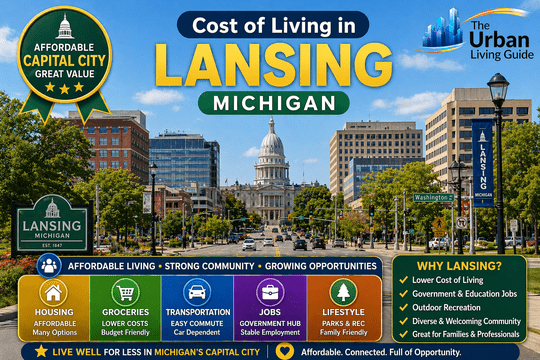
What to Expect From Lansing’s Living Costs
Lansing doesn’t get the attention that Detroit or Ann Arbor does, but for budget-conscious movers, that’s actually the point. The cost of living in Lansing, Michigan sits well below state and national averages — making it one of the most genuinely affordable mid-size cities in the Midwest. As Michigan’s state capital and home to Michigan State University, Lansing has a stable economic base that keeps the job market steady without the demand-driven price inflation that hits college-heavy cities like Ann Arbor.
The city-specific insight worth understanding early: Lansing’s affordability is real, but it’s not uniform. The East Lansing pocket — which bleeds into the MSU campus zone — runs noticeably more expensive than Lansing proper, driven by student housing demand. Where you land relative to that boundary shapes your entire budget.
Average Monthly Cost in Lansing
Lansing is one of the few Michigan cities where a moderate income goes genuinely far. Here’s a realistic monthly snapshot:
- Single person: Around $1,700–$2,200/month
- Couple: Typically $2,700–$3,500/month
- Family (2 adults, 2 kids): Around $3,800–$5,200/month including childcare
These figures reflect comfortable day-to-day living — not bare minimum budgeting.
📹 Watch this video for a ground-level look at what your money actually gets you in Lansing before making your move.
Housing Costs in Lansing
Housing is where Lansing’s affordability story is most convincing. Compared to nearly every other Michigan city of comparable size, rents here are lower — and the gap widens significantly versus Ann Arbor. Downtown Lansing and the REO Town arts district have seen some revitalization-driven rent increases, but nothing close to the university-market pressures of East Lansing or Ann Arbor.
- Studio: $650–$950/month
- 1-bedroom: $800–$1,200/month
- 2-bedroom: $1,050–$1,550/month
- 3-bedroom/family home: $1,300–$2,000/month
Locals often point out that state government employment creates a uniquely stable rental demand in Lansing — the city doesn’t boom and bust with private sector swings the way manufacturing-dependent cities do. That stability keeps the market predictable, which is useful for anyone planning a longer-term relocation. If you’re coming from Detroit’s suburbs or Grand Rapids, Lansing’s rent-to-space ratio will feel like a meaningful upgrade.
Utilities & Internet
Utility costs in Lansing follow Michigan’s seasonal rhythm — manageable in summer, demanding in winter.
- Electricity + Gas + Water: Typically $120–$190/month
- Winter peak (Dec–Feb): Can climb to $200–$260/month
- Internet (Comcast/AT&T): Around $50–$75/month
- Combined monthly average: Budget $170–$260/month year-round
Lansing’s housing stock includes a mix of older and newer builds — older homes tend to run higher on heating bills, so it’s worth checking insulation and window quality before committing to a lease.
Grocery & Food Costs
Grocery costs in Lansing track close to Michigan averages — Meijer (headquartered in Michigan) has a strong local presence and consistently competitive pricing.
- Single person: Around $230–$330/month
- Family of 4: Typically $550–$750/month
Aldi, Kroger, and Walmart round out the budget options. The dining scene in Lansing is modest but improving — a solid restaurant meal runs $12–$18 per person, and the Old Town and REO Town neighborhoods have developed a small but genuine independent food culture. If you’re relocating from a food-forward city, the options are serviceable rather than exciting — but the savings elsewhere more than compensate.
Transportation Costs
Lansing is fundamentally a driving city. The CATA bus system covers the metro area reasonably well for a mid-size Michigan city, but for most residents — especially those outside the downtown core — a car is the practical reality.
- Car ownership (insurance + fuel + maintenance): $320–$520/month
- Auto insurance: $100–$160/month — lower than Detroit, broadly in line with Grand Rapids
- CATA bus pass: Around $40–$55/month for regular riders
- State government employees: Many work within easy distance of the Capitol complex, reducing commute costs
One practical advantage Lansing has over larger Michigan metros: traffic is genuinely light. Commute times are short by any reasonable standard, which reduces fuel costs and daily driving stress for most residents.
Healthcare & Insurance
Lansing has solid healthcare access anchored by Sparrow Health System and McLaren Greater Lansing — both large regional providers that ensure reasonable competition and quality.
- Employer-sponsored plan: Typically $130–$260/month employee contribution
- Marketplace individual plan: Around $220–$460/month
- Urgent care visit: $90–$170 without insurance
- State government employees: Often receive above-average benefits packages — a meaningful financial advantage for that segment of Lansing’s workforce
Other Living Expenses
Beyond core expenses, Lansing’s day-to-day lifestyle costs are among the lowest in Michigan:
- Gym membership: $20–$50/month
- Childcare (per child): $800–$1,200/month
- Entertainment & dining out: $100–$180/month
- Personal care & clothing: $70–$120/month
Lansing offers Lugnuts minor league baseball, the Lansing Art Gallery, a growing craft brewery scene, and easy access to Michigan State’s cultural programming — most at prices well below what comparable experiences cost in Ann Arbor or Detroit.
Cost of Living in Lansing vs Nearby Michigan Cities
Lansing holds its own as the most affordable option in this Michigan comparison — particularly on housing, where the gap versus Ann Arbor is substantial.
- vs Detroit: Lansing is slightly cheaper on housing; broadly similar on groceries and utilities; lighter traffic reduces transport stress
- vs Grand Rapids: Comparable overall — Lansing edges lower on rent; Grand Rapids offers more job market diversity
- vs Ann Arbor: Lansing is 30–45% cheaper on housing — the MSU vs UM demand difference is significant and real
- vs Flint: Flint is cheaper on paper, but infrastructure concerns and service gaps affect true cost of living comparisons
Micro insight: A number of MSU graduate students and staff choose to live in Lansing proper rather than East Lansing — the rent savings of $200–$350/month on a comparable unit are significant enough to justify the short commute across the city boundary.
Is Lansing Expensive or Affordable?
Lansing is genuinely affordable — not just by Michigan standards, but nationally. The monthly cost in Lansing is low enough that moderate incomes produce real savings capacity, which is increasingly rare in mid-size American cities. The trade-off is that Lansing doesn’t offer Ann Arbor’s lifestyle density or Grand Rapids’ job market breadth. For state employees, MSU-connected workers, remote workers, and families prioritizing financial breathing room, Lansing makes a strong case.
Who Can Afford to Live Comfortably in Lansing
- Singles earning $38,000–$48,000+/year can live comfortably with meaningful savings potential
- Couples on combined $58,000–$75,000 can afford a solid 2-bedroom, maintain vehicles, and save consistently
- Families targeting $75,000–$95,000+ combined will cover childcare, a comfortable home, and two cars without financial strain
- State government and MSU employees benefit from stable incomes and strong benefits that align well with Lansing’s cost structure
Who May Find Lansing Expensive?
Lansing’s affordability is real, but not universal. Service sector and gig economy workers face a wage floor that, while stretched by Lansing’s lower costs, still creates pressure when childcare is factored in. Single parents in particular find the childcare-to-income ratio challenging — $800–$1,200/month per child is significant against a $35,000–$42,000 salary even in a lower-cost city. And anyone expecting East Lansing’s walkability and campus energy while paying Lansing prices will find that specific combination doesn’t quite exist — the two cities are adjacent but meaningfully different in character and cost.
FAQs
What is the cost of living in Lansing, Michigan in 2026?
A single person typically needs $1,700–$2,200/month for comfortable living in Lansing. Families of four should plan for $3,800–$5,200/month including childcare and two vehicles.
Is Lansing more affordable than other Michigan cities?
Yes — living expenses in Lansing are lower than Detroit, Grand Rapids, and significantly lower than Ann Arbor. It’s consistently one of Michigan’s most budget-friendly mid-size cities.
Do I need a car to live in Lansing, Michigan?
For most residents, yes. CATA bus service exists but coverage is limited outside the core. A car is the practical choice for daily errands, work commutes, and family logistics.
What salary is needed to live comfortably in Lansing?
Singles need roughly $38,000–$48,000/year. Couples can live well on $58,000–$75,000 combined. Families should target $75,000–$95,000+ to manage housing, childcare, and transport without consistent financial pressure.
How does the cost of living in Lansing compare to East Lansing?
East Lansing runs noticeably more expensive on housing — the MSU campus proximity adds $200–$350/month on comparable units. Lansing proper offers better value for non-student residents who don’t need to be on campus daily.
🔗 Explore the complete Living in Lansing, Michigan guide with The Urban Living Guide