

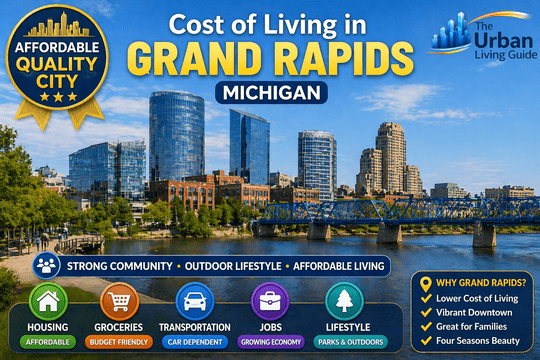
Grand Rapids is quietly becoming one of Michigan’s most talked-about cities for relocation — and for good reason. The cost of living in Grand Rapids, Michigan sits comfortably below national averages, with a job market that’s grown steadily thanks to healthcare, manufacturing, and a surprisingly strong craft beverage industry. This guide is for anyone seriously evaluating whether Grand Rapids fits their budget — whether you’re moving from within Michigan or relocating from out of state.
One thing worth knowing upfront: Grand Rapids has seen consistent population growth over the past decade, and that demand has pushed rents upward in the downtown core and near medical mile. But step even slightly outside those zones and the value proposition improves considerably.
Average Monthly Cost in Grand Rapids
Grand Rapids keeps monthly expenses manageable across most household types — here’s a realistic snapshot:
- Single person: Around $1,900–$2,500/month
- Couple: Typically $3,000–$3,900/month
- Family (2 adults, 2 kids): Around $4,200–$5,800/month including childcare
These ranges assume standard spending — not bare minimum, not lavish.
📹 Watch this video for a real-life walkthrough of what your money gets you in Grand Rapids before making the move.
Housing Costs in Grand Rapids
Housing is the biggest line item in any Grand Rapids budget, and it’s where your neighborhood choice makes the biggest difference. Downtown and the Medical Mile area command premium rents — the concentration of hospital workers and young professionals keeps demand high in these pockets. Move into neighborhoods like Eastown, Creston, or the southwest side and the same square footage costs noticeably less.
- Studio: $850–$1,150/month
- 1-bedroom: $1,000–$1,450/month
- 2-bedroom: $1,300–$1,850/month
- 3-bedroom/family home: $1,600–$2,400/month
Locals often mention that the rental market near Spectrum Health and Corewell Health campuses stays tight year-round — healthcare workers create consistent demand that keeps vacancy low and prices firm. If you’re not tied to that corridor, neighborhoods like Wyoming or Kentwood (just outside city limits) offer solid value with easy access to everything Grand Rapids has to offer.
Utilities & Internet
Utility costs in Grand Rapids follow Michigan’s seasonal pattern — winters push bills up significantly, summers are moderate.
- Electricity + Gas + Water: Typically $130–$210/month
- Winter months (Dec–Feb): Can spike to $220–$280/month with heating
- Internet (Comcast/AT&T): Around $50–$75/month
- Combined monthly average: Budget $180–$280/month across the year
The older housing stock in many Grand Rapids neighborhoods means insulation quality varies — worth checking before signing a lease.
Grocery & Food Costs
Grocery spending in Grand Rapids tracks close to the Midwest average — neither a bargain nor a burden for most households.
- Single person: Around $250–$360/month
- Family of 4: Typically $580–$800/month
Meijer, Aldi, and Gordon Food Service (a Grand Rapids original) keep everyday shopping affordable. The city’s food scene is genuinely strong — Grand Rapids has a craft beer culture that draws visitors nationally, and the restaurant scene has grown around it. Dining out runs $13–$22 per person at a mid-range spot, which is fair for the quality. If you’re coming from a coastal city, the food-to-price ratio here will feel like a pleasant surprise.
Transportation Costs
Grand Rapids is more walkable than Detroit but still fundamentally a car city for most residents. The Rapid bus system covers the metro reasonably well, but outside of downtown, a car is the practical choice for daily life.
- Car ownership (insurance + fuel + maintenance): $350–$580/month
- Auto insurance: $110–$180/month — noticeably lower than Detroit due to Michigan’s tiered reform
- The Rapid bus pass: Around $60/month for unlimited rides
- Ride-share dependence (no car): Adds $150–$250/month for regular users
One practical note: Michigan’s auto insurance reforms have made Grand Rapids meaningfully cheaper to insure a vehicle than Detroit — a real advantage for budget-conscious movers.
Healthcare & Insurance
Healthcare infrastructure in Grand Rapids is genuinely strong — the city is home to one of the largest medical clusters in the Midwest, which also keeps competition and quality high.
- Employer-sponsored plan: Typically $140–$280/month employee contribution
- Marketplace individual plan: Around $230–$480/month depending on age and tier
- Urgent care visit: $100–$180 without insurance
- Dental (basic plan): $20–$50/month additional
The presence of major health systems like Corewell Health and Mercy Health means access to care is above average — and many Grand Rapids employers offer competitive benefits packages as a result.
Other Living Expenses
Beyond the essentials, a few additional monthly costs to factor into your Grand Rapids budget:
- Gym membership: $25–$55/month
- Childcare (per child): $900–$1,350/month — a significant line item for young families
- Entertainment & dining out: $120–$220/month depending on lifestyle
- Personal care & clothing: $80–$140/month
Grand Rapids punches above its size for entertainment — ArtPrize (a massive annual public art event), live music, minor league baseball, and a walkable downtown bar scene all offer solid value for the cost.
Cost Comparison — Grand Rapids vs Nearby Cities
Grand Rapids sits in an interesting middle position within Michigan’s urban landscape — more expensive than Lansing or Flint, more affordable than Ann Arbor, and broadly comparable to Detroit’s suburban belt.
- vs Detroit: Housing is similar; auto insurance is lower in Grand Rapids; overall monthly cost is comparable
- vs Ann Arbor: Grand Rapids is 25–35% cheaper on housing — Ann Arbor’s university premium is significant
- vs Lansing: Lansing edges slightly cheaper on rent; Grand Rapids offers more job market depth
- vs Chicago: Grand Rapids is meaningfully more affordable across every category — roughly 30–40% lower overall living expenses in Grand Rapids
Micro insight: Many Ann Arbor and Detroit professionals have begun looking at Grand Rapids as a legitimate remote-work base — lower rent, same internet, and a lifestyle that many find more manageable than larger metros.
Is Grand Rapids Expensive or Affordable?
Grand Rapids sits in a sweet spot — affordable enough to save on a moderate income, developed enough to offer real amenities. The living expenses in Grand Rapids are below the national average overall, though the downtown rental market has tightened meaningfully as the city’s profile has risen.
The honest answer: if you’re strategic about neighborhood, Grand Rapids is genuinely good value. If you’re set on living in the most in-demand downtown blocks, you’ll pay rates that feel less like a Midwest bargain and more like a mid-tier national city. The city rewards flexibility.
Who Can Afford to Live Comfortably
- Singles earning $42,000–$52,000+/year can live comfortably, especially outside the downtown core
- Couples on combined $65,000–$85,000 can afford a good 2-bedroom, maintain vehicles, and build savings
- Families targeting $80,000–$105,000+ combined will cover childcare, a suburban home, and two cars without constant financial pressure
- Remote workers on coastal salaries will find Grand Rapids offers an unusually high quality of life relative to their income — this demographic has grown noticeably in the city over the past few years
Who May Find Grand Rapids Expensive?
The cost pressure in Grand Rapids is real for specific groups, and it’s worth being direct about it.
Single-income households with children face a tough equation — childcare alone ($900–$1,350/month per child) can consume a disproportionate share of a moderate salary, especially when combined with rent and car costs. Entry-level workers in retail, food service, or light manufacturing may find that wage growth hasn’t kept pace with the rental increases the city has seen over the past five years. And anyone specifically targeting the downtown or Medical Mile corridor will find that is Grand Rapids expensive by Michigan standards — those pockets genuinely are.
FAQs
What is the cost of living in Grand Rapids, Michigan in 2026? A single person typically needs $1,900–$2,500/month for a comfortable lifestyle in Grand Rapids, covering rent, groceries, transport, and utilities. Families of four should plan for $4,200–$5,800/month depending on childcare and housing choices.
Is Grand Rapids affordable compared to other Michigan cities? Yes — the monthly cost in Grand Rapids is lower than Ann Arbor and broadly comparable to Detroit’s suburbs. It’s one of the better value mid-size cities in the Midwest when you factor in job market strength alongside living expenses.
Do I need a car in Grand Rapids? For most residents, yes. The Rapid bus system is functional but limited in coverage. Outside of downtown, daily life — work, groceries, school runs — practically requires a vehicle. Budget accordingly.
Is Grand Rapids expensive for renters in 2026? Rents have risen over the past few years, particularly downtown and near the medical corridor. However, Grand Rapids remains more affordable than Ann Arbor and most coastal cities. Neighborhoods outside the core offer solid value.
What salary do you need to live comfortably in Grand Rapids? Singles need roughly $42,000–$52,000/year. Couples can live well on $65,000–$85,000 combined. Families with children should target $80,000–$105,000+ combined to handle childcare, housing, and vehicles without strain.
🔗 Explore the complete Living in Grand Rapids, Michigan guide with The Urban Living Guide